Table of Contents
- The Final Breath of a Giant: Galileo’s Last Moments in Arcetri
- The Twilight of a Renaissance Mind: Intellectual Turmoil in Early 17th Century Europe
- Galileo’s Life Before Arcetri: From Padua to Rome and Beyond
- The Scientific Revolution’s Scourge: The Clash with the Catholic Church
- Forbidden Stars: Galileo’s Trial and Sentence in 1633
- Exile and Isolation: Life Under House Arrest
- Arcetri: A Quiet Refuge on the Hills of Florence
- 1642: The World on the Brink as Galileo Faces His End
- The Day of January 8th, 1642: Detailed Account of Galileo’s Final Hours
- The Anatomy of Death: Medical Conditions and Debilitations
- Family and Friends: Who Was by His Side?
- The Scientific Legacy Carried Forward: Aftermath in the 17th Century
- The Church’s Shadow: Continued Censorship and Rehabilitation Efforts
- Galileo’s Intellectual Heirs: Inspiring Generations of Thinkers
- Modern Reflections: How the Death of Galileo Resonates Today
- How History Remembered Galileo: Monuments, Memorials, and Cultural Impact
- The Intersection of Science and Faith: A Continuing Dialogue
- Revisiting the Trial and Death in Contemporary Scholarship
- Public Memory and Mythmaking Around Galileo’s Death
- Conclusion: The End of a Life, the Dawn of a Legacy
The Final Breath of a Giant: Galileo’s Last Moments in Arcetri
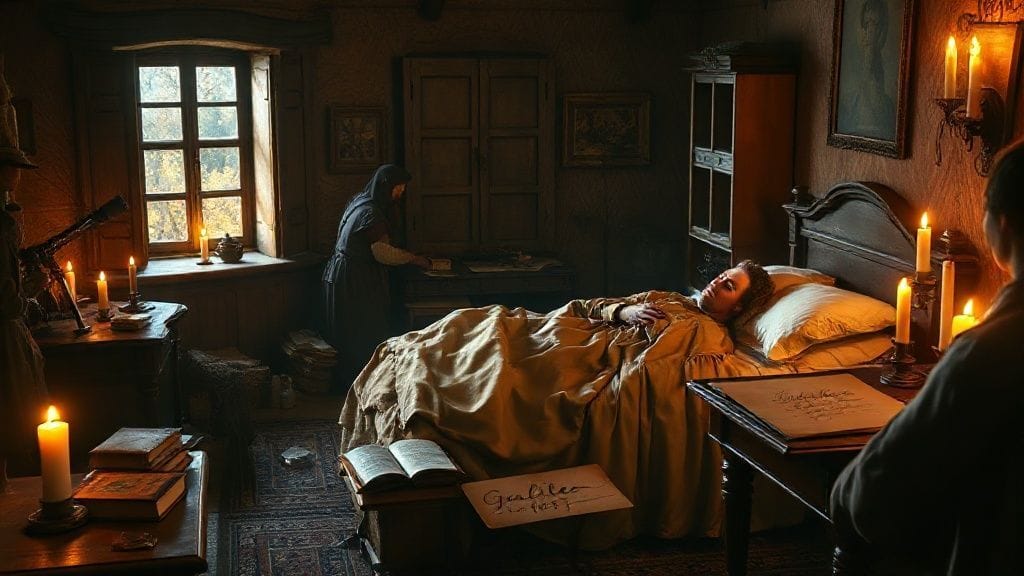
Against the rolling hills clothed in olive and cypress just outside Florence, a modest stone house stood bathed in the ghostly pallor of a January dawn. Inside, a figure long revered, reviled, and remembered hovered near the edge of mortality. Galileo Galilei, once the pride of the Italian Renaissance and the herald of the scientific revolution, fought his last earthly battle not in some grand hall or academic forum but in seclusion—a prisoner of old age, illness, and a church that had branded him heretic. The dawn of January 8, 1642, brought with it the quiet passing of a man whose telescopes had peered deep into the heavens, yet whose own life had faced dark, suffocating shadows down on Earth.
This was no ordinary death. It was the closing chapter of a lifetime marked by brilliance and tragedy, triumph and torment. How fitting, then, that Galileo, whose discoveries reshaped humanity’s understanding of the cosmos, should depart this world as the winter frost crept softly over the hills of Arcetri, leaving behind a world unknowingly on the cusp of a new age, with its stars a little less distant, and its truths forever expanded.
The Twilight of a Renaissance Mind: Intellectual Turmoil in Early 17th Century Europe
The early 1600s swirled with change, dissent, and discovery—the heartbeat of the Renaissance was beginning to pulse unevenly, as tradition and innovation clashed. Europe was straining under the weight of religious upheavals, the legacy of Reformation and Counter-Reformation policies, and the continued dominance of scholastic Aristotelian thought, which upheld Earth as the unmoving center of the universe. Scientific inquiry dared only tread cautiously in a world where intellectual heresy could mean mortal peril.
It was in this fragile intellectual environment that Galileo Galilei strode boldly forward. His work challenged not only established science but also deeply held religious worldviews. The clash between dogma and evidence would not only seal his fate but also define a turning point in the relationship between science, religion, and the power structures of Europe.
Galileo’s Life Before Arcetri: From Padua to Rome and Beyond
Born in Pisa in 1564, Galileo’s story is one of relentless curiosity and determination. Educated initially in medicine, he soon turned to mathematics and physics, recognizing their unparalleled potential for illuminating nature’s mysteries. His tenure at the University of Padua marked his rise to prominence, introducing revolutionary ideas on motion, mechanics, and astronomy.
Galileo’s invention and improvement of the telescope in 1609 resonated like thunder across the flowering sky of Renaissance astronomy. His observations—mountains on the Moon, moons orbiting Jupiter, the phases of Venus—shattered the geocentric universe imposed by Ptolemaic doctrine and endorsed by church doctrine. Invitations to court and intellectual debates brought him into the heart of European power, but also into its most dangerous scrutiny.
The Scientific Revolution’s Scourge: The Clash with the Catholic Church
By the time Galileo published Sidereus Nuncius and later Dialogue Concerning the Two Chief World Systems, his position as a scientific revolutionary was unassailable but precarious. The Catholic Church, especially the Roman Inquisition, saw his Copernican views as a threat to scriptural authority. The encroachment of science into theological territory sparked fierce resistance.
Church authorities summoned Galileo to Rome in 1633, where the trial unfolded with a grim finality. Galileo was forced to recant publicly and spent the remainder of his life under house arrest, his work banned, and his reputation sullied. It was the greatest personal and public defeat of Galileo's life, yet ironically it served to immortalize his cause and ignite debate that would last centuries.
Forbidden Stars: Galileo’s Trial and Sentence in 1633
Galileo’s trial is a study in tension—between enlightenment and repression, between reason and faith. Under the ominous gaze of Pope Urban VIII and the Inquisition tribunal, Galileo faced accusations of heresy precisely because he dared to assert the heliocentric system as physical reality, not just a mathematical convenience.
The trial was marked by profound drama and tragedy. Legend has it he muttered “Eppur si muove” (“And yet it moves”), though this phrase is likely apocryphal. His sentence confined him to house arrest indefinitely, banning his books, yet the indomitable spirit of his discoveries could not be extinguished. His stars were forbidden, but they continued to shine in the imagination of posterity.
Exile and Isolation: Life Under House Arrest
Following the trial, Galileo retreated to his villa in Arcetri, a small village perched on a hilltop overlooking Florence. While physically restricted, his mind remained active—he continued to write, to theorize, and to share his insights by correspondences with fellow scientists like Evangelista Torricelli and Vincenzo Viviani.
His household shrank to family and a few faithful friends. Physical pain from deteriorating health—blindness, arthritis, and other ailments—pressed on him relentlessly. Yet in the quiet confines of Arcetri, Galileo nurtured the final seeds of his intellectual legacy.
Arcetri: A Quiet Refuge on the Hills of Florence
Arcetri was more than just a place; it was a complex symbol of Galileo’s twilight years. The gentle Tuscan landscape, with cypresses pointing skyward, contrasted starkly with the turbulence that had defined his life. The little villa had witnessed moments of joy and sorrow, hospitality and imprisonment, and the slow fading of a once indomitable force.
Friends and family recalled his evenings spent in contemplation, the hands that once adjusted the great telescopes now trembling as they turned the pages of books or drafted letters. The surrounding hills bore silent witness to the closing act of a man who had expanded the boundaries of human thought.
1642: The World on the Brink as Galileo Faces His End
The year 1642 was a time of great turmoil beyond Galileo’s villa. Europe was enmeshed in the final throes of the Thirty Years’ War, and scientific ideas were spreading unevenly across fragmented political realms. Yet within Arcetri, Galileo’s personal world had contracted to shadows and the slow passage of days.
His health was rapidly failing—blindness complete, pain inexorable. The once fiery mind was now harried by the frailty of flesh. January approached quietly, a harbinger of the end to come. In a paradox as poetic as his life, just as the past was closing on Galileo, the seeds that would spark the modern scientific era were prodigiously germinating.
The Day of January 8th, 1642: Detailed Account of Galileo’s Final Hours
Accounts from relatives and contemporaries describe a solemn January morning. Though debilitated, Galileo’s spirit remained dignified. Surrounded by loved ones, including his daughters Virginia and Maria Celeste—who had passed years prior but remained a spiritual presence—and his son Vincenzo, Galileo was attended by physicians who understood the limits of their craft.
His breathing grew shallow, the end unmistakable but softened by the care and devotion of those present. According to witnesses, he passed with a serene expression, as if finally finding the quiet peace that had eluded him during decades of conflict. His death marked the silent fall of a giant, occurring on the very day that marked the birth of another scientific genius, Sir Isaac Newton.
The Anatomy of Death: Medical Conditions and Debilitations
Galileo’s health had deteriorated significantly over the last decade. Suffering from arteriosclerosis, eye disorders that led to complete blindness by 1638, and chronic arthritis, he was physically frail. Complications from these illnesses likely contributed to a stroke or heart failure leading to his death.
Physicians of the time, limited by the era’s medical knowledge, focused on comfort and supportive care. Despite the era’s primitive practices, Galileo’s mental faculties remained sharp until shortly before his death—a testament to the resilience of the mind even as the body crumbled.
Family and Friends: Who Was by His Side?
Though Galileo’s relationship with the Church was fraught, his familial bonds remained strong, especially with his daughters, the Ursuline nuns Maria Celeste and Arcangela. Maria Celeste’s letters reflect profound affection and care, blending spiritual support and practical assistance throughout his trials.
His son Vincenzo, legitimized later in life, handled many of Galileo’s affairs and ensured the continued preservation of his scientific manuscripts. Peers such as Vincenzo Viviani remained in close contact, advocating for Galileo and aiding in the conservation of his intellectual heritage—a small circle of affection amid a world that had largely cast him aside.
The Scientific Legacy Carried Forward: Aftermath in the 17th Century
Though Galileo died under house arrest, his ideas were far from extinguished. Scientists from across Europe studied his works, disseminating his methods and discoveries. The heliocentric model gained momentum, bolstered by advancing telescopic technology and Newtonian physics.
The decades following his death saw an accelerating dismantling of Aristotelian cosmology. Galileo became an emblem of scientific perseverance and martyrdom, his life inspiring a generation of thinkers eager to pursue truth despite institutional resistance.
The Church’s Shadow: Continued Censorship and Rehabilitation Efforts
For centuries after his death, Galileo’s works remained censored in Catholic countries. The Church officially condemned heliocentrism until the mid-18th century, illustrating the enduring tension between orthodoxy and inquiry.
It was not until 1992 that Pope John Paul II formally acknowledged the errors committed in Galileo’s case, symbolizing a measured reconciliation between science and faith. This belated rehabilitation underscored the long shadow cast by Galileo’s life and death.
Galileo’s Intellectual Heirs: Inspiring Generations of Thinkers
Galileo’s impact resonated through time. Figures such as Johannes Kepler, Christiaan Huygens, and later Isaac Newton built upon his foundations, advancing physics, astronomy, and the scientific method.
His insistence on observation and experimentation transformed European intellectual culture. The spirit of inquiry he championed endures as the cornerstone of modern science, a legacy that finds roots in the very hills of Arcetri where he spent his last days.
Modern Reflections: How the Death of Galileo Resonates Today
Today, Galileo’s death symbolizes more than the passing of a scientific luminary. It represents the complex interplay between knowledge, authority, and freedom of thought. His struggles echo through modern debates on scientific skepticism, secularism, and the necessity of intellectual courage.
His passing on January 8th—the same day Isaac Newton was born—becomes a poetic metaphor for the passing of one torch to another, marking the relentless march of human understanding.
How History Remembered Galileo: Monuments, Memorials, and Cultural Impact
Centuries after his death, monuments in Pisa, Florence, and across the world celebrate Galileo. The Galileo Museum in Florence, his tomb in Santa Croce, and numerous schools, institutions, and even planets bear his name.
His story is immortalized in literature, film, and art, cementing his role as a pivotal figure in humanity’s eternal quest to comprehend the cosmos and ourselves.
The Intersection of Science and Faith: A Continuing Dialogue
Galileo’s life and death continue to serve as a cautionary tale and a bridge in the ongoing dialogue between science and religion. His experience illuminates the challenges of reconciling empirical evidence with faith-based worldviews.
This intersection remains vital as humanity navigates new frontiers in genetics, physics, and cosmology, emphasizing the need for respect, dialogue, and humility.
Revisiting the Trial and Death in Contemporary Scholarship
Recent scholarship paints Galileo not merely as a victim or hero, but as a complex individual shaped by his epoch’s cultural, political, and religious currents. New perspectives explore his human flaws, strategic choices, and the nuanced reality of his conflicts.
Such studies humanize Galileo, inviting readers to appreciate not just his genius but his vulnerability amid the pressures of his time.
Public Memory and Mythmaking Around Galileo’s Death
The myths surrounding Galileo’s death—his stoic acceptance, the secret utterance of “Eppur si muove,” and the symbolism of his passing—reflect society’s enduring fascination with heroic struggle against oppression.
These narratives, though not always historically accurate, reveal collective aspirations and fears surrounding innovation and authority.
Conclusion: The End of a Life, the Dawn of a Legacy
Galileo Galilei died on a cold January morning in 1642, vulnerable and confined yet intellectually undefeated. His passing in Arcetri closed a chapter of exquisite conflict between tradition and innovation, faith and reason. But it signaled the dawn of a new epoch—a world where knowledge would no longer be shackled by dogma but propelled by curiosity and evidence.
His legacy is engraved not in stone alone but in the stars he unveiled and the spirit of inquiry he ignited. Galileo’s death was not an end but a passage—the closing of a life that forever altered humanity’s view of the heavens, and of itself.
FAQs
Q1: What caused Galileo’s death in 1642?
A1: Galileo died primarily due to natural causes associated with old age, including blindness, arthritis, and likely a stroke or heart failure.
Q2: How did Galileo’s trial affect his later years?
A2: After his 1633 trial, Galileo spent his remaining years under house arrest in Arcetri, restricted but still intellectually active despite his deteriorating health.
Q3: Who supported Galileo during his final days?
A3: His family, especially his son Vincenzo, and close friends like Vincenzo Viviani provided support; his daughters, particularly Maria Celeste, had passed earlier but played a significant role in his life.
Q4: How did Galileo’s death influence the scientific community?
A4: His death did not diminish his influence; his work continued to inspire scientists and helped lay the groundwork for the scientific revolution.
Q5: Did the Catholic Church acknowledge any wrongdoing in Galileo’s case?
A5: Yes. In 1992, Pope John Paul II formally recognized errors in Galileo’s trial and the condemnation of heliocentrism.
Q6: Why is Galileo’s death date significant in relation to Isaac Newton?
A6: Galileo died on January 8, 1642, the same day Isaac Newton was born, symbolically linking two pillars of the scientific revolution.
Q7: What is the importance of Arcetri in Galileo’s life?
A7: Arcetri was the site of Galileo’s house arrest and burial; it was both his refuge and the place where he composed some of his final works.
Q8: How is Galileo remembered today?
A8: He is celebrated worldwide as a pioneer of modern science, commemorated by monuments, museums, and cultural references that honor his legacy.