Table of Contents
- A Fateful Summer Day in Paris: The Last Hours of Blaise Pascal
- The Life That Shaped a Giant: Pascal’s Early Years and Intellectual Awakening
- Religious Upheaval and Pascal’s Spiritual Crisis
- The Scientist and Philosopher in the Midst of 17th Century France
- The Port-Royal Influence: Jansenism and Pascal’s Inner Conflict
- The Illness That Would End It All: Nature and Symptoms
- August 1662: A City Wrapped in Heat and Uncertainty
- Final Moments: Pascal’s Farewell Reflections and Spiritual Resolve
- A Death that Stirred Contemporaries and Shaped Legacy
- The Burial at Sainte-Étienne-du-Mont: A Quiet Departure Amidst Grandeur
- The Lost Manuscripts and the Mystique of Pascal’s Final Thoughts
- Pascal’s Death and the Scientific World: A Vacuum Left Behind
- The Philosophical Inheritance: Pensées and the Quest for Meaning
- The Interplay of Reason and Faith After Pascal’s Passing
- Commemoration, Memory, and the Enduring Symbolism of His Life
- Blaise Pascal in the Public Imagination: From 17th Century to Today
- The Legacy in Mathematics and Science: A Testament Beyond Mortality
- Pascal’s Death as a Mirror of 17th Century French Society
- A Moment Frozen in Time: The Impact on Paris and Beyond
- The Eternal Dialogue on Human Condition Sparked by Pascal
- Conclusion: From Mortal End to Immortal Influence
- FAQs About Blaise Pascal’s Death and Legacy
- External Resource
- Internal Link
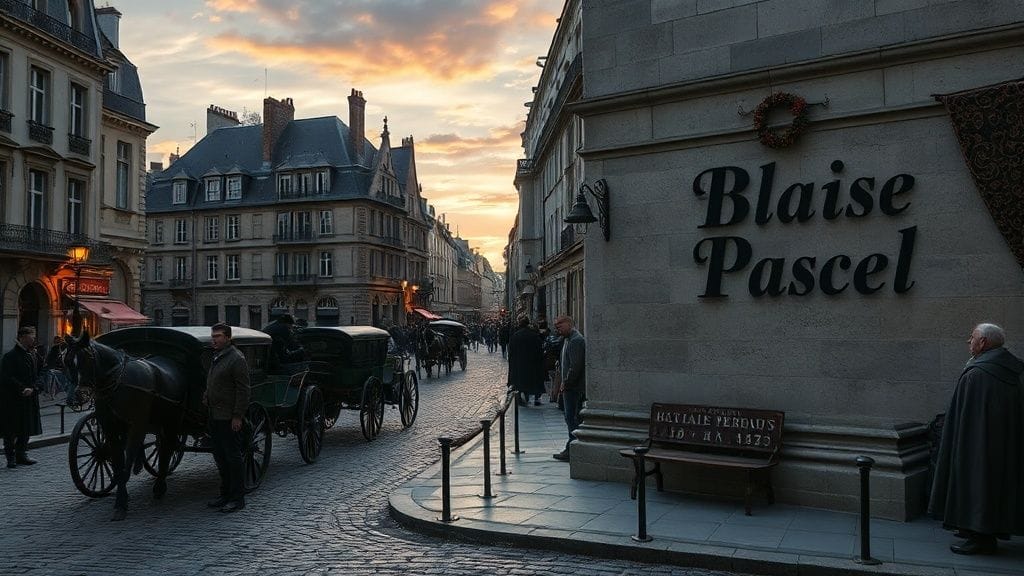
On a sweltering August afternoon in 1662, Paris gasped under the weight of its relentless summer heat, while within the hallowed walls of the Hôtel de Cluny, a fragile figure lay in profound pain. Blaise Pascal, a man whose name had already begun to echo through the corridors of science, philosophy, and theology, was dying. Far from the bustling royal court or the academic splendor of the Sorbonne, Pascal’s last breaths were marked by both intense suffering and piercing clarity, a paradox befitting a man who had spent his entire life treading the delicate line between reason and faith. This was not merely the death of a mathematician or philosopher; it was the end of a soul wrestling with the mysteries of existence itself.
The air inside the chamber was thick with the scent of incense and the whispered prayers of a few close friends and family. Pascal’s once radiant eyes, those same eyes that had envisioned the principles of probability and the infinite depths of human thought, were now dimmed by fever and anguish. Yet, in his final hours, Pascal maintained a serene conviction, a spiritual resolve that transcended the physical torment gnawing at his weakened body. It was a moment suspended between the fragility of human mortality and the indomitable force of ideas that refuse to fade.
But to understand the profound significance of this last day, one must first traverse the winding path of Pascal’s extraordinary life—a path marked by brilliance and suffering, doubts and revelations, a pursuit of God amidst the rational chaos of a rapidly changing world. His death was not an end but a crucial hinge, pivoting the intellectual and spiritual century toward new horizons.
The Life That Shaped a Giant: Pascal’s Early Years and Intellectual Awakening
Born on June 19, 1623, in Clermont-Ferrand, France, Blaise Pascal was a prodigy, a child whose insatiable curiosity quickly outgrew the expectations of even the most gifted scholar. His father, Étienne Pascal, a tax commissioner and a cautious but devoted tutor, carefully nurtured his son’s extraordinary mind. By the age of twelve, young Blaise shocked learned men by devising a method to calculate the areas under curves — a preamble to integral calculus. The intellectual ferment of the early 17th century, bristling with discoveries and debates, found in Pascal a restless mind that probed everything from geometry to mechanics.
Yet, Pascal was not content with the empirical alone. As he matured, his interests expanded beyond natural philosophy into theology and metaphysics. The religious conflicts of France, infused with intense political intrigue, influenced him deeply. These were years when the Catholic Church’s authority was challenged by new currents of thought and when France was rippling with tensions between religious factions, secular power, and emerging scientific inquiry.
Religious Upheaval and Pascal’s Spiritual Crisis
Pascal’s journey through faith was tumultuous. Initially educated in a rational and somewhat secular environment, he increasingly felt drawn toward the austere spirituality of Jansenism — a Catholic reform movement emphasizing original sin, human depravity, the necessity of divine grace, and the predestination of some for salvation. His association with the Port-Royal-des-Champs abbey became pivotal. The abbey was a beacon of theological rigor and intellectual circles fiercely opposed to the Jesuit order, representing a wider clash within French religiosity.
In 1654, a pivotal moment altered Pascal’s life forever: a mystical experience, a “night of fire,” where he reported a sudden, overwhelming awareness of divine love and grace. For Pascal, the quest for certainty moved from geometry to God. This spiritual awakening led him to abandon scientific research, dedicating his energies to apologetics and the defense of Jansenism. Yet his health, fragile from childhood ailments and exacerbated by ascetic practices, worsened.
The Scientist and Philosopher in the Midst of 17th Century France
The intellectual world in which Pascal operated was charged with competing paradigms. The scientific revolution clamored with new discoveries — Galileo’s telescopic revelations, Descartes’ methodic doubt, and the mechanical philosophy that sought to explain the universe in mathematical terms. Pascal’s own contributions, such as the invention of the Pascaline (an early calculating machine) and his probabilistic theories articulated in correspondence with Pierre de Fermat, revolutionized mathematics and logic.
Simultaneously, his philosophical inquiries wrestled with the limits of reason, the contradictions of human nature, and the necessity of faith. His “Pensées,” fragments assembled posthumously, shine as a meditation on man’s existential predicament, revealing a man torn between the empirical and the mystical.
The Port-Royal Influence: Jansenism and Pascal’s Inner Conflict
Pascal’s embrace of Jansenist ideals was not mere piety but a deep intellectual commitment that alienated him from many contemporaries, including the dominant Jesuit order and royal authorities wary of the sect’s challenges. The Port-Royal movement emphasized reason in faith but insisted on the primacy of grace over human effort, a doctrine provoking fierce debate and eventual persecution.
Pascal’s defenses of Jansenism, notably the “Provincial Letters,” were sharp, witty, and scandalous, making many enemies but solidifying his status as a moral and religious voice. This engagement took a toll on his health but also cemented his legacy as a thinker who dared to confront spiritual and political orthodoxies.
The Illness That Would End It All: Nature and Symptoms
Pascal’s physical decline was as relentless as his intellectual pursuit was fevered. For years, he battled chronic stomach pain, headaches, and debilitating nervous disorders. Contemporary accounts suggest a progressive cancer or a severe gastrointestinal disease exacerbated by his ascetic lifestyle and relentless mental exertion.
As August 1662 arrived, the symptoms intensified. Pascal grew increasingly frail, his strength ebbing away amid waves of pain and weakness. Rumors of his impending death circulated softly among his inner circle, but Pascal himself maintained a stoic calm that matched his belief in divine providence.
August 1662: A City Wrapped in Heat and Uncertainty
Paris in August was a city caught between languid summer heat and the restless stirrings of intellectual ferment. The salons and markets thrummed with conversations on politics, philosophy, and the mysterious new sciences shaking the world’s foundations. Yet, Pascal remained, in his final days, removed from public life, ensconced in private quarters with a small circle of friends and family.
This was also a time when the tension between royal power and religious minorities heightened, with the Catholic Church cracking down on dissenters. In this charged atmosphere, Pascal’s death was a quiet but potent symbol — a testament to the struggles and promises of his era.
Final Moments: Pascal’s Farewell Reflections and Spiritual Resolve
Witnesses recount that Pascal’s final hours were suffused with prayer, lucid reflections, and a serene acceptance of death. Despite his physical agony, his mind remained sharp. He repeated phrases emblematic of his spiritual journey, such as "Jesus Christ, Jesus Christ" — a mantra of faith that sustained him against despair.
Those present were struck by the contrast between the man’s physical frailty and the vibrant light of his inner conviction. It was as if a profound peace, born of his lifelong quest for truth, enveloped him as he passed.
A Death that Stirred Contemporaries and Shaped Legacy
News of Pascal’s death traveled quickly among Paris’s intellectual and religious communities. Mourning mingled with admiration; here was a figure who had united the rigor of science with the depth of faith. Letters from contemporaries reflected their deep sorrow and acknowledgment of a unique loss to French culture.
Yet Pascal’s death also ignited debates: how to reconcile his religious zeal with scientific rationality? What to make of a man who challenged both the Church and the Enlightenment before either fully emerged? The questions he posed did not die with him; instead, they became the seeds for future philosophical exploration.
The Burial at Sainte-Étienne-du-Mont: A Quiet Departure Amidst Grandeur
Pascal was interred at the church of Sainte-Étienne-du-Mont in Paris, a resting place shared with the great intellectuals and saints of France. His funeral was modest, attended mainly by close friends and members of the Port-Royal circle. The austere ceremony reflected both Pascal’s humility and the controversial nature of Jansenism, which remained under scrutiny.
The tomb, initially unassuming, would become a silent monument to a man whose ideas towered far beyond his earthly presence.
The Lost Manuscripts and the Mystique of Pascal’s Final Thoughts
One of the enduring mysteries surrounding Pascal’s death concerns the fate of several manuscripts and notes, some of which may have been destroyed or hidden due to their contentious nature. The incomplete “Pensées” compiled posthumously leave us with tantalizing glimpses but also profound gaps.
Scholars speculate on what might have lain in those lost pages: deeper insights into grace, the human condition, or reflections on his own mortality. This uncertainty fuels the legend of Blaise Pascal as an enigmatic figure straddling revelation and reason.
Pascal’s Death and the Scientific World: A Vacuum Left Behind
Pascal’s demise created a notable void in scientific circles. His early work on fluids, vacuums, and probability had opened new horizons; his calculating machine foreshadowed computational advances centuries ahead. The 17th century, already bustling with scientific luminaries, lost a restless mind whose interdisciplinary curiosity foreshadowed modern scientific inquiry.
His death symbolized the fragile boundary between the scientific and metaphysical, a balance many subsequent thinkers would attempt to negotiate.
The Philosophical Inheritance: Pensées and the Quest for Meaning
Pascal’s “Pensées,” painstakingly pieced together after his death, serve as both a philosophical masterpiece and a window into his mind at the end of his life. These fragments delve into the paradoxes of existence: human greatness and wretchedness, the silence of reason, and the “wager” — the bold argument that faith is the most rational bet a human can make amidst uncertainty.
For generations, this work has haunted and inspired, capturing the tension between doubt and belief, despair and hope.
The Interplay of Reason and Faith After Pascal’s Passing
Pascal’s death did not diminish the dialectic he embodied; on the contrary, it catalyzed enduring debates on the relationship between reason and faith. His articulation of the limits of human understanding challenged Enlightenment rationalism while offering a deeply human spiritual alternative.
This complex legacy influenced thinkers from Kierkegaard to contemporary existentialists, framing the perennial dialogue on the meaning of life and the place of God in an increasingly scientific world.
Commemoration, Memory, and the Enduring Symbolism of His Life
Over centuries, Pascal’s memory has been shaped by anniversaries, scholarly studies, and cultural portrayals. Monuments, plaques, and academic chairs in his name attest to his cross-disciplinary influence. Yet he remains elusive—a man defined by contradictions, who embodied the turmoil and promise of his epoch.
His death, etched into the collective consciousness of France, stands as a solemn reminder of the cost of genius and the mystery of existence.
Blaise Pascal in the Public Imagination: From 17th Century to Today
The image of Pascal has transcended time, morphing from a 17th-century recluse to a symbol of intellectual courage. His life and death have inspired novels, films, and philosophical discourse, making him accessible to audiences beyond academia.
This popular memory, while sometimes mythicized, reflects the continued relevance of his struggles and insights in the modern age.
The Legacy in Mathematics and Science: A Testament Beyond Mortality
Pascal’s contributions to mathematics—namely Pascal’s triangle, projective geometry, and probability theory—remain foundational. His insights underpin modern statistics, computing, and physical sciences. The mathematical structures he uncovered continue to illuminate the abstract and practical alike, ensuring his name endures not only in philosophy but as a scientific pioneer.
His death, though premature, did not halt the blossoming of modern science but rather intensified the thirst for knowledge he exemplified.
Pascal’s Death as a Mirror of 17th Century French Society
In many ways, Pascal’s dying reflected the contradictions of his time: a society caught between medieval religiosity and emerging secular rationalism, an absolutist monarchy grappling with dissent, and a culture torn by intellectual and spiritual upheavals.
His death, both a personal tragedy and a public event, encapsulated the epoch’s fragile balance—a poignant symbol of France’s own passage toward modernity.
A Moment Frozen in Time: The Impact on Paris and Beyond
While Paris continued to bustle and change, the death of Pascal was a quiet, momentary pause in the city’s relentless tempo. His passing was observed with somber reflection by those who realized the loss of a unique voice bridging the sacred and the scientific.
The ripples from that August day extended far beyond the city, influencing Europe’s intellectual landscape and shaping the contours of modern thought.
The Eternal Dialogue on Human Condition Sparked by Pascal
Perhaps Pascal’s greatest gift was to frame the human predicament in terms accessible to intellect and heart alike. Death, faith, reason, and despair intersected in his writings and final moments, compelling generations to confront the abyss of existence with courage and humility.
His death marked not an end but the beginning of an eternal conversation—one that continues to echo through time, challenging us to balance the known and the unknown, certainty and mystery.
Conclusion
The death of Blaise Pascal on August 19, 1662, was both an intimate human moment and a landmark in intellectual history. As the flames of his life flickered and dimmed in a small Parisian chamber, the ideas and passions ignited by his restless mind blazed anew across centuries. Pascal’s final struggle—a struggle not only against pain but against uncertainty—encapsulates the essence of the human quest.
His passing invites us to reflect not solely on the loss of a towering intellect but on the fragile, luminous intersection of reason and faith, science and spirituality. Pascal’s legacy is a testament to the enduring power of inquiry fueled by wonder and humility. It reminds us that in facing our own mortality, we encounter the profound question that defined his life: how to live meaningfully amidst the infinite unknown.
FAQs
Q1: What caused Blaise Pascal’s death?
A1: While medical diagnoses at the time were limited, contemporary and modern scholars believe Pascal suffered from chronic stomach ailments, possibly stomach cancer or a related gastrointestinal disease, exacerbated by his ascetic lifestyle.
Q2: How did Pascal’s religious beliefs influence his final days?
A2: Pascal’s conversion to Jansenism deeply shaped his spiritual resolve in his last moments. His faith provided him with a sense of peace and acceptance of death, which is reflected in his prayers and writings.
Q3: What is the significance of the “Pensées” in Pascal’s legacy?
A3: "Pensées" is a collection of Pascal’s posthumous reflections on theology, philosophy, and human nature. It is considered a masterpiece that bridges faith and reason, exploring human doubt and the justification for belief in God.
Q4: How did Pascal’s death affect his contemporaries?
A4: His death was mourned by fellow intellectuals and religious friends alike. It highlighted the loss of a rare mind capable of integrating science and faith, while sparking debates on the reconciliation of these domains.
Q5: Was Pascal’s burial controversial?
A5: The burial was modest and private, reflecting the contentious status of Jansenism at the time. Though not a public spectacle, it took place in a prestigious Parisian church, indicating respect despite religious tensions.
Q6: How did Pascal’s death influence scientific development?
A6: Pascal’s early demise deprived the scientific community of an innovative thinker; however, his existing works influenced the growth of probability theory, mechanics, and computing, paving the way for later breakthroughs.
Q7: Why is Pascal’s death often seen as symbolic in French history?
A7: Because it epitomized the clash between reason and faith, authority and dissent, and science and spirituality during a transformative period in France, Pascal’s death resonates as a symbol of the epoch’s complexities.
Q8: Are there any known lost works from Pascal’s final years?
A8: Yes, some manuscripts and notes were lost or destroyed, adding an aura of mystery to his final thoughts and contributing to the ongoing scholarly quest to fully comprehend his intellectual legacy.