Table of Contents
- Introduction
- Childhood in Paris
- Early Education and Barriers for Women
- Passion for Mathematics and Physics
- Relationship with Voltaire
- Translation of Newton’s Principia Mathematica
- Contributions to Energy and Motion
- Social Life and Intellectual Circles
- Personal Challenges and Strengths
- Final Years and Tragic Death
- Legacy in Science and Women’s Rights
- Anecdotes and Human Side
- Lasting Influence in Modern Science
- External Resource
- Internal Link
Introduction
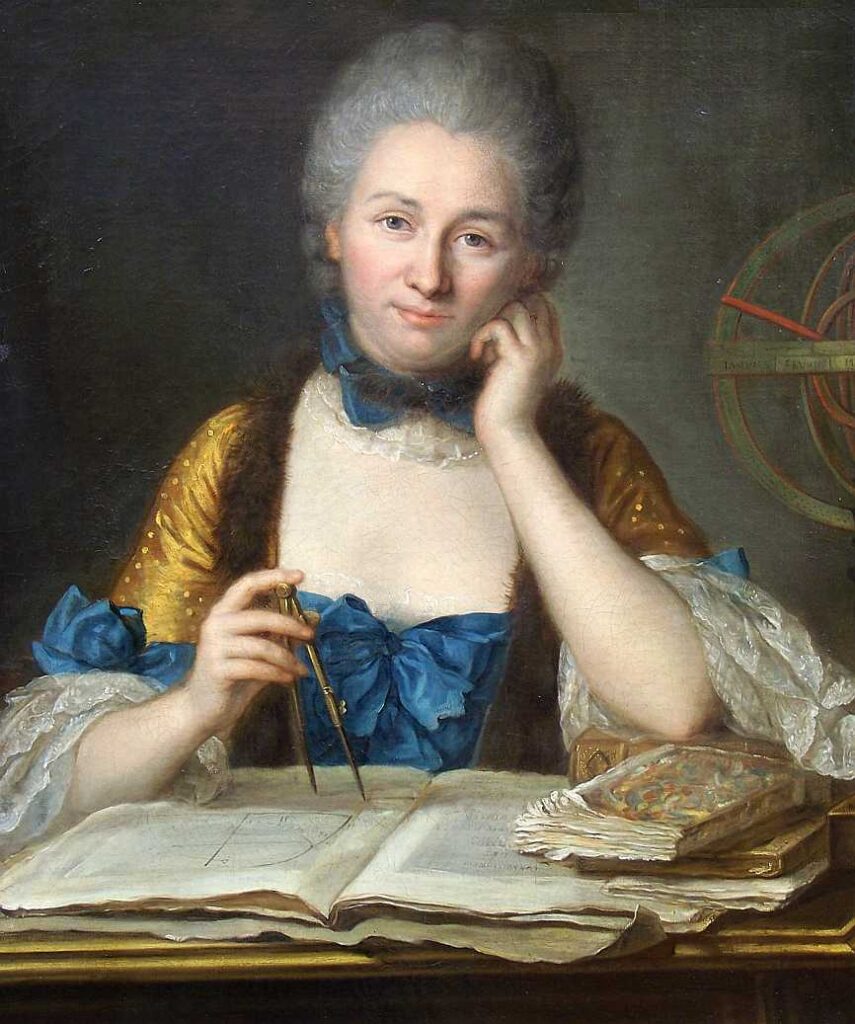
Émilie du Châtelet’s life was a defiance of the limits society placed on women in the 18th century. Born on December 17, 1706, in Paris, France, she became one of the most respected intellectual figures of the Enlightenment. At a time when women were largely excluded from formal education in science, she mastered mathematics, physics, and philosophy, leaving a legacy that still inspires today. Her crowning achievement — translating Isaac Newton’s Principia Mathematica into French — remains the standard edition used in France even now.
Childhood in Paris
Gabrielle Émilie Le Tonnelier de Breteuil was born into an aristocratic family. Her father, Louis Nicolas Le Tonnelier, served as an official at the court of Louis XIV. This position gave her access to education beyond what most girls could dream of. She grew up in a home filled with books, music, and lively discussions on politics and science.
While many young women of her time were taught only domestic skills, Émilie’s father encouraged her curiosity. Tutors were hired to teach her mathematics, languages, and fencing — skills considered unusual for a girl, but ones that she embraced fully.
Early Education and Barriers for Women
Despite her privilege, Émilie faced the same institutional obstacles as other women of her era. Universities were closed to her, and scientific societies refused her membership. She often had to disguise herself in men’s clothing to attend lectures. Imagine the determination it took to step into a lecture hall, knowing that discovery was worth more than the rules trying to keep her out.
Her fluency in multiple languages — including Latin, Italian, and German — gave her access to scientific works that were otherwise unavailable to the French-speaking public. This ability would later be critical for her groundbreaking translations.
Passion for Mathematics and Physics
Émilie’s scientific interests were not hobbies; they were the core of her identity. She studied advanced mathematics under the guidance of leading scholars such as Pierre-Louis Maupertuis and Alexis Clairaut. Her research explored the nature of energy, particularly the debate between whether it should be measured as mv (momentum) or mv² (kinetic energy). Her writings supported the mv² perspective, aligning with Gottfried Wilhelm Leibniz and influencing later physics.
Relationship with Voltaire
Her partnership with the philosopher Voltaire was both romantic and intellectual. They lived together at her husband’s estate in Cirey, turning it into a center for Enlightenment thought. The two spent countless hours debating philosophy, conducting experiments, and writing manuscripts side by side.
Voltaire once said of her: “A great man whose only fault was being a woman.” This statement reflects both admiration and the sad reality of how women’s achievements were framed in the 18th century.
Translation of Newton’s Principia Mathematica
In an era when Newton’s Principia was the pinnacle of scientific achievement, very few could read it in its original Latin. Émilie’s translation into French, completed shortly before her death, included her own commentary and clarifications.
This was no simple linguistic exercise — she explained Newton’s dense mathematical reasoning in a way that made it accessible to French scholars. Her edition remains the authoritative French translation to this day, a testament to her precision and insight.
Contributions to Energy and Motion
Her scientific work went beyond translation. Émilie conducted experiments to measure the impact of falling objects, providing evidence that energy depends on the square of velocity. This contribution helped pave the way for the modern understanding of kinetic energy, influencing future scientists like Émilie’s contemporaries and even shaping 19th-century physics.
Social Life and Intellectual Circles
Despite her rigorous intellectual pursuits, Émilie thrived in the salons of Paris. She engaged with leading thinkers, writers, and scientists, often hosting spirited debates. Her charm and wit made her a respected figure in these circles, even among those who initially doubted a woman could master complex science.
Personal Challenges and Strengths
Balancing her roles as a noblewoman, mother, lover, and scientist required remarkable resilience. She navigated social scrutiny for her unconventional relationships and relentless pursuit of knowledge. Her determination to live authentically — pursuing both love and science — challenged the rigid expectations placed on women of her class.
Final Years and Tragic Death
In 1749, at age 42, Émilie became pregnant, a situation that was medically risky at her age. Still, she continued working tirelessly on her Newton translation. Tragically, she died shortly after giving birth to a daughter, likely from complications of childbirth.
Her death cut short a career that still had much to offer, but her final work ensured her name would endure in the annals of science.
Legacy in Science and Women’s Rights
Émilie du Châtelet’s life is a beacon for both scientists and advocates of gender equality. She proved that intellectual ability is not bound by gender, and she laid the groundwork for future generations of women in science.
Anecdotes and Human Side
One famous anecdote tells of her gambling at the palace of Versailles to fund the purchase of scientific instruments. This mix of aristocratic flair and scientific purpose captures her unique character — a woman equally at home in the salon and the laboratory.
Lasting Influence in Modern Science
Today, Émilie is recognized not only as a translator but as a physicist and mathematician in her own right. Her works are studied by historians of science, and her story is told to inspire young scientists worldwide, especially women who face barriers similar to those she overcame.
External Resource
🌐 Wikipedia – Émilie du Châtelet