Table of Contents
- The Final Days of Voltaire: A Man’s Last Breath in Paris
- The Parisian Atmosphere of 1778: Enlightenment on the Brink
- Voltaire’s Life in Retrospect: From Provocateur to Philosopher
- The Illness That Would Claim a Giant: Voltaire’s Declining Health
- Death Approaching: The Last Moments in the Hôtel de Villette
- The Funeral Controversy: Church, State, and Enlightenment Clash
- Public Mourning in Paris: The City’s Reaction to Voltaire’s Passing
- The Enlightenment’s Grief: Intellectuals Remember a Colossus
- The Political Ramifications: Voltaire’s Death Amidst Royalist Skepticism
- Voltaire’s Legacy and Posthumous Reputation
- The Journey of Voltaire’s Remains: From Burial to Pantheon
- The Memory of Voltaire in the French Revolution
- The Cultural Impact: Voltaire as a Symbol of Reason and Liberty
- Historical Debates: Voltaire’s Personal Life vs. Philosophical Contributions
- Today’s View: Voltaire’s Enduring Influence on Modern Thought
The Final Days of Voltaire: A Man’s Last Breath in Paris
On a crisp spring day in May 1778, as the light of the waning afternoon sifted softly through the windows of the Hôtel de Villette in Paris, François-Marie Arouet — known to the world as Voltaire — lay gravely ill. The city, buzzing with intellectual fervor and political tensions, waited unknowingly for the passing of a man whose sharp wit, boundless pen, and fearless critique had shaped the very contours of modern reason. His breath was shallow, his body frail, yet his mind, ever restless, grasped the twilight of his existence with indomitable spirit.
Voltaire’s death was more than the end of a life; it was the closing of an era. The old Parisian walls bore witness to the final act of a lifelong battle against dogma, tyranny, and ignorance. This was not just a philosopher quietly slipping away — it was a monumental figure confronting mortality amidst the very society he had tirelessly sought to enlighten.
The Parisian Atmosphere of 1778: Enlightenment on the Brink
Paris in the late 1770s was a melting pot of contradictions — a city illuminated by the brilliance of the Enlightenment and shadowed by the rigid structures of monarchy and church power. Intellectual salons buzzed with debates about freedom, science, and secular governance. Yet the ancien régime clung desperately to its privileges, wary of the growing calls for reform.
Voltaire, at 83, was both a revered icon and a target of suspicion. His sharp critiques of the Church and the aristocracy resonated deeply within the burgeoning public sphere but also stirred unease among conservative factions. The atmosphere was charged; every word his death would unleash carried the potential to influence the fragile balance between old order and new ideas.
Voltaire’s Life in Retrospect: From Provocateur to Philosopher
Born in 1694, Voltaire’s journey from a rebellious youth to one of the Enlightenment’s most potent voices was marked by brilliance, wit, and controversy. From his early works that scandalized the court of Louis XV to his later eloquent defenses of civil liberties and freedom of expression, Voltaire’s life was a relentless campaign against oppression.
His sharp pen spared neither the king nor the clergy. Quoting Voltaire himself, “Écrasez l’infâme!” (“Crush the infamous thing!”) became a rallying cry against superstition and fanaticism. His exile in England and later years at his estate in Ferney refined his ideas and tactics, making him a thinker who was both accessible and fiercely uncompromising.
The Illness That Would Claim a Giant: Voltaire’s Declining Health
Voltaire’s robust defiance of mortality dimmed gradually during the spring of 1778. After decades of robust health, a lung disease — likely tuberculosis or pneumonia — cast a shadow over the philosopher’s vitality. Despite his advancing age, his voice remained sharp, and his mind, acute. Friends recorded his insistence on continuing to write and converse even as his body betrayed him.
Doctors were summoned, prayers whispered, but Voltaire’s skepticism of religion remained untouched. His own frustration at physical frailty echoed his lifelong disdain for helplessness in the face of ignorance and tyranny.
Death Approaching: The Last Moments in the Hôtel de Villette
In the final hours, Voltaire surrounded himself with a few close friends and admirers, including the mathematician and philosopher Denis Diderot and the marquise du Châtelet’s daughter, Madame Denis. Conversations ebbed and flowed between philosophy, laughter, and moments of silence weighed down by the inevitability of parting.
Voltaire is said to have uttered his famous final words, reflecting on the power of reason over fear: “I die adoring God, loving my friends, not hating my enemies, and detesting superstition.” The poignancy of this declaration crystallized the legacy he had forged through decades of tireless engagement.
The Funeral Controversy: Church, State, and Enlightenment Clash
Voltaire’s death ignited an immediate and fierce debate. The Church, unsettled by his irreverent writings and rejection of orthodox faith, denied him the rites of consecrated ground. Meanwhile, Enlightenment figures and key political patrons pressed for a public funeral that would honor his stature.
The tension was emblematic of the era’s struggle. The court initially forbade any grand ceremony, fearing political unrest, but public outcry and the philosopher’s admirers prevailed. Eventually, Voltaire received a spectacular funeral procession — a mise-en-scène where the ideals of tolerance and secular honor were visibly contested against the backdrop of a firmly religious France.
Public Mourning in Paris: The City’s Reaction to Voltaire’s Passing
Parisians of all classes, from academics to artisans, poured into the streets to pay homage. Newspapers eulogized the “champion of reason,” while cafés became hotbeds of impassioned debate on freedom and justice. Voltaire’s death served as a mirror reflecting the hopes and anxieties of an entire generation.
Anecdotes from eyewitnesses describe the outpouring of emotion — tears shed by allies, cold stares from detractors, and the palpable sense that with Voltaire’s passing, the city and the world had lost a beacon of critical thought.
The Enlightenment’s Grief: Intellectuals Remember a Colossus
Across Europe, intellectuals mourned. Letters from figures such as Jean-Jacques Rousseau and Christoph Martin Wieland conveyed grief mingled with resolve to continue the work Voltaire had championed. The death of a titan galvanized the Enlightenment community into renewed vigor.
Voltaire’s writings were republished, heretical ideas gained wider academic acceptance, and his life became a symbol of the unwavering quest for truth against dogma. Yet, beneath the public eulogies, there was also reflection on the limits of progress and the challenge of translating ideals into political reality.
The Political Ramifications: Voltaire’s Death Amidst Royalist Skepticism
The French crown, wary of the social and political upheaval brewing beneath the surface, viewed Voltaire’s legacy with unease. His death provided the monarchy a moment to tighten controls, but paradoxically, it also offered reformist factions an emblem to rally behind.
The intricate dance of politics, philosophy, and power that marked Voltaire’s life thus continued beyond his death. His ideas increasingly entered the political discourse, shaping the attitudes that would erupt in the French Revolution just a decade later.
Voltaire’s Legacy and Posthumous Reputation
Voltaire’s death did not mark an end, but rather a transformation. His works inspired generations of thinkers, writers, and revolutionaries. “Candide,” “Letters on England,” and his philosophical letters disseminated critique and satire across Europe.
However, his reputation oscillated. Revered as a hero of free thought by some, criticized for elitism or inconsistent personal conduct by others, Voltaire remained a complex figure—both a man of his time and a prophet for the future.
The Journey of Voltaire’s Remains: From Burial to Pantheon
Initially interred quietly at the church of Saint-Roch, Voltaire’s remains were later moved to the Panthéon, the secular mausoleum of French luminaries, recognized officially by the revolutionary government during the surge of the new Republic.
This posthumous honor was charged with symbolism — the embracing of reason over faith, the celebration of the individual’s contributions to the collective enlightenment. Yet even this gesture was fraught with political undertones, reflecting the turbulent path of French sociopolitical identity.
The Memory of Voltaire in the French Revolution
The French Revolution, erupting just over a decade after Voltaire’s death, enshrined him as a foundational figure. Revolutionary leaders invoked Voltaire’s ideals to legitimize their calls for liberty, equality, and fraternity.
His critiques of the Church’s abuses and monarchical absolutism resonated in the dismantling of the ancien régime. But the Revolution also tested the limits of Enlightenment optimism, revealing complexities that Voltaire himself had sometimes overlooked.
The Cultural Impact: Voltaire as a Symbol of Reason and Liberty
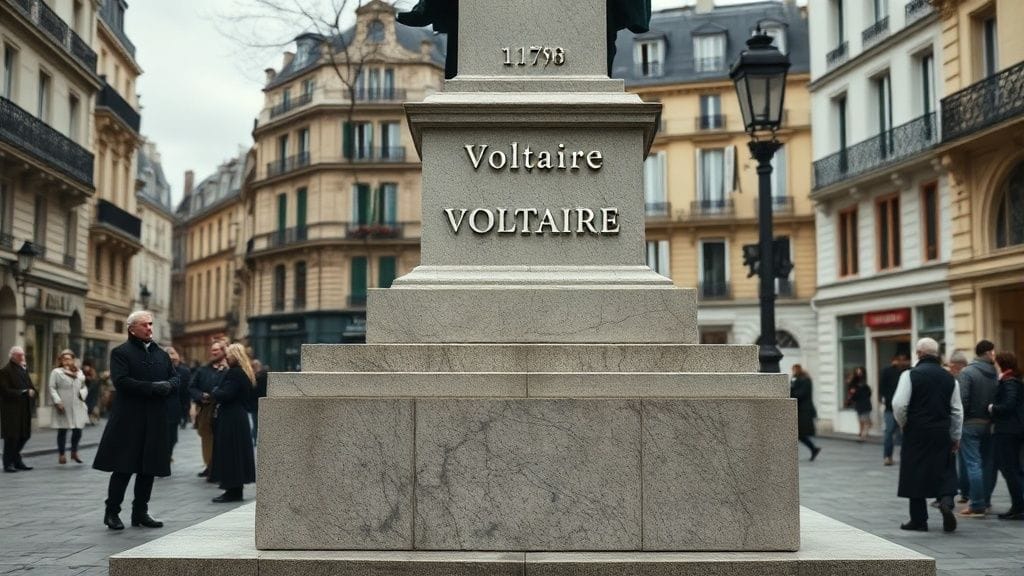
In literature, arts, and public discourse, Voltaire emerged as a symbol — not just of ideas but of a spirited challenge to oppression. Statues, plaques, and quoted maxims appeared in countless towns and cities. His name became synonymous with secular humanism and the power of critical thought.
Voltaire’s persona transcended history textbooks, inspiring debates about tolerance and freedom that resonate to this day.
Historical Debates: Voltaire’s Personal Life vs. Philosophical Contributions
Despite the reverence, Voltaire’s personal life — marked by complicated relationships, financial excesses, and political maneuverings — has sparked historical debate. Was he a flawless hero of reason or a more flawed, human figure shaped by contradictions?
This duality adds depth to his legacy, inviting modern readers to appreciate the complexity behind his luminous body of work.
Today’s View: Voltaire’s Enduring Influence on Modern Thought
As we survey the contemporary landscape of secularism, freedom of expression, and human rights, Voltaire’s shadow looms large. His clarion call to question authority, to cherish evidence over dogma, echoes in journalism, politics, and education worldwide.
More than two centuries after his death in Paris, Voltaire remains an enduring icon — a testament to the power of the written word and the courageous mind.
Conclusion
Voltaire’s untimely death on May 30, 1778, was not merely the passing of an individual but the symbolic closing of a chapter in humanity’s long struggle toward reason and freedom. His final moments in the Hôtel de Villette capture a man unwavering in his principles despite the frailties of the flesh. The response from Paris and across Europe illuminated how deeply his voice had penetrated the social soul.
But beyond the mourning, his death planted seeds for transformation. The controversies sparked by the handling of his funeral mirrored the ideological battles that would soon reshape France and the world. Voltaire’s legacy, rich with paradoxes and brilliance, challenges us still — to question, to debate, and above all, to think courageously.
In an age where misinformation and dogma continue to Kindle conflict, revisiting the final chapter of Voltaire’s life revives a vital lesson: that the torch of enlightenment must be passed on with tenacity, wit, and above all, humanity.
FAQs
1. Why was Voltaire denied a traditional church funeral?
Voltaire’s outspoken criticism of the Catholic Church and his unorthodox beliefs led the Church to deny him consecrated rites at death, highlighting the clash between Enlightenment ideas and established religion.
2. How did Parisian society react to Voltaire’s death?
Parisians mourned deeply, holding public ceremonies and much discussion in salons and cafés, reflecting his profound impact on French intellectual and social life.
3. What role did Voltaire’s death play in the lead-up to the French Revolution?
Voltaire’s death symbolized the passing of Enlightenment ideals into the public consciousness, helping to fuel revolutionary ideas against monarchy and clerical authority.
4. Where was Voltaire originally buried, and where are his remains now?
Initially, Voltaire was buried at the church of Saint-Roch, but his remains were later moved to the Panthéon in Paris, recognized as a key figure in the nation’s cultural history.
5. How do historians view the contradictions in Voltaire’s life?
While celebrated for his advocacy of reason, Voltaire’s personal life reveals complexities that humanize him and provide richer understanding of his legacy.
6. What lasting influence did Voltaire’s final works have?
His final works reinforced his themes of freedom, tolerance, and critique of authority, continuing to inspire Enlightenment thought and its modern descendants.
7. How was Voltaire’s death used politically both by supporters and opponents?
Supporters used it to champion freedom of thought and secularism; opponents emphasized his controversial stance to defend traditional structures.
8. What are Voltaire’s most famous last words, and what do they signify?
Reportedly, “I die adoring God, loving my friends, not hating my enemies, and detesting superstition”—a crystallization of his commitment to reason, tolerance, and human dignity.