Table of Contents
- The Twilight of an Era: Vienna on the Edge of Change
- The Final Hours of Maria Theresa: A Monarch’s Last Breath
- Maria Theresa’s Reign: The Architect of Modern Austria
- The Politics of a Matriarch: Power and Perseverance
- Vienna in 1780: A City Poised Between Tradition and Transformation
- The Habsburg Legacy: Dynasty, Duty, and Destiny
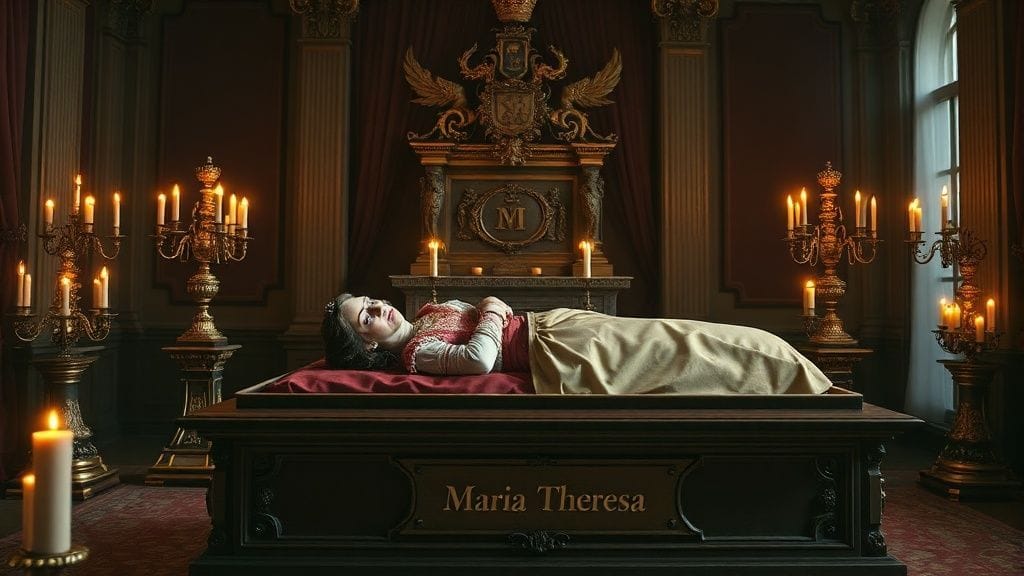
- Death in the Hofburg Palace: The Scene of a Historic Passing
- The Mourning of an Empire: Public Grief and Political Uncertainty
- Joseph II Ascends: The Son as Successor and Reformer
- The End of the War of the Bavarian Succession: A Kingdom in Flux
- Enlightened Absolutism: Maria Theresa’s Paradoxical Heritage
- The Impact on Austria’s Military and Diplomatic Strategy
- Cultural Reverberations: Arts, Education, and Religion
- The Personal Loss: Family and Court Reactions
- Maria Theresa’s Tomb and Memory: Monuments to a Queen
- The Wider European Context: Habsburg Power at a Crossroads
- From Empress to Myth: The Shaping of a Historical Icon
- The Death’s Effect on European Alliances and Peace Treaties
- Economic Shifts Triggered by a Dynastic Transition
- Women in Power: Maria Theresa’s Unparalleled Role
- Lessons from 1780: Leadership, Legacy, and Change
1. The Twilight of an Era: Vienna on the Edge of Change
Late November 1780 in Vienna was a city wrapped in a peculiar quietude that belied the immense tremors beneath the surface. The winter chill seeped through the narrow lanes, but inside the ornate walls of the Hofburg Palace, the air was thicker with anticipation, fear, and pathos. The Empress Maria Theresa, the indomitable figure who had ruled the Habsburg lands for four decades, was in her final hours. As the golden light of autumn waned and cast long shadows over the imperial city, Europe watched a torch passed—not just between generations but between epochs.
The silence around the palace was like the breath held of a continent, waiting to see what the death of a sovereign queen might mean to the fragile balance of power. This was no ordinary monarch: Maria Theresa’s reign had been an edifice of reform, war, motherhood, and empire-building. The world she had shaped was about to pivot in ways both subtle and seismic. For Vienna, and indeed all of Austria, the death on November 29, 1780, marked the end of an era and the beginning of a new, complex chapter.
2. The Final Hours of Maria Theresa: A Monarch’s Last Breath
The last moments of Maria Theresa’s life were harrowing to those closest to her. Following a sudden illness marked by fever and weakness, the Empress’s condition deteriorated rapidly. Courtiers whispered in fear of the inevitable, filling the hushed corridors with a tension that was almost tactile. To witness Maria Theresa—the formidable force who had stood combatively against enemies and managed the vast tapestry of multi-ethnic empires—now fading like a flickering candle was an experience drenched in sorrow.
Her children gathered around, their faces a mixture of grief and resolve. Among them stood Joseph, the heir, whose thoughts raced between personal loss and the crushing weight of impending responsibility. The Empress reportedly received the last rites with a solemn dignity that embodied the religious devotion that had been a cornerstone of her reign. As the final breath left her body, a palpable shudder seemed to ripple through the palace and beyond.
3. Maria Theresa’s Reign: The Architect of Modern Austria
To understand the magnitude of the moment, one must first understand the woman who passed that day. Maria Theresa was no mere ruler; she was a titan of 18th-century Europe. Born into the Habsburg dynasty in 1717, her ascent to power in 1740 was fraught with turmoil. As the sole female heir of Emperor Charles VI, her succession was contested, sparking the War of Austrian Succession—a brutal conflict that tested her resolve and strategic acumen.
Over her 40 years on the throne, Maria Theresa transformed Austria from a struggling patchwork of territories into a centralized state, modernized in law, economy, military, and education. She reformed the tax system, promoted commerce, and fostered scientific inquiry while remaining a devout Catholic custodian of tradition. The balance she maintained between reform and conservatism defined her leadership—a paradox that would echo beyond her death.
4. The Politics of a Matriarch: Power and Perseverance
Maria Theresa’s political life was one of unrelenting challenges. She navigated alliances and enmities in a Europe dominated by France, Prussia, and Russia. Her marriage to Francis I, Holy Roman Emperor, was both a personal and political partnership, cementing internal stability. Yet, as a woman in a male-dominated world, she faced skepticism and outright opposition, even from other royals.
Her dominance was evident in court intrigues and foreign diplomacy, where she maneuvered deftly. Her pragmatic alliances—such as siding with Britain against France during the Seven Years’ War—highlighted a ruler both shrewd and resilient. It was in the realm of diplomacy and internal governance that her legacy would lay the groundwork for Austria’s imperial endurance.
5. Vienna in 1780: A City Poised Between Tradition and Transformation
Vienna itself was a microcosm of the empire’s grandeur and contradictions in 1780. The city was adorned with Baroque palaces, burgeoning with salons alive with philosophical debates, yet still bound by rigid social hierarchies. The influence of the Enlightenment was seeping into the streets—a world of burgeoning sciences, questioning religion, and new ideas about governance. Yet, Maria Theresa’s reign had kept a cautious hand upon these currents.
As news of the Empress’s illness spread, Vienna’s populace waited anxiously. For many, she was a symbol of stability and faith. The imminent death of their sovereign stirred fears about what reforms her successor might pursue, and how long the empire’s peace would hold.
6. The Habsburg Legacy: Dynasty, Duty, and Destiny
The Habsburg dynasty had ruled Central Europe for centuries, often through complex marriages and inheritances rather than military conquests. Maria Theresa’s inheritance of power was underpinned by the Pragmatic Sanction of 1713, which allowed her to ascend despite being female—a legal maneuver that defied traditional Salic law.
Her life epitomized the dynastic burdens of duty and sacrifice. She bore sixteen children, many of whom married into powerful families throughout Europe, weaving a web of alliances that reinforced Habsburg influence. The weight of heritage rested heavily on her shoulders; ruling was not simply a privilege but a mandate rooted in divine right and historical necessity.
7. Death in the Hofburg Palace: The Scene of a Historic Passing
The Hofburg Palace, heart of imperial power, witnessed the conclusion of Maria Theresa’s life’s work. The vast chambers where treaties had been signed, armies had drawn plans, and pupils had learned statecraft became the stage for a monarch’s final moments. The palace’s ornate halls were quiet, save for whispered prayers and the soft shuffle of attendants turning pages of her favorite religious texts.
Her death was formally declared on the morning of November 29, setting in motion elaborate rituals that underscored the solemnity of the transition. A state of mourning was proclaimed; bells tolled throughout Vienna, and flags flew at half-mast.
8. The Mourning of an Empire: Public Grief and Political Uncertainty
The death of Maria Theresa unleashed waves of mourning across the empire. In the streets of Vienna, citizens lit candles and prayed for the soul of their sovereign. The nobility donned black garments, and public ceremonies commemorated her life. Yet beneath the grief lurked uncertainties—would Joseph II maintain his mother’s cautious reforms, or plunge Austria into radical transformations?
The uncertainty was not unfounded. Europe was a powder keg of shifting alliances and ideological awakenings. Maria Theresa had been the Empire’s anchor; without her, the political seas threatened to become treacherous.
9. Joseph II Ascends: The Son as Successor and Reformer
Joseph II, co-ruler during his mother’s later years, officially became sole ruler upon her death. Unlike Maria Theresa’s blend of tradition and pragmatism, Joseph aspired to more sweeping reforms inspired by Enlightenment ideals. His ascendance marked a turning point in Austrian history, from cautious consolidation to vigorous attempts at modernization.
His early reign saw efforts to reduce the power of the Church, introduce religious tolerance, and overhaul the legal system. Yet, these changes proved controversial, stirring opposition among conservative factions who revered his mother’s policies.
10. The End of the War of the Bavarian Succession: A Kingdom in Flux
Maria Theresa’s death arrived amidst the tail end of the War of the Bavarian Succession (1778-1779), a relatively bloodless conflict triggered by dynastic claims that threatened regional stability. Though hostilities had ceased, the unsettled peace cast shadows over the coming decades.
The transition in leadership placed further questions on Austria’s role within Europe. Would Joseph II continue his mother's complex balancing act, or shift toward a more expansive, assertive foreign policy? The answers would unfold slowly, but the death of Maria Theresa was undoubtedly a catalyst.
11. Enlightened Absolutism: Maria Theresa’s Paradoxical Heritage
The concept of “enlightened absolutism”—a sovereign who rules with absolute power yet espouses reforms for the public good—fits Maria Theresa like a glove, yet never perfectly. She modernized her administration, reformed education, and encouraged economic development, but remained attached to Catholic orthodoxy and hierarchical order.
Her reign is thus a paradox: reformer and conservative, innovator and defender of tradition. This duality shaped Austria's trajectory and offered a model for monarchs who sought legitimacy amid the Age of Enlightenment’s relentless challenges.
12. The Impact on Austria’s Military and Diplomatic Strategy
Maria Theresa was a strategic military leader, rebuilding Austria’s army after the Silesian Wars and working to sustain the empire’s vast borders. Her death marked a moment of reflection on Austria’s military future. Joseph II inherited the challenge of balancing military might with internal reform burdens.
Diplomatically, Maria Theresa’s careful web of alliances began to unravel slowly after her death. The shifting allegiances of later decades would reflect both her legacy and the changing tides of European power politics.
13. Cultural Reverberations: Arts, Education, and Religion
Beyond politics, Maria Theresa’s death rippled through Austrian cultural life. She was a patron of the arts and education, founding schools and promoting the sciences. Her devotion to Catholicism influenced religious life and censorship policies.
Her passing prompted debates about the future direction of culture in Austria: should the arts continue to serve the church and monarchy, or embrace more secular, enlightenment-inspired forms? This tension informed much of the intellectual ferment of the late 18th century.
14. The Personal Loss: Family and Court Reactions
At the court, Maria Theresa’s death was profoundly personal and political. Among her sixteen children, many played significant roles on the European stage, including Marie Antoinette, future Queen of France. The court's atmosphere was thick with grief and foreboding.
The internal family dynamics—marked by rivalry, alliances, and political marriages—continued to shape Austrian diplomacy. Her death left a vacuum not easily filled in the hearts and minds of those who knew her best.
15. Maria Theresa’s Tomb and Memory: Monuments to a Queen
The final resting place of Maria Theresa became a sacred site and focus of memory construction. The Kaisergruft (Imperial Crypt) in Vienna houses her remains alongside her ancestors. Over time, monuments, biographies, and historiography transformed her into a symbol of Austrian identity and continuity.
Her legacy became a touchstone in debates on monarchy, nationhood, and gender, affirming her place in the pantheon of European rulers.
16. The Wider European Context: Habsburg Power at a Crossroads
Maria Theresa’s death did not happen in isolation. Europe in 1780 was a continent on a knife-edge. The American Revolution was brewing, Enlightenment ideals challenged old orders, and empires jockeyed for influence. The Habsburgs’ future role was uncertain.
Her death symbolized both an end and a beginning, as Austria struggled to maintain relevance amid growing pressures—from Prussia’s rise to Russia’s assertiveness.
17. From Empress to Myth: The Shaping of a Historical Icon
The figure of Maria Theresa transcended history to become myth and legend. 19th-century nationalism, romanticism, and political narratives cast her as the mother of the nation, the warrior queen, and the bulwark of conservatism.
Her image was invoked in times of crisis to inspire unity, underscoring the potent blend of myth and memory that historical figures often acquire.
18. The Death’s Effect on European Alliances and Peace Treaties
The transfer of power from Maria Theresa to Joseph II altered diplomatic calculations. Agreements pending or negotiated under her authority faced new scrutiny. The subsequent years saw shifts in the balance of power, alliances reconfigured, and treaties renegotiated.
Austria’s diplomacy became more proactive yet fraught, setting the stage for conflicts and negotiations that would define late 18th-century geopolitics.
19. Economic Shifts Triggered by a Dynastic Transition
Political stability is often a prerequisite for economic growth; Maria Theresa’s death introduced an element of uncertainty which rippled through trade, taxation, and fiscal policy. Reforms instituted by her son sometimes conflicted with established practices, affecting merchants and landowners differently.
Economic historians trace this period as one of gradual transformation, where old models gave way to new economic thinking that prefigured modernization.
20. Women in Power: Maria Theresa’s Unparalleled Role
In an era when female sovereigns were rare and often contested, Maria Theresa’s effective reign was extraordinary. She defied gender norms, asserting authority with unmatched vigor. Her death invited reflections on the role of women in governance—a discussion that resonates even today.
Her legacy challenges assumptions about power, authority, and gender in European history.
21. Lessons from 1780: Leadership, Legacy, and Change
Looking back on November 29, 1780, with the fullness of history, we see more than the death of an empress. We see a turning point illustrating the complexities of leadership—how personal virtues and political realities combine, how legacies are contested and honored.
Maria Theresa’s final breath was not just an end but a signal for transformation, a meditation on the human dimension behind the grand narratives of empire.
Conclusion
The death of Maria Theresa on that cold autumn day in Vienna was far more than the passing of a ruler. It was the close of a colossal chapter in European history—of dynastic endurance, enlightened absolutism, and imperial ambition. Yet, in ending, it also opened the door to new questions, new conflicts, and new hopes under the watchful eyes of her successors.
Maria Theresa’s life and death resonate today as reminders of the fragile interplay between power and humanity, tradition and progress. She was, in many ways, the embodiment of an age’s contradictions and possibilities. Her story compels us to consider how leaders shape—and are shaped by—the times in which they live.
The empire mourned its mother, but the future awaited its child. And so history marched onward.
FAQs
Q1: What were the main causes leading to Maria Theresa’s death in 1780?
A1: Maria Theresa fell ill in late 1780, possibly from pneumonia or pleurisy, which rapidly worsened. Medical care at the time was limited in combating such illnesses, leading to her death on November 29.
Q2: How did Maria Theresa’s death affect the political stability of the Habsburg Empire?
A2: While initially causing uncertainty and mourning, Joseph II’s succession maintained political continuity. However, his reformist policies soon ignited tensions between tradition and change.
Q3: Who was Joseph II, and how did his reign differ from his mother’s?
A3: Joseph II was Maria Theresa’s son and co-ruler who became sole ruler after her death. His reign embraced more radical Enlightenment-inspired reforms, especially in religion and administration.
Q4: What was Maria Theresa’s legacy in terms of governance and reform?
A4: She modernized the Habsburg administration, reformed tax and education systems, and maintained strong Catholic values, balancing innovation with conservatism.
Q5: How did the death of Maria Theresa impact Vienna’s cultural life?
A5: The transition spurred debates over cultural direction, with a gradual opening to secular and Enlightenment ideas while maintaining traditional patronage of the arts.
Q6: What role did Maria Theresa play as a woman in 18th-century European politics?
A6: She was one of the few female monarchs who ruled in her own right, overcoming the gender biases of her time to exert significant political and dynastic influence.
Q7: How did European powers react to her death?
A7: Foreign courts watched closely, assessing whether Austria would maintain its strength or weaken. Diplomatic maneuvers followed to adjust to the new leadership.
Q8: How is Maria Theresa remembered today in Austria and Europe?
A8: She is remembered as a foundational figure for modern Austria, a symbol of strength, reform, and complex leadership—a heroine of history and myth alike.