Table of Contents
- The Twilight of the Terror: Paris, July 1794
- The Rise of Maximilien Robespierre: From Provincial Lawyer to Revolutionary Icon
- The Philosophical Roots: Enlightenment, Liberty, and Equality
- The Birth of the French Revolution: Storming the Bastille and the Promise of Change
- Robespierre’s Ascent: The Jacobin Club and the Committee of Public Safety
- The Terror Unleashed: Revolutionary Justice and the Guillotine’s Shadow
- The Cult of the Supreme Being: Faith, Politics, and Personal Conviction
- The Growing Opposition: Fear, Fatigue, and the Enemies Within
- The 9th Thermidor Coup: The Fall of the Incorruptible
- Robespierre’s Last Speech: Defiance in the Face of Death
- The Capture and Public Execution: The End of an Era on July 28, 1794
- The Immediate Aftermath: Paris Reacts to the Death of Robespierre
- The Thermidorian Reaction: Undoing the Terror
- Political and Social Consequences: France’s Path to Stability
- Robespierre’s Legacy: Hero, Tyrant, or Tragic Idealist?
- Historiographical Debates: Memory and Mythmaking
- Cultural Echoes: Robespierre in Literature, Film, and Popular Memory
- The Guillotine’s Symbolism: Justice or Horror?
- Lessons from the Terror: Revolution and the Limits of Power
- Conclusion: Reflections on a Revolutionary’s Final Day
- FAQs: Understanding Robespierre and 1794
- External Resource
- Internal Link
The Twilight of the Terror: Paris, July 1794
As the sun dipped beneath the smoky skyline of Paris on the evening of July 27, 1794, the city held its breath. The streets, often alive with cries of liberty or demands for justice, seemed eerily quiet, as if the revolution itself had paused in anticipation. The once omnipotent figure of Maximilien Robespierre, “The Incorruptible,” was cornered, betrayed, and about to meet his fate. The guillotine awaited him at the Place de la Révolution, its blade sharp, destined to sever not only a life but a chapter of the most turbulent and bloody period in French history—the Reign of Terror.
In a city where hope and horror danced side by side, where neighbors could become executioners overnight, that July marked the final unraveling of a man who had wielded power with uncompromising zeal. His arrest, capture, and subsequent execution on July 28 were not merely the fall of a revolutionary leader; they were the dramatic turning point that ended one of the most violent chapters in the age of revolutions.
But how did a provincial lawyer, shaped by Enlightenment ideals, rise to become the architect of terror? And why did the very revolution he championed conspire to destroy him?
The Rise of Maximilien Robespierre: From Provincial Lawyer to Revolutionary Icon
Maximilien Robespierre was born in Arras in 1758, a modest town in northern France far from the grandeur of Parisian salons. His early life was steeped in the classics, and his profound dedication to justice and morality charted a course toward public life. Known for his eloquence, integrity, and fierce devotion to the poor, Robespierre gained respect as an advocate for the marginalized.
By the time the French Revolution erupted in 1789, he was a rising star in Parisian political circles. His oratory skills and unwavering principles earned him a seat in the National Assembly, where he quickly emerged as a voice for radical democracy. Robespierre championed universal suffrage, the abolition of slavery, and a vehement defense of the rights of man.
He was a man who believed, almost religiously, in moral virtue as the foundation of politics. This belief, combined with his steadfast refusal to compromise with what he saw as corrupt interests, earned him both ardent followers and fierce enemies.
The Philosophical Roots: Enlightenment, Liberty, and Equality
To understand Robespierre, one must also grasp the intellectual currents of the time. The Enlightenment challenged centuries of monarchy and church power with ideas of reason, secularism, and individual rights. Philosophers such as Rousseau, Montesquieu, and Voltaire planted the seeds of revolutionary thought—ideas that liberty was not an abstract ideal but a birthright, and that equality demanded the overthrow of entrenched privilege.
Robespierre absorbed these ideals deeply. Rousseau’s concept of the “general will” became a guiding principle in his political philosophy. He believed that the sovereignty of the people was sacred, and that the revolution’s violence, as terrible as it sometimes was, was a necessary crucible for true democracy.
Yet this was a dangerous alchemy: the fusion of morality and politics, where dissent could be equated with treason and mercy with weakness.
The Birth of the French Revolution: Storming the Bastille and the Promise of Change
In 1789, Paris was ablaze with the fervor of revolution. When crowds stormed the Bastille prison on July 14—a symbol of royal tyranny—it signaled the beginning of a new era. The ancien régime, with its absolute monarchy and feudal privileges, was crumbling.
The newly formed National Assembly sought to construct an entirely new social order: one based on liberty, equality, and fraternity. For many citizens, this was the dawn of hope—an opportunity to transform France into a nation of justice.
Robespierre’s voice rose loud and clear during this period. He was tireless in exposing corruption and defending the rights of the common people. Yet the revolution’s path was uncertain, marked by political infighting, economic hardship, and escalating violence.
Robespierre’s Ascent: The Jacobin Club and the Committee of Public Safety
By 1792, the revolution had radicalized. France was at war with Europe’s monarchies, and internal enemies lurked everywhere—or so it seemed. Robespierre rose to prominence as leader of the Jacobin Club, the powerful political faction that advocated for a republic without monarchy.
The creation of the Committee of Public Safety in 1793 gave Robespierre and his allies near-dictatorial powers to “protect” the revolution from its enemies. It was a time when suspicion shaped politics, and accusations could seal a person’s fate. Revolutionary courts handed down death sentences as swiftly as applause.
Robespierre believed firmly in the virtue and necessity of the Terror as a means to purge France of those who threatened the revolution. This was a dark period marked by thousands of executions, including former allies and moderates. The guillotine, grim and inexorable, became the revolution’s most chilling symbol.
The Terror Unleashed: Revolutionary Justice and the Guillotine’s Shadow
The Reign of Terror, spanning roughly from September 1793 to July 1794, was an unprecedented orgy of state-sanctioned violence. Robespierre’s Committee executed an estimated 16,000 people officially; some scholars estimate that tens of thousands fell victim in total.
Targets ranged from aristocrats to ordinary citizens accused of counter-revolutionary sympathies. The Law of Suspects, passed in 1793, widened the scope of punishment to anyone deemed insufficiently revolutionary.
Behind this harsh crackdown, Robespierre justified his actions with a moral fervor that viewed terror as a necessary evil—even a form of justice. “Terror is nothing other than swift, severe, indomitable justice; it flows, then, from virtue,” he declared in a speech that chilled even sympathizers.
But terror begets fear, paranoia, and eventually, revolt.
The Cult of the Supreme Being: Faith, Politics, and Personal Conviction
In a dramatic departure from strict secularism, Robespierre introduced the Cult of the Supreme Being in 1794—a deistic, quasi-religious movement intended to replace Catholicism and unite the revolutionaries spiritually.
For Robespierre, this was both a genuine expression of faith and a political maneuver to foster civic virtue. He envisioned a festival celebrating republican values and morality—a spectacle of light in the dark days of terror.
Yet the Cult was poorly received. Many revolutionaries found it overwrought or hypocritical. More importantly, it alienated key allies who feared Robespierre's growing personality cult and potential dictatorship.
The Cult’s failure symbolized the widening gap between Robespierre and the revolutionary masses.
The Growing Opposition: Fear, Fatigue, and the Enemies Within
By mid-1794, Robespierre’s power was immense but increasingly precarious. Fatigue had set in among the populace—endless executions, food shortages, and the stifling atmosphere of suspicion weighed heavily.
Even among former Jacobin comrades, dissent simmered. Many feared that no one was safe from accusation—not even Robespierre’s closest friends. The political center was fragmenting, and the climate of fear had turned into outright hostility.
The stage was set for what historians call the “Thermidorian Reaction,” a revolt against the Terror’s architects.
The 9th Thermidor Coup: The Fall of the Incorruptible
On July 27, 1794 (9th Thermidor Year II in the revolutionary calendar), the National Convention convened in a tense session that would seal Robespierre’s fate.
Accused of tyranny and betraying the revolution, Robespierre was unable to find allies in his defense. The tide had turned decisively.
With dramatic urgency, armed forces loyal to the Convention arrested Robespierre and his supporters. Despite an attempted suicide that left him wounded, he was carted off to prison, a fallen titan.
This day marked the end of Robespierre’s reign—and of the Terror itself.
Robespierre’s Last Speech: Defiance in the Face of Death
Legend holds that Robespierre’s final speech, delivered moments before his capture, was a veiled plea and a fiery declaration of innocence. Though cut short by tumult and arrests, his words resonate with grim defiance.
He claimed loyalty to revolutionary ideals until the last breath and warned that the revolution’s enemies were still lurking.
To supporters, he was a martyr; to others, a fanatic whose vision had become a nightmare.
The Capture and Public Execution: The End of an Era on July 28, 1794
The next day, July 28, 1794, Paris witnessed a spectacle that was as much political theater as it was grim reality.
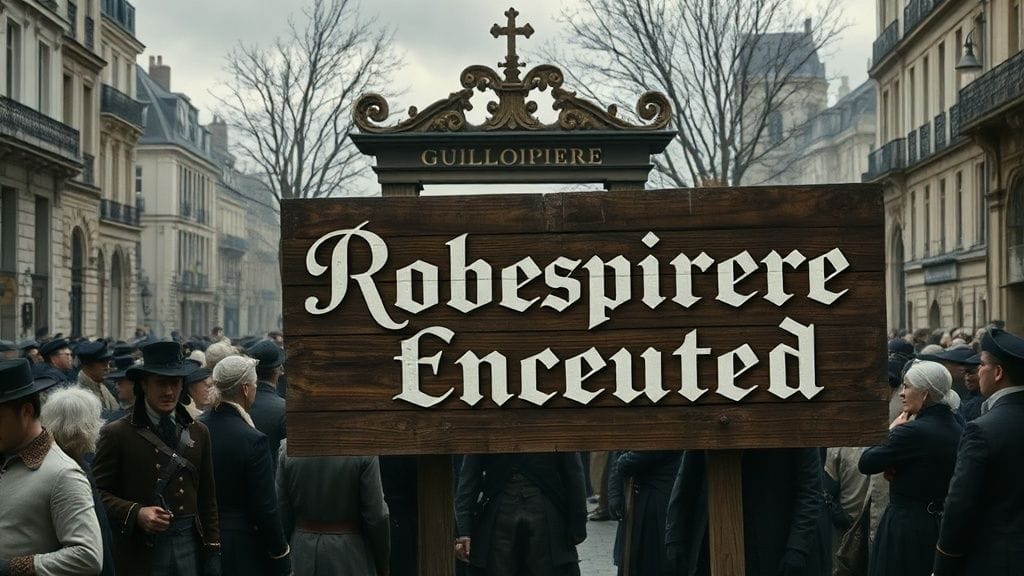
Robespierre, alongside his closest associates, was publicly executed by guillotine at the Place de la Révolution. The crowd was a mixture of relief, curiosity, revulsion, and sorrow.
His death symbolized not only the fall of a man but the end of a violent chapter in France’s desperate quest for liberty and justice. The Terror, with its guillotine shadows, was over.
The Immediate Aftermath: Paris Reacts to the Death of Robespierre
As dawn broke over Paris after the execution, the city was deeply divided. Many rejoiced that the Terror’s architect was gone, hoping for peace and moderation.
Yet for others, Robespierre’s death was a tragedy—a betrayal of the revolution’s purest ideals. His funeral was modest but marked by small groups of mourners who refused to let his legacy be erased.
Across France, the change was palpable as the instruments of the Terror were dismantled and the political pendulum swung.
The Thermidorian Reaction: Undoing the Terror
The months following Robespierre’s fall witnessed what is known as the Thermidorian Reaction—a movement to restore stability by curbing radicalism.
The Jacobin clubs were shut down, revolutionary tribunals lost power, and many former prisoners were freed.
Yet this reaction was far from a simple return to calm. France oscillated unpredictably, dealing with backlash from both royalists and radical revolutionaries.
A new government, the Directory, emerged with the aim to balance order and revolution, a fragile compromise born of difficult lessons.
Political and Social Consequences: France’s Path to Stability
Robespierre’s execution ushered a period of political recalibration. The new leaders rejected terror and dictatorship but struggled with growing economic hardship and ongoing war.
Socially, the revolution’s promise of equality remained elusive, with class struggles and political factionalism continuing.
Internationally, France’s revolution inspired movements but also warned of the dangers of ideological extremism.
The country would continue to evolve, but the scars of the Terror left deep marks on French consciousness.
Robespierre’s Legacy: Hero, Tyrant, or Tragic Idealist?
The question of Robespierre’s legacy remains one of history’s enduring debates.
Was he the “Incorruptible” hero of liberty, defending the revolution from its many enemies? Or was he a ruthless zealot, whose moral absolutism justified mass murder and terror?
Historians grapple with these contradictions, recognizing both his sincere devotion and his tragic miscalculations.
Robespierre embodies the paradox of revolutionary idealism corrupted by power and fear.
Historiographical Debates: Memory and Mythmaking
Throughout the 19th and 20th centuries, Robespierre’s image shifted according to political needs and ideologies.
Romantic writers mourned the lost idealist; conservatives demonized the tyrant; Marxists analyzed him as a necessary phase in class struggle.
This ongoing re-evaluation reveals more about the societies interpreting him than about the man himself.
His place in history is as nuanced as the revolution he helped shape—both inspiring and cautionary.
Cultural Echoes: Robespierre in Literature, Film, and Popular Memory
Robespierre’s life and death have inspired countless artistic works—from Hugo’s poetry to modern films and theatrical portrayals.
He appears as a tragic hero, madman, saint, or villain depending on the storyteller’s lens.
In popular memory, the guillotine and Robespierre’s chilling resolve symbolize the perils and passions of rebellion.
These cultural memories keep his story alive—ensuring that the past remains a haunting presence.
The Guillotine’s Symbolism: Justice or Horror?
The guillotine, forever linked with Robespierre and the Terror, remains a potent symbol—a double-edged one.
For revolutionaries, it was the “National Razor,” a tool of equality and swift justice.
For its victims, it was an instrument of horror and death.
The history of the guillotine reflects the complex relationship between revolutionary justice and human rights.
Lessons from the Terror: Revolution and the Limits of Power
Robespierre’s tragic fate underscores the delicate balance between ideals and pragmatism in times of upheaval.
The Terror warns against the dangers of ideological purity enforced by violence.
It is a lesson in how revolutions, birthed in hope, can spiral into cycles of fear and repression.
Yet it also speaks to the human yearning for justice and dignity—a paradox that resonates through history.
Conclusion: Reflections on a Revolutionary’s Final Day
On that midsummer day in 1794, as Maximilien Robespierre’s head fell beneath the guillotine’s blade, the course of France—and perhaps of modern history—was irrevocably changed.
He died condemned by the very revolution he helped ignite, caught in the whirlwind of idealism, power, and fear.
Yet his complex legacy persists—a testament to the explosive potential of revolutionary change, and to the human cost of pursuing utopia with unyielding fervor.
In the ruins of his final hour, we find a mirror reflecting not only the revolution’s triumph and tragedy but our own ongoing struggle to balance justice, liberty, and humanity.
FAQs: Understanding Robespierre and 1794
1. Who was Maximilien Robespierre and why was he called “The Incorruptible”?
Robespierre was a leading figure in the French Revolution known for his unwavering commitment to justice and virtue. He earned the nickname “The Incorruptible” due to his reputation for moral integrity and his refusal to be swayed by bribery or personal gain.
2. What led to Robespierre’s downfall in July 1794?
His extreme policies during the Reign of Terror alienated many allies and instilled fear among the public. Political opponents capitalized on widespread fatigue and paranoia, culminating in his arrest during the coup of 9th Thermidor.
3. Why was the Reign of Terror considered necessary by Robespierre and his allies?
They believed that revolutionary ideals were under threat from enemies—both internal and external—and that extreme measures, including executions, were vital to preserve the revolution and the republic.
4. How did Robespierre’s Cult of the Supreme Being fit into his political vision?
The Cult was Robespierre’s attempt to replace Catholicism with a deistic religion emphasizing civic virtue, morality, and patriotism, aiming to unify the revolutionaries spiritually while discouraging atheism and fanaticism.
5. What were the immediate effects of Robespierre’s execution on France?
His death marked the end of the Terror and led to a political shift known as the Thermidorian Reaction, which dismantled radical revolutionary institutions and moved toward more moderate governance.
6. How is Robespierre viewed by historians today?
Opinions vary widely; he is seen alternately as a visionary idealist, a ruthless tyrant, or a tragic figure caught in the revolutionary maelstrom. His legacy continues to provoke debate.
7. What lessons does Robespierre’s story offer about the nature of revolutions?
It highlights the dangers of ideological extremism, the complexity of balancing justice and power, and the potential for revolutions to both liberate and oppress.
8. Why does the guillotine remain a potent symbol when discussing Robespierre and the Terror?
The guillotine symbolizes both the revolutionary commitment to equality before the law and the brutal reality of political violence, embodying the paradox of justice and horror.