Table of Contents
- The Shadow of a Nation: England on the Brink, 1658
- Oliver Cromwell: Man of Iron and Vision
- A Life Forged in Revolution and War
- The Protectorate: Power and Paradox
- September 3, 1658: The Final Breath of the Lord Protector
- The Atmosphere in London: Mourning and Uncertainty
- Public and Private Reactions to Cromwell’s Death
- The Immediate Political Void: Richard Cromwell’s Rise
- From Mourning to Chaos: The Collapse of the Protectorate
- Cromwell’s Body: From Burial to Exhumation
- The Posthumous Trial and Symbolic Execution
- Cromwell’s Death Through the Eyes of Contemporaries
- The Religious and Cultural Impact of His Passing
- The Long Shadow: Cromwell in the Memory of Britain
- Legacy and Debate: Hero or Tyrant?
- Tracing the Echoes: How Cromwell’s Death Changed England Forever
- Conclusion: The End of an Era, the Birth of a New England
- FAQs: Understanding Oliver Cromwell’s Death and Its Aftermath
- External Resource
- Internal Link
The Shadow of a Nation: England on the Brink, 1658
On the fading afternoon of September 3, 1658, a fog clung stubbornly over London’s streets, mirroring the uncertainty enveloping the nation. The capital, vibrant yet restless under the shadow of the Commonwealth, felt the subtle tremors of a seismic shift. Oliver Cromwell, the Lord Protector—a man who had reshaped England with inexorable force—was drawing his last breaths. The city, rife with whispers and fears, braced for change, for the end of an epoch that had convulsed the very foundations of British monarchy and society.
This was no ordinary day. The death of Oliver Cromwell was the death of a towering, controversial figure whose ambitions had forged a new political order out of civil war rubble. In that moment, the fate of England teetered between continuity and chaos.
Oliver Cromwell: Man of Iron and Vision
Born in 1599 in Huntingdon, Oliver Cromwell was, at first glance, an unlikely revolutionary. A modest gentry family, a farmer by training, and a Puritan by faith, his early life was marked by quiet diligence more than dramatic turns. Yet beneath this unassuming veneer burned a fierce conviction and mastery of political and military strategy. His rise from a country squire to the de facto ruler of England spoke not only of personal ambition but a epochal struggle between monarchy, parliament, and religion.
Cromwell’s vision was radical: a England purified of royal absolutism and corrupt bishops, governed by godly men, protected by a disciplined army loyal not to crown but to the people’s representatives. But was this vision achievable? And at what cost?
A Life Forged in Revolution and War
The 1640s were a tempestuous decade. England plunged into civil war following years of King Charles I’s disputes with Parliament. Cromwell quickly distinguished himself on the battlefield—most famously at Marston Moor in 1644 and Naseby in 1645—leading the New Model Army to decisive victories. It was his leadership style, a blend of ruthless efficiency and religious zeal, that both won wars and sowed deep divisions.
The war culminated in regicide: King Charles I was tried and executed in 1649, an unprecedented act that shook Europe. Cromwell, never king but Lord Protector of the Commonwealth, attempted to govern a fractured island of England, Scotland, and Ireland, entangled in rebellion and religious discord. His rule blended iron-fisted control with revolutionary ideals—a paradox that would haunt his legacy.
The Protectorate: Power and Paradox
Upon assuming the role of Lord Protector in 1653, Cromwell sought to stabilize England through a ‘Godly’ republican government. But the Protectorate was a fragile construct, balancing military authority, parliamentary politics, and religious reform. Cromwell struggled against royalists eager to restore the monarchy, against radical sects pushing for utopia, and against the weary population taxed by incessant wars.
His vision of a “New England” included harsh campaigns in Ireland and Scotland, religious toleration for Protestant sects but persecution of Catholics, and a militarized state apparatus that brooked little dissent. Cromwell was a man who believed in divine providence, convinced his actions were God’s will, even while wielding absolute power.
But the Protectorate was always temporary—built on sand—and his inevitable death cast an ominous shadow.
September 3, 1658: The Final Breath of the Lord Protector
Amidst a cold, damp September, Oliver Cromwell lay gravely ill in Hampton Court Palace. Contemporary accounts speak of a man weakened physically yet burning with the intensity that had defined his public life. His doctors were baffled; some say his health had been declining rapidly following a battle with malaria.
Despite his ailing state, Cromwell remained acutely aware of his responsibilities. In the days preceding his death, he dictated letters and conferred with trusted advisers, focusing relentlessly on the fate of his nation—and notably, on securing the succession for his son, Richard.
As dusk fell on September 3rd, the Lord Protector closed his eyes for the last time. The silence that followed in London’s corridors was pregnant with uncertainty. The man who had dominated England was no longer.
The Atmosphere in London: Mourning and Uncertainty
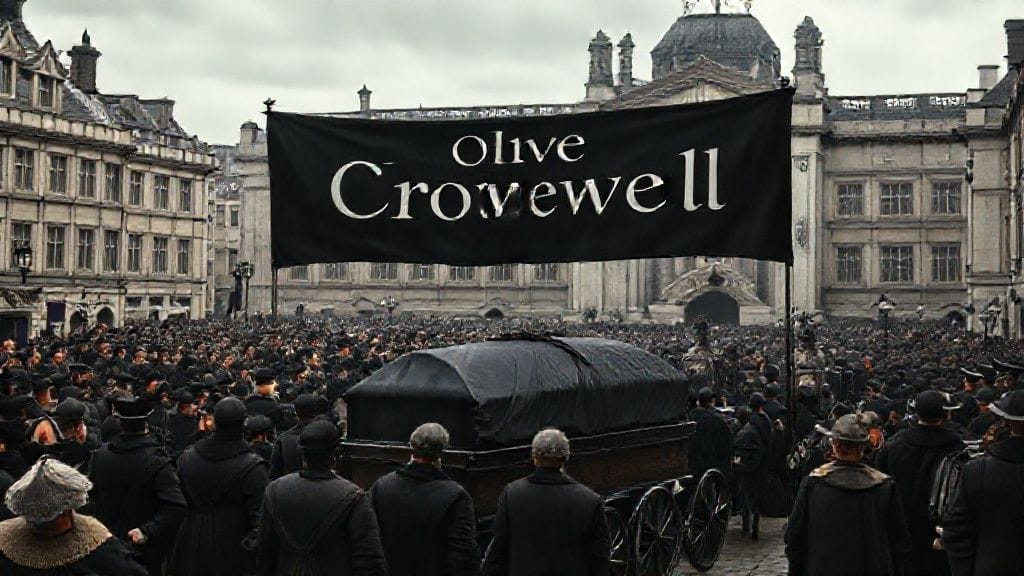
News of Cromwell’s death spread swiftly throughout London. Streets that had witnessed military parades and fiery sermons now gathered crowds in hushed reverence and anxious speculation. Bonfires were lit in some districts as cemeteries prepared for his interment in Westminster Abbey beside monarchs and noblemen.
Yet beneath the public mourning lurked uncertainty and fear. Cromwell was a polarizing figure; for royalists, his death was a harbinger of restoration, a chance to undo the Commonwealth’s radical experiment. For republicans and Puritans, it was a devastating blow and a personal loss.
Pamphlets and sermons flourished, many casting Cromwell as a martyr for the Protestant cause, others as a tyrant who had betrayed England’s ancient liberties. Murmurs of future upheaval grew louder.
Public and Private Reactions to Cromwell’s Death
The contrasting reactions to Cromwell’s death illustrate the nation’s fractured soul. Some contemporaries wept openly. Sir Thomas Fairfax, once his military commander, reportedly said, “A greater man England has not known.” Others, especially former royalists in hiding, privately rejoiced, hoping for the Crown’s swift return.
Queen Henrietta Maria, widow of Charles I, alleged that "the tyrant is dead, and truth shall now triumph," reflecting royalist optimism. In Puritan chapels, ministers extolled Cromwell’s piety and righteous stewardship, framing his demise as both tragic and preordained.
His family mourned deeply—his son Richard inherited a legacy far heavier than the Protectorate’s fragile throne.
The Immediate Political Void: Richard Cromwell’s Rise
Richard Cromwell’s ascension was announced with little fanfare but immense expectation. Unlike his father, he was neither a natural soldier nor a political firebrand. The naive son of a revolutionary lion, Richard inherited a role that required iron resolve and cunning—qualities he lacked.
Parliament and the army eyed him with suspicion. Veterans of the New Model Army doubted his authority, while moderates hoped for a gentler government. But the chaotic interplay of ambition, ideology, and exhaustion soon overwhelmed Richard’s fragile hold on power.
Within months, political stability eroded, demonstrating how reliant the Protectorate had been on Oliver’s unique leadership.
From Mourning to Chaos: The Collapse of the Protectorate
By 1659, less than a year after Oliver Cromwell’s death, the Protectorate crumbled. Military leaders ousted Richard, and England slipped into a power vacuum marked by factionalism and uncertainty.
The Rump Parliament was reinstated, but failed to provide lasting governance. Royalists conspired openly, and public fatigue with Puritan austerity grew. This turbulence set the stage for the Restoration of Charles II in 1660.
Ironically, Cromwell’s death accelerated the very monarchical return he had fought so fiercely against.
Cromwell’s Body: From Burial to Exhumation
Cromwell’s initial burial within Westminster Abbey was intended to honor his status. However, after the Restoration, new rulers viewed him as a regicide and usurper. In 1661, Charles II ordered the exhumation of Cromwell’s remains.
In a macabre ceremony, Cromwell’s corpse was hanged at Tyburn, alongside John Bradshaw and Henry Ireton, fellow regicides. His head was severed and displayed on a spike outside Westminster Hall—a chilling symbol of royal vengeance.
This posthumous humiliation revealed the deep divisions still simmering in English society and politics.
The Posthumous Trial and Symbolic Execution
The ‘trial’ of Cromwell’s corpse in 1661 was not merely judicial farce but political theater designed to delegitimize the Commonwealth and reinforce monarchical supremacy.
The symbolic execution underscored the perilous nature of revolutionary change: even death could not satisfy royalists’ demands for retribution. While Cromwell’s body bore the brunt of this revenge, his ideas and upheavals continued to ripple through English conscience.
Cromwell’s Death Through the Eyes of Contemporaries
Samuel Pepys, the famous diarist and naval administrator, wrote retrospectively on Cromwell’s death with a mixture of respect and relief. “He was a man of great parts, and none could deny him courage,” Pepys observed, “yet his passing marks the uncertainty of our times.”
Foreign observers such as the French diplomat Pierre de Vaissière noted how Cromwell’s death plunged England into ‘darkness and confusion.’
These contemporary voices framed Cromwell’s death as both a personal loss and a national crisis.
The Religious and Cultural Impact of His Passing
Cromwell’s death left a gaping hole in the religious reform movement. Puritan moral rigor began to wane, and the relaxation of Protestant strictness followed under Charles II’s reign.
His vision of a ‘Godly Commonwealth’ lost its earthly champion, sparking debates about the role of religion in governance for decades to come. Literary works, sermons, and political treatises grappled with his legacy—torn between admiration for his ideals and horror at his authoritarian methods.
The Long Shadow: Cromwell in the Memory of Britain
Oliver Cromwell’s death was not an end but a beginning—the inception of a complex legacy. To some, he was the ‘Great Protector’ who championed liberty and Protestantism. To others, a regicidal dictator whose iron hand stifled freedom.
Over centuries, historians have revisited his life and death, reflecting evolving values and political ideologies. His image has inspired revolutions abroad and divided historians at home, symbolizing the eternal tension between order and liberty.
Legacy and Debate: Hero or Tyrant?
Even today, Cromwell’s death evokes questions about power, morality, and national identity. Was he a necessary revolutionary who broke an outdated system, or a ruthless despot who crushed dissent? Did his death mark the failure of republican ideals in England, or merely a pause before progress?
These questions animate scholars and citizens alike, ensuring that the story of September 3, 1658, remains alive in Britain’s collective memory.
Tracing the Echoes: How Cromwell’s Death Changed England Forever
More than a mere passing, Cromwell’s death catalyzed the restoration of the monarchy, reshaped political thought, and influenced military governance worldwide. The fragile balance of power, religion, and national identity trembled, and England embarked on a new constitutional path with lessons deeply etched from this turbulent period.
His death was less an endpoint than a turning point—reshaping England’s future in ways impossible to foresee that September afternoon.
Conclusion
September 3, 1658, marks an indelible chapter in English history—a day when the towering figure of Oliver Cromwell breathed his last, leaving a nation suspended between a revolutionary past and an uncertain future. His death encapsulated the paradoxes of power, faith, and ambition; it was a personal demise with public consequences that still reverberate.
Cromwell’s life and death challenge us to reflect on the limits of authority, the costs of radical change, and the fragile quest for liberty. More than three centuries later, his final breath echoes across history’s pages, reminding us that the end of one life can indeed reshape the destiny of a nation.
FAQs
1. What caused Oliver Cromwell’s death on September 3, 1658?
Cromwell likely died from complications of malaria, compounded by a long period of declining health. His illness weakened him rapidly, leading to his death at Hampton Court.
2. How did London react to Cromwell’s death?
London was engulfed in a mix of mourning, uncertainty, and political speculation. Supporters lamented the loss, royalists saw an opportunity, and the general population was anxious about the future.
3. Who succeeded Oliver Cromwell as Lord Protector?
His son, Richard Cromwell, succeeded him but lacked his father’s leadership skills. Richard’s tenure was short-lived, hastening the collapse of the Protectorate.
4. What happened to Cromwell’s body after his death?
Initially buried in Westminster Abbey, Cromwell’s body was exhumed after the Restoration, publicly hanged, and decapitated as a symbol of royal revenge.
5. How did Cromwell’s death influence the Restoration of the monarchy?
His death removed the key figure holding the Commonwealth together, leading to political instability and eventually paving the way for Charles II’s return in 1660.
6. How do historians view Cromwell today?
Historians remain divided—some view him as a visionary who advanced parliamentary government and religious reform, others see a dictator responsible for harsh policies and internal repression.
7. What was the religious significance of Cromwell’s death?
His passing marked the decline of Puritan political dominance and a relaxation of strict Protestantism, influencing England’s religious landscape for decades.
8. Why was Cromwell’s corpse executed after his death?
This act was a symbolic posthumous punishment ordered by the restored monarchy to delegitimize the regicide and intimidate future dissenters.