Table of Contents
- The Final Winter of Prince Albert: Shadows over Windsor
- A Royal Partnership Sealed by Love and Duty
- The Prince Consort’s Role in Victorian Britain
- December 14, 1861: The Day the Heart Stopped
- The Medical Mystery: What Killed Prince Albert?
- Public Mourning: A Nation in Grief
- Queen Victoria’s Descent into Darkness
- The Mourning Queen and the Shaping of British Monarchy
- Windsor Castle: Silent Witness to Tragedy
- The Legacy of Albert’s Innovations and Patronage
- Political Ripples: How Albert’s Death Reshaped the Court
- The Public Response: Newspapers and Popular Culture
- The Royal Mourning Rituals: A Victorian Template
- Remembering Albert: Memorials, Statues, and Namesakes
- The Prince’s Influence on Industrial and Cultural Progress
- Historiographical Debates: Evaluating Albert’s Death Through Time
- The Personal and the Political: Victoria’s Legacy Post-1861
- From Tragedy to Myth: Albert in British National Memory
- Lessons from Windsor: Mourning, Monarchy, and Nationhood
- The Prince Albert Legacy in the 21st Century
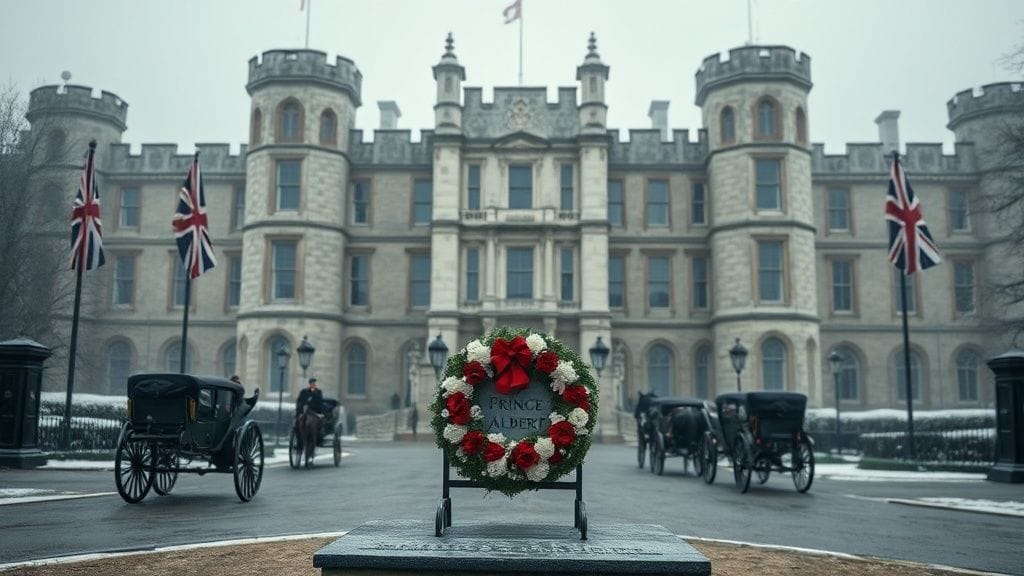
On a cold December morning in 1861, the great stone walls of Windsor Castle stood stoically under a gray, brooding sky. Inside, a pall hung over the chambers where Prince Albert, the beloved consort to Queen Victoria, breathed his last. The death of this singular figure—a man both central to the British monarchy’s evolution and deeply cherished by his people—marked a fissure in the fabric of Victorian Britain. It was a moment when duty met despair, and a nation was forced to confront the fragility behind imperial grandeur.
Albert’s passing was not just the loss of a royal husband; it was the eclipse of a visionary force who had guided Britain through industrial, cultural, and political transformation. As the news spread like wildfire, the country plunged into mourning, Queen Victoria into seclusion, and history into a narrative that melded love, loss, and legacy into one poignant tapestry.
But what exactly happened that winter day? How did a man so pivotal to his era collapse so suddenly? What echoes did his death leave on the monarchy and the nation? To unravel the significance of Prince Albert’s final days and their aftermath, we must first journey back through the life and times of this enigmatic figure.
Long before his untimely death, Prince Albert of Saxe-Coburg and Gotha had already cemented his place in the heart of Victorian England. Born in 1819 into German nobility, Albert arrived in Britain in the early 1840s and married his cousin, Queen Victoria, in 1840. Their union became emblematic of both personal affection and political alliance, shaping the royal image for generations.
But Albert’s influence went far beyond mere symbolism. As Prince Consort, he was an energetic force behind sweeping reforms in science, education, the arts, and industry. His vision married progress with morality—he championed the Great Exhibition of 1851, a landmark celebration of industrial prowess and international cooperation held in Hyde Park. In many ways, Albert embodied the Victorian spirit: earnest, industrious, and devoted.
Yet beneath the prince’s disciplined exterior, the pressures of public service and the demands placed upon the monarchy weighed heavily. By December 1861, Albert was visibly unwell. His relentless schedule and concern for his family and country came at a toll no one fully acknowledged until it was too late.
On the morning of December 14th, the prince awoke feeling weak and feverish. Though quietly stoic, those closest to him sensed something was deeply wrong. Within hours, he deteriorated rapidly—voices echoing through Windsor’s stately corridors relayed grim tidings: Prince Albert was dying.
The exact cause of Prince Albert’s death remains one of Victorian history’s most debated questions. Contemporary physicians diagnosed typhoid fever, a deadly bacterial infection linked to contaminated water—a common scourge in the 19th century’s urbanizing societies. Some modern historians have speculated about other possibilities including Crohn’s disease or kidney failure.
Whatever the medical reality, the sudden loss resonated far beyond hospital wards and royal chambers. For Queen Victoria, her husband was not only a partner but her closest confidant and advisor. Their shared grief was profound—Victoria’s life after Albert’s death would be marked by decades of mourning, withdrawal from public life, and the establishment of mourning customs that codified an entire era’s emotional etiquette.
Richard Holmes, a biographer of Albert, argues that the prince’s death “transformed a constitutional monarchy into a sentimental one, steeped in personal tragedy, changing the role of the sovereign forever.” As political frontiers blurred, the human element of monarchy was laid bare.
The public reaction to Albert’s death underscored the prince’s unique connection with his subjects. The British press, from The Times to regional newspapers, chronicled not just the facts but the emotion swirling around the event. Streets were draped in black, shops shuttered, and flags hung at half-mast. Public memorial services convened, attended by thousands from all walks of life.
This mass mourning was unprecedented in scale—creating a collective catharsis that both unified and softened social divides. Albert was remembered as a servant to the nation, a man who transcended his royal station to touch the industrialist, the artist, and the common citizen alike.
Within Windsor Castle, the atmosphere was heavy with grief and silence. Queen Victoria withdrew into her private chambers, isolating herself from the public gaze for years. The architecture of the castle—the halls, the galleries—became a physical memorial to lost love. Portraits of Albert, flowers in perpetual bloom, and even the layout of rooms took on symbolic significance.
Victoria’s mourning attire—black dresses, veils, and accessories—signaled a new public dimension to royal grief that inspired fashion and cultural mores across Europe. Mourning became a ritualized language, performed with carefully measured gestures and observances that helped society process loss.
Prince Albert’s legacy, however, was not to fade with his death. Indeed, his patronage of schools, scientific societies, and the arts continued to ripple through British cultural life for decades. The Royal Albert Hall, inaugurated in the years following his death, stands as a testament to his vision for connecting artistic excellence with public accessibility.
Politically, the absence of Albert shifted the balance of power within the court and Parliament. Without his moderating influence, Queen Victoria’s relationships with prime ministers and politicians became more volatile. Critics would later attribute some of the monarchy’s reduced political influence in the late 19th century to this loss.
The historical debates surrounding Albert’s death touch upon more than medical speculation; they intersect with reflections on grief, leadership, and legacy. How did a man defined by duty and intellect become a figure of sentimental myth? How did his death reshape Victorian England’s understanding of kingship and emotional expression?
Historian Lytton Strachey once suggested that Albert’s true death was as much a political event as a personal one, “the moment when the machinery of empire paused to weep.”
As decades passed, the figure of Prince Albert evolved into a symbol of Victorian values: perseverance, family, service, and innovation. Yet within this iconography lies a deeply human story of love and loss, ambition and mortality.
Today, as we walk the gardens of Windsor, visit the Royal Albert Hall, or peruse history books, the echoes of that December day in 1861 ripple still. They remind us that even in the corridors of power, the greatest force is often the bond between lovers and the legacy they leave behind.
Conclusion
Prince Albert’s death on December 14, 1861, was more than the passing of a royal figure—it was a profound rupture that revealed the fragility behind Victorian grandeur and imperial ambitions. The personal grief of Queen Victoria intertwined with the public sorrow of a nation, creating a moment where monarchy and humanity met in stark relief.
His life and untimely death shaped the emotional and political landscape of Britain, molding the monarchy’s image for generations. From mourning rituals to cultural patronage, Albert’s shadow stretched long beyond Windsor’s stone walls.
In that winter’s gloom, Britain learned anew that behind every crown is a heart vulnerable to the relentless passage of time—and that memory and love are among history’s most enduring legacies.
FAQs
Q1: What was Prince Albert’s official cause of death?
Most official records cite typhoid fever as the cause, although modern historians debate other illnesses like Crohn’s disease. The exact diagnosis remains uncertain.
Q2: How did Queen Victoria react to Albert’s death?
She entered a long period of mourning, withdrawing from many public duties and adopting black attire for the rest of her life, which influenced Victorian mourning culture.
Q3: What impact did Albert’s death have on British politics?
Albert acted as a political advisor and mediator; his absence created a vacuum that changed the dynamics between the monarchy and Parliament.
Q4: Were there any public memorials dedicated to Prince Albert?
Yes, including the Royal Albert Hall in London, the Albert Memorial in Kensington Gardens, and several statues and plaques across Britain and the Commonwealth.
Q5: How did the public express their grief at the time?
There were nationwide mourning observances, black draped streets, lower flags, and newspapers filled with tributes, reflecting widespread affection.
Q6: What legacy did Prince Albert leave behind?
He championed education, arts, scientific progress, and industrial innovation, many of which continued and expanded after his death.
Q7: How is Prince Albert remembered today?
As a symbol of Victorian ideals, husbandly devotion, and as a figure whose death deeply humanized the British monarchy.
Q8: Why is Windsor Castle significant in the story of Albert’s death?
It was both the place of his final days and a symbolic site of mourning and royal memory, central to the narrative of loss and legacy.