Table of Contents
- The Silent Twilight at Astapovo: The Final Hours of Tolstoy
- A Life Embattled: Tolstoy’s Enduring Struggle with Faith and Society
- From Yasnaya Polyana to the Railway Station: The Journey to Death
- The Escape from Home: Tolstoy’s Last Voyage Begins
- Arrival at Astapovo: The Railway Station Becomes a Historic Crossroad
- A Nation in Suspense: News of Tolstoy’s Flight and Illness Spreads
- The Physician’s Vigil: Dr. Botkin and the Struggle to Save Tolstoy
- Between Life and Legacy: Tolstoy’s Conversations and Final Reflections
- The Gathering Storm: Family Rift and Public Fervor
- When Time Stands Still: The Passing of a Literary Titan
- Mourning Russia: The Nationwide Reaction to Tolstoy’s Death
- The Funeral and the Pilgrimage to Yasnaya Polyana
- The Clash of Ideologies: Tolstoy’s Death as a Symbolic Turning Point
- Echoes Through the Century: How Tolstoy’s Death Shaped Russian Culture
- Tolstoy’s Final Legacy: From Controversy to Canonization
- Remembering Astapovo Today: The Death Place as Shrine and Museum
- The Myth, the Man, and the Moment: Reflections on Mortality and Genius
- Tolstoy’s Death in the Context of Pre-Revolutionary Russia
- The Astapovo Incident in International Perspectives
- Conclusion: The End of an Era, the Birth of an Idea
The Silent Twilight at Astapovo: The Final Hours of Tolstoy
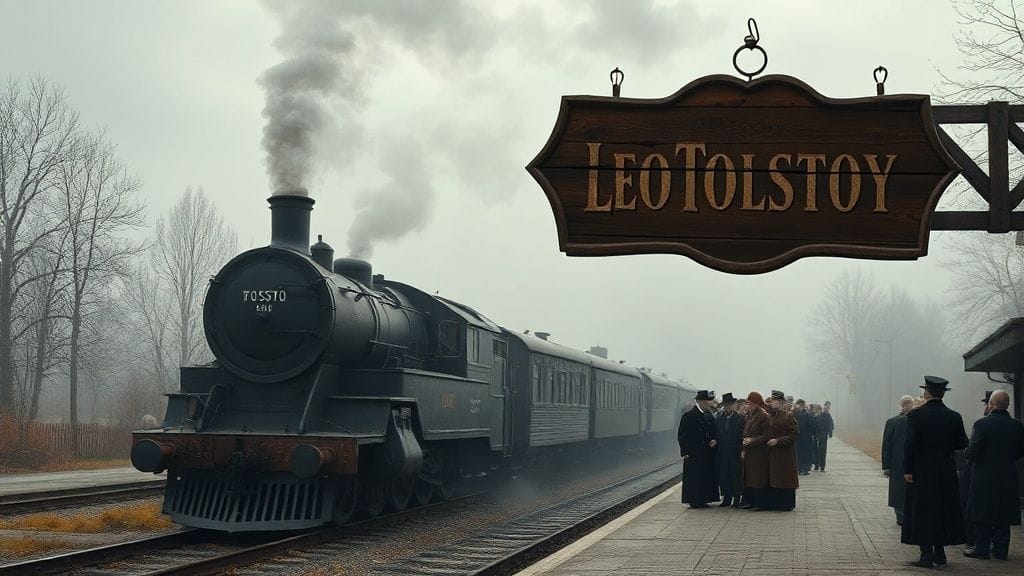
November 20, 1910, dawned cold and bleak over the remote railway station of Astapovo in the heart of Russia. The frosty air seemed heavier than usual that morning, laden not just with the chill of an early winter, but with the somber gravity of a great soul’s final breath. Leo Tolstoy, the unyielding moralist, the literary colossus, the prophet of peace and simplicity, lay gravely ill in a small waiting room once bustling with travelers. Outside, the whistling trains kept their ceaseless rhythm — indifferent to the death throes of a man who had captured the spirit of a nation.
Inside, the atmosphere was tense and charged. Tolstoy, aged 82, was now a fragile shadow of the towering figure who had once roamed the vast Russian countryside, challenging kings and priests alike through his pen and voice. His face, pallid and sunken, bore the marks of a long spiritual and physical ordeal. Conversations whispered around him, ranging from despair to reverence. Was it really the end of this man, who had spent his life wrestling with the deepest questions of existence, belonging and rebellion?
This quiet station had become, for a brief and tragic moment, the crucible where history and humanity intersected. What followed was not just the passing of a legendary author, but the culmination of a life's relentless journey—a death that encapsulated the profound contradictions of Tolstoy himself: his battle against his own family, his strife with the Church, his yearning for a simple, humble truth.
A Life Embattled: Tolstoy’s Enduring Struggle with Faith and Society
Tolstoy’s death at Astapovo was not an ending in a vacuum. It was the final act in a lifelong drama shaped by relentless introspection and radical re-evaluation of life’s purpose. Born into aristocracy in 1828, his early life was characterized by privilege but also a restless dissatisfaction. Through his literary genius, he captured the sweep of history in epics like War and Peace and Anna Karenina, but personal fulfillment eluded him.
The catalyst of his torment was his spiritual crisis in the 1870s, when Tolstoy turned from fiction to philosophy, renunciation, and pacifism. He rejected the Orthodox Church’s dogma, embraced Christian anarchism, and advocated a return to simple living and non-violent resistance. This stance alienated him from his noble peers, drew the ire of church authorities, and fractured his own family relations.
By 1910, Tolstoy had become a symbol of moral purity and radical conscience in Russia, worshipped by peasants and revolutionaries alike but also reviled by conservatives who saw him as a dangerous heretic. This turbulent life built up to one final act of defiance — his secret departure from his stately home in Yasnaya Polyana, seeking to die in exile.
From Yasnaya Polyana to the Railway Station: The Journey to Death
The story of Tolstoy’s death cannot be told without recounting the dramatic flight from Yasnaya Polyana that precipitated it. On the icy night of October 28, 1910, Tolstoy, weary of family conflicts, suffering from pneumonia, and disillusioned by endless disputes over his writings and religious beliefs, slipped away into the darkness with only a handful of belongings and a devoted assistant, Valentin Bulgakov.
The journey was perilous. Carriages, trains, cold nights under the stars: each kilometer carried the weight of desperation and hope for a dignified death free from worldly entanglements. But Tolstoy’s health was failing rapidly.
After days of travel, Astapovo, a minor railway junction, became the unintended endpoint of this epic departure. There, he collapsed, the flames of his body’s rebellion against nature fanned by the harsh Russian winter.
The Escape from Home: Tolstoy’s Last Voyage Begins
To understand the profound pathos of Tolstoy’s last days, one must glimpse the storm that drove him from home. His family—especially his wife, Sofia Andreyevna—had long been in conflict with his growing asceticism and public stances. But the final fracture came when Sofia vehemently opposed Tolstoy’s wishes to donate his copyrights to the peasantry and to live completely independently.
His choice to escape was both an act of despair and dignity—by fleeing, Tolstoy sought control over his death and legacy, rejecting the cozy prisons of aristocratic comfort. It was a journey toward the unknown, not just a physical passage, but a metaphysical crossing.
Arrival at Astapovo: The Railway Station Becomes a Historic Crossroad
Astapovo was far from grand, a dusty, frigid outpost on the vast Russian plain. Yet on that day, it became the fulcrum of a nation’s collective breath. When the train stopped, Tolstoy was barely conscious. The station master and local officials quickly realized the gravity of the visitor—the “great Russian thinker” who was now more myth than man had come among them, marked by suffering and frailty.
Within hours, the news rippled through Russia’s cities and villages. Reporters arrived, official telegrams hurriedly dispatched. Astapovo was transformed from a forgotten byway into a shrine of hope and mourning.
A Nation in Suspense: News of Tolstoy’s Flight and Illness Spreads
The press frenzy was immediate and intense. As telegrams and newspaper headlines flooded in, the whole country was gripped by a mix of concern, curiosity, and veneration. Tolstoy—who had inspired peasants, revolutionaries, poets, and intellectuals—was disappearing before their eyes, a fugitive from his own home, now at nature’s mercy.
This media attention transformed Tolstoy’s final hours into public spectacle, a paradox for a man who had shunned fame. Streets in Moscow and St. Petersburg filled with mourners and supporters, church bells tolled in confusion and fear.
The Physician’s Vigil: Dr. Botkin and the Struggle to Save Tolstoy
By Tolstoy’s bedside stood Dr. Vladimir Botkin, the physician summoned to attend the dying man. Botkin’s presence marked the intersection between cold science and spiritual crisis. Despite his skill, medicine had few tools against pneumonia in 1910 Russia.
Botkin observed Tolstoy’s gradual weakening with a mix of professional concern and personal reverence. He noted how Tolstoy’s final breath was as much a surrender as an embrace—a relinquishing of the body that had borne so much intellectual and emotional weight.
Between Life and Legacy: Tolstoy’s Conversations and Final Reflections
Even in his weakness, Tolstoy was lucid enough to engage in profound discourse. Accounts from Bulgakov and others recall moments where Tolstoy spoke of love, forgiveness, and the meaning of life. His mind wrestled to the end with existential questions that had tormented him for decades.
One of his last intelligible utterances was reportedly, “I want to live for truth.” Those words resonated like a final manifesto, encapsulating a life steeped in moral inquiry.
The Gathering Storm: Family Rift and Public Fervor
While the public mourned, the atmosphere among Tolstoy’s kin was tense. Sofia, torn between grief and resentment, struggled to assert control over her husband’s legacy. Family disputes erupted over control of his manuscripts and property, foreshadowing decades of contention.
Yet among the masses, Tolstoy’s death was hailed as the death of a moral beacon, an emblem of Russia’s strained soul in a pre-revolutionary epoch.
When Time Stands Still: The Passing of a Literary Titan
On November 20, 1910, as the late afternoon sun cast long shadows over Astapovo, Leo Tolstoy breathed his last. The moment was a stillpoint, a deep silence following a lifetime of thunderous literary and ideological storms.
Witnesses described a serene passing, as if the great man had found the peace he spent his life seeking. His death was not merely bodily—it was the closing of a monumental chapter in Russian and world literature.
Mourning Russia: The Nationwide Reaction to Tolstoy’s Death
The Russian Empire plunged into mourning. Telegrams flew between cities; memorials were held spontaneously. Tolstoy’s death inspired an outpouring of grief that transcended class and creed. From peasants who saw in him a prophet to students who envisioned a freer future, the artist’s final curtain was a national catharsis.
Public figures and writers gathered to honor his memory—yet beneath the sorrow simmered debates over his radical philosophy and whether his ideals could—or should—survive the coming political upheaval.
The Funeral and the Pilgrimage to Yasnaya Polyana
Tolstoy’s body was transported back to Yasnaya Polyana, his beloved family estate, where a simple funeral awaited. Eschewing pomp, the ceremony refl ected his own beliefs in humility and simplicity.
Thousands from across Russia made the pilgrimage to the country home, turning a private grief into a collective homage. The site became a symbol of Tolstoy’s dual existence—aristocrat and ascetic, literary master and moralist.
The Clash of Ideologies: Tolstoy’s Death as a Symbolic Turning Point
Tolstoy’s passing came at a tumultuous time in Russian history. His death embodied the clash between old imperial structures and emerging revolutionary currents. His philosophical rejection of violence and authority stood in stark contrast to the growing radicalism fermenting among the populace.
For many, Tolstoy was the moral conscience of Russia, an unbearable light in the gathering darkness before World War I and the 1917 revolutions.
Echoes Through the Century: How Tolstoy’s Death Shaped Russian Culture
Over the decades, Tolstoy’s death at Astapovo took on mythical proportions. Writers, filmmakers, and scholars repeatedly revisited the image of the weary prophet dying far from home, an emblem of suffering genius.
His ideas infiltrated global nonviolent movements, inspiring figures like Gandhi and Martin Luther King Jr., ensuring that even in death, Tolstoy’s influence was sprawling and indelible.
Tolstoy’s Final Legacy: From Controversy to Canonization
Although controversial in life, Tolstoy’s posthumous reputation blossomed into near-universal acclaim. His critique of injustice, emphasis on love and simplicity, and literary artistry became foundational to modern philosophy and literature.
Institutions named after him, and his estate transformed into a museum—Tolstoy became not just a historical figure but a living symbol of moral resistance.
Remembering Astapovo Today: The Death Place as Shrine and Museum
Today, Astapovo is known as Lev Tolstoy town, home to a small museum devoted to the last days of the great author. The station waiting room where he died has been preserved, visited by thousands each year seeking a tangible connection to history.
It remains a sacred place for admirers worldwide—reminding us that even great men must confront the fragility of mortality.
The Myth, the Man, and the Moment: Reflections on Mortality and Genius
Tolstoy’s death invites reflection on the paradox of greatness and human frailty. How does one reconcile the powerful intellect with the vulnerable body? The dying process at Astapovo reveals not just an end, but a profound moment of transcendence—where the man whose words shaped millions meets the immutable boundary of life.
Tolstoy’s Death in the Context of Pre-Revolutionary Russia
The fraught political climate surrounding his death cannot be ignored. Russia was a nation on edge, simmering with unrest and yearning for change. Tolstoy’s death foreshadowed the collapse of the old order and the birth pains of modern Russia.
His values and critiques presaged some of the ideological currents that would reshape the 20th century.
The Astapovo Incident in International Perspectives
Internationally, Tolstoy’s death was reported with awe and solemnity. European intellectuals and American readers mourned the loss of a literary giant and moral philosopher.
Newspapers chronicled his flight and demise, weaving his tragic final journey into the broader narrative of modernist crisis and hope.
Conclusion: The End of an Era, the Birth of an Idea
Leo Tolstoy’s passing at Astapovo was not simply the death of a man, but the symbolic close of a tumultuous epoch in Russian history and thought. His life’s work and death encapsulate humanity’s perennial struggle between comfort and conscience, power and peacefulness, tradition and transformation.
As the trains continue their relentless pace beyond Astapovo, the legacy of Tolstoy reverberates still—a testament to the enduring power of the human spirit to question, to rebel, and ultimately, to seek peace.
Conclusion
Standing at the crossroads of history on that cold November day in 1910, the death of Leo Tolstoy reminds us how intimately intertwined the personal is with the political, the spiritual with the mundane. Here at a remote Russian railway station, a titan of literature and morality breathed his last — not in grandeur, but in quiet defiance of a world that both shaped and shunned him.
His legacy persists not only in the pages of great novels or philosophical treatises but within the hearts of countless readers and thinkers who, over a century later, still wrestle with his questions. Tolstoy’s life and death invite us to ponder how one confronts the vastness of existence, the inevitability of mortality, and the hope for a better world.
He departed the earth not with the triumph of conquest, but with a whispered prayer for truth and love. And that, more than anything, is the immortal imprint of Leo Tolstoy.
FAQs
Q1: Why did Leo Tolstoy leave his home before his death?
A1: Tolstoy left Yasnaya Polyana due to severe conflicts with his wife and family over his wishes to live simply and donate his literary rights. He sought to die free from domestic disputes and worldly attachments.
Q2: What illness caused Tolstoy's death?
A2: Tolstoy died from pneumonia, aggravated by the harsh conditions of his journey and his advanced age.
Q3: How did Russian society react to Tolstoy’s death?
A3: The country plunged into mourning. He was celebrated as a moral leader by many, while also causing debates about his controversial religious and political views.
Q4: Who attended to Tolstoy during his last days?
A4: Dr. Vladimir Botkin was the primary physician. Tolstoy was also attended by his assistant Valentin Bulgakov and a handful of family members.
Q5: What is the significance of Astapovo today?
A5: Astapovo, now renamed Lev Tolstoy town, hosts a museum commemorating Tolstoy’s final days and serves as a pilgrimage site for admirers worldwide.
Q6: How did Tolstoy’s death influence later political or cultural movements?
A6: His advocacy of nonviolence and simple living deeply influenced figures like Gandhi and Martin Luther King Jr., embedding his philosophy into global peace movements.
Q7: Was Tolstoy’s family supportive of his beliefs at the end?
A7: No, his family, especially his wife Sofia, often contested his views and control over his literary works, leading to rifts that precipitated his flight.
Q8: How is Tolstoy’s literary legacy regarded today?
A8: Tolstoy is considered one of the greatest novelists and moral thinkers in history, whose works remain central to world literature and ethical philosophy.