Table of Contents
- The Twilight of a Titan: October 18, 1931
- The Final Hours in West Orange
- A Life Woven into the Fabric of Innovation
- Early Sparks: Edison’s Path to Greatness
- The Menlo Park Era: Where the Light Was Born
- A World Transformed by the Incandescent Bulb
- The Challenges and Rivalries Behind Edison’s Fame
- The Unseen Personal Struggles
- Edison and the American Dream: The Myth and the Reality
- The Day the Lights Seemed to Dim
- The News of Edison’s Passing: National Shockwaves
- Mourning a Man Who Lit the World
- Funeral and Tributes: A Nation Bows Its Head
- The Immediate Impact on Science and Industry
- How Edison’s Death Catalyzed New Innovation
- The Evolution of Edison’s Legacy in Popular Culture
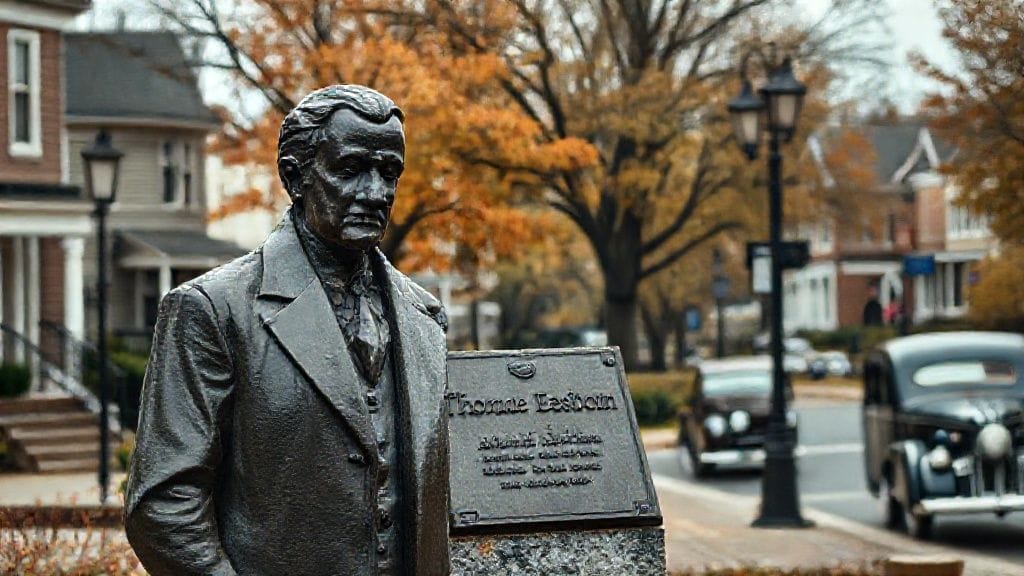
- The Museums, Memorials, and Commemorations
- Revisiting Edison’s Achievements in Modern Perspective
- The Inescapable Controversies: Credit and Invention
- Edison’s Death and the American Identity
- The Scientific Community’s Reflection on His Contributions
- Lessons Drawn from a Life Exploding with Curiosity
- The Legacy That Continues to Illuminate
- Conclusion: The End of an Era and the Dawn of a Century’s Promise
- FAQs
- External Resource
- Internal Link
1. The Twilight of a Titan: October 18, 1931
On a crisp autumn day, as the golden hues of fall gently faded to dusk in West Orange, New Jersey, the world quietly turned a page. In a modest laboratory-home complex edged by the whispering trees of his beloved estate, Thomas Alva Edison breathed his last. It was October 18, 1931, a day marked by the gentle extinguishing of a man whose brilliance had permanently altered the course of humanity. While no explosive headlines on Broadway matched the drama of his innovations, within those peaceful hours, an era came to its close — a life that had sparked the modern world itself.
The death of Thomas Edison was not a sudden explosion losing power but the soft dimming of a light that had burned fiercely for over half a century. Around the world, mourning unfolded quietly, reflecting the profound attachments held for the innovator whose incandescent bulb had chased away centuries of darkness. Though his passing was grounded in the humbleness of a West Orange home, the world’s pulse felt the tremor. It signified the conclusion of a solemn chapter in technological history — and the lingering dawn of an age ignited by invention.
2. The Final Hours in West Orange
In those last moments, Edison, at 84, had become an emblem of relentless invention fused with human frailty. His health, long a subject of concern, had finally capitulated. Reporters and admirers had gathered subtly outside his estate, a cathedral of innovation where he had woven dreams into electric reality.
Inside, surrounded by his family and devoted assistants, Edison faced the inevitable with a quiet dignity. His mind, sharp almost to the end, seemed to flicker like the dimming of his beloved filament bulbs. Of particular note was the profound silence that settled over the estate, as if the very air paid homage.
Details from eyewitnesses described a man’s farewell imbued with a mixture of serenity and lingering curiosity. “He spoke calmly,” noted Mina Edison, his wife, “as if sharing secrets with the shadows.” These intimate shadows, etched by a life of endless nights in laboratories, now crept closer with a final tenderness.
3. A Life Woven into the Fabric of Innovation
To understand why Edison’s death created a global resonance requires a step back into the narrative of his extraordinary life. Born in 1847 in Milan, Ohio, Edison was the quintessential self-made inventor — a man not born into privilege but driven by insatiable curiosity and an unyielding will. His journey from a struggling telegraph operator to the “Wizard of Menlo Park” echoes a distinctly American tale: a saga where individual creativity touches the whole world.
Edison’s legacy is not just about light bulbs and phonographs but about a transformation of the very way humans live, communicate, and think. His work shaped the 20th century’s fundamental infrastructure — electricity distribution, sound recording, motion pictures. Few individuals in history have commanded such broad and deep influence.
4. Early Sparks: Edison’s Path to Greatness
Long before his death, Edison’s path was marked by staggering determination and ceaseless experimentation. As a young boy, his education was patchy, but his thirst for knowledge insatiable. Apprenticed early to the telegraph, Edison quickly began envisioning improvements and challenges.
His initial inventions, such as the stock ticker and the universal telegraph repeater, hinted at an engineering genius with a knack for practical applications. But it was in the late 1870s that Edison’s creative fire truly blazed — when the world teetered on the edge of darkness and awaited the promise of electric illumination.
5. The Menlo Park Era: Where the Light Was Born
Menlo Park, New Jersey, was more than a laboratory; it was the crucible of Edison’s legend. Here, in a sprawling complex of workshops and offices, Edison and his team worked day and night, experimenting relentlessly to create a viable incandescent lamp. The image of Edison seated under a makeshift tent, smoking a cigar and engrossed in the faint glow of a bamboo filament, has entered historical mythology.
Edison’s method was revolutionary: systematized trial and error, team-based experimentation, and a vision to not just invent but commercialize. By 1879, he succeeded in creating a durable, long-lasting incandescent bulb, a moment that shifted humanity out of lit candlelight and gas lamps.
6. A World Transformed by the Incandescent Bulb
The ripple effects were immediate and profound. Cities illuminated at night no longer cowered in shadows. Factories operated longer, streets became safer, homes more comfortable. The light bulb transformed social habits, extended working hours, and ushered in the modern urban fabric.
Yet Edison’s triumph was not simply a technological feat. It became a symbol of progress, hope, and the endless potential harbored in human ingenuity. Newspapers proclaimed Edison as a hero, a man whose “invention conquered darkness itself.” The world seemed to hold its breath as motion pictures, phonographs, and electrical grids followed in quick succession.
7. The Challenges and Rivalries Behind Edison’s Fame
But success brought rivalry and controversy. Edison’s battles with innovators such as Nikola Tesla and George Westinghouse revealed a fierce competitive landscape behind the public triumphs. The “War of Currents,” a bitter struggle to establish the dominant electrical current format, became emblematic of a larger clash of ideas and business interests.
Edison’s resistance to alternating current reflected not just technological conservatism but complex economic stakes. These years revealed a far less romantic side of invention — one marked by litigation, industrial espionage, and public relations warfare. Edison’s image as a solitary genius belied the intricate web of partnerships and conflicts underlying his empire.
8. The Unseen Personal Struggles
Behind the inventors’ lab coat was a man with complex emotions and personal challenges. Edison’s marriage to Mina Miller, his three children, and his relationships with employees often balanced delicately against the towering demands of his work. Historians have noted his sometimes authoritarian management style and relentless drive could alienate those around him.
Moreover, Edison suffered various physical ailments later in life, including hearing loss and the toll exacted by decades of intense labor and chemical exposure. His death at West Orange closed a chapter filled with human vulnerabilities that complemented his technological invincibility.
9. Edison and the American Dream: The Myth and the Reality
Edison’s life exemplified the American Dream in its most compelling mythos: a poor boy rising through talent and perseverance to change the world. This narrative became deeply ingrained in the American psyche during the early 20th century, especially as the country industrialized rapidly.
But historical revisionists have nuanced this portrait, revealing the complexity behind Edison’s “self-made” image, acknowledging the contributions of his team, the capital backing he secured, and the broader context of innovation ecosystems. Yet, his story remains an irresistible emblem of possibility.
10. The Day the Lights Seemed to Dim
On October 18, 1931, a somber stillness settled over West Orange that felt emblematic of Edison’s twilight. The world did not see a grand public display but rather a measured and respectful silence. Newspapers ran eulogies alongside editorials contemplating the course of modern science and technology.
President Herbert Hoover issued a statement lauding Edison as “a man who proportioned to his ability to live a life of service to humanity.” Radio broadcasts paused briefly that evening to honor the man who had brought their airwaves into homes worldwide.
11. The News of Edison’s Passing: National Shockwaves
Across the United States, and indeed internationally, Edison’s death reverberated with a mixture of grief and gratitude. Major cities dimmed their lights in acts of remembrance; factories paused; schools held moments of silence. The event bridged social divides — rich and poor, scientists and workers recognized the man who had illuminated their lives.
International leaders sent condolences, recognizing Edison’s role not just as an American icon but a global pioneer whose inventions had become integral to daily life across continents.
12. Mourning a Man Who Lit the World
The mourning transcended mere media reportage. Letters poured in from children who grew up reading about Edison, from scientists who saw him as a role model, from ordinary citizens whose nights were brighter and safer thanks to his work.
Within families, Edison was remembered not just as a public figure but a gentle patriarch who kept meticulously to his routines, cherished baseball games, and nurtured a household enriched by inventive spirit.
13. Funeral and Tributes: A Nation Bows Its Head
Edison’s funeral was a solemn event held within the walls of his West Orange home, attended by dignitaries, inventors, and family. The ceremony reflected his plain but profound life — no grand mausoleum, yet a reverence imbued with genuine affection.
Speeches recalled Edison’s humility, his dedication to experimentation, and his capacity to dream. The mournful cadence was interspersed with hope — that his legacy would not die, but serve as a beacon for future generations.
14. The Immediate Impact on Science and Industry
In the weeks following his death, industries grappled with transitioning from “Edison’s era” into a new age of innovation. His laboratories passed into custodianship, and competing firms sought to reinterpret and expand upon his patents.
Nonetheless, while the “Wizard” himself had departed, his inventions continued to power homes, drive industries, and feed imaginations. Scientific journals paid tribute while pointing to emerging figures like Tesla, Bell, and others who now stepped into the limelight.
15. How Edison’s Death Catalyzed New Innovation
Paradoxically, Edison’s death did not signify scientific stagnation but renewal. As the world mourned, it also reflected — what frontiers remained? How would invention evolve without this singular figure?
In laboratories worldwide, Edison’s methodologies — the iterative experimentation, the team approach, the integration of science with entrepreneurship — became standardized practices. His death motivated a generation to pursue relentless creativity while questioning the limits Edison had set.
16. The Evolution of Edison’s Legacy in Popular Culture
Over time, Edison became a cultural symbol, immortalized in biographies, films, and folklore. His image morphed between a solitary genius, a businessman, and a symbol of American optimism.
The early decades after his death saw commemorative stamps, educational curricula, and public monuments proliferate. Yet, the mythos has continually evolved as new scholarship and social attitudes reshape how society views historical figures.
17. The Museums, Memorials, and Commemorations
The Thomas Edison National Historical Park in West Orange stands as a living monument to invention. Visitors walk through his restored laboratories, gaining a tactile sense of the relentless quest that shaped modernity.
Monuments across the world — from Chicago to Paris — attest to Edison’s global impact. Special anniversary events recall not just a man's death but the enduring flame of his contributions to human progress.
18. Revisiting Edison’s Achievements in Modern Perspective
Contemporary historians examine Edison’s extraordinary output alongside ethical and social questions — patent battles, labor conditions, the role of credit, and the interplay of invention and capital.
Even the incandescent bulb he perfected now gives way to LEDs and other innovations. Yet, Edison’s role as a catalyst for the electrical revolution remains undiminished in the served frameworks of technological triumph.
19. The Inescapable Controversies: Credit and Invention
No biography of Edison can ignore controversies: Was he a lone genius or a coalescer of collective labor? Did his battles with Tesla reveal more about commerce than science?
These questions humanize Edison, highlighting that great inventions are intertwined with complex human drama — conflict, collaboration, ambition, and sometimes opportunism. His death reopened debates that continue in scholarly circles.
20. Edison’s Death and the American Identity
Edison’s passing was more than the loss of an inventor; it symbolized a transition in American self-perception — from rugged individualism to a more collaborative, corporate-driven innovation system.
His life and death invite reflection on identity, progress, and the ideals the United States aspires to embody, even as technology redefines society at an accelerating pace.
21. The Scientific Community’s Reflection on His Contributions
Science mourned yet celebrated Edison, recognizing both practical ingenuity and visionary scope. Nobel laureates and engineers alike acknowledged how Edison laid foundations upon which countless discoveries have been built.
Symposia and scientific tributes explored lessons from his career — persistence, creativity under pressure, and the conversion of ideas into tangible, life-changing products.
22. Lessons Drawn from a Life Exploding with Curiosity
Edison’s relentless spirit teaches that invention is as much about faith in the possible as technical skill. His willingness to fail thousands of times in pursuit of a solution underscores the resilience at the heart of progress.
His death invites us to consider how curiosity, discipline, and collaboration can be woven together in the service of human betterment.
23. The Legacy That Continues to Illuminate
Though nearly a century since his death, Edison’s influence glows in every corner of modern life — from lighting homes to recording voices, from early cinema to mass communication.
His story is a luminous thread in humanity’s tapestry, reminding us that even amid darkness, a single spark of ingenuity can light countless futures.
24. Conclusion: The End of an Era and the Dawn of a Century’s Promise
Thomas Edison’s death on October 18, 1931, closed a vibrant chapter in the anthology of human innovation. Yet, it also marked a threshold — a passage from the age of individual “wizards” to a future defined by collective scientific endeavor.
His life, with all its triumphs and contradictions, beckons us to honor the past by nurturing the spirit of inquiry and perseverance that he so brilliantly embodied. The light he birthed in late 19th century laboratories still pulses, undimmed, within the heart of modern civilization. And that light—both literal and metaphorical—reminds us that human creativity, once ignited, never truly dies.
Conclusion
The death of Thomas Edison was the quiet dimming of a man whose life had been a beacon through some of the darkest hours of human history. From the flicker of his first incandescent bulb to the sophisticated technologies that followed, Edison’s mark on the world is indelible. But beyond technology, it is his story—the ceaseless pursuit of possibility, the resilience in the face of failure, the vision to push humanity forward—that continues to inspire.
Edison’s passing in West Orange was a human moment: a family gathering, a nation pausing, a world reckoning with loss. It teaches us that behind every great invention is a person—a complex, passionate, flawed soul—whose passing is not just the end but a call to a new beginning. To remember Edison is to remember the eternal dance between darkness and light, and the human heart’s capacity to bring illumination.
FAQs
Q1: What were the primary causes leading to Thomas Edison’s death?
A1: Edison died of natural causes related to age and declining health at 84. His body had endured years of physical strain from intense work, exposure to chemicals, and partial hearing loss.
Q2: How did the public react to Edison’s death in 1931?
A2: The public response was deeply respectful and somber. Schools, factories, and public institutions held moments of silence, and cities like New York dimmed their lights in tribute.
Q3: What was Edison’s greatest invention and legacy?
A3: While Edison invented many devices, his most famous achievement was perfecting the practical incandescent light bulb, revolutionizing electricity use. His legacy is the modern electrical infrastructure and the model of innovation.
Q4: How did Edison’s death affect the scientific community?
A4: It triggered reflection on the nature of invention and collaboration. His passing opened space for new leaders in science while reaffirming the systems Edison pioneered for systematic engineering and innovation.
Q5: Were there controversies surrounding Edison’s inventions at the time of his death?
A5: Yes. Disputes over credit—particularly with Nikola Tesla—and ethical questions about patent control and industrial monopoly persisted, with debates about the singular genius myth versus collaborative efforts.
Q6: How is Edison commemorated today?
A6: Edison is commemorated through museums, historical parks like the Thomas Edison National Historical Park in West Orange, educational curricula, and public monuments worldwide.
Q7: How does Edison’s death symbolize changes in American culture?
A7: Edison’s passing marked a shift from individual inventive genius toward a more corporate and collaborative innovation model, mirroring wider social and economic transformations in America.
Q8: What lessons can modern innovators draw from Edison’s life and death?
A8: Edison exemplifies perseverance, the power of experimentation, and the importance of combining vision with practical application. His life encourages embracing failure as part of progress.

