Table of Contents
- The Final Chapter of a Pioneer: January 30, 1948
- A Day in Dayton: Silence After the Storm
- Orville Wright: The Last Living Wright Brother
- From Kitty Hawk to Dayton: A Life of Flight and Innovation
- The Early Struggles of Flight: Dreams Forged in Wood and Wire
- The Wright Brothers’ Legacy: Revolutionizing the Skies
- Orville’s Role After Wilbur’s Death: Guardian of a Fallen Titan’s Dream
- The Evolution of Aviation by 1948: A World Transformed
- The Day Orville Wright Passed: Reactions and Reverence
- Dayton’s Mourning: A City Bids Farewell to a Native Son
- National Tributes: The United States Honors a Pioneer
- Personal Stories: Friends and Family Recall Orville’s Final Days
- The Impact of Orville Wright’s Death on Aviation History
- Theories and Misconceptions in the Shadow of His Passing
- Preserving the Wright Legacy: Museums, Memorials, and Memories
- The Wright Brothers’ Invention in the Postwar Age
- How Orville’s Life Reflected the Spirit of American Innovation
- The Cultural Resonance of Flight and the Wright Brothers’ Mythos
- From Obscurity to Immortality: The Journey of the Wright Name
- The End of an Era and the Dawn of a New Age of Flight
- Conclusion: Remembering Orville Wright, the Man Behind the Wings
- FAQs: Curiosities and Clarifications about Orville Wright and His Death
- External Resource
- Internal Link
1. The Final Chapter of a Pioneer: January 30, 1948
It was a quiet winter’s day in Dayton, Ohio, yet the air seemed heavy with the invisible weight of an era coming to a close. On January 30, 1948, Orville Wright, the last surviving Wright brother, took his final breath. The man who had once conquered the skies, who had laid the cornerstone of powered flight alongside his brother Wilbur, was now fading into history. For over four decades, Orville had stood as a living link to one of humanity’s greatest achievements—the first controlled, sustained flight of a powered aircraft. But now, that link was about to vanish.
2. A Day in Dayton: Silence After the Storm
Dayton, a modest Midwestern city known more for its industrial vibrancy than for international fame, fell into a somber hush. The city had nurtured the Wright brothers’ dreams, a place where two bicycle mechanics dared to reach beyond the horizon. On that January day, the steady hum of life in Dayton paused for a moment of reflection. People from all walks of life recognized what had been lost—an icon of innovation, a man whose vision had forever altered the course of human history.
3. Orville Wright: The Last Living Wright Brother
Orville Wright, born in 1871, had outlived his older brother Wilbur by 38 years. Wilbur had passed away in 1912, his death a blow not only to Orville personally but to the ongoing mission to steer the burgeoning world of aviation into its future. Orville took up the mantle with humility and determination. Yet to be the surviving brother also meant carrying the heavy burden of legacy, memories, and the unspoken challenge of living up to an extraordinary past.
4. From Kitty Hawk to Dayton: A Life of Flight and Innovation
The Wright story began long before January 1948. It blossomed on the windswept sands of Kitty Hawk, North Carolina, in 1903, with a fragile machine that defied the known limits of physics at the time. Those twelve seconds aloft changed everything. Success came not through mere genius, but through relentless experimentation—compound ideas, thousands of flights of fancy grounded in science. Orville’s life was a tapestry of invention and persistence, transforming the unimaginable into the achievable.
5. The Early Struggles of Flight: Dreams Forged in Wood and Wire
The path to powered flight was littered with failures and rejection. The Wright brothers’ workshop in Dayton was a crucible of tireless effort. Early designs crashed, tests went awry, and skepticism ran rampant. Yet, Orville and Wilbur remained undeterred. Their bicycle shop was more than a business—it was a laboratory, their notebooks filled with sketches of wings, propellers, and mechanisms designed to command the invisible forces of lift and thrust.
6. The Wright Brothers’ Legacy: Revolutionizing the Skies
The 1903 flight was only the beginning. The Wrights rapidly evolved their designs, incorporating control systems, balancing wind resistance, and refining propulsion. Their work laid the theoretical and practical foundation for modern aeronautics. They pioneered three-axis control, a principle still central to flight today. Orville’s contributions did not wane after Wilbur’s death; if anything, he became the steady steward of their achievements—teaching, advising, and preserving their pioneering spirit.
7. Orville’s Role After Wilbur’s Death: Guardian of a Fallen Titan’s Dream
Wilbur’s death came young, at age 45, from typhoid fever in 1912. Orville’s grief was profound but never paralyzing. He continued working on aviation but also devoted himself to promoting the brothers’ legacy. He served on the National Advisory Committee for Aeronautics, helped establish the Wright Aeronautical Corporation, and regularly lectured on the importance of flight. His life was a bridge linking the dawn of aviation to its explosive growth during the World Wars and beyond.
8. The Evolution of Aviation by 1948: A World Transformed
By the time of Orville’s passing in 1948, humanity had achieved feats Wilbur and Orville might have scarcely dreamed possible. World War II had thrust aircraft technology into a new epoch—jet engines, bombers capable of intercontinental strikes, and the infancy of the supersonic era. Commercial flight was becoming routine. The era of exploration proved the Wrights’ dreams were the seeds of a global, airborne civilization—one where millions soared above the clouds each year.
9. The Day Orville Wright Passed: Reactions and Reverence
News of Orville Wright’s death spread swiftly, reaching across the United States and beyond. Newspapers hailed him as a symbol of American ingenuity and perseverance. President Harry Truman sent condolences, recognizing him as a man who “gave to the world the gift of flight.” Yet the tone was bittersweet—while the man had died, his influence was eternal. Toasts at aviation clubs, radio broadcasts, and newsreels reminded the world that the twin boys from Dayton had rewritten history.
10. Dayton’s Mourning: A City Bids Farewell to a Native Son
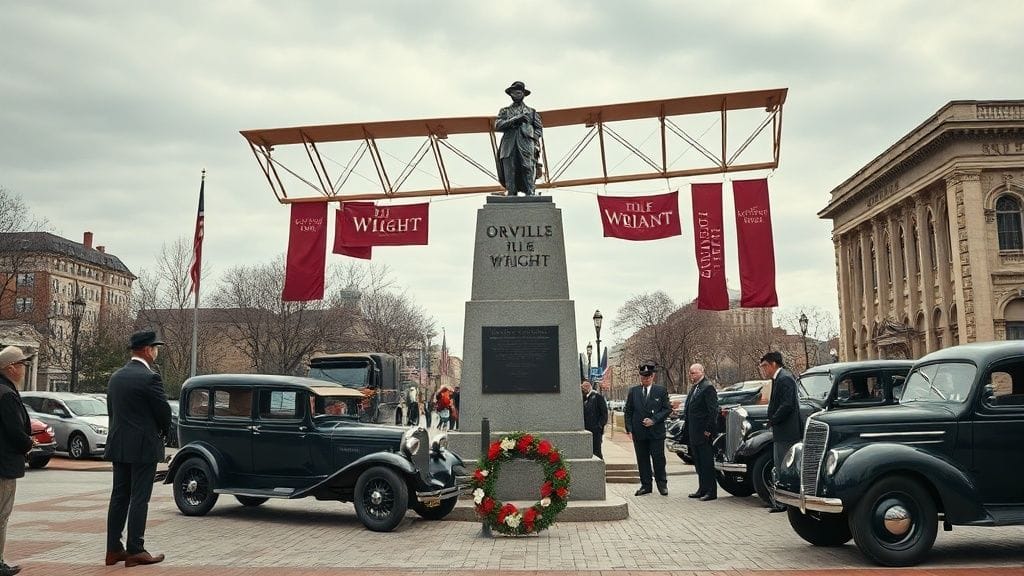
In Dayton, the sorrow was deeply personal. Orville had lived most of his life in the city, his modest home an emblem of humility beyond his achievements. Thousands of citizens gathered to pay respects, visiting memorials and the local aviation museum. Streets bore banners commemorating the man who had helped place Dayton on the map forever. The city officials declared days of mourning, underscoring the local pride and global significance of their native son.
11. National Tributes: The United States Honors a Pioneer
Congress passed resolutions commemorating Orville's life, while institutions like the Smithsonian prepared special exhibitions. Schools taught future generations about the brothers’ lasting legacy, inspiring new innovators and dreamers. The U.S. Air Force acknowledged the Wright brothers as the progenitors of all American military and commercial aviation—a living testament echoed in every craft taking to the sky.
12. Personal Stories: Friends and Family Recall Orville’s Final Days
Those close to Orville remembered a man both gentle and resolute, bearing the marks of a lifetime spent challenging norms. Though limited by health issues in his later years, he remained mentally sharp and curious. Anecdotes from family reveal his pride in Wilbur and gratitude to the public who embraced their story. Visitors recalled firsthand encounters with Orville—an unassuming giant amidst a world transformed by his ideas.
13. The Impact of Orville Wright’s Death on Aviation History
Orville’s passing marked a symbolic turning point. As the last Wright brother, the story of powered flight transitioned fully from that intimate family narrative to a collective human endeavor. The aviation community acknowledged a shift—from pioneers wielding hand-crafted machines to scientists commanding complex technology. Yet, the foundational spirit of ingenuity and courage remained undiminished, forever linked to the brothers who first dared to fly.
14. Theories and Misconceptions in the Shadow of His Passing
Despite acclaim, myths and misunderstandings about the Wright brothers persisted. Some questioned their originality, others overstated their role, overshadowing contemporaries like Glenn Curtiss. Orville himself had been reticent, careful to emphasize collaboration and shared progress. After his death, historians continued peeling back layers, separating legend from fact, ensuring that true recognition matched the Wright brothers’ genuine contributions.
15. Preserving the Wright Legacy: Museums, Memorials, and Memories
Following 1948, efforts intensified to honor the Wright legacy. The Wright Brothers National Memorial at Kitty Hawk and the Dayton Aviation Heritage National Historical Park both became sites of pilgrimage. Museums preserved original artifacts, from the 1903 Flyer to personal letters. These places serve as portals into the past, inspiring awe and reflection on the brothers’ monumental impact.
16. The Wright Brothers’ Invention in the Postwar Age
The postwar years saw aviation shape geopolitics, economics, and culture in unprecedented ways. The Wright brothers’ humble beginnings contrasted sharply with sprawling international airports and transcontinental flights. Yet, in every corner of the world where people took to the air, echoes of Orville and Wilbur’s workshop in Dayton could be felt—proof that from small beginnings come monumental transformations.
17. How Orville’s Life Reflected the Spirit of American Innovation
Orville Wright embodied the values often associated with the American spirit—curiosity, perseverance, and innovation fueled by practical problem-solving. His journey from bicycle repairman to aviation icon illustrates how passion and intellect can intersect to rewrite history. His death closed a chapter but also reinforced the belief that future pioneers would inherit his legacy.
18. The Cultural Resonance of Flight and the Wright Brothers’ Mythos
Flight has always symbolized freedom, transcendence, and human ambition. The Wright brothers became mythic figures in cultural imagination—from children’s books to Hollywood films. Orville’s death did not dim that glow; instead, it intensified the folklore, reminding humanity that behind every technological marvel stands human courage and determination.
19. From Obscurity to Immortality: The Journey of the Wright Name
At the turn of the 20th century, the Wright brothers were unknown bicycle makers in a small town. By 1948, their names were enshrined worldwide, synonymous with flight itself. Orville’s life and death bookended an extraordinary journey from obscurity to immortality—a narrative celebrated by historians and aviation enthusiasts alike.
20. The End of an Era and the Dawn of a New Age of Flight
Orville’s death marked the end of an intimate connection to the genesis of powered flight. Yet it signified also the dawn of a new age—jet engines, space exploration, and beyond. The foundation laid by the Wright brothers would support the soaring ambition of humanity for generations. Their story became a compass, a constant reminder of what vision combined with persistence can achieve.
Conclusion
Orville Wright’s passing on that cold January day in 1948 was more than the death of a man; it was the closing of a remarkable chapter in human history. He was the embodiment of innovation’s quiet resilience—the craftsperson and thinker whose hands shaped the future’s wings. As the world looked upwards, transforming dreams into realities that soared across continents and into the stratosphere, Orville’s legacy continued to inspire—not just in the roar of engines but in the human capacity to imagine and invent.
Remembering Orville Wright is to remember the audacity of hope and the power of relentless pursuit. His legacy, coupled indelibly with that of his brother Wilbur, serves as a beacon to all who dare to question limits and reach for the skies, reminding us that the horizon always beckons those bold enough to try.
FAQs
Q1: What caused Orville Wright’s death in 1948?
A1: Orville Wright died of natural causes at age 76. He had suffered health issues in his later years but remained mentally sharp until his passing.
Q2: How significant was Orville Wright compared to Wilbur Wright?
A2: Both brothers were essential to the invention of powered flight. Wilbur was often seen as the more intense visionary, while Orville was his technical complement and surviving custodian of their legacy.
Q3: How did Orville Wright contribute to aviation after Wilbur’s death?
A3: Orville continued to promote aviation, served on advisory panels, supported aeronautical companies, and preserved the Wright brothers’ history through lectures and writings.
Q4: How was Orville Wright’s death received by the public and government?
A4: His death was widely mourned, with tributes from government officials, media, and the aviation community emphasizing his foundational role in flight.
Q5: What legacy did Orville Wright leave behind?
A5: Orville left a legacy of innovation, perseverance, and the foundation of modern aviation technology, inspiring future generations of inventors and pilots.
Q6: Were there misconceptions about the Wright brothers’ achievements?
A6: Yes, some myths persisted, sometimes minimizing their role or attributing inventions to others. Historians have worked to clarify their rightful place as aviation pioneers.
Q7: How is Orville Wright remembered today?
A7: Orville Wright is remembered through museums, memorials, museums like the Wright Brothers National Memorial, and through ongoing recognition in aviation history.
Q8: What was the state of aviation when Orville died?
A8: In 1948, aviation had advanced tremendously, with widespread commercial flight and military aircraft that far surpassed the Wrights' original Flyer, marking a new age.