Table of Contents
- The Final Hours: Salvador Dalí’s Last Day
- Figueres: The Surrealist’s Hometown
- A Life of Grandeur and Madness
- The Twilight of a Legend: Health Declines
- The Role of Gala: Muse and Keeper of the Flame
- Death at Port Lligat: The Scene of Inspiration
- The Immediate Aftermath: Shock and Mourning
- Figueres Prepares for Its Eternal Guest
- The Journey Home: Returning the Master’s Remains
- The Theatre-Museum: Dalí’s Ultimate Legacy
- Public Reactions: From Veneration to Controversy
- The Art Market and the Death of the Artist
- The Spiritual and Symbolic Meanings of Dalí’s Passing
- Preservation of Memory: The Dalí Foundation’s Mission
- Dalí’s Death in the Context of 20th Century Art
- Cultural Reflections: Surrealism and the End of an Era
- The Intersection of Personal, Public, and Mythology
- Analyzing Dalí’s Last Will and Testament
- International Media Coverage and Myth-Making
- Continuing Influence: Dalí Beyond Death
- Contemporary Debates on Dalí’s Legacy
- Figueres Today: The City as a Pilgrimage Site
- Conclusion: The Eternal Surrealist
- FAQs: Questions on Dalí’s Death and Legacy
- External Resource
- Internal Link
1. The Final Hours: Salvador Dalí’s Last Day
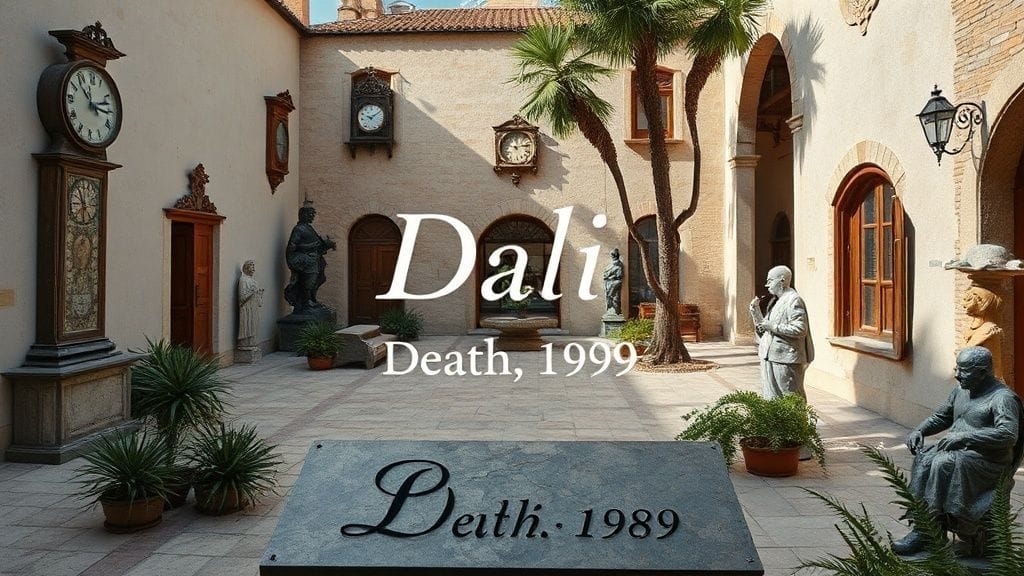
On the cold, gray morning of January 23, 1989, in the quiet coastal town of Port Lligat, Spain, the surrealist giant Salvador Dalí breathed his last. The light filtered through the drawn curtains, painting long shadows on the whitewashed walls where countless visions were once conjured. It was a scene both humble and profound—the end of a man whose imagination shattered boundaries and stirred the subconscious of generations.
His last moments were marked by the stillness that always follows the storm of a vivid life. Dalí, frail and withdrawn, had been confined to hospital care for months, his once fiery eyes now dimmed but still carrying an echo of that peculiar glint that had captivated the world. Surrounded by medical monitors and nurses, the brilliant eccentric departed quietly, leaving behind a stunned artistic world and a small Catalan town soon to become the eternal keeper of his spirit.
2. Figueres: The Surrealist’s Hometown
Figueres, a modest city in Catalonia where Dalí was born in 1904, had always played a central role in his story—a place of return, a constant reference in his oeuvre. Nestled between the mountains and the sea, it was both a cradle and a stage for Dalí’s erratic genius. Throughout his life, Figueres was the backdrop to his complex identity, a city intertwined with his personal mythology.
The streets where Dalí once roamed as a boy echoed the Mediterranean rhythms, narrow alleys that whispered the stories of a young man destined to upend conventions. His family home, the local schools, the shops where he first discovered the classics—all points on the map of a creative journey that ran from provincial obscurity to international stardom.
3. A Life of Grandeur and Madness
Salvador Domingo Felipe Jacinto Dalí i Domènech was no ordinary artist. His life was a whirlwind of flamboyant extravagance and uncompromising creativity. From his explosive beginnings in the 1920s Paris avant-garde scene to his embrace of surrealism alongside André Breton and Luis Buñuel, Dalí sculpted a reputation not only for his paintings but for his verbal eccentricity and theatrical public persona.
His art was a blend of hyper-realism infused with dream imagery—a place where melting clocks dripped into landscapes of irrationality and desire. Yet beyond the brushstrokes lay a mind tormented by contradictions: a profound insecurity under a facade of arrogance, the constant tension between genius and madness, fame and solitude.
4. The Twilight of a Legend: Health Declines
The 1980s were merciless to Dalí’s towering figure. His health, strained by years of excess and emotional turmoil, deteriorated steadily. Stroke, heart ailments, and infections reduced the once indomitable visionary to something fragile and dependent. The man who once openly mocked death, flaunted his mortality, now faced its inexorable approach.
Witnesses recall his long silences and confusion, a stark contrast to the lively provocateur of decades past. Yet even in his final decline, Dalí remained surrounded by his devoted inner circle and the watchful eyes of his wife and muse, Gala.
5. The Role of Gala: Muse and Keeper of the Flame
No account of Dalí’s death is complete without Gala, his wife, muse, and guardian. More than a partner, she was the axis around which he revolved, the pragmatist to his poet, managing his career fiercely and protecting his legacy ruthlessly.
Gala’s own health declined prior to Salvador’s passing, casting a shadow over his final years. Her death a few years before his left an unfillable void, signaling the approaching end of an era. Their relationship, complex and oft-scrutinized, was symbiotic—a joint venture in art, life, and myth.
6. Death at Port Lligat: The Scene of Inspiration
Port Lligat, the tiny fishing village turned artist's sanctuary, was both birthplace of Dalí’s creativity and the setting of his death. His home here was not merely a residence but an immersive environment where every corner, every artifact, bore the imprint of his surrealist vision.
It was fitting, some say poetic, that the artist who relentlessly manipulated reality should pass away in the solitude of the place where he had so often retreated to dream.
7. The Immediate Aftermath: Shock and Mourning
News of Dalí’s death reverberated instantly through artistic circles and media worldwide. A mix of grief, nostalgia, and reflection set in; artists mourned a titan, critics debated his influence, and fans flocked to Figueres in homage.
Journalists portrayed the passing as the closing of a surrealist chapter of 20th-century art. Yet for many, the shock also reopened conversations around his controversial politics and capricious personality.
8. Figueres Prepares for Its Eternal Guest
As arrangements were made, Figueres transformed. The Teatro-Museo Dalí—a monument to his life and craft—prepared to receive the mortal remains of its most famous citizen. The city braced for a pilgrim influx, knowing that Dalí’s death would only amplify its significance.
Locals have recounted how though a man of the world, Dalí’s heart remained tethered to his hometown, making the decision to entomb him locally a deeply symbolic gesture.
9. The Journey Home: Returning the Master’s Remains
Dalí’s remains were transported from Port Lligat to Figueres under great ceremony. The procession was somber but filled with the quiet theatrics befitting the artist—flags fluttered, flowers adorned every corner, and a sea of admirers lined the streets.
The final journey marked the artist’s last performance, a surrealist tableau merging mortality and myth, ending where the strange and miraculous had long intertwined—the Dalí Theatre-Museum.
10. The Theatre-Museum: Dalí’s Ultimate Legacy
Opened in 1974, the Dalí Theatre-Museum was designed by Dalí himself as a grand homage to his work and madness. The building, a former theatre, was transformed into a living labyrinth, a totally immersive space where art and life collided.
The artist’s decision to be buried beneath the stage was not an afterthought but a deliberate act: here lies the man who lived for spectacle, his ashes resting beneath the spotlight he so adored.
11. Public Reactions: From Veneration to Controversy
The public’s response to Dalí’s death was anything but uniform. While many celebrated his genius, others revisited his political sympathies during the Spanish Civil War and Franco’s regime. The complexity of his legacy—brilliant yet flawed, visionary yet egotistical—sparked debates that continue to this day.
His death sharpened these tensions, turning Dalí from a living enigma into an enduring symbol of paradox.
12. The Art Market and the Death of the Artist
Dalí’s death caused immediate ripples in the art market. The scarcity of future works inflated prices overnight, while questions of authenticity and estate control arose. The Dalí Foundation moved quickly to secure copyrights and protect the artist’s oeuvre.
For collectors and curators, the event cemented Dalí’s status as an untouchable icon, pushing surrealism back into the spotlight.
13. The Spiritual and Symbolic Meanings of Dalí’s Passing
Dalí spoke often about death, decay, and transcendence in his work. His passing was laden with symbolic interpretations: the master leaving the stage of reality, dissolving into the surreal landscapes he painted.
Scholars noted how his death reflected the cycle of surrealism itself—a movement that both embraced and opposed life’s arbitrary chaos, now coming to terms with finality.
14. Preservation of Memory: The Dalí Foundation’s Mission
After his death, the Dalí Foundation took on the colossal task of safeguarding his memory, artworks, and personal archives. The foundation operates not only as a guardian but as an evolving force interpreting Dalí’s impact for future generations.
The challenge has been balancing mythologization and critical analysis, allowing Dalí to remain relevant without distortion.
15. Dalí’s Death in the Context of 20th Century Art
Dalí’s death marked the fading of the surrealist epoch, a bridge between the passionate avant-gardes of the early century and the conceptual art of the postmodern age. His passing symbolized the shift from individual flamboyance to collective experimentalism.
In this light, Dalí stands both as an end and a beginning—a figure who shaped modern artistic consciousness even in absence.
16. Cultural Reflections: Surrealism and the End of an Era
Surrealism, once a revolutionary assault on rationality, found in Dalí its most visible incarnation. His death coincided with a waning of the movement’s cultural momentum, prompting reflections on surrealism’s legacy and its resonance in contemporary culture.
Film, fashion, literature, and digital arts continue to echo Dalí’s influence, underscoring his death as a moment of transformation rather than closure.
17. The Intersection of Personal, Public, and Mythology
Dalí’s death blurred lines between the man and the myth. His life had been a performance, and his death became an extension—a carefully staged spectacle that blended real grief with artistic narrative.
This interplay complicates historical understanding but enriches the human story at its core.
18. Analyzing Dalí’s Last Will and Testament
Dalí’s will revealed his final wishes regarding his estate and artistic heritage. It underscored his awareness of mortality and desire for posthumous control—a reflection of his lifelong obsession with legacy.
Legal battles over his estate hinted at the difficulties in managing such a vast, complex personal and artistic fortune.
19. International Media Coverage and Myth-Making
The global press framed Dalí’s death through various lenses: eccentric genius, tragic figure, marketable brand. Headlines straddled admiration and skepticism, further mythologizing the man.
Some coverage echoed Dalí’s own flair for spectacle, turning his passing into an event akin to a surrealist performance piece.
20. Continuing Influence: Dalí Beyond Death
Even decades later, Dalí’s work remains vibrant. Exhibitions worldwide draw crowds, new generations discover his visions, and artists cite him as a key influence.
Dalí’s death did not silence his voice—it amplified it, inviting continual rediscovery.
21. Contemporary Debates on Dalí’s Legacy
Modern scholarship grapples with Dalí’s complex persona: his flirtations with fascism, consumerism, and self-mythologizing versus his undeniable artistic innovations.
Debates persist—should Dalí be celebrated unreservedly, or critically reassessed? His death did not end these questions; it only intensified them.
22. Figueres Today: The City as a Pilgrimage Site
Figueres transformed after Dalí’s death into a cultural beacon. Pilgrims arrive to the theatre-museum to connect with the surrealist spirit, to walk the cobbled streets that witnessed genius.
The city thrives on this legacy, blending tourism, art, and memory into a living homage.
23. Conclusion: The Eternal Surrealist
Salvador Dalí’s death on January 23, 1989, was less an end than a metamorphosis. His departure echoed the surrealist ethos—blurring boundaries between life and art, reality and dream, death and immortality.
In Figueres, beneath the theatre’s glowing eyes, Dalí sleeps eternally, a reminder that in art, the final brushstroke is never the last.
Conclusion
The passing of Salvador Dalí was a moment suspended between worlds—the fading of a man and the birth of a myth. It called upon the memories of a twentieth century wrought with artistic revolution and personal eccentricity, a time when imagination triumphed over convention. In the quiet corners of Port Lligat and the illuminated halls of Figueres’ museum, Dalí’s legacy remains alive, a beacon for those who dare to walk the shadowy line between reality and dream.
Far from silence, Dalí’s death has reverberated through decades, reminding the world that true art transcends mortality. Like the melting clocks and enigmatic figures he painted, his life and death continue to defy simple explanation—beckoning us into the depths of human creativity and the unknown landscapes of the mind.
FAQs
Q1: What were the main causes of Salvador Dalí’s death?
A1: Dalí died at 84 due to heart failure complicated by declining health, including strokes and infections, worsened by his advanced age and frail condition in the late 1980s.
Q2: Why was Dalí buried in Figueres?
A2: Figueres was Dalí’s birthplace and the location of his theatre-museum, which he designed. His wish was to be buried beneath this museum, symbolically entwining his life, art, and death.
Q3: How did the death impact the art market?
A3: Dalí’s death intensified interest and prices for his artworks. It triggered legal and copyright battles managed by the Dalí Foundation to protect his legacy.
Q4: What role did Gala play in Dalí’s final years?
A4: Gala acted as his protector and manager, facilitating his career and preserving his image until her death prior to him, which deeply affected his last years.
Q5: How did the public and critics react to Dalí’s death?
A5: Reactions varied from deep admiration to controversial reassessments of his political past. His death reignited debates on his complex persona.
Q6: What is the significance of the Dalí Theatre-Museum?
A6: It is both a shrine and an artwork, representing Dalí’s vision of art as immersive experience. Housing his remains, it acts as a central monument to his life’s work.
Q7: Did Dalí’s death signal the end of surrealism?
A7: While symbolic, surrealism continued influencing arts and culture. Dalí’s death marked a turning point but not the definitive end of the movement.
Q8: How is Dalí’s legacy preserved today?
A8: Through the Dalí Foundation managing his estate, ongoing exhibitions, scholarly studies, and the vibrant cultural tourism centered around Figueres and his work.