Table of Contents
- The Final Days of a Legend: Frida Kahlo in Coyoacán, July 1954
- A Life Marked by Pain and Passion
- Early Triumphs and Tragedies: Foundations of a Complex Artist
- The Political and Cultural Landscape of 1950s Mexico
- The House of Blue Walls: La Casa Azul as Sanctuary and Stage
- The Illness That Never Let Go: Frida’s Chronic Suffering
- July 1954: The Waning of a Fiery Spirit
- The Last Breath: July 13th, 1954 — Death in Coyoacán
- Mourning Mexico: Public Reaction and National Grief
- Diego Rivera’s Mourning and the Complex Legacy Between Them
- The Transcendence of Kahlo’s Image: From Pain to Icon
- Artistic Legacy: How Death Cemented Her Myth
- The Role of Politics in Remembering Frida Kahlo
- The International Reverberations of Her Passing
- La Casa Azul Today: Shrine, Museum, and Pilgrimage Site
- Frida’s Death and the Rise of Feminist Art Discourse
- Revisiting Kahlo’s Final Message Through Her Last Works
- The Lasting Symbolism of Kahlo’s Life and Death
- The Healing Power of Memory: Kahlo in Contemporary Culture
- Conclusion: The Eternal Flame of Frida Kahlo
- FAQs: Answering the Enduring Questions
- External Resource
- Internal Link
1. The Final Days of a Legend: Frida Kahlo in Coyoacán, July 1954
It was a blistering summer in Mexico City, the air thick with both heat and unspoken sorrow. Behind the cobalt walls of La Casa Azul in Coyoacán, a silhouette grew dimmer with each passing hour. On July 13, 1954, amid the vibrant chaos of a city pulsing with life, one of the most enigmatic and evocative figures of 20th-century art breathed her last. Frida Kahlo—painting’s wounded spirit, the iconoclast of pain and passion—died surrounded by color, memory, and the thousand untold stories etched into her flesh and brushstrokes.
The news rippled quickly through Mexico — and the world beyond — kindling a wave of mourning and reflection. For Kahlo was more than a painter. She was a symbol: of suffering, resilience, identity, and fiery artistic rebellion. But in those final days, the woman behind the myth struggled with more than her physical agony; she faced the weight of her turbulent life and the shadow of a country wrestling with its own transformation.
This article navigates the intimate contours of Frida Kahlo’s death in 1954, exploring not just the moment itself, but the life that led there and the enduring ember she left behind.
2. A Life Marked by Pain and Passion
Long before the summer of 1954, Frida Kahlo’s journey was shaped by adversity layered with ferocious love for life’s most vivid experiences. Born in 1907, she was no ordinary woman in a society shaped by post-revolutionary Mexico’s aspirations and contradictions. Paralyzed briefly in her youth by polio, later devastated by a near-fatal bus accident at eighteen, Kahlo’s body became a landscape of pain — a narrative etched into her self-portraits as much as into her physical being.
Yet, if her body was broken, her spirit blazed. Her union with Diego Rivera, the monumental muralist, was a saga of tempestuous creativity and emotional upheaval that intertwined personal suffering and political conviction. Kahlo’s art transcended autobiography; it became a visual lexicon of Mexican identity, indigenous culture, and feminist expression decades ahead of its time.
3. Early Triumphs and Tragedies: Foundations of a Complex Artist
Frida’s early years were a tempest. The polio that struck her left one leg thinner and weaker — a fragmentation echoed by the dramatic crash when the bus she rode collided with a tram. Pierced by metal rods and shattered by trauma, her spine broke, her pelvis fractured. The months of immobilization awakened a hunger for painting that transformed her suffering into a language no one had spoken before.
Through Lázaro Cárdenas’s Mexico, with its fervor for cultural nationalism, Frida found not only inspiration but the fertile soil from which her identity grew — an identity marked by both indigenous heritage and modernist defiance.
Yet, her marriage was no sanctuary. The relationship with Rivera was fiery, marred by infidelities and separations, but also intense artistic collaboration. This dynamic fueled much of the passion and pain expressed in her art and life.
4. The Political and Cultural Landscape of 1950s Mexico
To understand Kahlo’s death and its resonance, one must witness the Mexico of the 1950s — a nation in the throes of modernity, struggling with the aftermath of revolution and poised between tradition and industrialization.
The Mexican government promoted a renaissance of muralism and national art, celebrating indigenous roots and socialist ideals. Both Rivera and Kahlo were emblematic of this moment, their art deeply intertwined with leftist politics. Yet by the 1950s, the country was also experiencing political conservatism, repression of dissent, and cultural shifts that challenged earlier revolutionary optimism.
Within this environment, Kahlo’s health and artistic output reflected both personal and societal fractures.
5. The House of Blue Walls: La Casa Azul as Sanctuary and Stage
Frida’s home in Coyoacán was more than just a house — it was a symbol, sanctuary, and witnessing stage of her entire existence.
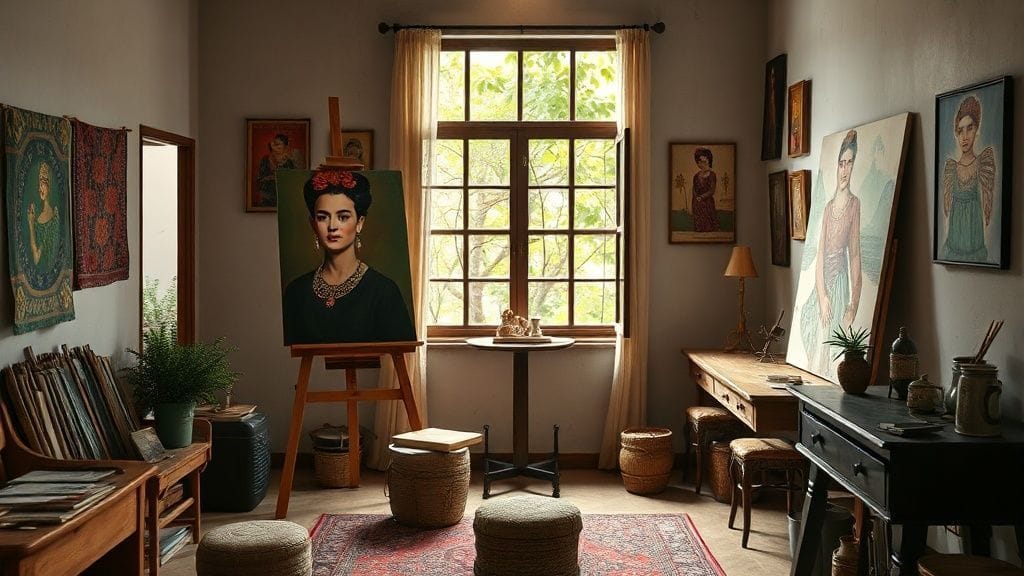
Painted in a cobalt blue that echoed the brilliant Mexican sky, La Casa Azul housed her pain, love, and creativity. It was here that she confronted the confines of her illness, held salons buzzing with intellectuals, and assembled artifacts of her culture and memories.
By 1954, the Casa Azul had become a shrine to Kahlo’s life, a physical container for her brokenness and brilliance.
6. The Illness That Never Let Go: Frida’s Chronic Suffering
Pain was the shadow that stalked Kahlo until her final breath. Despite numerous surgeries—some as many as 30—and life-long agony from her injuries and polio, she continued to paint, almost obsessively.
In her last years, her health deteriorated drastically: gangrene worsened, leading to the amputation of her right leg in 1953, infections racked her body, and depression clouded her spirits.
Doctors warned her repeatedly, but the embodiment of physical and emotional tumult seemed fated to march inexorably toward an end.
7. July 1954: The Waning of a Fiery Spirit
July dawned with the searing heat typical of Mexico City’s summer, but within La Casa Azul, the atmosphere was heavy with fragility.
Frida, aged 47, was confined to bed, her body emaciated and frail. Still, she summoned the will to paint, to write, to resist death’s claims. Friends, family, and lovers gathered, sharing memories laced with grief, hope, and disbelief.
Yet, the shadows lengthened, and the devil of pain tightened his grip.
8. The Last Breath: July 13th, 1954 — Death in Coyoacán
Shortly before midnight on July 13th, in the stillness of her blue sanctuary, Frida Kahlo passed away. Cause of death was officially listed as pulmonary embolism, though rumors and theories would later swirl—from suicide to complications of polyps.
Her passing was both a relief and a shock, closing a chapter of brutal beauty—a life that had defied conventions and the limits of flesh.
9. Mourning Mexico: Public Reaction and National Grief
Mexico mourned in tidal waves. Newspapers printed images of her face etched with pain and beauty. Thousands flooded the streets of Coyoacán to pay homage.
At limited invitation-only events, relatives and artists spoke of a woman who had become more myth than mortal. The government, despite earlier political tensions with her leftist stances, recognized her contribution to national culture.
Kahlo’s death was not only a personal loss but a national moment for Mexico to reckon with identity, suffering, and creativity.
10. Diego Rivera’s Mourning and the Complex Legacy Between Them
Diego Rivera—the lover, rival, husband—was a pillar in the aftermath. Often overwhelmed by their volatile relationship, he expressed profound grief.
His eulogy was tinged with tenderness and regret, recalling Frida’s indomitable spirit, her luminous talent, and the fractured love they shared.
Rivera’s stewardship of her legacy, both protective and complicated, helped shape the continuing narrative of Kahlo’s life and death.
11. The Transcendence of Kahlo’s Image: From Pain to Icon
Death transformed Kahlo from celebrated artist to universal icon. Her image—painted with flowers and unibrow—became the emblem of perseverance and rebellious identity.
Within years, her self-portraits adorned walls, public spaces, and entering global consciousness, representing not just Mexican culture but feminist and queer identity worldwide.
12. Artistic Legacy: How Death Cemented Her Myth
Paradoxically, Kahlo’s death ignited a renaissance of interest in her art. Posthumous exhibitions dotted Mexico and eventually the world.
Her canvases—a fusion of surrealism, symbolism, and stark autobiography—were revisited and revered. The visceral honesty of her paintings gained deeper appreciation.
Death, while ending her physical output, launched the eternal life of her artistic influence.
13. The Role of Politics in Remembering Frida Kahlo
Kahlo’s politics were complex: communist, feminist, Mexican nationalist. After her death, the Mexican state’s selective embrace of her legacy highlighted broader cultural wars.
Her image was sometimes sanitized for public consumption, while underground movements celebrated her radicalism.
Thus, Kahlo’s memory became a battleground of ideologies as much as art.
14. The International Reverberations of Her Passing
Worldwide, the death of Frida Kahlo was noted by artistic and political communities.
Figures like André Breton and Pablo Neruda championed her work, and her mythos grew beyond borders.
Her story resonated with global audiences hungry for narratives of resistance, suffering, and identity.
15. La Casa Azul Today: Shrine, Museum, and Pilgrimage Site
Today, La Casa Azul stands as an official museum, maintained by the National Institute of Fine Arts.
Visitors from all over the globe walk its rooms, experiencing the textures of Frida’s life—her personal items, paintings, and the aura of her final days.
The house is a pilgrimage for those drawn to her story of pain turned to creation.
16. Frida’s Death and the Rise of Feminist Art Discourse
From the late 20th century onwards, feminist scholars and artists reclaimed Kahlo as a proto-feminist figure.
Her death marked a beginning of discourse celebrating female subjectivity, bodily autonomy, and political expression.
Kahlo’s life and death became a cornerstone in feminist art history.
17. Revisiting Kahlo’s Final Message Through Her Last Works
Frida’s final paintings—laden with symbolism of mortality and rebirth—offer haunting insights into her state of mind.
Works such as “Viva la Vida” pulse with irony and vitality in the shadow of impending death.
These last creations form a poignant coda to her uniquely vibrant life.
18. The Lasting Symbolism of Kahlo’s Life and Death
Frida Kahlo embodies contradictions: strength and fragility, joy and suffering, nationalism and universalism.
Her death crystallized these dualities, making her a symbol that continues to inspire debate and devotion.
A woman who lived intensely and died as an icon.
19. The Healing Power of Memory: Kahlo in Contemporary Culture
Frida’s legacy is alive in popular culture, feminist movements, fashion, and film.
Her image adorns murals, clothing, and protests—a testament to the healing and empowering power of memory and myth.
20. Conclusion: The Eternal Flame of Frida Kahlo
Frida Kahlo’s death in July 1954 was more than an end; it was a beginning of myth, memory, and inspiration.
Her life’s anguish painted through vivid colors lives on, reminding us of the resilience of spirit in the face of mortal fragility.
Frida’s cobalt blue house still stands—a beacon for all who seek courage in the beautiful entanglement of suffering and art.
Conclusion
Frida Kahlo’s final days unfurl as a dramatic benediction of a life lived with uncompromising intensity. Her death in the summer heat of 1954 marked the closing of a wound that had never fully healed but also birthed a mythos powerful enough to transcend death itself. From the blue walls of her Coyoacán home to the farthest corners of the earth, Kahlo continues to speak—through color, pain, and passion—to remind us that suffering and creativity are often inseparable companions in the human journey.
Her legacy invites us not only to admire the artist but to inhabit her fierce humanity: flawed, fiery, and profoundly alive.
FAQs
Q1: What caused Frida Kahlo’s death?
Officially, Frida Kahlo died of a pulmonary embolism— a blockage in the lungs. However, some scholars and acquaintances suspect that her fragile health and chronic pain, as well as possible suicide, contributed to her death.
Q2: How did Frida Kahlo’s health problems affect her art?
Her lifelong pain deeply influenced her art’s themes—identity, suffering, mortality. Many of her surreal self-portraits visually narrate her physical and emotional trauma.
Q3: What was the public reaction in Mexico to her death?
Kahlo’s death prompted widespread mourning in Mexico, with thousands visiting her home and participating in commemorations. The government finally recognized her as a cultural icon.
Q4: How did Diego Rivera respond to Frida Kahlo’s death?
Rivera publicly mourned deeply, highlighting her strength and talent while reflecting on their turbulent relationship. He became a guardian of her posthumous legacy.
Q5: Why is Frida Kahlo considered a feminist icon?
Because of her unapologetic self-expression, exploration of female experience and pain, and her challenge to patriarchal norms in both personal life and art.
Q6: How did Frida’s death influence the perception of her art?
Her death intensified interest, helping establish her myth as a tragic artist, which contributed to the enduring global appreciation and academic study of her work.
Q7: What role does La Casa Azul play today?
It serves as a museum and cultural site preserving Kahlo’s life and works, attracting visitors who seek to understand her intimate environment and legacy.
Q8: How has Frida Kahlo’s legacy evolved internationally?
Her story resonates worldwide, inspiring feminist, LGBTQ+, and postcolonial discussions, turning her into a global symbol of resistance, creativity, and identity.