Table of Contents
- The Final Hours: Mao Zedong’s Last Breath in Beijing
- A Giant in Decline: Mao’s Health and the Shadow of Death
- The Political Landscape of 1970s China: Turmoil and Transition
- The Cultural Revolution’s Lingering Echoes
- The Inner Circle: Key Players Around Mao’s Deathbed
- September 9, 1976: A Nation Holds Its Breath
- Public Announcement and National Mourning
- The Power Vacuum: Struggles Behind the Curtain
- The Rise of Hua Guofeng: Mao’s Successor Emerges
- The Fall of the Gang of Four: End of an Era
- Reevaluation of Mao’s Legacy: From Reverence to Controversy
- How Mao’s Death Redefined China’s Future Path
- Global Reactions: The World Watches the Giant’s Passing
- The Human Side: Anecdotes from Those Who Witnessed the End
- Memorials and Rituals: Honoring Mao in the Midst of Change
- The Cultural Revolution’s Aftershocks: Healing a Fractured Society
- Economic Reforms on the Horizon: The Seeds of Modernization
- Mao’s Death and the Rebirth of Chinese Foreign Policy
- The Struggle for Historical Memory: Mao in Chinese Education and Media
- Conclusion: An End and a Beginning
- FAQs: Understanding Mao’s Death and its Aftermath
- External Resource
- Internal Link
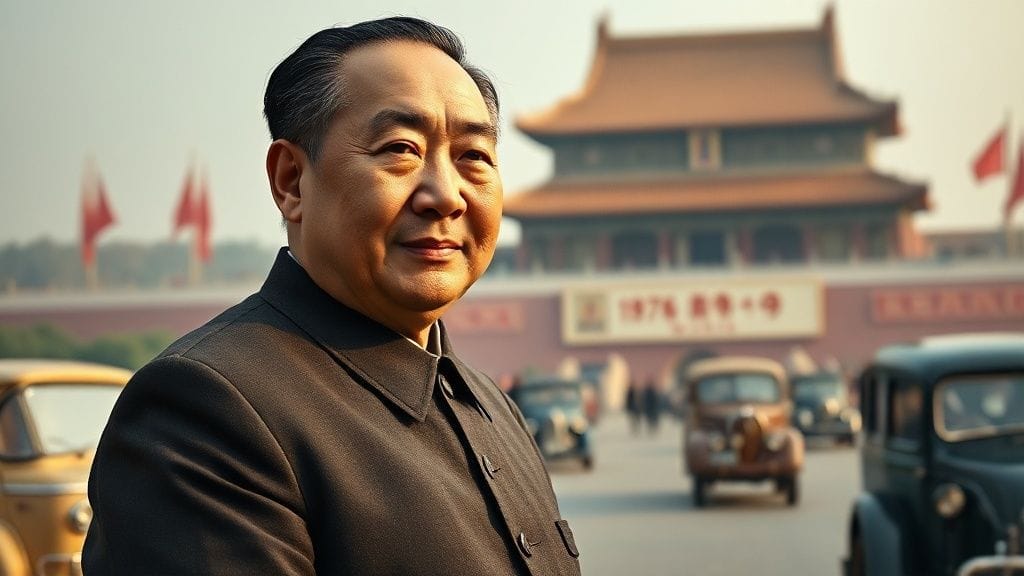
Mao Zedong’s death on the early morning of September 9, 1976, was a tectonic event for China and the world. It arrived like the setting of a monumental, almost mythic chapter in a nation’s long history. Beijing was shrouded in a heavy stillness, a city steeped in reverence, anxiety, and uncertainty. The palpable silence was broken only by the low murmur of officials and the occasional cries of mourners pouring into Tiananmen Square. This was no ordinary death. It was the dying gasp of an era defined by radical upheaval, ideological fervor, and a ruler who shaped modern China with an iron will.
As dawn broke over a smog-draped Beijing, the world slowly absorbed the news: the Great Helmsman, Mao Zedong, had passed away. He had been China’s revolutionary leader for more than three decades, a man who had presided over epic transformations, often at a staggering human cost. Now, his absence left a vacuum fomenting both hope and fear. But the story of Mao’s final days and the immediate aftermath is about much more than a man’s mortality. It is the story of a nation on the cusp of historic change, caught between the ghosts of revolution and the uncertain promise of reform.
A Giant in Decline: Mao’s Health and the Shadow of Death
By the mid-1970s, Mao Zedong’s vitality had visibly waned. For years, rumors of his deteriorating health simmered beneath the iron facade he maintained. The Great Helmsman, once a towering figure of delight and terror, was now frail, confined to chambers within Zhongnanhai—the political heart of Beijing—and tethered to a relentless cadre of doctors and advisors.
Despite his failing physical state, Mao remained shrewdly alert to political tides. His last years were marked by an ambivalence: a refusal to relinquish power, combined with moments of introspection and curiosity about the country’s future. Yet, his declining health intensified the internal battles within the Communist Party. Who would fill the void left by this icon—this architect of revolution who had become also a symbol of grim sacrifice?
The Political Landscape of 1970s China: Turmoil and Transition
The 1970s in China were anything but tranquil. The Cultural Revolution, initiated by Mao himself in 1966, had wreaked havoc on the nation’s social fabric. Intellectuals suffered exile and humiliation, cities became flashpoints of factional violence, and the entire country seemed suspended in an endless ideological storm.
Within the Communist Party, factions jostled for dominance. The so-called Gang of Four—led by Mao’s widow Jiang Qing—held significant power but were increasingly viewed with suspicion and resentment by other party officials. The old guard grappled with the question: how to preserve the revolution’s gains while steering China away from chaos? Mao’s death would become the crucible in which these tensions erupted.
The Cultural Revolution’s Lingering Echoes
To understand Mao’s final days, one must grasp the Cultural Revolution’s deep imprint on China. It was a period when loyalty to Mao defined one’s very existence, when revolutionary zeal overwhelmed reason, and when the country oscillated between fervent hope and brutal repression.
By 1976, many Chinese lived in exhaustion. Schools and universities had been shuttered, industry suffered, and the economy lagged behind. But the Cultural Revolution's specter lingered in every debate and decision. Mao’s death challenged the nation to reckon with both the trauma and the unfinished business of this turbulent decade.
The Inner Circle: Key Players Around Mao’s Deathbed
In those final hours, Mao was surrounded by a select circle of party officials—some devoted, others wary—each reading the signs of impending change. Among these figures were Zhou Enlai, the premier and one of Mao’s most trusted lieutenants, although he had passed away earlier in January 1976; Hua Guofeng, a relatively obscure but loyal politician; and of course the Gang of Four, whose ambitions shadowed every move.
Doctors describe Mao’s condition as fragile but stable during his last days. Officials whispered anxiously about succession and the future of Communist China. Mao was no longer the infallible leader but a man at the mercy of time, his deathbed a stage for political drama still unfolding.
September 9, 1976: A Nation Holds Its Breath
The morning of September 9 arrived with a somber quiet. Beijing’s streets were unusually subdued as news of Mao’s imminent demise slowly filtered through the party’s inner circles. At exactly 7:50 am, Mao Zedong, aged 82, passed away in Beijing.
The official announcement was made at noon that day. Radio broadcasts interrupted regular programming to relay the grave news. In Tiananmen Square, thousands gathered spontaneously, some falling to their knees, others breaking into tears. The Great Helmsman was gone—but his shadow still stretched long across the land.
Public Announcement and National Mourning
The official mourning period lasted for weeks and was marked by ceremonies that blended grief with political theater. Millions participated—whether out of genuine sorrow, respect, or obligation. Portraits of Mao were displayed everywhere: on walls, in homes, and in public squares.
State media framed Mao’s death as the loss of a father of the Chinese nation, the liberator who had led China from semi-colonial backwardness to the threshold of greatness. Yet, beneath the solemnity, whispers of relief and speculation about what was next circulated discreetly.
The Power Vacuum: Struggles Behind the Curtain
Mao’s death unleashed a volatile power struggle. The party was divided, and the Gang of Four, despite their prominence, found their influence challenged. Hua Guofeng, quietly promoted by Mao before his death, moved swiftly to consolidate power.
Behind closed doors, officers and officials navigated treacherous political waters. The party’s future depended on who would emerge victorious—the radicals clinging to Cultural Revolution ideals or the pragmatists eager for reform.
The Rise of Hua Guofeng: Mao’s Successor Emerges
Hua Guofeng, a relatively obscure figure only known for his loyalty and adherence to Maoist principles, was quickly elevated as the Chairman of the Communist Party. His rise was both surprising and strategic—representing a temporary bridge between competing factions within the party.
Hua’s leadership was shaped by his adoption of the phrase “Two Whatevers”—supporting “whatever policy decisions Chairman Mao made” and “whatever instructions Chairman Mao gave.” This position temporarily postponed open confrontation, but it was not to last.
The Fall of the Gang of Four: End of an Era
Just months after Mao’s death, in October 1976, Hua Guofeng orchestrated the arrest of the Gang of Four. This dramatic move effectively ended the Cultural Revolution’s radical phase and turned a page in Chinese history.
The Gang of Four were tried and imprisoned, their fall symbolizing a rejection of the excesses that had characterized Mao’s later years. This purge also allowed reform-minded leaders to begin reshaping China’s political and economic future, albeit cautiously.
Reevaluation of Mao’s Legacy: From Reverence to Controversy
In the years following Mao’s death, an intense debate about his legacy erupted within China and internationally. Official rhetoric continued to praise Mao’s role in founding the People’s Republic and liberating China. Yet, growing recognition of the Cultural Revolution’s devastating impact prompted a more nuanced appreciation.
Scholars and historians debated Mao as a visionary leader and a ruthless autocrat. Chinese society itself was divided: some mourned their heroic father; others remembered the chaos and loss. This duality remains central to Mao’s complex memory.
How Mao’s Death Redefined China’s Future Path
The passing of Mao was a catalyst for profound change. While initially, the party hesitated, the groundwork was soon laid for China’s transition away from ideological purity toward pragmatic governance.
Within a few years, Deng Xiaoping would rise to power, initiating sweeping economic reforms that transformed China into a global powerhouse. But none of this would have been possible without first surviving the seismic shock of Mao’s death and the political rifts that followed.
Global Reactions: The World Watches the Giant’s Passing
Mao’s death reverberated far beyond China’s borders. Governments worldwide—from the Soviet Union to the United States—reevaluated their policies in light of the shifting tides in Beijing.
Allies and adversaries alike recognized the uncertainty that Mao’s death represented. For some, it was the end of an era of ideological confrontation; for others, the beginning of a new chapter of cautious engagement with the rising Asian giant.
The Human Side: Anecdotes from Those Who Witnessed the End
Behind the headlines were stories of individuals—doctors, party officials, family members—witnessing Mao's final moments.
One physician reportedly recalled Mao’s calm demeanor and clarity of mind even as his body faltered. A nurse described the palpable tension between officials who tried to control the procession of visitors to his bedside.
These personal vignettes add a poignant human layer often obscured by the grand sweep of history.
Memorials and Rituals: Honoring Mao in the Midst of Change
In the months after Mao’s death, China embarked on elaborate memorials. His body was embalmed and placed in the Mausoleum on Tiananmen Square, making him a permanent fixture of national identity.
The rituals blended traditional Chinese customs with communist symbolism, creating a unique form of remembrance that reflected both mourning and political continuity.
The Cultural Revolution’s Aftershocks: Healing a Fractured Society
Mao’s death did not instantly heal the wounds of the Cultural Revolution. Society remained deeply fragmented, families torn apart, trust eroded.
The new leadership had to overcome decades of suspicion and brutality embedded in everyday life. Schools reopened, intellectuals returned, and slowly, China began to repair its social fabric.
Economic Reforms on the Horizon: The Seeds of Modernization
Although Hua Guofeng initially advocated for adherence to Mao’s policies, economic pragmatism soon won out. Under Deng Xiaoping’s guidance, China embarked on market-oriented reforms that would lift millions out of poverty.
Mao’s death, therefore, indirectly sparked an economic revolution that reshaped the global order.
Mao’s Death and the Rebirth of Chinese Foreign Policy
Foreign policy, previously dominated by ideological confrontation, shifted after Mao’s death. China cautiously opened diplomatic relations, notably with the United States and Western nations.
This new pragmatism marked a clear break from the isolation and antagonism that defined Mao’s reign, paving the way for China’s international resurgence.
The Struggle for Historical Memory: Mao in Chinese Education and Media
Since Mao’s death, the Chinese government has carefully managed his legacy. School textbooks paint him as a hero while downplaying the violence of his campaigns.
Controversies over statues, biographies, and public discourse continue to ignite debates among historians, citizens, and political leaders over how best to remember Mao.
Conclusion: An End and a Beginning
Mao Zedong’s death on September 9, 1976, was both a monumental end and a tentative beginning. It marked the close of a chapter defined by revolutionary zeal, immense suffering, and dramatic transformation. Yet, it also catalyzed the slow, deliberate shift toward modernization and international engagement.
The story of Mao’s passing—its political intrigue, national mourning, and global impact—remains etched deeply in the collective consciousness. It reminds us that leadership, however towering, is mortal, and that history moves inexorably forward, shaped by those who follow.
FAQs
Q1: What were the main causes of Mao Zedong’s death?
A1: Mao died primarily from complications related to Parkinson’s disease, heart and lung problems, and general decline due to old age.
Q2: Who succeeded Mao as the leader of China?
A2: Hua Guofeng was named Mao’s immediate successor, though Deng Xiaoping would later emerge as the paramount leader.
Q3: What was the significance of Mao’s death for the Cultural Revolution?
A3: Mao’s death signaled the end of the Cultural Revolution’s radical phase and initiated the downfall of the Gang of Four.
Q4: How did the Chinese people react to Mao’s death?
A4: Reactions were mixed—profound mourning for a revered leader combined with relief among those weary of political turmoil.
Q5: How did Mao’s passing affect China's foreign relations?
A5: It opened the way for improved relations with Western countries and a shift toward pragmatic diplomacy.
Q6: What role did the Gang of Four have after Mao’s death?
A6: The Gang of Four attempted to retain power but were arrested in October 1976, ending their political influence.
Q7: How is Mao remembered in China today?
A7: Mao is officially remembered as a founding father and hero, though with acknowledgment of mistakes, reflecting a complex legacy.
Q8: Did Mao’s death immediately change China’s economy?
A8: Not immediately. Economic reforms began a few years later, under Deng Xiaoping’s leadership, marking a departure from Maoist policies.
External Resource
Internal Link
🏠 Visit History Sphere → https://historysphere.com/