Table of Contents
- The twilight of an era: February 19, 1997 unfolds in Beijing
- Deng Xiaoping: A titan of transformation on his final journey
- The man behind the reforms: Deng’s rise to power and resilience
- China in the 1990s: Economic boom amid political complexities
- February 19, 1997: The day Deng Xiaoping passed away
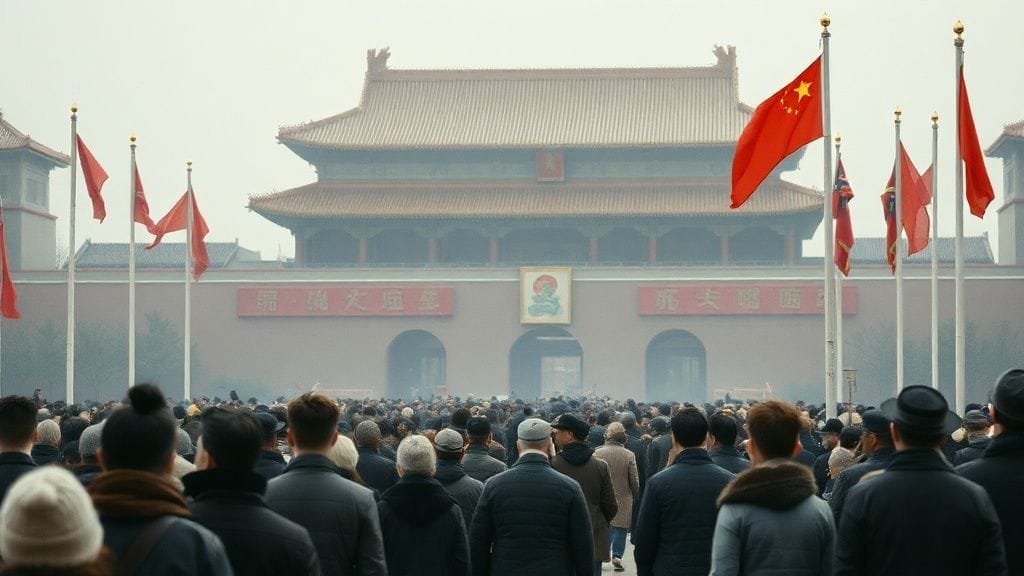
- The atmosphere in Beijing: A city frozen by grief and anticipation
- Immediate government response: Secrecy, solidarity, and state control
- The funeral procession: Masses in mourning and rituals of homage
- Deng’s final legacy: The Pathfinder of China’s Modernization
- The political vacuum: Who would step into Deng’s shoes?
- Domestic reactions: Between reverence and political calculus
- Global acknowledgment: Western praise meets cautious optimism
- The symbolism of Deng’s death in Chinese society
- Economic reforms post-Deng: Continuity or subtle redirection?
- The narrative of reform and stability in contemporary China
- Humanizing Deng: Anecdotes, contradictions, and charisma
- Deng Xiaoping’s lasting imprint on China’s global role
- Remembrance and memorialization: How Beijing honors its reformer
- Reflections on leadership and legacy in authoritarian regimes
- Conclusion: The closing of a remarkable chapter in modern history
- FAQs: Understanding Deng Xiaoping’s death and its impact
- External Resource
- Internal Link
1. The twilight of an era: February 19, 1997 unfolds in Beijing
In the relentless chill of a Beijing winter morning, a silence seemed to hang heavier than usual. It was February 19, 1997 — a day etched into the collective memory of China and the world. Across the sprawling capital, a solemn energy rippled beneath the ever-brightening sky. News traveled quietly but inexorably through corridors of power and whispers on the streets: Deng Xiaoping, the architect of modern China’s rebirth, had breathed his last. The death of Deng was more than the loss of a leader; it was the closing of a transformative epoch that had reshaped the social, economic, and political fabric of the world’s most populous nation. Yet, amidst the mourning, there was a subtle undercurrent of reflection—a moment to ponder the incredible journey from the ashes of Mao’s Cultural Revolution to the dawn of a new China.
2. Deng Xiaoping: A titan of transformation on his final journey
Few individuals have left as indelible a mark on 20th-century history as Deng Xiaoping. A man who survived purges, political storms, and exile, Deng emerged not merely as a survivor but as a visionary pragmatist. His death in 1997 was the end of a life marked by contradictions — a communist revolutionary who embraced elements of capitalism, a patient strategist who instigated rapid reforms, and an authoritarian leader who nonetheless orchestrated China’s opening to the world. To understand the gravity of his passing, one must first grasp the trajectory that had brought him to the pinnacle of Chinese political life.
3. The man behind the reforms: Deng’s rise to power and resilience
Born in 1904 in Sichuan province, Deng’s life journey was entwined with China’s revolutionary upheaval. Educated in France and the Soviet Union, his early exposure to Marxism shaped a lifelong commitment to the Communist Party. Deng endured years of political exile during Mao's purges, notably during the Cultural Revolution, when he was once branded a “capitalist roader.” Yet, his resilience was unparalleled. By the late 1970s, after Mao’s death, Deng stealthily maneuvered into power, eclipsing rivals with his bold vision: to “seek truth from facts” and prioritize economic modernization over ideological rigidity.
4. China in the 1990s: Economic boom amid political complexities
The 1990s in China were a time of dizzying transformation. Thanks to Deng’s policies of “Reform and Opening Up” initiated in 1978, the country was sprinting toward a new identity—one no longer shackled by Maoist austerity but fueled by market experimentation and foreign investment. Economic growth rates often surpassed 10% annually, lifting hundreds of millions out of poverty. Yet, politically, the Communist Party maintained an iron grip, wary of challenges to its authority, especially after the 1989 Tiananmen crackdown that had sent shockwaves worldwide. Deng’s legacy was thus a paradox: economic liberalization under authoritarian tutelage.
5. February 19, 1997: The day Deng Xiaoping passed away
At 10:00 a.m. on February 19, 1997, Deng Xiaoping died quietly at the People’s Liberation Army General Hospital. He was 92 years old, frail yet lucid until the end, surrounded by a close circle of confidants and family. His passing marked the final exit of the last major elder statesman from the revolutionary generation that had established the People’s Republic of China in 1949. News of his death was carefully controlled by the government, who understood the delicate balance between reverence and political stability that had to be maintained in the capital and across the nation.
6. The atmosphere in Beijing: A city frozen by grief and anticipation
Beijing pulsated with a solemn intensity. Normally bustling streets seemed subdued, as if the city itself mourned. Shops draped in black banners, flags flying at half-mast, and the iconic Tiananmen Square stood as a backdrop of national grief. Spontaneous gatherings of citizens, many clutching small photos or simply staring into silence, reflected a collective contemplation of what Deng had meant personally and politically. Journalists and foreign diplomats sensed a city standing at the crossroads—mourning a patriarch while bracing for the political shifts to come.
7. Immediate government response: Secrecy, solidarity, and state control
The Chinese Communist Party swiftly moved to orchestrate an official mourning campaign, blending sincerity with control. Television broadcasts interrupted programming to deliver official announcements, laden with praise for Deng’s contributions. The Central Military Commission placed heightened security around Beijing to prevent unrest or demonstrations. Yet, Deng’s death was publicly framed as a unifying moment, emphasizing continuity and stability under the party’s leadership. Behind this facade, intense discussions steamed over succession planning and the future direction of reform.
8. The funeral procession: Masses in mourning and rituals of homage
Deng’s funeral, held on February 27, was a massive national event attended by hundreds of thousands, including top leaders, veterans of the revolution, and ordinary citizens. The procession, symbolic in its route and rituals, began at the Great Hall of the People, passing through Tiananmen Square. Followers and onlookers stood silently along the way. The ceremonies highlighted Deng’s dual legacy—as a revolutionary hero and a reformer. Eulogies spoke of his courage, wisdom, and unyielding patriotism. Yet, beneath the official pomp, many quietly grappled with the uncertainty of China’s trajectory beyond Deng.
9. Deng’s final legacy: The Pathfinder of China’s Modernization
Deng Xiaoping’s legacy cannot be distilled into simple terms. He was undeniably the architect of China’s economic modernization, shifting the nation from collectivized agriculture and state-owned enterprises toward market-oriented reforms. His pragmatic approach—embodied in slogans like “It doesn’t matter whether a cat is black or white, as long as it catches mice”—revolutionized China’s growth engine. His insistence on “socialism with Chinese characteristics” allowed flexibility and adaptability unknown in rigid communist orthodoxy. By the time of his death, China was already a global player on the cusp of transformative influence.
10. The political vacuum: Who would step into Deng’s shoes?
Deng’s demise revealed a fissure in the party’s leadership structure. Unlike Mao, who had cultivated a cult of personality, Deng had carefully avoided such adulation, focusing instead on collective leadership. His designated successor, Jiang Zemin, was expected to uphold and deepen reforms. Yet, political watchers sensed a subtle shift—Jiang needed to assert himself independently, balancing party orthodoxy and Deng’s reformist heritage. The absence of Deng’s commanding presence introduced a delicate interregnum that would shape China’s political landscape for decades.
11. Domestic reactions: Between reverence and political calculus
Across China, the public response was deeply respectful, shaped by decades of propaganda and genuine admiration for the man who had lifted the country from economic ruin. Yet, within party ranks, there was a pronounced undercurrent of political maneuvering. Hardliners sought to slow reform, whereas reformists called for acceleration. The debate over Deng’s legacy—especially regarding political liberalization—remained unresolved but silenced beneath unified tribute. For many Chinese, Deng was a symbol of pragmatic hope, but also a reminder of limits imposed on political freedoms.
12. Global acknowledgment: Western praise meets cautious optimism
International reactions poured in swiftly. Western leaders lauded Deng’s role in opening China’s economy and contributing to global growth. American officials noted China’s rising influence while cautiously monitoring human rights concerns and political rigidity. For neighboring Asian countries, Deng’s death signaled potential shifts in diplomatic strategy. Scholars worldwide debated whether China under post-Deng leadership would maintain its trajectory of reform or retreat into more conservative policies. The question hung in the air: Was this a turning point or merely a historical waypoint?
13. The symbolism of Deng’s death in Chinese society
Deng’s death symbolized much more than the end of an individual life. It was the passing of the revolutionary generation—the final link to the foundation of the modern Chinese state. For a society in rapid flux, Deng’s death grounded collective memory in a narrative of national rejuvenation and pragmatic progress. Statues, plaques, and writings extolled him as a model leader who balanced vision and realism. At the same time, his death invited debates about governance, development models, and China’s place in a globalizing world.
14. Economic reforms post-Deng: Continuity or subtle redirection?
In the years following Deng’s death, economic reforms continued but often with more cautious pacing. The leadership welcomed foreign investment and technological development but tightened controls on political expression. The duality of openness and authoritarianism—pioneered by Deng—became entrenched. Analysts point to the late 1990s as a period when China consolidated its place in the World Trade Organization and initiated infrastructure-driven growth, all while maintaining tight party control. Deng’s blueprint remained central but increasingly intertwined with new challenges and global pressures.
15. The narrative of reform and stability in contemporary China
The mantra that emerged from Deng’s era—“reform and opening up, political stability first”—has become a defining feature of China’s developmental narrative. His death cemented the importance of this balance within the Communist Party’s ideology. Stability was portrayed as essential for continued progress, quelling any calls for democratization. Leaders invoked Deng’s legacy repeatedly to justify economic policies and suppress dissent. In this way, Deng’s death was not just an end point but a narrative anchor in China’s complex modern identity.
16. Humanizing Deng: Anecdotes, contradictions, and charisma
Despite the monumental political figure he was, Deng Xiaoping was also a man with peculiar humor, contradictions, and relatable humanity. He was known to enjoy simple pleasures like playing mahjong and smoking cigars. Close associates described his straightforwardness and a willingness to listen, unusual among political elites. Yet, he was also responsible for harsh decisions—such as the Tiananmen crackdown—which continue to shade his image. Bringing Deng back to a human scale helps understand why millions mourned him not only as a leader but as a complex individual.
17. Deng Xiaoping’s lasting imprint on China’s global role
Deng’s pioneering of modernization fundamentally altered the geopolitical landscape. Under his guidance, China transformed from an isolated, impoverished state into an engine of global trade and diplomacy. His policies paved the way for China’s integration into international institutions and partnerships, challenging the post-Cold War Western dominance. More than two decades after his death, China’s assertiveness in global affairs—from economic initiatives like the Belt and Road to technological advances—traces roots back to Deng’s vision of a “peaceful rise.”
18. Remembrance and memorialization: How Beijing honors its reformer
In Beijing today, Deng’s memory is carefully curated. Monuments such as the Deng Xiaoping statue in Shenzhen—a city emblematic of his reforms—stand as enduring testaments. His former residences and museums draw visitors intrigued by his life story. The annual commemorations of his death, though solemn and official, continue to inspire reflection on China’s journey. However, public discourse balances praise with careful avoidance of controversial aspects of his tenure, reflecting continuing sensitivities in Chinese politics.
19. Reflections on leadership and legacy in authoritarian regimes
Deng’s death highlights broader questions about leadership longevity, legitimacy, and legacy within authoritarian systems. Unlike charismatic cults of personality, Deng’s power rested more on strategic vision and policy innovation than personal adulation. His transition of power set a precedent for more collective leadership, even as it maintained strict party supremacy. Examining his death and aftermath offers insights into how authoritarian regimes manage succession, memory, and political stability amid modernization pressures.
20. Conclusion: The closing of a remarkable chapter in modern history
Deng Xiaoping’s death in 1997 closed a chapter that transformed not only China but the global order. His visionary reforms propelled millions out of poverty and introduced China to the international stage as an economic powerhouse. Yet, his legacy is a mosaic of contradictions—economic openness juxtaposed with political control. As Beijing stood shrouded in mourning that winter, the world grasped that China was entering a new phase—one shaped but no longer guided directly by the man known as the Father of Modern China. His life and death invite us to reflect on the complexities of progress, leadership, and historical change in a turbulent century.
FAQs
Q1: What were the primary causes leading to Deng Xiaoping’s death?
Deng died at the age of 92 due to complications from Parkinson’s disease and other age-related illnesses. His health had been declining for several years prior.
Q2: How did Deng’s death affect China’s political landscape immediately?
His death triggered a controlled mourning period and raised questions over succession, ultimately solidifying Jiang Zemin’s position. It marked the end of the revolutionary generation’s direct influence.
Q3: What role did Deng play in modernizing China’s economy?
Deng was instrumental in initiating market-oriented reforms, opening China to foreign investment, and promoting technological and industrial development, which spurred rapid growth.
Q4: How did the international community react to Deng’s passing?
Reactions were mixed with Western nations praising his reforms but expressing caution regarding China’s political authoritarianism. Many viewed it as a pivotal moment in global geopolitics.
Q5: What controversies surround Deng’s legacy?
Aside from economic achievements, Deng’s legacy includes the suppression of political dissent, most notably the Tiananmen Square crackdown in 1989, which remains a sensitive topic.
Q6: How does China commemorate Deng Xiaoping today?
China honors him through statues, museums, annual remembrances, and official narratives celebrating his role as the architect of modern China, while politically managing the discourse around his controversial decisions.
Q7: What was Deng’s leadership style?
Pragmatic and strategic, Deng combined political toughness with flexibility. He avoided cults of personality and emphasized collective leadership and policy innovation.
Q8: Did Deng’s death lead to any immediate policy changes?
There were no abrupt policy shifts; instead, China continued its reform agenda with some modifications under new leadership, maintaining stability and economic growth.

