Table of Contents
- The Fateful Morning of March 18, 1944: Nature’s Relentless Fury
- A Sleeping Giant Awakens: The Historical Context of Vesuvius
- Vesuvius and Campania: A Land Shaped by Fire and Time
- The Second World War and the Shadow of the Volcano
- Early Signs and Warnings: The Volcano Stirring to Life
- The Unleashing: The Day Vesuvius Roared in 1944
- Eyewitness Accounts: Voices from the Ashes
- The Military Struggle against Lava: The Allies in the Line of Fire
- Destruction in the Shadow of the Mountain: Towns and Villages Affected
- The Human Toll: Lives Lost and Displaced
- Scientific Observations Amidst Chaos: Volcanology in Wartime
- The Eruption’s Impact on the Allied Campaign in Italy
- Media and Propaganda: Reporting the Eruption during War
- After the Ashes: Immediate Relief and Recovery Efforts
- Long-Term Consequences on Campania’s Landscape and Economy
- Cultural Responses: Art, Literature, and Memory of the 1944 Eruption
- Vesuvius in Modern History: Lessons from 1944
- The Volcano Today: Monitoring and Preparedness in Campania
- Remembering 1944: Memorials and Collective Memory
- The Legacy of Fire: Vesuvius as a Symbol of Nature’s Indomitable Power
The Fateful Morning of March 18, 1944: Nature’s Relentless Fury
It was just before dawn, yet the quiet of the early morning belied the drama about to explode in a fiery spectacle miles above the Bay of Naples. The earth trembled beneath the feet of thousands, and a massive column of smoke and ash erupted from Mount Vesuvius, a sight both terrifying and mesmerizing. In that moment, the ancient mountain reawakened with a vengeance that no one in the war-torn region was fully prepared for. The year was 1944, the world was engulfed in conflict, and yet in Campania, Italy, an eruption of catastrophic proportions would burn its mark into history, forever entwined with the human tragedies of war.
The eruption of Mount Vesuvius that year was more than a geological event; it was a dramatic collision of human history and elemental fury. For centuries, this iconic volcano cast a long shadow over the lives of local populations — a sleeping giant that held the power to both nurture and destroy. But 1944 was different. The eruption came amid one of the most complex chapters of the Second World War, its lava flows and ash clouds complicating the struggle for control of Italy and dramatically impacting soldiers and civilians alike.
A Sleeping Giant Awakens: The Historical Context of Vesuvius
Mount Vesuvius had long been infamous: world history remembers its catastrophic eruption in AD 79 that buried Pompeii and Herculaneum beneath meters of volcanic ash, preserving a unique time capsule of Roman life. In the centuries since, the volcano had rested in relative quiet, punctuated by intermittent eruptions but nothing approaching the scale of the ancient disaster.
By the mid-20th century, Vesuvius was considered active but stable — a natural sentinel guarding over Naples and the fertile plains of Campania below. The region itself was a vibrant crossroads of culture, agriculture, and commerce, deeply connected to the mountain that had shaped its identity. And yet, beneath the calm surface, the magma chamber stirred once more.
Vesuvius and Campania: A Land Shaped by Fire and Time
Campania’s fertile soils owed much to volcanic ash and minerals, which had nourished farmers for generations. Vineyards, olive groves, and orchards thrived on the mountain’s foothills, supporting communities whose rhythms were tied to the earth. But this prosperity came with the price of living in the shadow of Vesuvius’ terrifying power.
Locals revered and feared the volcano in equal measure. Myths and folklore spoke of fire gods and cataclysmic punishments, testifying to the mountain’s dual nature as creator and destroyer. The Campania landscape itself was a mosaic of ruins from past eruptions and rebirth — villages built, lost, and rebuilt again.
The Second World War and the Shadow of the Volcano
As Italy became a pivotal battleground in WWII, with Allied forces landing on its shores in 1943 and making a harrowing push northward, Vesuvius unexpectedly became part of the war theatre. Around the volcano, military installations, airfields, and encampments sprouted, capitalizing on strategic vantage points.
Campania itself was deeply scarred by war. The civilian population endured bombings, displacements, and food shortages. Into this fraught mix, the restless mountain added another layer of danger, complicating logistics and morale.
Early Signs and Warnings: The Volcano Stirring to Life
Scientists and locals had noted unsettling tremors and increased fumarolic activity in the months leading up to the eruption. Small earthquakes, steam emissions, and gas discharges hinted at a brewing catastrophe. Yet war-time distractions delayed coordinated monitoring and disaster preparedness.
Some communities began to prepare, drawing on traditional knowledge and early warnings, but for many, the signs were missed or underestimated. The scale and timing of the eruption caught nearly everyone off guard.
The Unleashing: The Day Vesuvius Roared in 1944
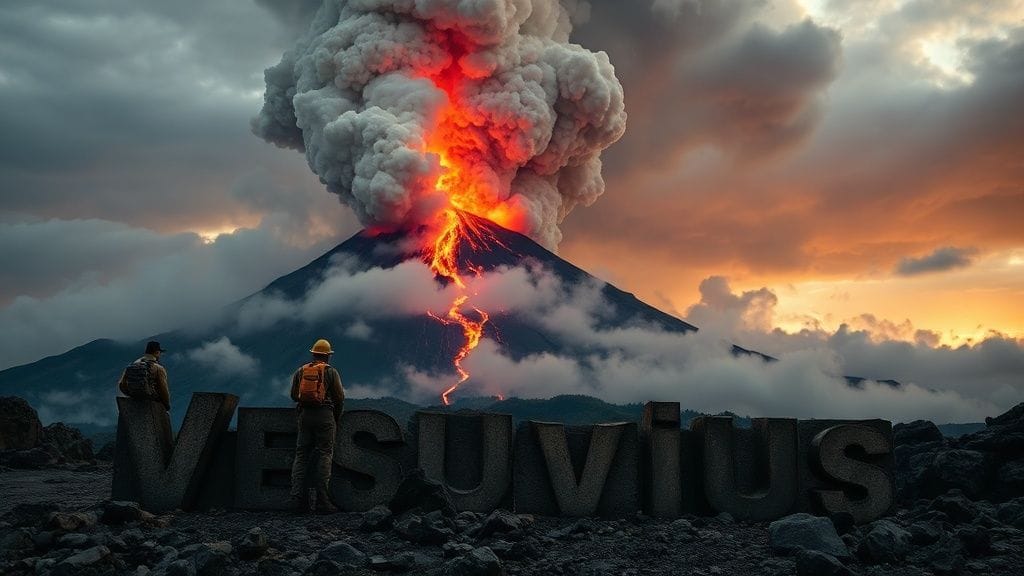
On March 18, 1944, around 8:30 AM, Vesuvius violently shattered its silence. A gigantic explosion expelled dense ash and sulfurous gases kilometers high into the sky. Lava fountains sprayed incandescent rocks, while pyroclastic flows raced down its slopes at terrifying speeds — unstoppable rivers of fire aimed squarely at populated areas.
Ash rained continuously, darkening skies and choking the air with acrid smoke. The ground shook relentlessly, sending shockwaves through nearby settlements.
The eruption’s intensity and immediacy forced a chaotic scramble for survival. Both civilians and soldiers found themselves caught in a desperate race against the devastation.
Eyewitness Accounts: Voices from the Ashes
Survivors’ testimonies bring to life the raw human experience of that day. One local farmer recounted, “The sky turned black like midnight at noon, and the mountain thundered like the gods were fighting above us. Houses trembled and then were buried in ash. We fled with our children, not knowing if we’d return.”
An American soldier stationed near the volcano described the eruption as “a hellscape — fire and smoke everywhere, the ground shaking like the world was ending. We tried to help the locals, but nature was beyond any weapon.”
These personal stories underscore how the eruption was not just a natural disaster but a deeply human tragedy amplified by the chaos of war.
The Military Struggle against Lava: The Allies in the Line of Fire
While Allied forces pushed northward through Italy, their efforts were suddenly challenged by an unexpected foe: the volcano itself. The nearby Air Force base at Pompeii was heavily damaged; many planes were incinerated or buried under ash and lava flows, hindering aerial operations.
Engineers and troops worked tirelessly to clear ash and debris, evacuate personnel, and protect equipment. Yet even military discipline could not fully contain the unpredictable wrath of Vesuvius.
The eruption created logistical nightmares: clogged roads, disrupted communications, and disarray that stalled operations during a critical phase of the Italian Campaign.
Destruction in the Shadow of the Mountain: Towns and Villages Affected
Several small towns bore the brunt of the eruption’s fury. Ottaviano, San Sebastiano al Vesuvio, and Massa di Somma saw streets covered in thick ash layers; many homes were destroyed or rendered uninhabitable.
Infrastructure collapsed: water supplies were contaminated, power lines severed, and transportation halted. Crops and livestock suffered devastating losses, threatening food security.
Yet amidst the ruin, communities showed remarkable resilience, banding together to confront the aftermath.
The Human Toll: Lives Lost and Displaced
The eruption claimed 26 lives directly, though the total impact in human suffering was greater due to injuries, respiratory illnesses caused by ash inhalation, and the displacement of thousands.
Shelters quickly became overcrowded as refugees from the devastated areas sought refuge in nearby cities. Psychological trauma and loss further compounded the region’s wartime hardships.
For many, the eruption symbolized a cruel layering of misfortune, as nature dealt a harsh blow on top of the ravages of armed conflict.
Scientific Observations Amidst Chaos: Volcanology in Wartime
Despite the grim conditions, volcanologists saw this event as a pivotal opportunity to study Vesuvius’ behavior. Italian and Allied scientists collaborated under difficult circumstances, collecting ash samples, mapping lava flows, and documenting eruption dynamics.
Their findings contributed to volcanology’s broader knowledge, shedding light on eruption precursors and the complex mechanics of stratovolcanoes.
Ironically, the eruption advanced scientific understanding while simultaneously wreaking havoc.
The Eruption’s Impact on the Allied Campaign in Italy
The eruption distracted and delayed Allied forces, complicating military strategy in a region already marked by fierce Italian and German resistance.
The destruction of airfields and disruption of supply lines forced adjustments in operational planning, momentarily slowing advances.
Nonetheless, the Allies ultimately resumed their push, leveraging local knowledge post-disaster and rebuilding infrastructure with urgency.
Media and Propaganda: Reporting the Eruption during War
News of the eruption traveled quickly, both through Italian and Allied channels. Propaganda efforts by Axis and Allied powers alike sought to use the event for morale or political advantage.
Photographs and films captured the dramatic visuals of the eruption, stirring awe and sympathy worldwide.
Yet amid wartime censorship and priorities, the natural disaster often competed with battlefront reports for attention.
After the Ashes: Immediate Relief and Recovery Efforts
Humanitarian responses mobilized swiftly. The Italian government, local authorities, Allied forces, and aid organizations coordinated evacuation, medical care, and distribution of food and shelter.
Rebuilding homes and farms was a monumental task, complicated by ongoing war conditions and economic scarcity.
Nevertheless, community solidarity and resilience propelled initial recovery.
Long-Term Consequences on Campania’s Landscape and Economy
The eruption reshaped the area’s geography. New lava formations and thick ash layers altered land use patterns—some fertile fields were lost, requiring decades for restoration.
Economically, agriculture and tourism suffered; vineyards and orchards needed years to recover full productivity.
Yet the catastrophe also prompted infrastructure modernization and improved disaster preparedness programs.
Cultural Responses: Art, Literature, and Memory of the 1944 Eruption
The 1944 eruption left a profound imprint on regional culture. Local artists painted haunting landscapes of ash and fire. Writers and poets memorialized the tragedy, weaving the event into Campania’s collective identity.
Annual commemorations and oral histories preserved the memory, ensuring that the eruption’s lessons endured.
Vesuvius in Modern History: Lessons from 1944
Historians view the eruption as a turning point, highlighting challenges in disaster management amid conflict zones.
The event underscored the need for integrated scientific monitoring and civil protection, insights that influence current volcanic risk strategies globally.
The Volcano Today: Monitoring and Preparedness in Campania
Modern technology monitors Vesuvius continuously — seismic sensors, gas analyzers, and satellite imaging provide early-warning systems unmatched in past decades.
Emergency plans and evacuation routes have been devised meticulously, aiming to prevent another 1944-scale tragedy.
Remembering 1944: Memorials and Collective Memory
Memorials in Campania honor the lives lost and those who struggled through the dual trials of war and eruption. Museums exhibit artifacts and personal accounts, inviting visitors into a poignant historical journey.
These remembrance efforts transform the catastrophe from mere tragedy into enduring lessons of human endurance.
The Legacy of Fire: Vesuvius as a Symbol of Nature’s Indomitable Power
Mount Vesuvius remains a symbol of volatile beauty and danger—its 1944 eruption a stark reminder that beneath human conflict and everyday life lies the restless heart of the Earth.
This volcano’s story intertwines destruction and renewal, fear and fascination, evoking respect for the forces that shape our world beyond human control.
Conclusion
The eruption of Mount Vesuvius in 1944 was more than a natural disaster — it was a harsh intersection of elemental fury and human history, unfolding against one of the darkest backdrops in modern memory. In the shadow of war, amidst the chaos of military campaigns and civilian hardship, nature unleashed a devastating and spectacular force that shaped lives, landscapes, and legacies. The resilience of Campania’s people, the courage of soldiers caught between battle and lava, and the scientific curiosity sparked by disaster all reflect the complexity of this episode.
Today, as the world watches Vesuvius through sophisticated instruments and prepares for potential future eruptions, the events of 1944 remain a potent reminder: human fate is inextricably linked to nature’s unpredictable rhythms. The mountain’s roar that day was not just an end, but also a beginning—of new understanding, renewed vigilance, and a shared story of survival.
FAQs
Q1: What triggered the 1944 eruption of Mount Vesuvius?
A1: The eruption was caused by the buildup of magma beneath the volcano’s crater, which increased pressure until it violently released. This was preceded by earthquake tremors and increased gas emissions signaling volcanic unrest.
Q2: How did World War II affect the response to the eruption?
A2: The war complicated disaster response efforts, as military priorities, damaged infrastructure, and chaotic communication hindered evacuation and relief operations. The presence of troops and military installations near the volcano also added complexity.
Q3: Which communities were most affected by the 1944 eruption?
A3: Towns such as Ottaviano, San Sebastiano al Vesuvio, Massa di Somma, and surrounding villages near Vesuvius suffered substantial damage from lava flows, ash fall, and destruction of homes and infrastructure.
Q4: How many people died in the eruption?
A4: Approximately 26 people lost their lives directly due to the volcanic eruption, with many more injured or displaced. The eruption’s broader impact increased suffering amid wartime hardships.
Q5: What scientific advances came from studying the 1944 eruption?
A5: The eruption provided valuable data on eruption precursors, lava and ash behavior, and volcanic gas emissions, advancing the field of volcanology and improving future monitoring and prediction capabilities.
Q6: How is Vesuvius monitored today to prevent similar disasters?
A6: Vesuvius is continuously monitored using seismic instruments, gas analyzers, geophysical surveys, and satellite imagery. Emergency plans and evacuation procedures are also in place to protect residents.
Q7: Did the eruption significantly affect the Allied military campaign in Italy?
A7: Yes, the eruption damaged airfields, equipment, and disrupted logistics, temporarily delaying Allied advances in the region. However, these challenges were eventually overcome.
Q8: How does the local culture remember the 1944 eruption?
A8: Through memorials, museums, oral histories, art, and annual commemorations, the 1944 eruption remains a poignant part of Campania’s collective memory and identity.

