Table of Contents
- A Fiery Prelude: Sicily on the Brink
- Setting the Stage: Mount Etna’s Volcanic Temperament
- The Fragile Balance of 17th Century Sicily
- April 4, 1669: The Awakening Roar
- Early Signs and Local Folklore
- The Volcano’s Fury Unleashed: The First Days of Eruption
- Villages Under Siege: The Flow of Destruction
- Catania in the Crossfire: The Race Against Lava
- The Human Stories: Courage, Loss, and Resilience
- The Natural Amphitheater: How Etna Reshaped the Land
- Religious Interpretations and Superstitions
- The Response of Spanish Authorities and the Church
- Artistic and Literary Echoes of the 1669 Eruption
- Scientific Insights Emerging from Disaster
- The Aftermath: Reconstruction and Recovery
- Legacy of the 1669 Eruption in Modern Volcanology
- Memories and Monuments: Etna in Sicilian Culture
- Environmental Impact and Geological Evolution
- Lessons Learned from the Old World’s Greatest Eruption
- Conclusion: Fire and Earth — The Enduring Spirit of Sicily
- FAQs: Understanding the 1669 Etna Eruption
- External Resource
- Internal Link
1. A Fiery Prelude: Sicily on the Brink
The Sicilian sky bloomed with an ominous glow on the night of April 4, 1669. Without warning, the Earth cracked open, and the eternal giant beneath the island—Mount Etna—awoke in a violent crescendo of fire and ash. The ancient landscape was about to be irrevocably transformed. Villages clustered nervously at the volcano’s base felt the first tremors of a cataclysm in waiting. For many, the eruption was not just a natural disaster but a profound, terrifying upheaval woven into their fate and faith.
The air was thick with sulfur; rivers of molten rock began their relentless march down the mountain’s slopes, swallowing orchards, homes, and centuries of history. This eruption was unlike any Etna had demonstrated in decades—if not centuries. It would become the largest and most destructive event recorded from Europe's most active volcano, challenging the resilience of a people and the imagination of an entire continent.
2. Setting the Stage: Mount Etna’s Volcanic Temperament
Mount Etna, towering over Sicily at nearly 3,350 meters, is Europe's most active volcano and one of the world’s most studied. Its history is punctuated by eruptions both frequent and devastating. Rooted in the complex tectonic dance where the African plate slides beneath the Eurasian plate, Etna’s fiery heart has told stories of creation and destruction for millennia.
By 1669, residents had coexisted uneasily with Etna’s unpredictable moods. The volcano’s activity was familiar, almost cyclical, but the scale of the threat was uneven—some years quiet, others marked by danger. People worshipped and feared Etna; their lives intertwined with the volatile mountain’s rhythms.
3. The Fragile Balance of 17th Century Sicily
In the mid-17th century, Sicily was part of the Spanish Empire’s vast Italian holdings. The island was a mosaic of rural poverty, noble estates, and burgeoning towns like Catania, which lay directly in Etna’s shadow. Economically dependent on agriculture—especially wheat, citrus, and grapes—Sicilian society relied heavily on the fertility that volcanic soil offered, all while living with the constant threat of natural disaster.
Socially, the island was a place of contrasts: superstition permeated everyday life, the Church wielded immense influence, and the Spanish authorities maintained control with a blend of formality and neglect. Disaster preparedness was minimal; most saw eruptions as divine punishment or supernatural portents.
4. April 4, 1669: The Awakening Roar
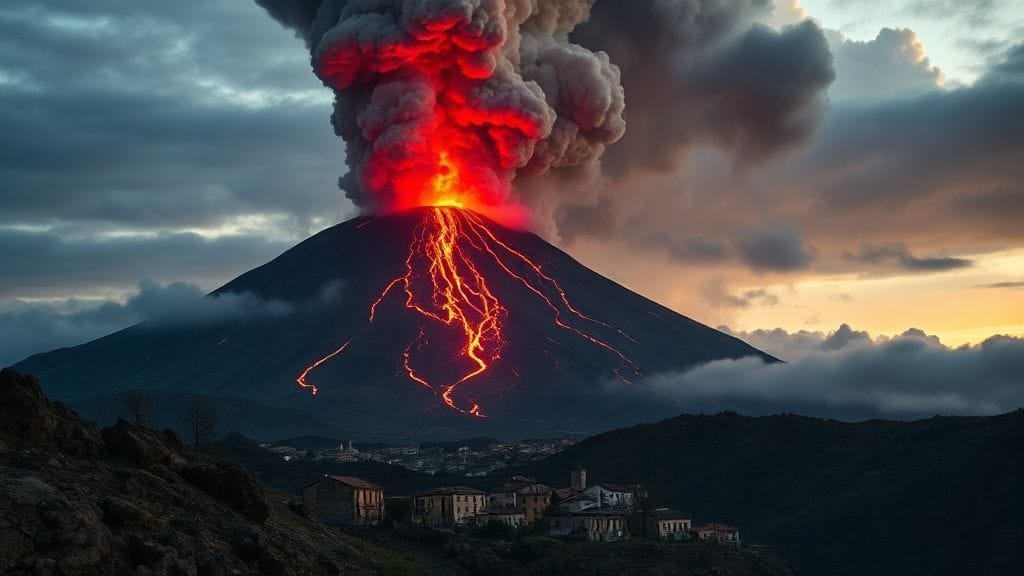
On a brisk spring day, the first signs were subtle earthquakes, faint tremors echoing through the valleys. By evening, a fissure tore open near Etna’s southeastern flank, spewing ash and glowing lava that scarlet-streaked the night. Villagers looked up, awestruck and terrified as a river of fire began its inexorable descent.
The eruption had begun, and with it, a chain of events that would test the courage and endurance of Sicily’s inhabitants. The mountain’s roar was both an ancient chant and a new, dreadful command: nature was reclaiming its dominion.
5. Early Signs and Local Folklore
Before scientists had frameworks to understand volcanic activity, communities relied on legends and omens. The people near Etna had long noted a constellation of signs: strange animal behaviors, changes in the wind, and unusual sky colors. Villagers whispered about the “fire devil” stirring in the mountain's depths.
Letters from the time describe children crying out in fear and priests calling for prayers and processions. The eruption, terrifying as it was, was interpreted as a cosmic message. These early days mixed dread with superstition—a poignant reminder of humanity's vulnerability.
6. The Volcano’s Fury Unleashed: The First Days of Eruption
The initial fissure quickly grew, releasing torrents of molten rock at speeds that confounded observers. Streams of lava fused together, forming thick, glowing rivers that roared like beasts serpentine down the slopes. Ash clouds spewed upwards to the sky, blotting out stars and prompting sorrowful cries from the population.
The lava advanced relentlessly, engulfing farmland and small settlements, consuming everything in its path. Catania’s outlying communities felt the first vibrations of a wrath impossible to halt.
7. Villages Under Siege: The Flow of Destruction
Over weeks, the lava flows intensified and multiplied, branching into deadly tendrils. Ancient villages became islands of life besieged by fire. The agricultural heartbeat of eastern Sicily faltered as orchards and fields vanished beneath rock.
Stories abound of villagers fleeing with little more than their lives, clutching sacred relics, watching helplessly as their homes succumbed. The eruption was not just geological; it was a profound human tragedy, rupturing families and communities.
8. Catania in the Crossfire: The Race Against Lava
The city of Catania, with its baroque churches and bustling markets, lay directly in Etna’s threatening path. By June, lava flows had reached the outskirts, and panic swelled among the city's 20,000 inhabitants. The citizens organized themselves, refusing to abandon their homes without resistance.
Efforts to divert lava using walls and channels were attempted; some proved partly effective, but largely the eruption disregarded human endeavor. The city endured ash fall and tremors, watching the fiery menace approach like an unstoppable flood.
9. The Human Stories: Courage, Loss, and Resilience
Amid destruction, tales of extraordinary human spirit emerged. Families risking everything to save neighbors, priests conducting midnight prayers in trembling churches, farmers returning to their fields in defiance of devastation—the eruption was a crucible of suffering and hope.
One account tells of a woman named Francesca who led a band of villagers to safety across treacherous terrain. Another recalls a local nobleman who sheltered starving survivors. These stories are the heartbeat of the catastrophe, illuminating the human cost beyond geological facts.
10. The Natural Amphitheater: How Etna Reshaped the Land
Geologically, the 1669 eruption was transformative. Lava fields expanded the coastline around Catania by nearly four square kilometers. New hills and craters emerged, altering the topography dramatically. The flows filled rivers and changed irrigation patterns, reshaping the very face of Sicily.
This reconfiguration of the landscape had lasting effects—some regions turned barren, others saw new fertile grounds. Etna had rewritten the geography with molten script.
11. Religious Interpretations and Superstitions
In a deeply Catholic society, the eruption was wrapped in spiritual meaning. The Church declared it a message from God, a punishment for sins. Processions were held, and prayers intensified, hoping to quell Mount Etna’s rage through faith.
At the same time, folk traditions blended pagan beliefs about earth spirits, forging a complex tapestry of interpretation. This fusion reveals the profound human need to find meaning amid chaos and destruction.
12. The Response of Spanish Authorities and the Church
The Spanish viceroyalty governing Sicily dispatched emissaries and engineers to assess the damage. Response efforts were limited but marked by attempts to maintain order and offer aid. The Church played a critical role, organizing relief and framing the disaster within a narrative of redemption.
However, political focus remained on tax collection and control, underscoring the gulf between officialdom and suffering villagers. The eruption tested governance and revealed societal fractures.
13. Artistic and Literary Echoes of the 1669 Eruption
Etna’s fiery spectacle ignited artistic imagination beyond Sicily. Writers, painters, and poets interpreted the eruption’s drama, capturing its fear and awe in their works. Accounts by travelers and scholars spread across Europe, contributing to evolving understandings of volcanic phenomena.
The eruption entered the canon of natural disaster literature, influencing later works by Enlightenment thinkers fascinated by nature’s power.
14. Scientific Insights Emerging from Disaster
Though volcanology was nascent in the 17th century, the 1669 eruption provided invaluable data. Observations of lava flow behavior, ash deposition, and eruption patterns laid early groundwork for understanding stratovolcanoes.
Naturalists of the era sought to reconcile faith and reason, marking a shift towards scientific inquiry that would blossom in subsequent centuries.
15. The Aftermath: Reconstruction and Recovery
Sicily faced a monumental task in rebuilding. Entire communities were displaced, farmland stripped bare. Relief and rebuilding efforts were hindered by poverty and political neglect, yet determined efforts gradually restored life.
Catania itself underwent reconstruction that, despite the trauma, spurred architectural innovation, eventually inspiring Baroque masterpieces that still stand today.
16. Legacy of the 1669 Eruption in Modern Volcanology
Modern volcanologists regard the 1669 event as a benchmark eruption, frequently cited in studies of lava flow dynamics and risk management. Its scale and documentation provide critical lessons in hazard assessment.
Today’s Etna monitoring owes much to lessons first implied by the resilience and suffering witnessed then, blending past and present scientific progress.
17. Memories and Monuments: Etna in Sicilian Culture
The eruption remains a profound chapter in Sicilian collective memory. Oral histories, festivals, and local commemorations honor those who lived through it. Monuments and museums stand as testaments to survival and warning.
Etna is both destroyer and benefactor in Sicilian identity—the fiery mountain woven indelibly into the island’s heartbeat.
18. Environmental Impact and Geological Evolution
Beyond immediate destruction, the eruption influenced soil fertility cycles, ecological succession, and regional climate patterns temporarily. It serves as a vivid example of volcanic processes shaping human habitats over time.
Observations from 1669 contribute to understanding long-term interactions between geology and environment.
19. Lessons Learned from the Old World’s Greatest Eruption
The 1669 Etna eruption underscores the need for early warning, community preparedness, and scientific awareness. Its history warns of complacency and highlights the power—and unpredictability—of natural forces.
As global populations expand into hazard zones, Etna’s fiery past offers timeless guidance.
20. Conclusion: Fire and Earth — The Enduring Spirit of Sicily
The eruption of Mount Etna in 1669 was more than a geological event; it was a crucible forging the spirit of an island and its people. From the fiery chasms of destruction emerged resilience, faith, and transformation.
The narrative of lava and ash, fear and hope, devastation and renewal continues to resonate, a poignant reminder that beneath the earth’s fury lies the enduring heart of human perseverance.
Conclusion
The Etna eruption of 1669 was an epic chapter of nature’s raw force meeting human fragility. It exposed the delicate balance between mankind and the volatile planet, revealing both the vulnerabilities and indomitable resilience of Sicilians. While lava reshaped the land, the eruption carved itself into the collective memory and identity of Sicily, inspiring awe, fear, and respect for centuries.
This event serves not only as a historical moment but as an ongoing dialogue between past and present—a warning, a lesson, and ultimately, a testament to the enduring bond between people and their land. The fire that flowed from Etna was a fierce herald of destruction but also a fiery forge of new beginnings.
FAQs
Q1: What triggered the 1669 eruption of Mount Etna?
The eruption was caused by tectonic activity linked to the African plate subducting beneath the Eurasian plate, leading to magma accumulation and eventual eruption through a fissure on Etna’s southeast flank.
Q2: How destructive was the 1669 eruption compared to others on Etna?
It was the most extensive eruption in recorded European history at the time, covering nearly 13 square kilometers with lava and causing significant destruction, particularly around Catania.
Q3: How did the people of Sicily interpret the eruption in 1669?
They viewed it largely as divine wrath or a supernatural sign, prompting religious processions and prayers. Folklore and superstition played significant roles in their understanding.
Q4: What were some key human impacts of the eruption?
Thousands were displaced, villages and farms destroyed, and lives irrevocably changed. Despite losses, communities demonstrated remarkable resilience in rebuilding.
Q5: Did this eruption influence scientific study of volcanoes?
Yes, the detailed observations from 1669 contributed to early volcanological knowledge and inspired later systematic scientific inquiries.
Q6: How is the 1669 Etna eruption remembered in Sicily today?
It is embedded in local culture through stories, monuments, religious events, and as a symbol of Sicilian identity and resilience.
Q7: What geological changes resulted from the eruption?
The lava flows extended the coastline, created new landforms, and altered hydrology, impacting agriculture and settlement patterns.
Q8: What lessons does the 1669 eruption teach modern society?
It highlights the importance of monitoring natural hazards, preparedness, and respecting nature’s unpredictability, especially in volcanic regions.

