Table of Contents
- Introduction
- Childhood and Early Life in Budapest
- Early Display of Genius
- Studies in Mathematics and Chemistry
- Move to Germany and Göttingen
- Early Academic Contributions
- Emigration to the United States
- Work at Princeton and the Institute for Advanced Study
- Quantum Mechanics Contributions
- Development of Game Theory
- Von Neumann Architecture and Modern Computing
- Role in the Manhattan Project
- Influence on Economics and Social Sciences
- Military Consulting and Cold War Era
- Personality and Anecdotes
- Teaching Style and Influence on Students
- Later Years and Health Struggles
- Death and Legacy
- Cultural Memory and Honors
- Why John von Neumann Remains Relevant Today
- External Resource
- Internal Link
Introduction
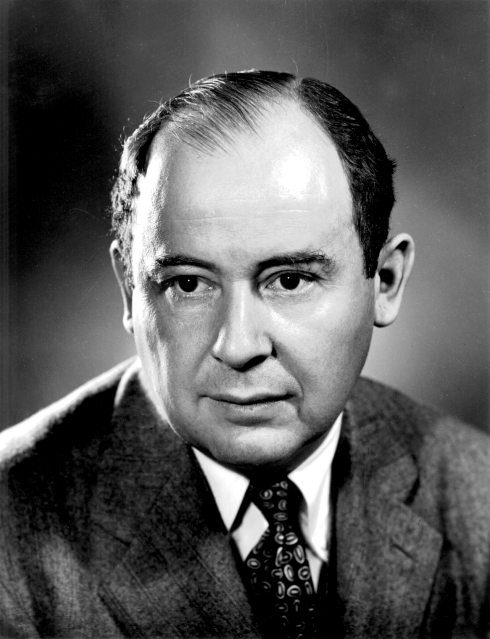
John von Neumann was one of the greatest polymaths of the 20th century, born on December 28, 1903, in Budapest, Hungary. A child prodigy with an extraordinary memory and intellect, he contributed to mathematics, physics, computer science, economics, and military strategy. His work laid the foundations for the computers we use today and created game theory, transforming fields as diverse as economics and political science.
Known as the “father of modern computing”, von Neumann was also a key figure in the Manhattan Project and Cold War military strategy. His legacy is that of a man whose ideas shaped much of the modern technological and intellectual landscape.
Childhood and Early Life in Budapest
Born into a wealthy Jewish family, von Neumann displayed remarkable intellectual abilities from an early age. By age six, he could divide eight-digit numbers in his head and converse in Ancient Greek. His parents encouraged his intellectual curiosity, providing him access to books, private tutors, and a stimulating cultural environment.
Early Display of Genius
Stories from his youth describe him solving complex math problems for fun and astounding his teachers with his near-photographic memory. His brilliance was evident across languages, history, and science.
Studies in Mathematics and Chemistry
He studied chemical engineering in Zurich to satisfy his father’s wish for a practical career, while simultaneously pursuing a PhD in mathematics at the University of Budapest. His dual education reflected both his practical and theoretical talents.
Move to Germany and Göttingen
Von Neumann spent time at the University of Göttingen, a hub for theoretical physics and mathematics in the 1920s. There he interacted with great minds like David Hilbert and absorbed cutting-edge developments in quantum mechanics.
Early Academic Contributions
By his mid-20s, von Neumann had published pioneering work on set theory, functional analysis, and quantum mechanics. His clarity and rigor made him a rising star in European mathematics.
Emigration to the United States
As political tensions rose in Europe, von Neumann accepted an invitation to Princeton University in 1930. He later joined the newly established Institute for Advanced Study, becoming one of its founding faculty members alongside Albert Einstein.
Work at Princeton and the Institute for Advanced Study
At Princeton, von Neumann became a central figure in American science. He mentored young mathematicians, collaborated with physicists, and increasingly turned his attention to applied mathematics.
Quantum Mechanics Contributions
Von Neumann’s 1932 book Mathematical Foundations of Quantum Mechanics formalized quantum theory with mathematical precision, introducing the Hilbert space formalism that remains central today.
Development of Game Theory
With the publication of Theory of Games and Economic Behavior (1944), co-authored with economist Oskar Morgenstern, von Neumann pioneered game theory, a mathematical framework for analyzing decision-making, strategy, and competition. This work revolutionized economics, political science, and evolutionary biology.
Von Neumann Architecture and Modern Computing
Von Neumann designed the stored-program computer architecture that underlies nearly all modern computers. His blueprint for data and instructions sharing the same memory space remains the cornerstone of computer design.
Role in the Manhattan Project
During World War II, von Neumann contributed to the Manhattan Project, applying his expertise in shock waves and explosives to nuclear weapon design. His mathematical insights were critical in making the atomic bomb feasible.
Influence on Economics and Social Sciences
Game theory and mathematical models gave economists new tools to understand markets, competition, and cooperation. His insights still shape modern economic theory and negotiations.
Military Consulting and Cold War Era
Von Neumann advised the U.S. military on nuclear strategy, advocating for a strong deterrence posture during the Cold War. His work on computing also accelerated military applications of technology.
Personality and Anecdotes
Friends and colleagues described him as witty, sociable, and exuberant, with a love for jokes and practical humor. He could astonish dinner guests by reciting entire pages from books he had read years earlier.
Teaching Style and Influence on Students
Though not always the most patient teacher, von Neumann inspired generations of scientists through his brilliance and generosity in collaboration. His lectures combined rigor with a contagious enthusiasm for discovery.
Later Years and Health Struggles
In the 1950s, von Neumann was diagnosed with cancer, likely linked to radiation exposure during his wartime research. Despite his illness, he continued advising on scientific and military matters until his death.
Death and Legacy
Von Neumann died in 1957 at age 53. His passing was mourned as the loss of one of humanity’s greatest minds.
Cultural Memory and Honors
From the von Neumann architecture to game theory, his name remains attached to concepts that shape everyday life. Institutions, awards, and scientific programs worldwide honor his legacy.
Why John von Neumann Remains Relevant Today
Every time we use a computer, engage in economic modeling, or study quantum mechanics, von Neumann’s influence is present. His polymathic genius reminds us of the interconnectedness of knowledge.
External Resource
🌐 Wikipedia – John von Neumann