Table of Contents
- A Night of Fire and Fury: The Stromboli Eruption of 1930
- The Aeolian Islands: A Volcanic Playground in the Mediterranean
- Stromboli’s Fiery Personality: The Volcano That Never Sleeps
- The Calm Before the Storm: Life on Stromboli Before 1930
- Early Warnings: Signs of an Impending Disaster
- The Eruption Unleashed: Nighttime Cataclysm and Lava Flows
- Voices from the Edge: Eyewitness Accounts and Survivor Stories
- The Human Toll: Evacuations, Injuries, and Loss
- Scientists Rushing In: Early Volcanology and Understanding Stromboli
- The Aeolian Archipelago’s Fragile Ecosystem Under Siege
- The Italian State’s Response: Crisis Management in 1930
- The Cultural Impact: How Stromboli’s Eruption Shaped Local Identity
- Stromboli in the Global Imagination: Volcanoes and Myth in the Early 20th Century
- Rebuilding Amidst Ashes: Recovery and Resilience on Stromboli
- Lessons Learned: From 1930 to Modern Volcanology
- The Legacy of the 1930 Eruption in Geological and Social Memory
- Stromboli Today: A Living Volcano and Tourist Attraction
- Comparing the 1930 Event with Other Strombolian Eruptions
- The Role of Technology: Capturing Volcanic Fury in the Early 20th Century
- Myth, Legend, and Science: The Enduring Mystery of Stromboli
On a sultry summer evening in July 1930, the serene rhythm of island life in the Aeolian archipelago was shattered by a fiery spectacle etched with both awe and terror. The ever-watchful volcano Stromboli, perched like a fiery sentinel over the Tyrrhenian Sea, began to roar in a crescendo that no one on the island could ignore. From scattered villages nestled on steep volcanic slopes, families gazed upward, eyes reflecting the molten glow piercing the night sky. For centuries, Stromboli’s periodic eruptions had fascinated and frightened locals, but the events of this summer night transcended all previous memory, unleashing a fury that would forever mark the community’s history and the scientific study of volcanoes.
To understand the magnitude of the 1930 eruption is to journey into the heart of a landscape shaped by fire and water, where human perseverance and nature’s raw power continually collide. The Aeolian Islands, a string of volcanic jewels just north of Sicily, have long been a crossroads of culture, myth, and geological intrigue. Stromboli itself—a volcano often described as the “Lighthouse of the Mediterranean” due to its persistent glowing activity—had never before displayed such a violent outburst in the modern era.
This article will peel back the layers of smoke and ash to relive the night when Stromboli awakened with unprecedented fury. It will explore the island’s delicate ecology, the lives upended by the eruption, the scientific fascination ignited by the event, and the enduring legacy felt in volcanic studies and the soul of the Aeolian people. From the first trembling tremors beneath the island’s crust to the slow healing of scarred earth and hearts, we retrace an episode where nature’s unpredictability was both a destroyer and a creator.
The Aeolian Islands, rising like emerald and obsidian fragments from the Tyrrhenian Sea north of Sicily, form one of Europe’s most striking volcanic archipelagos. Named after Aeolus, the mythic keeper of the winds, these islands have long been shaped by both the elemental forces of the Earth and the tides of human history. Comprising seven main islands and numerous islets, they have been home to thriving communities for millennia, their inhabitants dependent on the land and sea for subsistence.
Among them, Stromboli stands apart—not necessarily for its size but for its ceaseless volcanic activity. Unlike the dormant giants nearby, Stromboli is almost continuously active, emitting small explosions and lava flows that have earned it a reputation as the “Volcano of Fire.” This ceaseless simmering has fascinated geologists for centuries. It is one of the few volcanoes in the world whose activity has been observed and recorded in semi-continuous detail since antiquity.
Yet, while the constant geysers of flame created an almost hypnotic show, they also bred complacency among those who lived in its shadow. Many on the island regarded Stromboli’s eruptions as routine, even reassuring signs of life rather than death. But beneath this apparent permanence, pressure was building—a pressure destined to explode in one of the most violent eruptions of the twentieth century in this region.
Stromboli’s distinct brand of volcanic activity is classified by vulcanologists as “Strombolian,” named after the volcano itself. Characterized by regular, moderate bursts of incandescent bombs and lapilli from its summit craters, Stromboli’s eruptions tend to be explosive yet localized. This pattern establishes a unique relationship between fire and community—one of wary respect but also enduring coexistence. However, the pattern of activity before 1930 suggested a shift.
In the months leading up to the eruption, there had been increased fumarolic activity and tremors too subtle for islanders to interpret as warnings but sufficient to rouse the interest of visiting geologists. The lack of sophisticated seismographic technology limited precise forecasting, but anecdotal signs indicated a build-up. Villagers noted darker smoke plumes, louder rumbles, and ground shaking that even unsettled the hardiest fishermen preparing to set sail.
The local population, while nervous, continued their routines. Children played on sun-baked lava fields that had cooled from earlier flows; shepherds tended goats on the caldera slopes; families harvested capers and grapes on terraces etched into volcanic rock. Life was precarious but rhythmic—balanced delicately between danger and survival.
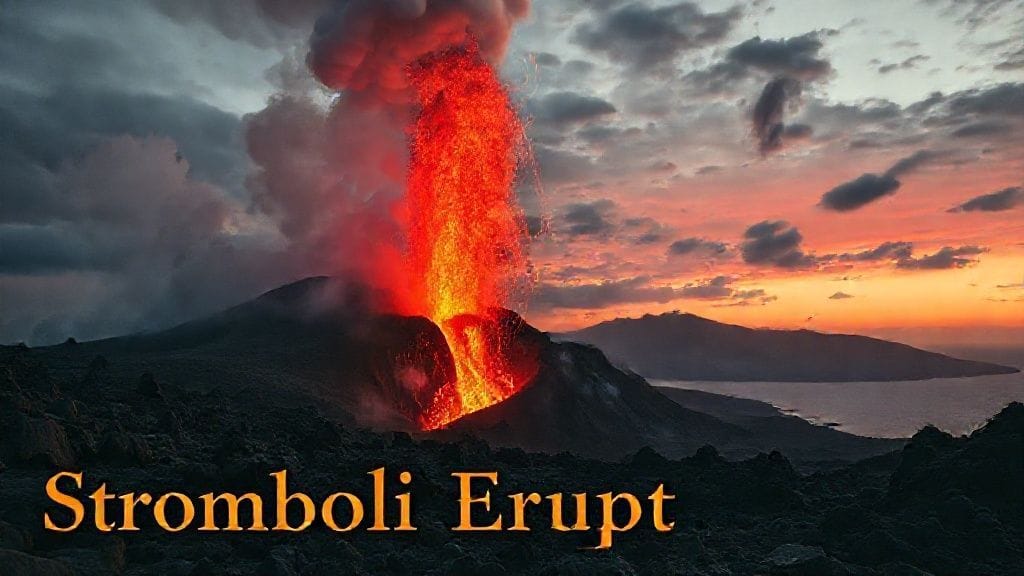
Then, on the evening of July 27, 1930, the volcano’s simmer turned into a roar that split the night. From a calm twilight, a towering plume of ash and incandescent rock burst skyward, lighting the horizon in hellish gold and red. The rhythmic detonations grew into almost continuous explosions. Rivers of molten lava spilled over the crater rim, cascading down the mountainside to thunder into the sea, igniting clouds of steam and scattering glowing bombs hundreds of meters.
The landscape became a furnace; clouds of ash darkened the sky, hiding stars and moonlight. The island shook as tremors rattled homes and sent fires spreading through dry grasses and scattered woods. Villagers scrambled, some climbing to the island’s rugged interior in a desperate bid for safety, others huddled in caves or the few stone-built houses bracing against the onslaught.
Eyewitnesses later recalled the surreal and terrifying scenes—the sky painted with violent colors, the ground trembling beneath their feet, the crackling roar that seemed to tear at the very air. One fisherman described the volcano “like a great dragon breathing fire and fury,” while an elderly woman prayed continuously, fearing the end.
Amidst the chaos, survival instincts kicked in. Families banded together as rescue efforts emerged quickly from within the community. Although formal emergency services in this remote spot were limited, local authorities coordinated evacuations to the neighboring island of Lipari. Small boats crossed the choppy waters under ash-filled skies, ferrying terrified but hopeful survivors.
Despite the heroic efforts, the toll was significant. Several lives were lost to burns, landslides, and collapsing homes. Livestock and crops were decimated under layers of ash, threatening the island’s fragile economy. The aura of normalcy that once shaded Stromboli's villages was shattered into a landscape of grief and uncertainty.
Scientists from continental Italy and beyond arrived soon after, drawn by the eruption’s magnitude and the opportunity to study an active volcano in such a dramatic state. Early volcanologists applied rudimentary seismographs and collected lava samples that revealed insights into magma composition and subterranean dynamics.
This eruption marked one of the first attempts to link volcanic activity to geophysical signals—an embryonic phase in volcanology that would evolve into modern predictive science. Researchers documented the lava flow rates, ash dispersion patterns, and explosion frequencies, laying groundwork that still informs hazard assessment today.
The eruption also underscored the fragility of the Aeolian ecosystem. Ash blanketed farming terraces, vineyards, and olive groves, while toxic gases affected local flora and fauna. Marine life near the lava entry points suffered from altered temperatures and chemical changes. The event cast a spotlight on the delicate balance islanders lived with—the constant negotiation between volcanic fertility and sudden destruction.
Italy’s government, under Mussolini’s regime, faced a complex challenge in responding to the disaster. The remote location complicated aid efforts, while political considerations shaped media coverage and resource allocation. Yet, the state deployed relief, rebuilding aid, and scientific teams to stabilize the affected population. Infrastructure improvements followed, including safer evacuation routes and rudimentary monitoring stations.
This intervention marked an important chapter in Italian disaster response and reflected broader early 20th-century trends in centralizing state power and scientific control over natural forces.
Culturally, the eruption deepened Stromboli’s mythos both locally and abroad. Stories of fire gods, ancient curses, and miraculous escapes intermingled with contemporary reports. The islanders’ identity became bound with the volcano’s temper, seen not just as a threat but as a fiery protector and provider.
Artists, writers, and filmmakers took interest, with Stromboli inspiring works that mingled documentary realism and poetic imagination. The volcano entered the global imagination as a symbol of natural beauty, terror, and timeless mystery.
In the years following the eruption, island life limped back toward normalcy but never quite the same. Recovery was slow, with rebuilding efforts hampered by economic hardship during the interwar period. Yet, resilience defined Stromboli’s people, whose intimate knowledge of the volcano’s moods shaped daily decisions—when to plant, when to fish, when to flee.
The event also sparked increased investment in geological monitoring and disaster preparedness on the islands, embedding the lessons learned into both local practice and international volcanology.
Today, Stromboli remains one of the most studied volcanoes worldwide, its steady eruptions observed by scientists and tourists alike. The 1930 eruption stands as a poignant reminder of nature’s duality—capable of creation through volcanic soils and destruction through fiery wrath.
Comparisons with past and more recent eruptions reveal recurring patterns but also changes likely tied to subtle shifts in tectonic activity and magma chemistry. Each eruption, while terrifying, contributes to a deeper understanding of volcanic behavior and the ever-evolving dialogue between humans and Earth.
The 1930 eruption was caught at the cusp of scientific and technological progress. Though photography and early motion pictures captured some of its dramatic moments, limitations meant much of the event was recorded in personal recollections and traditional media. This blend of myth and early science adds a layer of romance and mystery to its enduring story.
In the end, the tale of Stromboli’s 1930 eruption is not just one of devastation, but of the unyielding human spirit. It is a story of a community faced with the unpredictable forces of nature, struggling to understand, survive, and ultimately thrive amid the flickering shadows of fire and stone.
Conclusion
The summer night of 1930 on Stromboli forever altered the landscape—not merely the physical contours of the island, scarred by torrents of molten rock and ash, but the very soul of its people. This eruption was a profound moment of reckoning, confronting islanders and scientists alike with the raw, awe-inspiring power of the Earth. Yet, it also ignited resilience, curiosity, and a deeper bond between humans and their volatile homes.
Stromboli continues to teach us about nature’s unpredictability and endurance—the paradoxes of destruction and renewal intertwined in volcanic life. As we trace the molten paths of 1930’s firestorms, we are reminded that history is not just a series of dates and facts, but a vivid story pulsing with human courage and the relentless forces that shape our world.
FAQs
Q1: What caused the 1930 Stromboli eruption?
A: The eruption was triggered by the accumulation of magma beneath the volcano’s summit, increasing pressure until explosive release. Stromboli’s characteristic Strombolian activity results from gas bubbles bursting in the magma, but in 1930, this activity intensified dramatically.
Q2: How severe was the human impact of the eruption?
A: The eruption caused fatalities, injuries, and displacement among the island’s population. Agricultural and economic disruptions were severe, but timely evacuations helped limit the loss of life.
Q3: What role did the 1930 eruption play in the science of volcanology?
A: It was one of the first well-documented eruptions studied with early scientific instruments, contributing to foundational knowledge on volcanic monitoring and eruption forecasting.
Q4: How did the Italian government respond to the disaster?
A: Relief efforts included evacuations, aid distribution, and later infrastructure improvements, reflecting early centralized disaster response in Italy under Mussolini’s regime.
Q5: Has Stromboli erupted since 1930?
A: Yes, Stromboli is one of the world’s most continuously active volcanoes, with frequent eruptions of varying intensity continuing to the present day.
Q6: What cultural significance does Stromboli’s eruption hold for locals?
A: The eruption deepened local identity around the volcano, blending respect, fear, and cultural mythology, shaping folklore, art, and collective memory.
Q7: How is Stromboli monitored today?
A: Modern instruments include seismographs, gas analyzers, satellite imagery, and real-time video surveillance to predict and warn against eruptions.
Q8: Are there similar volcanic eruptions in the world?
A: Yes, Strombolian eruptions occur at other volcanoes worldwide, but Stromboli’s persistent activity makes it a prime natural laboratory for studying this eruption type.

