Table of Contents
- The Darkened Sky: A World Shaken by Fire
- Iceland on the Verge: Society and Landscape before the Eruption
- The Geology of Eldgjá: A Rift’s Fiery Secret
- Beginning of the Inferno: The Eruption Unfolds
- Smoke over the Arctic: Atmospheric and Climatic Impact
- Ashes and Lava: Transforming Iceland’s Terrain
- Eyewitnesses and the Saga Literature: Chronicles of the Firestorm
- The Human Toll: Life Amid Ash and Fear
- Eldgjá’s Reach Beyond Iceland: Echoes Across Europe and Asia
- Climate Anomalies and Crop Failures: A Planet in Peril
- The Scars in the Landscape: Visual Remnants of Eldgjá Today
- Ancient Ice and Charcoal: Scientific Windows into the Past
- Eldgjá and Katla: Sibling Giants on Iceland’s Volcanic Front
- The Poetic Voice: Eldgjá in Medieval Icelandic Literature
- Modern Understanding: Volcano Science Meets History
- Eldgjá’s Lessons: Natural Disaster, Human Resilience, and Memory
- Conclusion
- FAQs
- External Resource
- Internal Link
The Darkened Sky: A World Shaken by Fire
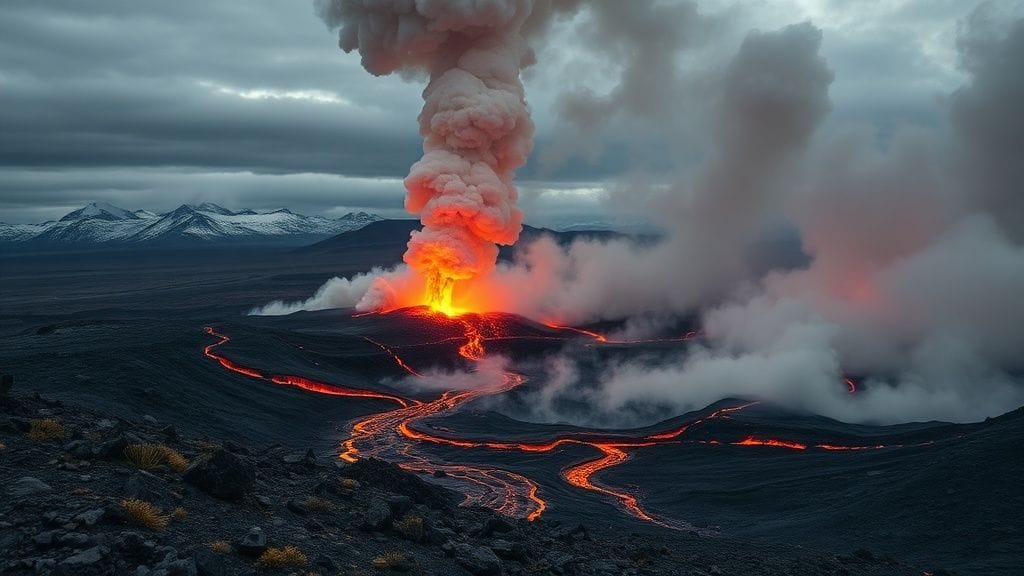
Imagine standing on an Icelandic plateau in the heart of the year 939, when the earth itself seemed to rend open, spewing flames and rivers of molten rock in an apocalypse that cloaked the sky in smoke and ash. For over a year, from 939 to 940, Eldgjá—a vast volcanic fissure—erupted with a fury that reshaped the island’s landscape and rippled out to affect the climate and societies far beyond Iceland’s shores.
The air was thick with choking soot. Sunlight dimmed to twilight; an eerie hush fell over communities. Livestock perished; crops failed. People with no scientific understanding of tectonics or geology faced the incomprehensible rage of nature. This was not merely a local calamity—it was a cataclysm with planetary echoes. Eldgjá’s eruption remains the largest flood lava event in recorded history and a stark testament to Earth’s volatile forces.
Yet beneath this fiery tale lies another narrative—the human dimension: the resilience, the myth-making, the poetic witness encapsulated in medieval Iceland’s literary tradition. This story is not only of destruction, but of survival and memory.
Iceland on the Verge: Society and Landscape before the Eruption
In the early 10th century, Iceland was a land in flux. Settled mostly by Norsemen escaping the tyranny and chaos of mainland Scandinavia, Iceland had become an emerging society focused on farming, fishing, and saga storytelling, a tapestry of loosely organized chieftains known as goðar. The rugged volcanic island’s dramatic geography carved a life of endurance, sparsity, and fierce independence.
Far from a land of simple wilderness, Icelanders had begun to tame the soil and sea, weaving their survival into the landscape. However, beneath this fragile human endeavor churned a restless Earth. Iceland sits astride the Mid-Atlantic Ridge—a caustic rift where two tectonic plates diverge, birthing volcanism and earthquakes with boundless energy.
Long before the dramatic crack of Eldgjá, local legends whispered of fire giants and the land’s violent spirit. But a cataclysm of this scale? Few could have envisioned it.
The Geology of Eldgjá: A Rift’s Fiery Secret
Eldgjá ("Fire Canyon") is no ordinary volcano. It’s a volcanic fissure system stretching over 75 kilometers in the southern highlands of Iceland—a part of the larger Katla volcanic system. The eruption of 939–940 was produced along this fissure, ejecting immense quantities of basaltic lava in one of the greatest flood lava events ever recorded by science or saga.
The eruption was characterized by fissure-fed lava flows rather than a singular explosive cone, creating an uneven but overwhelming outpouring of molten rock. Scientists estimate eruption volumes to be between 18 to 21 cubic kilometers of lava.
The eruption’s violent expanses scorched vast tracts of land, releasing copious amounts of volcanic gases such as sulfur dioxide, which combined with atmospheric water to produce acid rain that devastated plant and animal life.
Beginning of the Inferno: The Eruption Unfolds
The eruption likely began in earnest in late spring 939. Initial reports—if we may call them that—are buried in the skaldic poetry and medieval chronicles of the Icelanders. The earth trembled; fissures opened up in multiple places, glowing with rivers of fresh lava.
Witnesses would have seen an awe-inspiring but terrifying phenomenon: walls of fire advancing like hungry beasts, dark clouds billowing upwards, and the air thick with the acrid scent of brimstone. Lava flowed relentlessly into river valleys, transforming the terrain in days what took centuries.
The eruption raged intermittently, with explosive phases exhibiting plinian characteristics—powerful, tall eruption columns ejecting ash high into the stratosphere. It lasted for approximately a year, finally petering out sometime during 940.
Smoke over the Arctic: Atmospheric and Climatic Impact
Eldgjá’s explosiveness did not just affect local Icelanders; it sent vast plumes of volcanic gases and aerosols far into the upper atmosphere, where the fine particulates dispersed globally.
Studies based on ice cores drilled in Greenland and Antarctica reveal elevated sulfuric acid deposits dating precisely to this eruption period. Such atmospheric pollution had a documented cooling effect on the climate in the immediate subsequent years worldwide.
Data suggest that the northern hemisphere experienced a significant drop in average temperatures around 940–945, leading to a series of poor harvests—a volcanic winter of sorts. Contemporary chronicles from Europe document unusually cold summers and famines, reflecting the profound reach of Eldgjá beyond Iceland’s borders.
Ashes and Lava: Transforming Iceland’s Terrain
The eruption shaped the Icelandic environment in dramatic ways. Lava fields expanded, covering pre-existing landscapes with fresh, barren basalt. Ash layers blanketed wide areas, suffocating vegetation and contaminating waterways.
Rivers were dammed or diverted by new lava flows, while fertile farmland was lost beneath scorched soil and stone. The Eldgjá fissure formed a canyon now some 40 kilometers long and up to 600 meters deep—a gash in the Earth that remains a striking natural monument.
The terrifying beauty of molten rivers frozen in basalt is a lasting echo, silent yet telling, of this fiery upheaval.
Eyewitnesses and the Saga Literature: Chronicles of the Firestorm
Though no written accounts by direct human witnesses survive, the eruption’s memory was immortalized in Iceland’s rich oral tradition, eventually inscribed in sagas and poems.
Most notably, the Völuspá (Prophecy of the Seeress), part of the Poetic Edda, is believed to contain veiled references to the Eldgjá eruption. The poem’s descriptions of a world-wracking fire, darkness over the sun, and apocalyptic wilderness invoke the chaos wrought by Eldgjá’s fires.
Medieval skalds used vivid metaphorical language to connect natural disaster with mythic themes, blending elemental fury with existential dread. These literary echoes humanize the disaster, giving voice to collective trauma.
The Human Toll: Life Amid Ash and Fear
Though population estimates in 10th-century Iceland are rough, the eruption undoubtedly caused hardship and loss. Farms were buried; herds died from polluted pastures and toxic waters. Food shortages would have been common post-eruption, undermining the fragile subsistence economy.
Families were displaced; some settlements may have been abandoned entirely. Psychological suffering from living through months of fire and ash must have been profound—fear of the unknown mingled with despair.
But Iceland’s small communities persisted—their survival proof of resilience in the face of invisible, elemental enemies.
Eldgjá’s Reach Beyond Iceland: Echoes Across Europe and Asia
Though far-flung, Eldgjá’s eruption impacted the broader Old World. Ice core data show a sulfate spike coincident with poor climate and harvests reported in Europe, unraveling a thread between remote volcanic activity and continental hardships.
Some historians link the eruption to historical records of “mysterious darkness” and cold summers in Europe around 940. Asian chronicles, though less specific, also mention unusual weather anomalies.
Eldgjá’s eruption thus serves as an early example of how local geological events can have planetary-scale climatic implications, influencing agriculture, economics, and even social stability far from the source.
Climate Anomalies and Crop Failures: A Planet in Peril
The sulfur dioxide expelled massively increased stratospheric aerosols that reflected sunlight, lowering surface temperatures. June–August averages in Europe possibly dropped by 1–2°C compared to normal decades.
The subsequent short summers caused widespread crop failures, notably in grain-producing regions reliant on predictable weather. Chroniclers in Germany, France, and England spoke of famine, forest dieback, and strange fogs.
This climatic whiplash exacerbated political tensions and social unrest in some areas, demonstrating how a volcanic disaster thousands of kilometers away could ripple into human affairs.
The Scars in the Landscape: Visual Remnants of Eldgjá Today
Modern visitors to Iceland’s southern highlands can witness Eldgjá’s scars firsthand. The canyon’s jagged walls, blackened lava fields, and imposing cliffs form a grand spectacle of geological power.
Hiking through Eldgjá’s fissure reveals fresh basaltic tongues frozen mid-flow and surreal landscapes that feel suspended between earth and myth. This physical presence is a constant reminder of the island’s fiery heart and the Earth's restless temper.
These scars are not just physical; they are etched into Iceland’s cultural and environmental identity.
Ancient Ice and Charcoal: Scientific Windows into the Past
Recent advances in volcanology, geochemistry, and paleoclimatology have refined our knowledge of Eldgjá’s eruption timeline and magnitude.
Ice cores from Greenland show sulfur deposits precisely dated to 939–940, corroborating geological findings. Charcoal and pollen analyses indicate a major ecological disruption at the time.
These multidisciplinary techniques offer a vivid reconstruction of the event’s environmental impact and reaffirm the eruption’s role as a key marker in late first millennium volcanic history.
Eldgjá and Katla: Sibling Giants on Iceland’s Volcanic Front
Eldgjá does not stand alone. It is part of the larger Katla volcanic system, itself infamous for frequent and devastating eruptions.
While Eldgjá hawked flood lavas along fissures, Katla erupts more explosively from caldera vents, often triggered by glacier melting. The dynamic between these two volcanic entities illustrates the complexity of Iceland’s geology.
Understanding Eldgjá also improves volcanic hazard assessments for Katla, highlighting ongoing risks for inhabitants and scientists.
The Poetic Voice: Eldgjá in Medieval Icelandic Literature
Beyond sagas, Eldgjá’s eruption inspired poetic expressions describing temporal and cosmic upheaval.
The Völuspá speaks of a “world set aflame” and darkness swallowing the sun, metaphorically conjuring the eruption’s environmental drama. This poetic imagery captures not only physical destruction but profound existential dread and cultural reckoning.
Icelandic poets transformed Eldgjá’s catastrophe into an allegory of renewal and apocalypse, a dynamic interplay between destruction and rebirth, linking natural forces with human destiny.
Modern Understanding: Volcano Science Meets History
Combining natural sciences with medieval literature enriches our grasp of Eldgjá’s eruption as both a geological and cultural event.
Geologists map lava flows; chemists analyze gases; historians interpret saga texts; climate scientists reconcile ice core records. This interdisciplinary approach paints a comprehensive portrait of Eldgjá’s scale and consequences.
It is a model for studying past catastrophes—melding hard data with human testimony, bridging the empirical and the emotional.
Eldgjá’s Lessons: Natural Disaster, Human Resilience, and Memory
The story of Eldgjá transcends volcanic geology. It is a saga of how humanity confronts nature’s fury, how memory preserves trauma, and how culture encodes survival.
Eldgjá reminds us of our planet’s restless character and the fragile balance we inhabit. It offers cautionary insights into climate impacts provoked by sudden environmental shocks, resonant even today.
Yet it also celebrates the spirit of endurance, the power of narrative, and the bond between land and people forged in fire.
Conclusion
Eldgjá’s eruption of 939–940 stands as one of history’s great natural cataclysms—a vast, unrelenting volcanic assault that darkened skies and altered the climate, reshaping not only Iceland’s land but the wider world’s fate. This fiery episode is etched into basalt and saga, science and story, a testament to the intertwining of earth and human spirit.
It was a crucible of fire that tested the resilience of medieval Icelanders and cast a shadow across continents. Today, Eldgjá challenges us to remember the planet’s volatile past and to confront the unpredictable future with knowledge, respect, and hope. In the glowing embers of ancient lava and the haunting lines of old poetry, we hear the voice of a world forever changed by flame.
FAQs
Q1: What caused the Eldgjá eruption?
A1: Eldgjá was caused by a fissure eruption along the Mid-Atlantic Ridge, where tectonic plates diverge, allowing magma to surface and flood the land with lava.
Q2: How long did the Eldgjá eruption last?
A2: The eruption spanned approximately from 939 to 940, with the bulk of volcanic activity lasting about a year.
Q3: What were the main climatic effects of the eruption?
A3: The eruption released large amounts of sulfur dioxide into the atmosphere, leading to a volcanic winter with cooler temperatures, crop failures, and famines in Europe and beyond.
Q4: How do we know about Eldgjá’s eruption today?
A4: Through geological studies of lava flows, fissures, ice core sulfate deposits, charcoal and pollen data, as well as references in medieval Icelandic literary sources.
Q5: Did Eldgjá directly cause widespread loss of life?
A5: While direct fatality records are non-existent, the eruption likely caused significant hardship: crop losses, displacement, and economic instability for Icelandic communities.
Q6: What is the cultural significance of Eldgjá in Iceland?
A6: Eldgjá is immortalized in Icelandic sagas and poetry, notably the Völuspá, reflecting a deep intertwining of natural disaster and cultural memory.
Q7: How is Eldgjá connected to the Katla volcano?
A7: Eldgjá is part of the same volcanic system as Katla, sharing magma sources and geological context but exhibiting different eruption styles.
Q8: Can Eldgjá’s eruption inform us about modern volcanic hazards?
A8: Yes, studying Eldgjá helps scientists understand fissure eruptions and associated climatic impacts, aiding in hazard prediction and preparedness.

