Table of Contents
- The Awakening of Bárðarbunga: A Tremor Beneath Iceland’s Ice
- Iceland’s Volcanic Heartbeat: Geological and Cultural Backdrop
- The Calm Before the Fire: Early Signs of a Brewing Eruption
- August 2014: When Earth’s Fury Began to Stir
- The Dyke Intrusion: A Vein of Molten Rock Expands
- Holuhraun’s Fiery Birth: Explosive Outpourings Across the Lava Field
- Sky Darkened by Smoke: Environmental and Atmospheric Shifts
- The Battle Between Ice and Fire: Bárðarbunga’s Glacial Influence
- Monitoring Madness: Scientists Race to Decode Nature’s Signals
- The Volcanic Gas Plume: Invisible Hazards and Global Reach
- Voices from the Ground: Eyewitness Accounts and Icelandic Communities
- Aviation on Alert: Managing Ash Clouds Across Europe
- Economic Ripples: Fishing, Tourism, and Local Livelihoods Tested
- The Slow Waning: Eruption’s End and the Land Reborn
- Legacy of Fire: Bárðarbunga’s Imprint on Science and Society
- Myth, Memory, and Modernity: Iceland’s Eternal Dance with Volcanoes
- Conclusion: Reflections on Power, Vulnerability, and Resilience
- FAQs: Understanding Bárðarbunga’s Fiery Tale
- External Resource
- Internal Link
In the late summer of 2014, an island cloaked in glaciers and mystery stirred beneath its frozen surface. Deep within Iceland’s most massive central volcano, Bárðarbunga, a restless energy began to pulse—a deadly and dramatic prelude to one of the largest volcanic eruptions in the country’s recent memory. As the earth cracked open, spilling rivers of molten lava onto the barren Holuhraun lava field, the world watched in awe and apprehension. This is the story of the Bárðarbunga Holuhraun eruption—a volcanic drama woven from fire, ice, smoke, and science.
The Awakening of Bárðarbunga: A Tremor Beneath Iceland’s Ice
Imagine standing at the edge of a vast ice cap, the Vatnajökull glacier, its crystalline silence suddenly shattered by a chorus of earth-shaking rumbles. July 2014 saw exactly this eerie awakening as seismic activity surged beneath the glacier, signalling the reawakening of a sleeping giant. Bárðarbunga, Iceland’s highest and one of its most voluminous volcanoes, concealed beneath kilometers of ice, began to stir with pulses of magma seeking a path to the surface.
The tremors were not just a simple shake; they were a clarion call. In the days that followed, thousands of earthquakes, some exceeding magnitude 5, rattled the region. For locals and scientists alike, the question echoed: Was Iceland about to witness another volcanic spectacle? The stage was set—nature’s tectonic forces had begun their subterranean dance of destruction and creation.
Iceland’s Volcanic Heartbeat: Geological and Cultural Backdrop
To comprehend Bárðarbunga’s eruption, one must first understand the crucible that is Iceland. Nestled astride the Mid-Atlantic Ridge, this island is a direct surface expression of tectonic divergence where the North American and Eurasian plates pull apart. This geological setting fuels a chain of volcanic systems that have shaped Iceland’s rugged landscape and cultural identity for millennia.
Volcanism is woven into Iceland’s very soul. Myths of fire giants and reluctant earth spirits mingle with sagas of farmers and fishermen who lived in the volcanic shadow. From the famous Eyjafjallajökull eruption in 2010 to the relentless Hekla’s ancient brooding, Icelanders know that fire beneath ice is often a gateway to disaster—and renewal.
Bárðarbunga, a caldera some 10 km in diameter under the Vatnajökull ice cap, holds the largest magma chamber in Iceland. Its volcanic history is characterized by infrequent but immensely powerful eruptions, making its awakening a focal point for scientists and civil authorities alike.
The Calm Before the Fire: Early Signs of a Brewing Eruption
The summer months of 2014 were unusually restless beneath the glacier. In July, seismicity increased steadily, with tremors migrating away from the caldera’s center. This hinted at a dyke—a linear intrusion of magma—beginning to cut through the earth’s crust toward the north. It was a dynamic geological prelude, meticulously captured by instruments that traced every movement.
Residents of the uninhabited highlands experienced no immediate disruption, but for the observatories, the data was a warning. The volume of magma estimated to be moving underground was substantial. This was not a minor restlessness but the gestation of a significant event that few imagined would soon transform the landscape.
August 2014: When Earth’s Fury Began to Stir
The crumbling of the earth’s crust finally revealed itself on August 29, 2014, when a fissure eruption ignited at Holuhraun, a barren lava field north of the Vatnajökull glacier. This site, previously little known outside of geologist circles, quickly became synonymous with volcanic spectacle. But instead of a towering ash cloud like the Eyjafjallajökull eruption, the Holuhraun eruption offered a relentless outpouring of lava fountains.
The fissure, initially narrow and fragile, soon widened as lava poured in monumental rivers, slowly reshaping the barren land. The eruption remained mostly effusive, emitting large volumes of basaltic lava instead of explosive ash—yet the ecological and atmospheric impacts were no less dramatic.
The Dyke Intrusion: A Vein of Molten Rock Expands
Beneath this openly flowing lava, the subterranean narrative was intense. Scientists documented a dyke extending some 45 kilometers northward from Bárðarbunga’s caldera, carving a path through rock and sediment. This dyke injection exerted pressure on the crust and triggered further earthquake swarms.
The intruding magma, visible only through scientific instruments, unveiled the violent processes that create new land and reshape the earth from below. By early September, the dyke reached the northern margin of the glacier, and the eruption journeyed into its most intense phase, feeding a lava field of unprecedented scale.
Holuhraun’s Fiery Birth: Explosive Outpourings Across the Lava Field
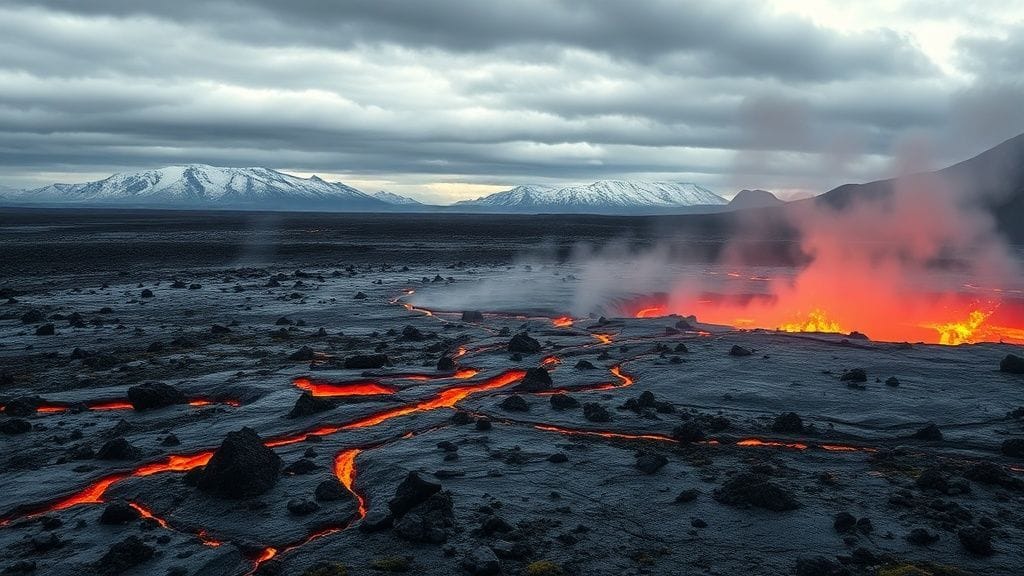
Over months, kilometers of lava streamed over the Holuhraun plain, eventually covering some 85 square kilometers with new rock. Streams of molten basalt created a desolate yet wondrous landscape of twisted, blackened flows, some areas reaching thicknesses of 20 meters. Temperature at the vents surged to over 1,000°C, sending spectacular fountains of lava 50 to 60 meters high.
Villages far from the eruption watched the fiery spectacle with a mix of awe and trepidation. The Holuhraun lava was the largest Icelandic eruption by volume since the Laki fissure in 1783—a historical event that had left deep scars on Europe’s climate and Iceland’s population.
Sky Darkened by Smoke: Environmental and Atmospheric Shifts
The Holuhraun eruption emitted vast quantities of volcanic gases, particularly sulfur dioxide (SO₂), casting a yellow haze across Iceland and even reaching cities in mainland Europe. The pungent smell of sulfur became a grim reminder of the volcano’s invisible impact.
This gas plume affected air quality, causing health issues such as respiratory irritation and forcing authorities to issue warnings. The eruption illustrated that volcanic hazards extend beyond molten rock—airborne pollutants can disrupt lives hundreds of kilometers away.
The Battle Between Ice and Fire: Bárðarbunga’s Glacial Influence
Bárðarbunga’s location under the Vatnajökull ice cap added complexity and drama. Melting from geothermal heat and magmatic intrusion raised fears of a jökulhlaup, a sudden glacial flood that could devastate downstream areas. In late August 2014, a collapse of the caldera floor—evidenced by a subsidence of up to 60 meters—confirmed the magma chamber’s partial emptying.
Yet feared catastrophic floods never fully materialized, thanks to the glacier’s buffering. This battle beneath the ice between fire’s fury and water’s power is an epic of nature rarely witnessed at such scale, and Icelandic scientists gained invaluable insights.
Monitoring Madness: Scientists Race to Decode Nature’s Signals
Iceland’s scientists were on high alert. Instruments measuring seismic activity, ground deformation, gas emissions, and lava flow rates produced mountains of data daily. Each tremor, each ash plume, each shift in the caldera floor was interpreted with feverish attention.
The Icelandic Meteorological Office (IMO), in collaboration with international experts, tasked itself with forecasting eruption behavior and advising civil protection. Their vigilant efforts prevented unnecessary evacuations and helped prepare for worst-case scenarios, underscoring how modern science interfaces with age-old volcanic forces.
The Volcanic Gas Plume: Invisible Hazards and Global Reach
While the lava flows shaped the volcanic landscape, the gaseous emissions painted an invisible but deadly threat in the atmosphere. Estimates ranged upwards of 5 million tonnes of sulfur dioxide emitted over six months—enough to cause acid rain and contribute to atmospheric cooling.
Satellite imagery tracked the plume crossing Europe, prompting aviation alerts and highlighting the global dimension of this localized volcanic event. These emissions remain an area of intensive study, connecting geological phenomena to environmental and climate science.
Voices from the Ground: Eyewitness Accounts and Icelandic Communities
Though remote, the region surrounding Holuhraun is a gateway for Icelandic highland hikers and locals who shared gripping stories. One farmer, recounting the constant distant rumbles, depicted the eruption as “a living beast breathing fire.” Tour guides noted the surreal experience of walking near fountains of incandescent lava, an encounter with primal earth forces.
Communities tens of kilometers away coped with haze, uncertainty, and occasional tremors. Their resilience speaks to the deep relationship Icelanders have cultivated with their volatile land.
Aviation on Alert: Managing Ash Clouds Across Europe
Unlike explosive ash clouds of previous eruptions, Bárðarbunga’s lava was mostly quiet ash-wise. Still, the possibility of explosive phases led to precautionary flight restrictions over Northern Europe.
Air travelers and airlines braced for disruption, recalling the chaos wrought by Eyjafjallajökull four years prior. The event tested Europe’s ability to balance safety, economics, and nature’s unpredictable rhythm.
Economic Ripples: Fishing, Tourism, and Local Livelihoods Tested
Beyond geological drama, the eruption impacted everyday life. Iceland’s fishing industry worried about acid rain fallout affecting aquatic ecosystems. Tourism initially faced uncertainty as tour operators weighed safety concerns.
Yet, after initial caution, the Holuhraun eruption became a tourist attraction, drawing eager visitors to witness fresh volcanic landscapes—a testament to nature’s paradox as both destroyer and creator.
The Slow Waning: Eruption’s End and the Land Reborn
By late February 2015, the volcanic fountains diminished, and the eruption subsided. The fissure sealed, leaving behind a transformed landscape—almost otherworldly, yet raw and pulsing with energy.
Scientists continued to monitor Bárðarbunga’s caldera, noting ongoing seismic activity and gradual stabilization. The Holuhraun lava field stands as a vivid chronicle of months of fire and ash, a fresh testimonial to the earth’s restless creativity.
Legacy of Fire: Bárðarbunga’s Imprint on Science and Society
The Bárðarbunga-Holuhraun eruption enriched scientific understanding of dyke propagation, magma chamber dynamics, and gas emissions. Its lessons influenced volcanic risk management not only in Iceland but globally.
Moreover, it reinforced the community’s intimate bond with volcanic nature—a relationship marked by respect, preparedness, and awe.
Myth, Memory, and Modernity: Iceland’s Eternal Dance with Volcanoes
This eruption became yet another chapter in Iceland’s millennia-old saga of living with volcanic power. From ancient lore to satellite monitoring, from fjords to data centers, Bárðarbunga’s story is a testament to human perseverance amid the earth’s colossal forces.
Conclusion: Reflections on Power, Vulnerability, and Resilience
The Bárðarbunga Holuhraun eruption reminds us of our planet’s raw might—its capacity to remake landscapes in fiery torrents and silent gas clouds. Yet it also speaks of human curiosity, courage, and adaptation. Icelanders faced the volatile spectacle with pragmatic vigilance and cultural reverence.
It is a narrative of coexistence: where ice meets fire, ancient earth meets modern science, and destruction inevitably seeds renewal. As the lava fields cool and time advances, Bárðarbunga’s fiery breath remains etched into Iceland’s geological and human memory—a monument to nature’s unpredictable grandeur.
FAQs
Q1: What caused the Bárðarbunga eruption in 2014–2015?
A1: The eruption was triggered by magma rising beneath the Bárðarbunga volcano, leading to dyke intrusion that extended northward beneath the glacier and broke the surface at Holuhraun. This was driven by Iceland’s location on the Mid-Atlantic Ridge where tectonic plates diverge.
Q2: How long did the Bárðarbunga eruption last?
A2: The eruption began in late August 2014 and ceased in February 2015, spanning approximately six months of sustained lava flows.
Q3: What were the main hazards associated with this eruption?
A3: The primary hazards were extensive lava flows, emissions of sulfur dioxide gas causing air pollution and health risks, and seismic activity including glacial floods, though no such floods caused serious damage.
Q4: How did the eruption affect nearby communities?
A4: Though the eruption occurred in a sparsely populated area, nearby communities experienced air quality issues, seismic tremors, and disruptions in tourism and fishing industries.
Q5: What scientific advances resulted from studying this eruption?
A5: Scientists gained new insights into magma dyke propagation, caldera subsidence, volcanic gas emissions, and improved eruption prediction models.
Q6: How does the Bárðarbunga eruption compare to previous Icelandic eruptions?
A6: It was the largest by lava volume since the historic Laki eruption of 1783, but less explosive and ash-rich than Eyjafjallajökull in 2010.
Q7: What role did Iceland’s glaciers play during the eruption?
A7: The glaciers over Bárðarbunga absorbed some heat, mitigating glacial floods, but melting and glacier collapse also occurred due to the volcanic activity beneath.
Q8: Is Bárðarbunga still active?
A8: Bárðarbunga is an active volcanic system monitored continuously; while the 2014–2015 eruption ended, seismic activity remains a sign of ongoing volcanic potential.

