Table of Contents
- A Fiery Prelude: The Midnight Awakening of Askja
- Iceland on the Brink: The Nation Before the Eruption
- The Building Storm: Geological Forces at Play
- The Night the Sky Burned: October 1875’s First Explosions
- Witnesses of Fire and Ash: Eyewitness Accounts and Tales
- The Mountain Roars: Magnitude and Progression of the Eruption
- The Dark Blanket: Ash Clouds and Their Deadly Spread
- Nature’s Fury Unleashed: The Impact on Iceland’s Landscape
- Human Tragedy: The Displacement and Suffering of Local Populations
- The Silent Villages: Agricultural Ruin and Economic Collapse
- Exodus and Diaspora: From Iceland to America
- Scientific Curiosity Awakened: Early Volcanology and Askja’s Lessons
- Comparison with Past and Future Eruptions: A Unique Catastrophe
- The Eruption’s Global Reach: Climatic Ripples Across the Northern Hemisphere
- Myths Forged in Fire: Askja in Icelandic Culture and Memory
- Rebirth from Ash: Ecosystem Recovery and Environmental Changes
- The Volcano Today: Askja’s Continuing Role in Geology and Tourism
- The Long Shadow: Askja’s Place in Iceland’s National Identity
- Conclusion: Nature’s Indomitable Will and Human Resilience
- FAQs about the 1875 Askja Eruption
- External Resource
- Internal Link
The plumes of fire, the roar of the ancient earth cracking open—those are the images that defined the night of October 1875 in Iceland, when Askja, a remote volcano nestled deep in the country’s central highlands, violently awoke after centuries of dormancy. The eruption was not just a geological event; it was a turning point that reshaped landscapes, lives, and the understanding of nature itself. Picture the sky over the stark Icelandic wilderness painted in hues of orange and black, fields of ash swallowing homes whole, and the desperate exodus of entire communities fleeing a destruction they could neither comprehend nor halt.
This was not a sudden catastrophe sprung from nowhere. It was the climax of forces simmering beneath the surface for thousands of years—a dramatic episode in Iceland's eternal dance with fire and ice. The eruption would have consequences far beyond the molten rock and drifting dust. It would sow despair, stir scientific inquiry, sculpt the identity of a nation, and even send ripples across continents.
The story of the 1875 Askja eruption is a profound testament to the volatile power of the earth and the resilience of its people. To understand its magnitude, we must begin with the Iceland that existed before the flame.
1. A Fiery Prelude: The Midnight Awakening of Askja
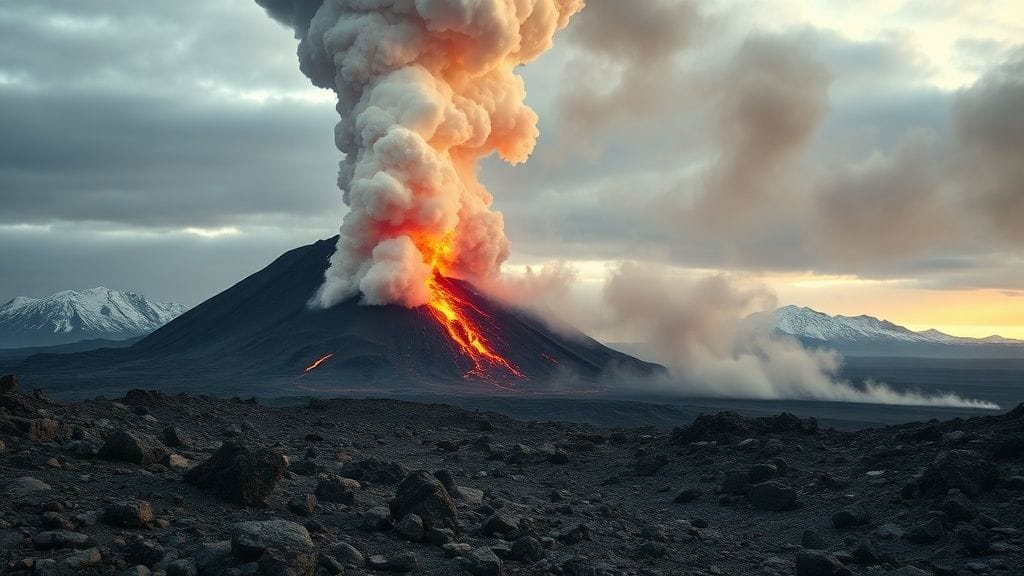
October 28, 1875. The air was cold and crisp beneath the stark, rugged skyline of Iceland’s central plateau. Yet beneath that calm, the ground betrayed its quiet surface with a rumble of seismic unrest. Then, as if summoned by an ancient vow, Askja erupted. It began with a towering column of smoke and ash suddenly bursting from the earth’s fissure, blotting out the stars and casting the stark landscape in an eerie glow.
In the early hours, the eruption expanded—fire fountains spitting molten rock hundreds of feet into the sky, accompanied by deafening explosions that shattered the night’s stillness. From afar, villagers watched helplessly, the horizon glowing ominously in the distance like the gates of some underworld flung open.
The sky was a turbulent canvas of incandescent red smudged with thick, choking ash. This first night was not merely the start of an eruption but the birth of a legend—of a mountain that torn apart, reshaped, and flaunted its wrath against the land and life.
2. Iceland on the Brink: The Nation Before the Eruption
In the 19th century, Iceland was a nation clinging to tradition in a harsh but beautiful environment. Populated by mostly small farming communities and scattered settlements, life was challenging. The island’s volcanic nature was familiar—fjords, glaciers, hot springs, and previous eruptions had shaped the land and informed folklore. Yet even so, Icelanders largely viewed volcanoes with a mixture of respect and resignation, aware of their destructive power but reliant on the land they shaped.
Politically, Iceland was still under the Danish crown, struggling for autonomy and national identity. Its economy hinged precariously on agriculture, fishing, and some trade. Many families were self-sufficient but vulnerable to natural disasters that could wipe out their fragile livelihoods overnight.
In this context, the Askja eruption was more than a geological event; it threatened the very survival of communities and challenged Iceland’s steady rhythm of life.
3. The Building Storm: Geological Forces at Play
Askja is one of the largest volcanic systems in Iceland, located in the Vatnajökull National Park region. It lies on the Mid-Atlantic Ridge, where the Eurasian and North American tectonic plates slowly diverge. This tectonic activity, combined with mantle plumes beneath Iceland, fuels continuous volcanic and geothermal dynamics.
Before 1875, Askja had been dormant for centuries. But beneath its surface, magma had been accumulating, pressure building silently. Increased earthquakes in the months leading to October indicated a change underground. A series of smaller eruptions in neighboring areas foreshadowed that Askja's chamber was primed to explode.
When the pressure finally became unbearable, the crust fractured spectacularly, opening fissures and collapsing parts of the caldera. The geological drama that followed was a textbook case of how rifts and hotspots combine to unleash some of Earth's most violent natural spectacles.
4. The Night the Sky Burned: October 1875’s First Explosions
The eruption commenced in the late evening, bursting into the night like a cataclysmic beacon. Witnesses described a sky split by lightning within ash clouds, with bombs of molten rock raining down. The atmosphere grew thick and heavy, filled with sulfurous gases that burned the eyes and lungs of all who dared approach.
The first day saw the creation of a deep caldera as parts of the mountain collapsed into emptied magma chambers. This depression would later become the famous Víti crater, a name meaning “hell” in Icelandic—a fitting label for this volcanic inferno.
Explosive phases alternated with quieter lava fountains, a pattern lasting several weeks. The interplay of fire and ash was relentless, forcing residents to flee their homes amidst choking darkness.
5. Witnesses of Fire and Ash: Eyewitness Accounts and Tales
Eyewitness testimonies from local inhabitants and visitors provide haunting and vivid portraits of the eruption. Jón Pétursson, a farmer from the vicinity, recalled the eerie silence before the initial blast, followed by a “light as if the sun had exploded.” Others spoke of rivers of lava streaming across the high plateau like glowing serpents and ash turning the snow black in a matter of hours.
Foreign scientists and explorers, drawn by the unfolding event, arrived to document a rare spectacle. Danish geologist Þorvaldur Thoroddsen later reflected on the eruption’s scale and chaos, noting the “devastating beauty,” a phrase that encapsulates both awe and fear.
These narratives transform geological data into human experience, highlighting the emotional and existential crises generated by living amidst destruction.
6. The Mountain Roars: Magnitude and Progression of the Eruption
Askja’s 1875 eruption ranked among the most powerful volcanic events in Iceland’s recorded history. It was characterized by highly explosive Strombolian and Plinian phases, with lava flows spreading over tens of square kilometers.
The eruption reshaped the terrain, creating new craters, fissures, and lava fields. Its progression was marked by bursts of activity interspersed with phases of relative calm, giving locals brief, tense respites.
Researchers estimate the erupted volume to have been around 0.7 cubic kilometers of material—enough to blanket extensive areas and dramatically alter the physical geography.
7. The Dark Blanket: Ash Clouds and Their Deadly Spread
Arguably, one of the most devastating aspects was the pervasive ash fallout. Ash clouds soared miles into the atmosphere, drifting with prevailing winds to cover much of northern and eastern Iceland. This grey shroud blotted out sunlight, poisoned grazing land, and contaminated water supplies.
Ash was so thick in some places that daylight resembled twilight. The weight of accumulated ash destroyed roofs and vegetation, compounding the disaster.
Beyond Iceland’s shores, modest ash fall affected parts of Scandinavia and the British Isles, drawing international scientific attention and warning of volcanic eruption’s wide-reaching impacts.
8. Nature’s Fury Unleashed: The Impact on Iceland’s Landscape
The physical aftermath of the eruption was profound. Forests—in limited patches where trees grew—were scorched or buried. Rivers were blocked or diverted. Farmlands turned into barren deserts of volcanic sand and pumice. The temperature of local waters increased, affecting fish and aquatic life.
Víti crater, formed by explosive activity, became a stark, eerie lake—one of Iceland’s most famous volcanic landmarks. Lava fields spread vast and desolate, remnants of the mountain’s wrath frozen mid-flow.
Askja’s eruption sculpted a rugged wilderness, simultaneously a monument to destruction and a cradle of renewal.
9. Human Tragedy: The Displacement and Suffering of Local Populations
The eruption was disastrous for Iceland’s fragile rural communities. Entire farms were buried under ash and pumice; livestock perished in the choking air or starvation as grazing land vanished overnight.
Families faced starvation, disease, and homelessness. Many were forced to abandon ancestral lands, some never to return. The psychological trauma of witnessing their livelihoods consumed was immense.
The crisis exacerbated poverty and hardship in already struggling parts of Iceland, deepening divides between geologically safer and more perilous regions.
10. The Silent Villages: Agricultural Ruin and Economic Collapse
Beyond immediate destruction, agriculture suffered long-term damage. Ash-infused soil was barren, crops failed for years, and food shortages became commonplace. The economy, reliant on farming, took a hard blow.
Sheep farming, essential for wool and meat, suffered incalculable losses. Fishing, while less directly impacted, faced its own challenges due to ecological changes.
Markets stalled, trade diminished, and entire communities faced socioeconomic collapse, pushing many to despair or desperate measures.
11. Exodus and Diaspora: From Iceland to America
Faced with desperation, many Icelanders embarked on arduous journeys to seek new lives. The eruption accelerated waves of emigration to North America, particularly to the U.S. Midwest and Canada.
The 1870s saw significant migration increases, as displaced farmers searched for fertile lands and stability. This diaspora reshaped Icelandic society by thinning rural populations and spreading Icelandic culture abroad.
For many, the eruption was both a moment of loss and a catalyst for new beginnings on foreign soil.
12. Scientific Curiosity Awakened: Early Volcanology and Askja’s Lessons
Askja’s 1875 eruption became a milestone for the then-burgeoning science of volcanology. Though specialized geological study was in its infancy, observations of Askja helped pioneer understanding of caldera formation, eruption phases, and ash dispersion.
Scientists like Thoroddsen collected samples, recorded seismic data, and mapped the altered landscape. Their work laid foundations still relevant today.
The event highlighted Iceland as a natural laboratory for geophysical research, attracting future generations of scientists.
13. Comparison with Past and Future Eruptions: A Unique Catastrophe
Though Iceland is known for volcanic activity—like Laki’s 1783 flood basalts or the 2010 Eyjafjallajökull eruption—Askja’s 1875 event stood out for its combination of explosive power, ash production, and socio-economic impact.
Unlike the prolonged lava flows of Laki, Askja’s eruption was shorter but more violent. It served as a chilling reminder of the range of volcanic behaviors in Iceland’s complex geological setting.
Subsequent eruptions confirmed Askja’s place among the most significant powerhouses of the Icelandic volcanic system.
14. The Eruption’s Global Reach: Climatic Ripples Across the Northern Hemisphere
The vast ash emission and released aerosols from Askja entered the stratosphere, influencing weather patterns. Scientific studies link the eruption to cooler temperatures and crop failures across parts of Europe and possibly North America in the following years.
While not on the scale of later eruptions like Krakatoa, Askja’s global footprint demonstrated how localized volcanic events monitored in remote Iceland could have planetary consequences.
Its atmospheric impact triggered early conversations on the interconnectedness of earth systems.
15. Myths Forged in Fire: Askja in Icelandic Culture and Memory
Icelanders have incorporated Askja’s eruption into their rich tapestry of folklore and cultural identity. The name Víti, meaning “hell,” evokes the terrifying spectacle that scarred the land and psyche.
Stories of the “Fire Mountain” blend historical fact and myth, warning of nature’s unpredictable peril. Poets and writers have immortalized the eruption, capturing its dual nature of devastation and awe.
Askja remains a symbol of Iceland’s wild heart—both beloved and feared.
16. Rebirth from Ash: Ecosystem Recovery and Environmental Changes
Despite the initial devastation, the volcanic soils of Askja proved fertile over time. Natural succession began: lichens, mosses, and hardy plants colonized the ash fields, gradually restoring life.
The new landscapes foster unique ecosystems adapted to volcanic environments. This cycle of destruction and regeneration draws ecologists and nature lovers alike.
Askja thus embodies nature’s resilience—a phoenix rising slowly from its burnt ashes.
17. The Volcano Today: Askja’s Continuing Role in Geology and Tourism
Today, Askja is a site of intense scientific interest and rugged tourism. The caldera and the Víti crater are destinations for adventurous visitors seeking to experience Iceland’s primal forces firsthand.
Ongoing monitoring keeps watch for renewed activity, as Askja remains restless beneath its frozen exterior. Its lakes and lava fields attract volcanologists aiming to decode ongoing earth dynamics.
Askja today is a living classroom, bridging past and future, science and myth.
18. The Long Shadow: Askja’s Place in Iceland’s National Identity
The 1875 eruption casts a long shadow over Icelandic history, epitomizing the country’s unique relationship with its natural environment. It reminds Icelanders of vulnerability, courage, and adaptation.
The eruption’s story is taught in schools, commemorated in literature and art, and shapes national narratives of endurance amid elemental forces.
Askja is not merely a volcano—it is part of Iceland’s soul.
Conclusion
The 1875 eruption of Askja was more than a moment of geological upheaval; it was a crucible where nature's fierceness collided with human endurance. From the first violent explosion that lit up the midnight sky to the slow recovery of ecosystems and communities, the tale of Askja is both a warning and an inspiration.
It tells us of a land born of fire and shaped by ice, a people who lived and died with the mountain’s breaths, and a planet where distant eruptions can ripple through atmospheres and lives continents away. In the ruins left behind, Iceland forged resilience—an enduring testament to the unpredictable power of the earth and the indomitable spirit of those who call it home.
Askja’s legend continues to resonate, a fiery chapter in the story of a land forever caught between creation and destruction.
FAQs about the 1875 Askja Eruption
Q1: What caused the Askja eruption of 1875?
A1: The eruption was triggered by tectonic plate divergence along the Mid-Atlantic Ridge combined with magma pressure buildup beneath the volcano, causing the crust to fracture and release volcanic material explosively.
Q2: How severe was the eruption in terms of scale?
A2: It produced about 0.7 cubic kilometers of erupted material, created a large caldera including the Víti crater, and spread thick ash across northern and eastern Iceland, marking it as one of Iceland’s most powerful eruptions.
Q3: What effects did the eruption have on local populations?
A3: The eruption devastated farms, killed livestock, poisoned grazing land, forced evacuations, and caused widespread famine and economic hardship, leading to significant emigration from affected regions.
Q4: Did the Askja eruption influence climate beyond Iceland?
A4: Yes, ash and aerosols released into the atmosphere contributed to cooler temperatures and crop disruptions in parts of Europe and possibly North America in subsequent years.
Q5: How did the eruption affect scientific understanding of volcanology?
A5: The event prompted detailed study of caldera formation, eruption phases, and ash dispersal, helping to advance early volcanology and establish Iceland as a key location for geological research.
Q6: Is Askja still active today?
A6: Yes, Askja remains an active volcanic system closely monitored due to its history and potential for future eruptions. It serves as an important site for ongoing geological observation.
Q7: How is Askja remembered in Icelandic culture?
A7: The eruption entered folklore and literature, with places like the Víti crater symbolizing "hell." It is remembered as a defining event encapsulating Iceland’s natural power and human resilience.
Q8: What is the current ecological status of the Askja region?
A8: The area has undergone gradual ecological recovery, with volcanic soils supporting new plant life and unique ecosystems adapted to the volcanic landscape, illustrating nature’s regeneration.

