Table of Contents
- The Thunderous Awakening: Krakatau’s Fiery Prelude
- Sunda Strait: The Crucible of Nature’s Fury
- A World on the Brink: The Global Context of 1883
- The First Roar: August 26’s Explosive Awakening
- The Cataclysm Unfolds: August 27’s Immense Eruption
- Fire, Steam, and Sea: The Collapse of Krakatau’s Caldera
- The Devastating Tsunami: Waves That Engulfed the Coast
- Eyewitness Voices: Tales from the Survivors
- Death and Destruction: Human Toll and Environmental Ruin
- The Atmospheric Aftershock: Ash Clouds and Global Climate
- Krakatau’s Sound Heard Around the World: A Sonic Phenomenon
- Scientific Marvels: How Krakatau Changed Volcanology Forever
- Rebirth from Ashes: The Ecological Recovery of the Island
- Myth, Memory, and Media: Krakatau in Popular Culture
- Lessons Learned: Human Vulnerability and Preparedness
- The Legacy of Krakatau in Modern Indonesia
- Krakatau and the Dawn of Global Natural Disaster Awareness
- The Volcano in Art and Literature: From Horror to Inspiration
- Remembering 1883: Centennials and Commemorations
- Conclusion: The Eternal Voice of the Mountain's Fury
- FAQs: Unraveling the Mysteries of Krakatau’s Eruption
- External Resource
- Internal Link
When the ground trembled and the sky ignited above the Sunda Strait in August 1883, the world bore witness to one of nature’s most terrifying and awe-inspiring spectacles. The eruption of Krakatau would not simply shatter the islands surrounding it; it would echo across continents, stir the imaginations of millions, and challenge humanity’s understanding of the planet’s volatile forces. The thunderous roars that tore through the tropical night marked the beginning of a cataclysm unlike any other. This is the story of Krakatau’s fiery wrath: a narrative carved in ash, steam, and sea.
1. The Thunderous Awakening: Krakatau’s Fiery Prelude
In the months leading to August 1883, Krakatau—an island straddling the narrow Sunda Strait between Java and Sumatra—had already begun rumbling ominously. The volcano, unassuming to many but long known to local populations and seafarers, started showing signs of unrest. Steam vents hissed, darkness thickened the skies, and faint tremors shook the earth beneath dense tropical forests. Few could have envisioned that these subtle whispers would escalate into a deafening roar.
2. Sunda Strait: The Crucible of Nature’s Fury
The Sunda Strait is a narrow, bustling marine corridor connecting the Indian Ocean and the Java Sea, dotted with islands that had long been home to vibrant communities. Krakatau sat like a sleeping giant in this strategic waterway. The region was a mix of colonial interests—Dutch-controlled Indonesia—and indigenous cultures, each with legends of volcanic wrath. Understanding the geography is crucial: Krakatau was not isolated. Its eruptions would impact densely populated coastlines and major trade routes, amplifying the disaster’s human cost.
3. A World on the Brink: The Global Context of 1883
The year 1883 was marked by rapid industrial advances and colonial expansion. News traveled slower than the eventual reach of Krakatau’s ash cloud. Yet soon, newspapers in Europe and America would carry grim headlines describing the hellish scenes unfolding thousands of miles away. The eruption happened during a period when scientific curiosity about volcanism was rising but had yet to fully grasp the planet’s interconnected atmospheric systems. This lack of understanding fed into a mix of fear, wonder, and political reflection worldwide.
4. The First Roar: August 26’s Explosive Awakening
On the morning of August 26, the volcano exploded with great force. The initial blasts shattered the calm, sending towering plumes of ash and gas miles into the sky. The signature sound was unlike any thunder the locals had heard—it was a guttural, ripping bellow that seemed to tear the very air apart. Smoke darkened the daylight; the sea churned with fury. For those living nearby—in villages on Sumatra and Java—the roar was both a signal and a dire threat.
5. The Cataclysm Unfolds: August 27’s Immense Eruption
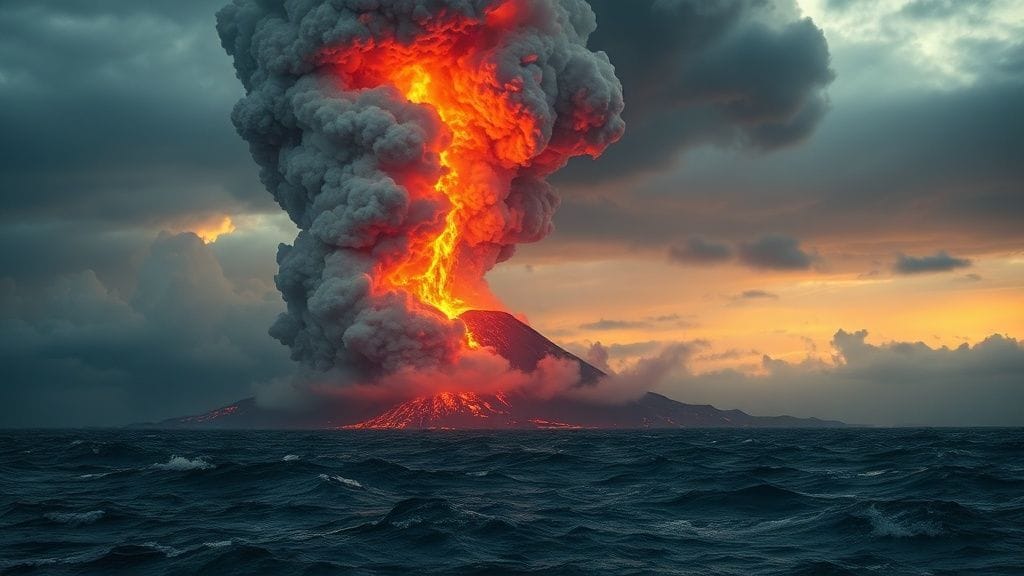
The night of August 27 was the climax of Krakatau’s fury. Multiple giant explosions ripped through the island, pulverizing the core of the volcano. The sound waves traveled an estimated 3,000 miles, heard on islands and ships far out at sea. Columns of ash shot skyward, blotting out stars and turning night into an eerie fiery gloom. Lava fountains lit the darkness, while enormous pyroclastic flows raced down slopes into the ocean, triggering violent steam explosions.
6. Fire, Steam, and Sea: The Collapse of Krakatau’s Caldera
The overwhelming pressure led to the catastrophic collapse of Krakatau’s volcanic cone. Gigantic portions of the island caved into the ocean, creating a massive underwater landslide. This cataclysmic event shook the seabed and displaced enormous volumes of water. The violent interaction of fire, steam, and sea became a textbook case of what geologists now understand as a caldera-forming eruption.
7. The Devastating Tsunami: Waves That Engulfed the Coast
The underwater landslide and explosion generated enormous tsunamis. Waves, some reported as high as 40 meters (130 feet), slammed into the surrounding shorelines. Entire villages were swept away in seconds. Thousands drowned, their cries drowned out by the roaring ocean. The tsunami’s reach extended across the Sunda Strait and beyond, ravaging coastal communities on Sumatra and Java. This deadly wave was one of the greatest killers in this disaster, compounding the volcanic destruction.
8. Eyewitness Voices: Tales from the Survivors
Amid the horror, stories of survival emerged—fishermen caught at sea, families clinging to trees, villagers fleeing into hills. One account tells of a man who watched the island explode into fiery fragments from three miles away; another recalls children huddled in caves, emerging to find their homes obliterated. These testimonies give a human face to the cataclysm, where nature’s fury met human fragility.
9. Death and Destruction: Human Toll and Environmental Ruin
Estimates of the death toll vary but range between 36,000 and 120,000 lives lost—arguably one of the deadliest volcanic disasters recorded. The physical destruction was immense: farms destroyed, forests burnt, sea life devastated. Ash blanketed the land for hundreds of miles, rendering water supplies toxic and air choked with particulates. The immediate aftermath was a crucible of disease, hunger, and displacement.
10. The Atmospheric Aftershock: Ash Clouds and Global Climate
Beyond the immediate vicinity, Krakatau’s eruption had far-reaching atmospheric impacts. Enormous volumes of sulfur dioxide and ash were injected into the stratosphere, leading to spectacular sunsets around the globe for years after. Scientists later linked the eruption to global temperature drops and “volcanic winters.” The planet’s climate responded to Krakatau’s invisible hand, reminding humanity of the interconnectedness of earth systems.
11. Krakatau’s Sound Heard Around the World: A Sonic Phenomenon
The explosion was the loudest sound known in recorded history. Its echoes circled the globe multiple times, measured on barographs thousands of kilometers away. Sailors reported the sound as a continuous roar lasting several minutes, shaking ships even far out at sea. This sonic phenomenon challenged contemporary scientists’ understanding of sound propagation and remains a symbol of nature’s raw power.
12. Scientific Marvels: How Krakatau Changed Volcanology Forever
Krakatau’s eruption was a pivotal moment in volcanic science. For the first time, detailed observations linked volcanic activity to atmospheric and oceanic phenomena on a global scale. Scientists such as Rogier Verbeek conducted extensive investigations, pioneering volcano hazard mapping and interpretations of caldera formation. Krakatau became a natural laboratory for understanding pyroclastic flows, tsunamis, and volcanic climate forcing.
13. Rebirth from Ashes: The Ecological Recovery of the Island
Remarkably, life returned to Krakatau. Over decades, biologists documented the gradual recolonization of the island by plants, insects, and birds. This natural experiment offered insights into ecological succession and resilience. New vegetation created habitats, and the island slowly transformed from a barren wasteland into a burgeoning ecosystem, offering hope amid desolation.
14. Myth, Memory, and Media: Krakatau in Popular Culture
The eruption captured popular imagination worldwide through newspapers, photographs, and later films. It inspired literature exploring the sublime and terrifying aspects of nature. Locally, oral traditions evolved, weaving Krakatau into mythic narratives. The name “Krakatau” became synonymous with apocalyptic power, featuring in countless works and continuing to evoke awe.
15. Lessons Learned: Human Vulnerability and Preparedness
The disaster exposed the limits of human preparedness and the need for disaster risk reduction. It prompted Dutch colonial authorities and later independent Indonesia to develop early warning systems and disaster-response protocols. Krakatau remains a stark reminder of how societies must balance coexistence with nature’s unpredictable forces.
16. The Legacy of Krakatau in Modern Indonesia
Today, Krakatau’s legacy endures not only in geological terms but also in cultural memory and national identity. The volcano is monitored constantly; its lessons inform regional disaster management. It has fostered scientific collaboration and tourism, reminding modern Indonesians of resilience amidst challenge.
17. Krakatau and the Dawn of Global Natural Disaster Awareness
The eruption marked a turning point in how the world viewed natural disasters. Krakatau’s global atmospheric impacts heightened awareness of nature’s reach beyond local borders, laying groundwork for international cooperation in monitoring and responding to catastrophes.
18. The Volcano in Art and Literature: From Horror to Inspiration
Artists and writers captured Krakatau’s drama in vivid imagery—depicting both destruction and renewal. Its fiery spectacle and sonic snarls feature in poetry, painting, and later cinema, symbolizing the sublime terror and beauty of the natural world.
19. Remembering 1883: Centennials and Commemorations
Commemorations around the eruption have kept its memory alive. Centenary events in 1983 brought scientists, historians, and descendants of survivors together, blending mourning with reflection on scientific progress. Krakatau remains a powerful symbol of nature’s grandeur and fragility.
Conclusion: The Eternal Voice of the Mountain's Fury
The eruption of Krakatau was not merely an isolated geological event but a profound moment that resonated far beyond the Sunda Strait. It was a violent reminder of the earth’s restless heart and humanity’s place within its vast narrative. In ash and ocean, in sound and silence, the mountain’s fury continues to speak—of destruction, survival, and rebirth. Krakatau teaches us humility in the face of nature’s overwhelming power and hope in the relentless cycle of life.
FAQs: Unraveling the Mysteries of Krakatau’s Eruption
Q1: What caused the Krakatau eruption in 1883?
The eruption was triggered by magma rising through the earth’s crust beneath the volcano, increasing pressure until the cone catastrophically exploded. The unique geological setting at the convergent boundary of the Indo-Australian and Eurasian plates contributed to Krakatau’s volatility.
Q2: How powerful was the eruption of Krakatau in terms of energy released?
Estimates suggest the energy released was equivalent to over 200 megatons of TNT, surpassing many modern nuclear explosions and making it one of the most powerful eruptions in recorded history.
Q3: Why was the sound of the eruption heard so far away?
The immense explosion generated extremely low-frequency sound waves that traveled tens of thousands of kilometers through the atmosphere, allowing it to be heard across the Indian Ocean and beyond.
Q4: How many people died because of the eruption and subsequent tsunami?
Casualty estimates range from 36,000 to possibly over 120,000 people, with many victims drowned by the tsunami waves caused by the volcanic collapse and underwater landslides.
Q5: Did Krakatau’s eruption affect global climate?
Yes, the injection of sulfur dioxide and ash into the stratosphere caused a measurable drop in global temperatures and spectacular sunsets worldwide, phenomena associated with volcanic “volcanic winters.”
Q6: How has Krakatau changed since 1883?
The original island was largely destroyed, but new volcanic activity has formed Anak Krakatau (“Child of Krakatau”), a smaller island born from ongoing eruptions since 1927, symbolizing the volcano’s continuing life cycle.
Q7: What scientific advances resulted from studying Krakatau?
Krakatau’s eruption propelled advances in volcanology, meteorology, and oceanography, especially in understanding pyroclastic flows, tsunamis, eruption waves, and atmospheric impacts of volcanic activity.
Q8: How is Krakatau remembered and commemorated today?
Through scientific research, memorial events, museum exhibits, literature, and cultural traditions in Indonesia and worldwide, Krakatau is remembered as a powerful symbol of natural disaster and resilience.

