Table of Contents
- The Roar of Mount Agung: Prelude to Catastrophe
- Bali in the Early 1960s: A Land of Contrasts
- The Geological Imperative: Understanding Mount Agung
- Signs of a Sleeping Giant: Early Warnings in 1963
- Local Responses: Balinese Faith Meets Natural Fear
- The First Explosions: October 1963 Awakens the Volcano
- Ash Clouds and Earthquakes: The Island’s Darkening Sky
- The Cataclysmic Eruption: March 1963’s Deadly Fury
- The Human Toll: Lives Lost and Homes Devastated
- Government and International Reaction amid Crisis
- The Cultural Shock: How Faith Was Challenged and Reinforced
- Volcanic Aftershocks: The Continuing Agung Activity
- Evacuation and Resettlement: The Struggle to Survive
- Agricultural Devastation and Economic Fallout
- Scientific Insights Gleaned from the Eruption
- The Long Shadow: Environmental and Social Repercussions
- Mount Agung in Balinese Myth and Identity Post-Eruption
- Global Attention on Volcanic Hazards: Lessons Learned
- Remembering 1963: Memorials and Oral Histories
- The Eruption’s Place in the Larger Indonesian Political Context
- Volcano Tourism Emerges: A New Chapter for Bali
- Contemporary Monitoring and Preparedness Inspired by 1963
- Agung Today: Nature’s Quiet Reminder
- The Legacy of 1963–1964: Balancing Risk and Reverence
The Roar of Mount Agung: Prelude to Catastrophe
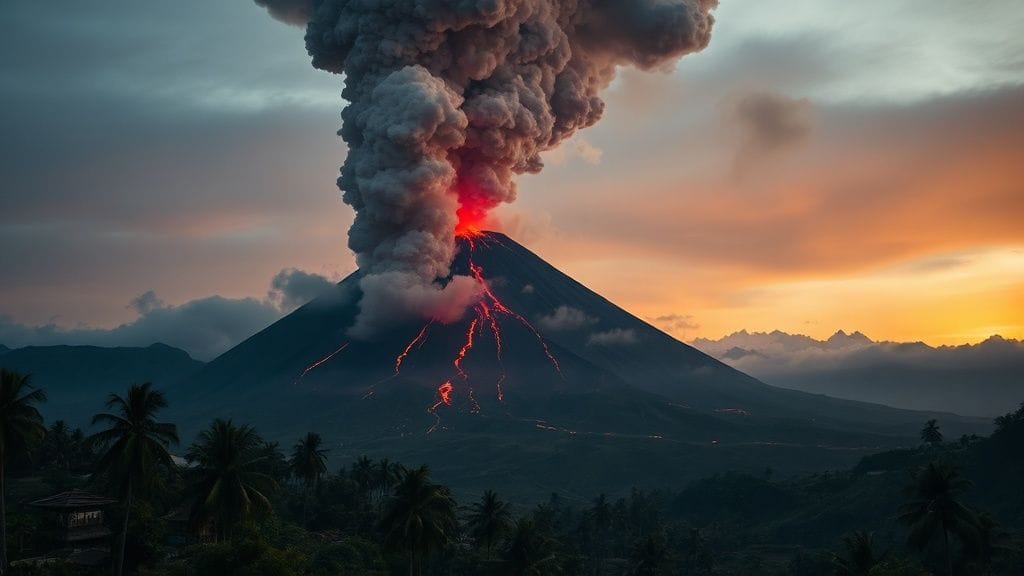
Imagine waking in the predawn hours to an ominous tremor rippling beneath your feet, a low rumbling heartbeat expressing the throbbing unrest of the earth itself. For the people of Bali in the early 1960s, this was no dream but an encroaching reality. The mighty Mount Agung—venerated as the spiritual heart of the island—was stirring to life after centuries of slumber. The air soon thickened with ash; the sky darkened with clouds of volcanic smoke, foreshadowing tragedy to come. It was a time when faith, fear, and nature collided with breathtaking violence.
In 1963 and into 1964, one of the 20th century’s most powerful volcanic eruptions unfolded in Bali, Indonesia, forever altering the island’s landscapes, ecosystems, societies, and psyche. The eruption of Mount Agung would claim thousands of lives, destroy villages, and upend centuries-old ways of living. Yet, it also inspired scientific discovery, demonstrated the resilience of Balinese culture, and transformed the approach to volcanic hazard management in tropical island environments.
This is the story of the Agung eruption, told with the textures of human experience, geological inevitability, and historical consequence.
Bali in the Early 1960s: A Land of Contrasts
To understand the magnitude of the 1963 eruption, it is essential to step back into Bali of the early 1960s—a place of vibrant cultural traditions intertwined with modern pressures. The island was, and continues to be, renowned for its intricate caste systems, deeply religious Hindu Balinese society, and a thriving agrarian way of life centered around rice paddies and irrigation channels (subak). Rural villages cherished their relationship with nature and the gods, embodied most vividly in the reverence afforded to Mount Agung itself, regarded as the abode of the supreme deity.
At the same time, Bali was slowly opening itself to the outside world. The 1960s marked the beginning of international tourism, political shifts were brewing within Indonesia after independence in 1945, and infrastructural improvements were underway. Yet the island’s infrastructure and disaster preparedness remained rudimentary. The land was vulnerable, and its people lived in the shadow of an ancient volcano whose last notable eruption had been in 1843—a memory only of the oldest generations.
The juxtaposition of age-old beliefs and modern challenges framed the stage for the events about to unfold.
The Geological Imperative: Understanding Mount Agung
Mount Agung is no ordinary mountain. It rises over 3,000 meters above sea level, dominating the eastern landscape and playing a critical role in both geology and culture. Classified as a stratovolcano, Agung’s formation is the consequence of the tectonic rings around the Pacific “Ring of Fire”—a zone notorious for seismic and volcanic volatility.
Geologically, Mount Agung sits atop a complex subduction zone where the Indo-Australian Plate slips beneath the Eurasian Plate. Magma accumulates beneath the summit within a vast chamber, cooled but volatile, capable of unleashing pyroclastic fury and lava flows at any time. Its previous eruptions, recorded sporadically over centuries, were marked by long quiescent intervals punctuated by violent episodes—making it as unpredictable as it was dangerous.
The volcano’s temperament was historically tied to cycles that challenged human settlement in its shadow, yet yielded fertile soils enriching agriculture. This precarious balance between benevolence and destruction was about to tip over in a way never seen before.
Signs of a Sleeping Giant: Early Warnings in 1963
Throughout early 1963, signs of agitation began to unsettle Mount Agung. Local villagers and watchful priests observed increased fumarolic activity—visible steam and gas emissions—while subtle tremors rocked isolated settlements. Records from Indonesian geological monitoring, although limited at the time, noted unusual patterns of seismicity by mid-year.
An eerie silence followed sudden mounds of ash and smoke, felt even by travelers and officials who ventured close to the mountain. Old Balinese rituals, normally steady and reassuring, were performed with an anxious edge, invoking protective deities and seeking to appease the restless mountain spirit.
The first clear warning emerged in October 1963 when a series of explosive eruptions shattered the calm, spewing ash that darkened skies as far as 1,000 kilometers away. The air was thick with sulfur—the unmistakable breath of the volcano’s awakening.
Yet many villagers, reliant on the mountain’s bounty, hesitated to abandon their homes despite displacement advisories. It would prove to be a tragic hesitation.
Local Responses: Balinese Faith Meets Natural Fear
In Balinese culture, Mount Agung was not merely a geological entity but an axis mundi—a sacred connection between the physical and spiritual realms. The volcano was home to gods and ancestors, its eruptions interpreted as divine messages.
When tremors and eruptions began, local priests and shamans conducted purification ceremonies and traditional sacrifices, attempting to appease the volcano’s spirit. Such rituals were both acts of faith and psychological bulwarks against mounting fear. People spoke openly of the mountain’s anger and hoped the ceremonies could calm its wrath.
However, these spiritual responses were juxtaposed with very real fears: the ash fall contaminated crops; water sources became scarce; respiratory illness rose. Communities faced a painful dilemma—whether to believe in the protective power of faith or yield to the scientific warnings of imminent disaster.
While some began organized evacuations, others stayed, drawing on centuries-old beliefs. This tension between tradition and survival would shape the human tragedy soon to unfold.
The First Explosions: October 1963 Awakens the Volcano
On October 18, 1963, the dream of balance ended. That day, Mount Agung erupted with enormous force, producing towering ash columns that blotted out the sun. Thunderous explosions echoed across the island, felt as far as Java.
The eruption expelled hundreds of millions of cubic meters of pyroclastic material. Ash clouds climbed tens of kilometers into the atmosphere, disrupting daily life and bringing darkness even in midday. Villages within the volcano’s immediate vicinity were hit by pyroclastic flows—hot avalanches of ash and gas that obliterated all in their path.
These first explosions were not one isolated event but the start of months of volcanic fury. Residents struggled to interpret the scale of the threat while many still clung to hope that the mountain’s rage would subside.
Ash Clouds and Earthquakes: The Island’s Darkening Sky
For weeks following the initial eruption, Bali was cloaked in a persistent drape of gray ash. Skies alternated between heavy darkness and eerie orange hues, the sun a phantom behind volcanic haze. Ash dusted rooftops, fields, and waterways, a stubborn layer that smothered life and complicated recovery efforts.
Earthquakes rattled the island in frequent bursts, fracturing homes and roads. Many Balinese reported unbearable headaches and respiratory distress—a physical testament to the eruption's indiscriminate violence. Schools closed, markets shuttered, and trade slowed.
This tumultuous period also strained the island’s social fabric. Families huddled together for safety, while some leaders scrambled to coordinate evacuations. Communication challenges exacerbated the chaos, given Bali’s mountainous terrain and limited infrastructure.
Yet even in despair, the community found moments of solidarity—neighbors shared food, faith gatherings continued, and resilience quietly grew.
The Cataclysmic Eruption: March 1963’s Deadly Fury
While the initial eruption shocked the island in October, it was in February and March of 1964 that Mount Agung unleashed its deadliest assault. The volcano reached its climax, sending devastating pyroclastic flows speeding down its slopes and triggering massive ash falls.
One of the deadliest aspects was the rapid onset of these pyroclastic currents—searing clouds of gas and volcanic debris that swept through villages without warning. The fleeing blackened landscapes were littered with the remnants of homes and lives.
Official estimates suggest that approximately 1,100 lives were lost during this period, although exact numbers remain uncertain due to the chaos. Entire agricultural regions were rendered barren, and the ecological scars were profound.
This cataclysm shocked the globe, pushing attention toward Bali and revealing the raw power of volcanic forces in the tropics.
The Human Toll: Lives Lost and Homes Devastated
The eruption’s aftermath was a human tragedy on an almost incomprehensible scale. Villages such as Bugbug and Kubu suffered total devastation. Families were torn apart; survivors bore wounds both physical and psychological.
Eyewitness accounts tell of nights spent in ash-covered shelters, of mothers shielding children from falling cinders, of farmers watching their livelihoods turn to dust. The death toll included farmers, children, aging elders—people bound by their connection to the land and mountain.
The impact extended beyond the immediate loss of life. Thousands were displaced, forced into camps with limited resources. Food shortages, disease, and exposure added layers of suffering to an already dire situation.
Despite this, the community's spirit endured, with many returning to rebuild their lives amid still-smoking ruins.
Government and International Reaction amid Crisis
The Indonesian government, led by President Sukarno, initially grappled with the enormity of the crisis. Resource constraints and limited disaster response experience hindered rapid action. However, efforts were soon underway to organize evacuations, provide medical relief, and assess damage.
International aid began to flow in from neighboring countries and scientific agencies. Volcanologists arrived to study the eruption in situ, gathering crucial data that would enrich global understanding of volcanic phenomena.
The episode also catalyzed Indonesian policies toward disaster preparedness and infrastructure development in vulnerable regions, marking a shift from reactive to proactive governance.
Yet challenges persisted, as political turbulence in Indonesia intertwined with the volcanic emergency—underscoring the complex nature of managing disasters within dynamic societies.
The Cultural Shock: How Faith Was Challenged and Reinforced
The eruption tested Balinese spirituality as never before. For a population whose worldview was inextricably linked to the sacredness of Mount Agung, the catastrophe raised existential questions. How could a divine protector bring such destruction?
Some interpreted the disaster as a spiritual warning or punishment—fueling deeper religious devotion and intensified rituals aimed at renewal and harmony. Local temples, briefly damaged, were rebuilt as acts of faith and resilience.
Others experienced a crisis of belief, struggling to reconcile myth with harsh reality. Yet communal gatherings for prayer and remembrance proliferated, reinforcing social cohesion despite tragedy.
This interplay of faith and disaster exemplified the profound human need to find meaning amid chaos.
Volcanic Aftershocks: The Continuing Agung Activity
Following the peak of destruction in early 1964, Mount Agung did not immediately return to silence. It exhibited months of fluctuating activity—intermittent ash plumes, minor eruptions, and continued seismic tremors.
This extended phase kept locals on edge, complicating recovery and resettlement. Scientists closely monitored the volcano, recognizing that such high-level activity might presage further eruptions.
Meanwhile, environmental damage persisted: acid rain damaged vegetation, water sources were compromised, and soil fertility declined. The ecosystem of Bali’s eastern region was struggling to regenerate under volcanic stress.
It would take years for the full ecological and social consequences to become clear.
Evacuation and Resettlement: The Struggle to Survive
The eruption precipitated one of Indonesia’s largest emergency evacuations at the time. Tens of thousands were displaced—some resettled in temporary camps, others relocated elsewhere on Bali.
The process was chaotic, complicated by limited transportation, communication difficulties, and trauma. Balinese elders and leaders played instrumental roles in coordinating movements and maintaining morale.
Resettlement exposed survivors to new hardships—overcrowding, unfamiliar environments, and strained resources. Yet it also fostered innovation in community support and disaster management.
The experience shaped future Indonesian policy and collective memory concerning volcanic hazards.
Agricultural Devastation and Economic Fallout
Bali’s agricultural heartland, reliant on rice cultivation via intricate irrigation systems, was profoundly affected. Thick layers of volcanic ash suffocated crops and contaminated water, leading to failed harvests for multiple seasons.
Farmers confronted not only immediate losses but also long-term fertility challenges. The economic impact rippled across the island, contributing to food insecurity and loss of income.
However, volcanic ash also slowly contributed to soil renewal—over decades, eventually enriching the land once more. This interplay between destruction and regeneration became part of Bali’s ecological narrative.
Meanwhile, the tourism sector—still nascent—suffered setbacks, delaying economic diversification efforts.
Scientific Insights Gleaned from the Eruption
The 1963–1964 eruption of Mount Agung became a landmark case for volcanology in Southeast Asia. The extensive data gathered—seismic records, ash fall analysis, pyroclastic flow behavior—helped refine eruption forecasting models and risk assessments.
Scientists identified the importance of integrating local observations with technological monitoring. The eruption underscored the need for continuous surveillance of active volcanoes, especially near populated areas.
Academic studies also deepened understanding of subduction zone volcanism and its unique tropical expressions. Lessons from Agung informed global volcanic hazard mitigation strategies, influencing agencies like the United States Geological Survey (USGS) and international disaster frameworks.
The Long Shadow: Environmental and Social Repercussions
Decades after the eruption, Bali still bears the imprint of the 1963–1964 disaster. Landscapes reshaped by lava and ash testify to nature’s immense power. Flora and fauna adapted anew, with some species flourishing in the nutrient-rich soils.
Socially, the disaster reinforced Balinese values of community solidarity and reverence for nature’s cycles. Oral histories passed generation to generation preserve memories and lessons from the catastrophe.
The eruption also raised critical questions about human vulnerability and resilience in volcanic environments—a topic revisited with each subsequent eruption.
Mount Agung in Balinese Myth and Identity Post-Eruption
Far from diminishing Mount Agung’s sacred status, the eruption redefined its role in Balinese cosmology. The mountain became a potent symbol of both destruction and renewal.
Art, dance, and literature from this period reflect themes of tragedy, resilience, and spiritual reconciliation with nature’s forces. The mountain’s spirit was invoked in ceremonies acknowledging human humility amid overwhelming natural forces.
This nuanced relationship illustrates how culture can absorb and transform trauma, integrating it into evolving identities.
Global Attention on Volcanic Hazards: Lessons Learned
Mount Agung’s eruption caught the attention of volcanologists, emergency planners, and governments worldwide. It highlighted the necessity of early warning systems and public education to prevent future tragedies.
International collaboration emerged on sharing volcanic hazard data, advancing remote sensing technologies, and promoting disaster risk reduction.
Agung became a case study demonstrating that the science of volcanoes must be complemented by social understanding—listening to local communities and integrating indigenous knowledge.
Remembering 1963: Memorials and Oral Histories
Today, memorials on Bali honor those lost, serving as spaces of reflection and remembrance. Annual ceremonies commemorate the eruption’s victims, blending ritual with historical consciousness.
Oral traditions—stories, songs, testimonies—keep alive the human side of the catastrophe, transmitting lessons of vigilance, courage, and faith.
These memories function as bridges between past and future, reminding Balinese and visitors alike that nature’s beauty comes with profound risks.
The Eruption’s Place in the Larger Indonesian Political Context
Indonesia in the early 1960s was in political flux—navigating post-colonial aspirations, internal power struggles, and emerging Cold War dynamics.
The eruption occurred against this backdrop, complicating government response and resource allocation. President Sukarno’s charisma and nationalist policies shaped aid efforts and public messaging.
Some scholars argue that natural disasters like Agung’s eruption influenced political stability by exposing governmental weaknesses or rallying national unity.
Thus, the eruption was not just a natural event but part of Indonesia’s modern history tapestry.
Volcano Tourism Emerges: A New Chapter for Bali
Despite devastation, Bali’s dramatic landscapes including Mount Agung attracted growing numbers of adventurous travelers post-eruption. Hiking expeditions to the crater, photographic expeditions, and cultural tourism grew.
The volcano became a symbol that linked natural grandeur and human resilience, adding complexity to Bali’s tourism image.
However, balancing economic opportunity with safety concerns remained an ongoing challenge for local and national authorities.
Contemporary Monitoring and Preparedness Inspired by 1963
Modern volcanic observatories on Bali owe much to lessons learned from the Agung eruption. Sophisticated seismic networks, satellite monitoring, and community education programs now exist.
Authorities conduct regular drills and disseminate evacuation plans—recognizing the ongoing threat Mount Agung poses.
The 1963 experience remains a catalyst for continued vigilance and investment in volcanic risk mitigation.
Agung Today: Nature’s Quiet Reminder
After decades of relative calm, Mount Agung still commands awe and respect. Periodic minor eruptions remind locals and scientists alike that the volcano is restless.
Its smoke and occasional rumbles punctuate the landscape—a living monument to Bali’s past and future.
For all who live in its shadow, Mount Agung remains a constant testament to nature’s dual gifts of abundance and danger.
The Legacy of 1963–1964: Balancing Risk and Reverence
The 1963–1964 eruption of Mount Agung stands as a powerful narrative about humanity’s relationship with nature—a tale of destruction and renewal, faith and science, memory and adaptation.
It underscores the need to respect natural forces while harnessing knowledge to protect lives and livelihoods.
As Bali continues to grow and change, the eruption’s legacy endures as a solemn reminder: that beneath beautiful landscapes lie ancient rhythms, sometimes cruel, often majestic, always humbling.
Conclusion
The eruption of Mount Agung in 1963–1964 was more than a geological event; it was a crucible in which the identities of people, place, and nature were tested and remade. In the dance of ash clouds and fiery flows, the Balinese faced the terrifying power of a mountain that was also their sacred protector. The disaster revealed vulnerabilities but also extraordinary resilience, weaving tragedy and triumph into the island’s collective soul.
Today, as the volcano quietly exhales smoke, its story challenges us to remember the fragile balance between human ambition and Earth’s profound unpredictability. It invites us to listen—both to scientific warnings and cultural wisdom—with humility and hope. For in that balance lies the survival of communities and the enduring spirit of Bali.
FAQs
1. What caused the 1963 eruption of Mount Agung?
Mount Agung sits on a tectonic subduction zone, where the Indo-Australian Plate sinks beneath the Eurasian Plate. Magma pressure built up beneath the volcano over time due to this geological activity, eventually leading to the explosive eruption starting in late 1963.
2. How many people died during the eruption?
Estimates vary, but approximately 1,000 to 1,500 people lost their lives due to pyroclastic flows, ash fall, and related impacts during the peak eruption phase.
3. What role did Balinese culture play during the eruption?
Balinese Hindu beliefs deeply influenced how communities perceived and responded to the eruption. Rituals and prayers were conducted to appease the mountain’s spirit, blending faith with attempts to cope emotionally and socially with the disaster.
4. How did the Indonesian government respond?
The government organized evacuations and received international aid, though initial response was limited due to infrastructural weakness. The eruption spurred improvements in volcanic monitoring and disaster preparedness policy nationally.
5. What were the long-term environmental effects of the eruption?
Volcanic ash initially devastated vegetation and agriculture but over time enriched the soil. Ecosystems endured stress but gradually regenerated, illustrating volcanic disturbance as part of natural cycles.
6. How has the 1963 eruption influenced modern volcanic monitoring?
It highlighted the need for continuous seismic monitoring, early warning systems, and community education. These measures have been implemented on Bali and informed global volcanic hazard management.
7. Is Mount Agung still active today?
Yes, Mount Agung remains an active volcano with occasional eruptions and seismic activity. Ongoing monitoring is essential to protect nearby populations.
8. How is the eruption remembered in Bali today?
The event is commemorated through memorials, ceremonies, and oral storytelling. It remains a poignant chapter in Balinese history, symbolizing resilience and the intimate bond between people and their mountain.

