Table of Contents
- The Dawn of Destruction: Morning of the Kelud Eruption
- Mount Kelud: A Sleeping Giant in East Java
- The Historical Legacy of Kelud’s Past Eruptions
- The Socio-Political Landscape of Java in 1919
- Precursors to Catastrophe: Early Signs and Local Reactions
- The Eruption Unfolds: Explosive Power and Fiery Cataclysm
- Ash and Agony: The Immediate Impact on Surrounding Villages
- Human Stories Amid the Disaster: Survival and Loss
- The Role of Colonial Authorities: Dutch East Indies Governance
- Scientific Observations and the Geological Significance
- Rescue and Relief Efforts: Challenges and Triumphs
- The Aftermath: Environmental Devastation and Agricultural Ruin
- Psychological Scars and Cultural Memory in East Java
- The Economic Ripples: Trade, Agriculture, and Community Hardship
- Reinforcing Resilience: How East Java Rebuilt After the Eruption
- Kelud’s Eruptive Patterns: Lessons from 1919 to Today
- Volcanoes and the Human Spirit: Myth, Meaning, and Modern Science
- The 1919 Kelud Eruption in Global Context: Early 20th Century Volcanism
- Commemoration and Remembrance: Memorializing the Tragedy
- Conclusion: Nature’s Fury and Human Endurance
- FAQs: Understanding Kelud and Its Legacy
- External Resource: Wikipedia Link to Kelud Eruption
- Internal Link: Visit History Sphere
The Dawn of Destruction: Morning of the Kelud Eruption
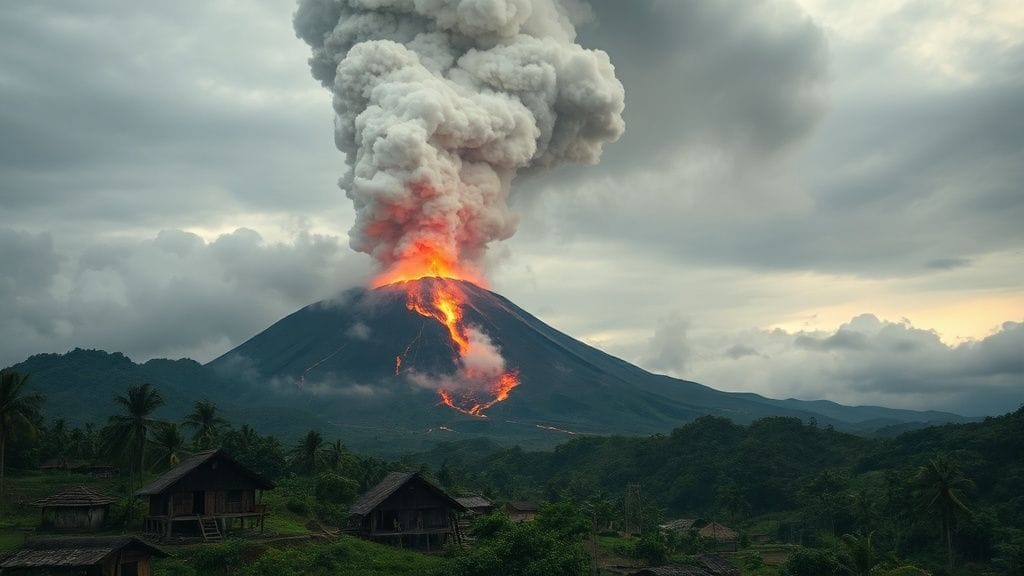
The sky had barely begun to turn a faint pink when the earth beneath East Java roared to life. It was February 4th, 1919, a restless morning filled with an ominous tremor that whispered of the chaos to come. In a sudden, terrifying crescendo, Mount Kelud, a majestic yet volatile stratovolcano, erupted with a ferocity that sent shockwaves rippling through the surrounding landscape and souls alike. Villagers who had known only the mountain’s quiet silhouette witnessed a monstrous plume of ash and fire erupt into the heavens, blotting out the sun and painting an apocalyptic canvas. The air was thick with sulfur and ash; a suffocating gloom settled, heralding one of the most deadly volcanic events in early 20th century Indonesia — a moment forever etched into the memory of Java and volcanic history.
Mount Kelud: A Sleeping Giant in East Java
Dominating the topography of East Java, Mount Kelud has been both a source of life-giving fertility and sudden death for centuries. Rising to approximately 1,731 meters, Kelud’s cone stood as a sentinel to millions, offering rich volcanic soil while hiding deep within its crater a volatile power. For local farmers, the mountain was a blessing and a threat—a fickle deity whose temperament could turn deadly. The primitive crater lake that often filled Kelud’s summit was a reservoir of potential peril; its waters could instantly transform into searing lahars — volcanic mudflows — that had ravaged villages in spectacular fashion over centuries. Though residents adapted their lives around Kelud’s cycles, the 1919 eruption shattered any illusions of control or safety.
The Historical Legacy of Kelud’s Past Eruptions
The 1919 event was not a sudden aberration but part of a long and violent sequence of outbursts. Historical records from Javanese chronicles and Dutch colonial archives detail several catastrophes—particularly the catastrophic eruptions of 1586, which reportedly killed thousands, and the devastating 1912 eruption, mere years before. These events wrote a narrative of destruction and rebirth, of communities resilient in the face of nature’s wrath. Yet, the relative quiet which followed often bred complacency. The land seemed to heal; crops flourished, and life returned to what was mistakenly seen as stability. But Kelud’s history was a chilling reminder: beneath its entrancing beauty, the mountain was an unpredictable beast lurking, ready to erupt.
The Socio-Political Landscape of Java in 1919
At the time of the eruption, Java was under Dutch colonial control, and the effects of the eruption played out against a backdrop of colonial policy and local governance. The early 20th century had seen increased settler activity, infrastructure expansions such as railroads and irrigation, and rising tensions in Javanese society under colonial rule. Indigenous communities largely bore the brunt of colonial extraction, often marginalized and struggling against imposed authorities. Within this fraught context, a natural disaster like Kelud’s eruption amplified vulnerabilities — economic precarity, social fragmentation, and the logistical challenge of providing relief amid bureaucracy. The eruption became not only a geological event but also a crucible where colonial dynamics and indigenous resilience tangled with tragic consequences.
Precursors to Catastrophe: Early Signs and Local Reactions
East Javanese villagers—farmers, traders, and elders—had noted increased ground tremors in the days prior to eruption, subtle but growing signs that rattled more than just stone. Locals reported a strange smell of sulfur in the air and boiling sounds from the crater lake, ominous warnings interpreted variously as spiritual portents or natural phenomena. Some fled, others prayed in traditional ceremonies aimed at appeasing the mountain spirits. But the colonial administration’s scientific observers, though aware of seismic unrest, often underestimated how sudden and violent the eruption would be. This disconnect between indigenous knowledge and colonial scientific protocols complicated timely evacuation efforts.
The Eruption Unfolds: Explosive Power and Fiery Cataclysm
On that fateful morning, the earth shuddered violently before a thunderous explosion tore through the calm. Mount Kelud discharged vast columns of ash and volcanic gases, high into the stratosphere, darkening skies over Surabaya and even as far as the neighboring islands. The eruption was characterized by a Plinian phase—marked by explosive ejection of ash and pumice—followed by devastating pyroclastic flows racing down the slopes, consuming everything indiscriminately. Within minutes, entire settlements were buried beneath meters of hot ash and rock, while lahars surged down river valleys like unstoppable mud tides. Witnesses spoke of a deafening roar, a sky choked with fire, and a world transformed into night, even at midday.
Ash and Agony: The Immediate Impact on Surrounding Villages
The tremors and blasts came amid a rapid descent into chaos. Villages near the volcano—such as Ngancar and Wates—suffered the worst, with fires ignited by hot ash, homes flattened, and crops incinerated. Families scrambled to flee paths of destruction, often separated and succumbing to toxic air, burns, or suffocation. The death toll mounted quickly; official tallies estimated thousands perished in the immediate vicinity, while countless animals and ecosystems suffered. Livestock perished, and the once-fertile rice paddies were smothered by ash layers so thick that farming was impossible. The psychological trauma was profound: the earth itself had betrayed its children.
Human Stories Amid the Disaster: Survival and Loss
Amid the tragedy, tales of survival speak to human courage and despair. One such story recounts a farmer named Raden, who, noticing the tremors, led his family up into the hills at the last moment, avoiding the molten flows by mere minutes. Elsewhere, a schoolteacher documented the events with harrowing precision, preserving in her diary the faces and names of those lost. These personal narratives resound through the catastrophe, reminding us that beyond statistics lie individual lives—dreams broken, acts of heroism, moments of unimaginable grief. Oral histories passed down through generations keep alive a collective memory that gives teeth to history’s abstract numbers.
The Role of Colonial Authorities: Dutch East Indies Governance
The eruption posed a complex challenge for the Dutch colonial administration. Initially caught unprepared, colonial officers scrambled to coordinate relief, relying on limited communication and slow infrastructure. Hospitals in major towns like Kediri became overwhelmed with the wounded, as health was endangered not only by injury but also by diseases fostered by ash-contaminated water supplies. The Dutch response was a mixture of organized military-led evacuations and ad hoc civilian relief efforts, but the sheer scale of devastation exposed the limits of colonial governance in emergencies. Moreover, aid distribution often favored colonial settlers, exacerbating tensions with indigenous populations.
Scientific Observations and the Geological Significance
Despite tragedy, the 1919 eruption provided critical data for volcanologists studying the complex behavior of Indonesian volcanoes. Researchers documented the sequence of eruption phases, the chemistry of emitted gases, and the distribution of lahars and ash. These observations contributed to early 20th-century understanding of stratovolcano mechanics and volcanic hazards in a region defined by the Pacific Ring of Fire. The eruption underscored the importance of continuous monitoring, though technology and logistical constraints of the time limited preventative capacities. Nevertheless, the knowledge gleaned would help inform future volcanic risk management in Java and beyond.
Rescue and Relief Efforts: Challenges and Triumphs
Organizing aid was daunting amid widespread devastation and poor transportation networks. Relief teams—comprising military personnel, medical staff, and missionaries—faced the dual tasks of treating injuries and preventing famine. Food shortages soon became critical as rice stocks were buried and farmlands rendered infertile. Displaced populations sought refuge in neighboring districts, while makeshift shelters sprang up. The collaboration between Dutch authorities and local elites, although imperfect, permitted vital relief distribution, driven by a marathon of endurance that underscored the human capacity to overcome natural disasters. Yet, the deep scars left by neglect and inequality would shape subsequent efforts.
The Aftermath: Environmental Devastation and Agricultural Ruin
The physical landscape was altered almost beyond recognition. Thick ash deposits blanketed fields, rivers clogged with volcanic debris transformed into lethal waterways during rainy seasons. The loss of arable land plunged communities into prolonged food insecurity. Forests, too, suffered—trees scorched or uprooted, wildlife displaced. Ecological recovery would take decades. Scientists later described the eruption’s impact as both cataclysmic and regenerative: lahars and ash deposits, while destructive, eventually enriched soils with minerals that enabled agricultural rebound. But for those dependent on daily harvests, the immediate decades were a struggle reflected in famine and economic hardship.
Psychological Scars and Cultural Memory in East Java
Beyond physical destruction, the eruption left profound psychological and cultural imprints. Many Javanese villagers interpreted the disaster through spiritual frameworks, seeing Kelud’s fury as a manifestation of divine wrath or ancestral displeasure. Traditional ceremonies and offerings increased in the years that followed, blending sorrow and hope. Yet, trauma was palpable, as survivors grappled with memories of loss and fear of recurrence. Oral traditions preserved vivid accounts, and historians today see the 1919 eruption as a turning point in local cultural narratives about nature, fate, and resilience—a cultural response to catastrophe that speaks to human endurance.
The Economic Ripples: Trade, Agriculture, and Community Hardship
Economic consequences rippled outward, hampering the regional economy dominated by agriculture and trade routes through the port of Surabaya. With staple crops wiped out and transportation disrupted by ashfall, local markets faltered. Many farmers lost their livestock and savings, forcing migrations to urban centers or other islands. Colonial economic structures meant that recovery aid was uneven, often funneled into export commodity sectors rather than subsistence farming communities. The eruption exposed the fragility of local economies dependent on both nature and precarious colonial frameworks. It highlighted the need for improved disaster risk reduction strategies that would only gradually develop in the decades ahead.
Reinforcing Resilience: How East Java Rebuilt After the Eruption
Despite devastation, the human spirit and communal bonds catalyzed a gradual rebuilding of East Java. Villages were reconstructed, crops replanted, and water systems gradually restored. Agricultural techniques adapted to new soil conditions, with innovations in irrigation and crop diversification. Community networks, often centered around village elders and religious leaders, facilitated recovery and mutual aid. Over time, disaster preparedness improved, informed by the hard-learned lessons of 1919. The eruption shaped a regional identity of resilience and respect for the mountain’s power, balancing reverence with practical adaptation.
Kelud’s Eruptive Patterns: Lessons from 1919 to Today
The 1919 eruption fits into a broader pattern of Kelud’s frequent activity, with significant eruptions roughly every few decades. For volcanologists, understanding this periodicity aids in forecasting and preparing for future activity. The eruption revealed the dangerous potentials of crater lake breaching and lahars, guiding future hazard mapping. Modern volcanic monitoring now employs seismic sensors, gas analysis, and satellite imagery to anticipate activity, a far cry from 1919’s limited warning system. Yet, Kelud remains unpredictable—a powerful reminder that volcanoes live by their own rhythms, indifferent to human concerns.
Volcanoes and the Human Spirit: Myth, Meaning, and Modern Science
The 1919 Kelud eruption is emblematic of the eternal tension between humanity and nature’s uncontrollable forces. While science seeks to predict and mitigate risks, cultural responses root the mountain in stories and spiritual meaning. For the people of East Java, Kelud is not merely a geological feature but a living entity—both protector and destroyer. This complex relationship reveals how human societies interpret and manage disaster, weaving together emotion, faith, and empirical knowledge. In this lies a universal story about coexistence and respect between people and the natural world.
The 1919 Kelud Eruption in Global Context: Early 20th Century Volcanism
Globally, the early 20th century witnessed several major volcanic eruptions that shaped geology and disaster management: the 1912 Novarupta eruption in Alaska, the 1902 Mount Pelée eruption in Martinique, among others. Kelud’s 1919 eruption contributed to expanding scientific understanding of explosive volcanic phenomena and underscored vulnerabilities faced by agrarian societies. It also highlighted colonial dynamics in disaster response and the importance of integrating indigenous knowledge into scientific frameworks. In comparing these events, a broader narrative emerges—one of a world awakening to the power of volcanoes and the necessity of preparedness in a rapidly industrializing era.
Commemoration and Remembrance: Memorializing the Tragedy
Today, the 1919 eruption lives on in monuments, local lore, and annual ceremonies in East Java. Communities gather to honor victims and celebrate survival, keeping alive stories passed through generations. These acts of remembrance serve not only as homage but as warnings—testaments to the mountain’s volatile spirit and the need for vigilance. Museums and educational programs in Indonesia incorporate the eruption into broader curricula on natural hazards. The memory of 1919 shapes how contemporary society navigates the delicate balance between reverence for nature and harnessing science for safety.
Conclusion: Nature’s Fury and Human Endurance
The eruption of Mount Kelud in 1919 stands as a vivid testament to nature’s capacity for sudden, overwhelming destruction and humanity’s remarkable will to endure and rebuild. From the fiery plumes that darkened the skies above East Java to the shattered villages and mourning families, this cataclysmic event embodied both the fragility and resilience of life. It challenged colonial systems, inspired scientific inquiry, and enriched cultural narratives about the relationship between people and the land they inhabit. More than a historical footnote, the 1919 eruption pulses through time as a story of survival, community, and the indomitable spirit that arises when faced with the raw power of the earth.
FAQs
Q1: What caused Mount Kelud to erupt so violently in 1919?
The eruption was triggered by the buildup of pressure from magma beneath the volcano’s crater lake. Over years, a combination of gas accumulation and increasing magma movement led to a Plinian explosive eruption, sending ash and pyroclastic flows across nearby areas.
Q2: How many people died during the 1919 eruption?
Estimates vary, but historical records suggest thousands perished, possibly between 5,000 and 10,000, mostly in nearby villages directly affected by pyroclastic flows and lahars.
Q3: What was the role of the Dutch colonial government in the response?
The Dutch authorities attempted to coordinate relief efforts but faced logistical challenges, limited resources, and administrative inefficiencies, resulting in uneven aid distribution that often prioritized colonial settlers over indigenous victims.
Q4: How did the eruption affect agriculture in East Java?
Massive ash deposits and lahars buried rice fields and orchards, causing long-term soil infertility and food shortages. Recovery took years, as soils needed to stabilize and farmers had to adapt techniques to reclaim the land.
Q5: What cultural significance does Mount Kelud hold for local communities?
Kelud is seen as a powerful spiritual entity, both feared and revered. The eruption reinforced traditional beliefs in the mountain’s supernatural power and inspired rituals aimed at appeasement and protection.
Q6: How has volcanic monitoring improved since 1919?
Advances include seismic monitoring, gas emissions analysis, satellite imagery, and early warning systems, allowing more timely evacuations and improved disaster risk management.
Q7: Are there lessons from the 1919 eruption still relevant today?
Yes, balancing scientific knowledge with local understanding, improving infrastructure for rapid aid, and recognizing social vulnerabilities remain key to managing volcanic risks effectively.
Q8: How is the 1919 eruption remembered in Indonesia today?
Through memorial ceremonies, educational programs, museums, and oral histories, ensuring that both the tragedy and lessons endure across generations.

