Table of Contents
- Dawn of Disaster: The Calm Before the Lamington Eruption
- Papua New Guinea in 1951: A Land of Tensions and Dreams
- The Volcanic Giant: Understanding Mount Lamington
- Early Signs: Foreshadows of an Impending Catastrophe
- The Explosion Heard Around Oro: April 21, 1951
- Pyroclastic Fury: The Mechanics of the Lamington Eruption
- Darkness and Destruction: The Immediate Impact on Oro
- Voices from the Ashes: Survivor Accounts and Heroism
- The Silent Killers: Ash, Gas, and Fallout—Hazards Beyond Lava
- Emergency Response: The Challenges of a Remote Crisis
- Colonial Administration and Crisis Management: Australian Governance in Action
- Counting the Toll: Human Loss and Environmental Devastation
- Scientific Breakthroughs: Understanding Volcano Behavior Post-Lamington
- Reconstruction Efforts: Rebuilding Lives and Communities
- Cultural Memory and Oral Traditions: Lamington in Papua New Guinean Identity
- Global Impact: How Lamington Reshaped Volcanology
- Lessons Learned: Volcano Monitoring and Disaster Preparedness in PNG
- Remembering 1951: Memorials, Museums, and Commemorations
- Comparing Catastrophes: Lamington Among the Greatest Eruptions of the 20th Century
- Conclusion: The Volcano that Changed a Nation
- Frequently Asked Questions
- External Resource
- Internal Link
Dawn of Disaster: The Calm Before the Lamington Eruption
In the early days of April 1951, the villages scattered along the lush slopes of Mount Lamington in Oro Province, Papua New Guinea, enjoyed what seemed to be an ordinary tropical morning. The sun rose, sending golden shafts of light through the dense jungle canopy. Birds sang, insects buzzed, and the daily hum of life echoed from garden plots and riverside dwellings. There was a gentle quiet over the land—one that belied the lurking threat beneath their feet.
But Mount Lamington was a sleeping giant, restless even in apparent dormancy. Unbeknownst to the communities nestled in its shadow, the earth was about to unleash one of the most devastating volcanic disasters of the 20th century—one that would forever alter their lives and the understanding of volcanic hazards across the globe.
Papua New Guinea in 1951: A Land of Tensions and Dreams
In 1951, Papua New Guinea was a complex mosaic of colonial administration, indigenous cultures, and emerging modern influences. The island was divided administratively: the southern part, including Oro Province where Lamington rises, was under Australian mandate as the Territory of Papua. The northern coasts and interior regions formed the Territory of New Guinea, also governed by Australia through the United Nations Trusteeship after World War II.
The local indigenous populations, including the Orokaiva people around Lamington, lived largely subsistence lifestyles, deeply connected to their land and ancestral traditions. Yet the winds of change were palpable. Missionaries, colonial officials, and emerging commercial enterprises introduced new crops, technologies, and ideas, fostering a fragile balance between tradition and the encroaching modern world.
Amid this, the natural landscape remained both a cradle of life and a source of peril. The rugged mountains, dense rainforests, and volcanic soils bore witness to millennia of human resilience but also the ever-present risk of natural calamities.
The Volcanic Giant: Understanding Mount Lamington
Mount Lamington was not officially recognized as an active volcano before 1951. In fact, it was considered a dormant peak, unassuming compared to the more infamous volcanic giants of the Pacific "Ring of Fire."
Yet Lamington’s geological history told a more ominous tale. A stratovolcano rising over 1,680 meters above sea level, it was formed by repeated layers of hardened lava flows and volcanic ash. Occasional signs of fumarolic activity had been noted by a few explorers and geologists in the decades prior, but there was little comprehensive study or monitoring infrastructure in place.
In geological terms, Lamington was a powder keg, waiting for the right triggers to awaken. Its proximity to numerous villages made it a latent threat of enormous consequences.
Early Signs: Foreshadows of an Impending Catastrophe
In the weeks leading up to the eruption, residents and experts alike began to notice subtle but unsettling changes. Earth tremors were felt intermittently, an unusual smoking vent emerged near the summit, and strange odors pervaded the air akin to sulfur.
Local accounts tell of birds suddenly fleeing the mountain slopes, and water sources turning murky. Yet the signs were ambiguous and, in many cases, dismissed as natural variations or minor disturbances.
Australian geological survey teams stationed in different parts of Papua New Guinea received initial reports but lacked the tools and experience to predict an imminent large-scale eruption at Lamington.
The Explosion Heard Around Oro: April 21, 1951
Then came the fateful morning of April 21st.
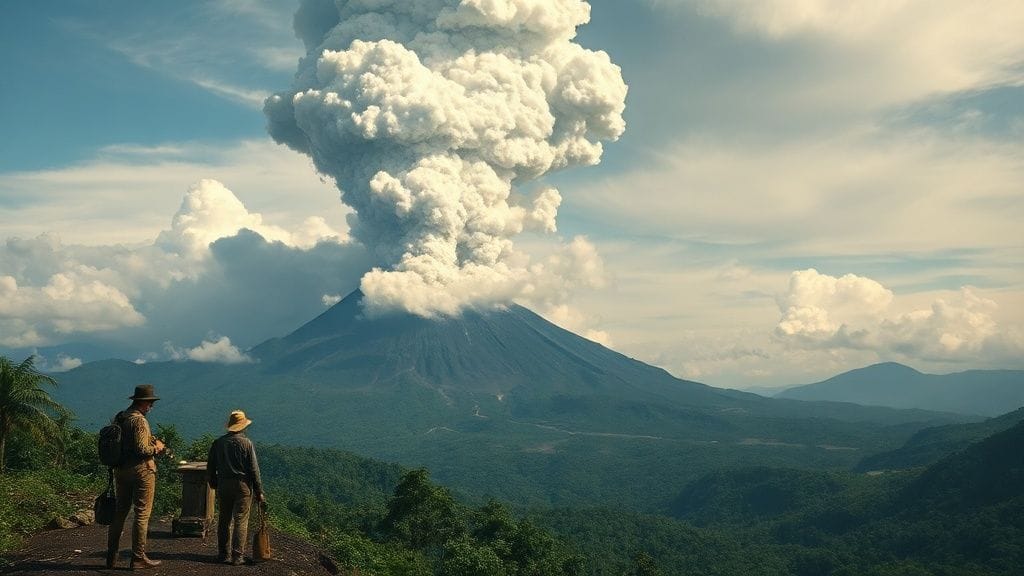
At 8:49 am local time, the volcano erupted in a catastrophic explosion, turning day into night for miles around. A massive column of ash and volcanic debris shot skyward, accompanied by a series of violent pyroclastic flows—a deadly cascade of hot gas and rock that surged down mountain slopes at hundreds of kilometers per hour.
The eruption was so intense it shattered windows over 50 kilometers away and sent shockwaves reverberating through the region. For the people living below, the event was apocalyptic: forests were obliterated, villages buried, and thousands thrown into chaos.
This explosion was not a gentle outpouring of lava but a violent, sudden release of pent-up geological fury.
Pyroclastic Fury: The Mechanics of the Lamington Eruption
Unlike slow lava flows that give time for evacuation, the Lamington eruption unleashed extensive pyroclastic flows—superheated avalanches of gas, ash, and rock fragments capable of incinerating and suffocating anything in their path.
Scientists would later classify Lamington as a Plinian eruption, a type characterized by explosive power, high eruption columns, and widespread ashfall.
The initial blast obliterated the summit dome, triggering a collapse and subsequent flows that surged down the flanks of the mountain and onto the inhabited valleys.
The speed and intensity of these flows meant survival was often impossible for those caught in them. Witnesses described a roaring, glowing wave engulfing entire villages within minutes.
Darkness and Destruction: The Immediate Impact on Oro
The aftermath was apocalyptic. Villages like Higaturu, residing within mere kilometers of the peak, were almost entirely wiped out. Homes were flattened, crops destroyed, and infrastructure vanished beneath layers of volcanic debris.
The sky blackened by ashfall turned the daytime into an eerie twilight, while choking ash blanketed the landscape for days.
The death toll soared beyond 3,000, according to official estimates—though accounting for remote villages and unregistered inhabitants, some suggest the number may have been even higher.
Survivors faced not only grief but acute shortages of food, clean water, and shelter. Disease outbreaks threatened amid the chaos, and psychological trauma permeated the communities.
Voices from the Ashes: Survivor Accounts and Heroism
Amid the horror, stories of resilience and bravery emerged.
One notable survivor recalled digging through ash to find family members buried alive, clinging to hope in the face of overwhelming despair. Indigenous guides led rescue teams through treacherous terrain, their intimate knowledge of the land proving indispensable.
Australian troops, first responders, and missionaries worked tirelessly, often risking aftershocks and hazardous conditions to assist survivors and recover bodies.
These personal narratives brought a human face to the tragedy—reminding us that behind every statistic stood lives irrevocably changed.
The Silent Killers: Ash, Gas, and Fallout—Hazards Beyond Lava
Beyond the immediate blast, the eruption released clouds of volcanic ash and gases including sulfur dioxide and carbon dioxide.
Ashfall contaminated water supplies and rendered agricultural land barren for months, while prolonged inhalation of fine ash particles posed respiratory hazards.
Toxic gases accumulated in low-lying areas, causing asphyxiation in some survivors.
These ‘silent killers’ compounded the challenges during rescue and recovery operations, revealing the multifaceted dangers inherent to explosive volcanic activity.
Emergency Response: The Challenges of a Remote Crisis
The disaster struck a remote and rugged region with limited infrastructure. Roads were sparse, communication difficult, and medical facilities inadequate.
Emergency responders faced logistical nightmares, from transporting supplies to ensuring the safety of personnel amid unstable ground.
The Australian colonial administration mobilized military and medical teams, while local communities organized informal support networks.
International aid, although minimal in scope, also trickled in, highlighting the growing awareness of disaster relief in the post-war world.
Colonial Administration and Crisis Management: Australian Governance in Action
The eruption tested the capacity of the Australian administration managing Papua New Guinea.
Governor Donald Cleland, along with senior officials and experts, coordinated relief efforts while addressing the political and social ramifications.
The disaster spurred a reevaluation of colonial governance strategies, emphasizing the importance of disaster preparedness, and infrastructure development in territories considered vulnerable.
Yet criticisms arose regarding initial delays and insufficient communication—a reflection of the broader challenges inherent in remote colonial administration.
Counting the Toll: Human Loss and Environmental Devastation
Official tallies eventually recorded approximately 3,000 lives lost, with entire villages wiped from the map.
The natural environment also bore deep scars—thousands of hectares of rainforest destroyed, wildlife displaced, and soil fertility altered.
Farming, the economic backbone for local communities, was devastated, leaving long-term effects on food security.
This dual human and ecological toll marked Lamington as one of the deadliest volcanic events of the mid-20th century.
Scientific Breakthroughs: Understanding Volcano Behavior Post-Lamington
The Lamington eruption became a case study for volcanologists worldwide.
Detailed examination of pyroclastic flows, eruption columns, and deposits enriched scientific understanding of eruption dynamics.
The tragedy underscored the need for systematic volcanic monitoring—a relatively nascent field at that time—ultimately influencing the establishment of surveillance programs in Papua New Guinea and beyond.
Eminent volcanologist Patrick Marshall and others contributed seminal papers analyzing Lamington’s geological identity and erratic behavior.
Reconstruction Efforts: Rebuilding Lives and Communities
Recovery efforts stretched over years. Government agencies worked alongside missionaries and local leaders to rebuild homes, schools, and infrastructure.
Resettlement programs relocated displaced families to less vulnerable areas, a sensitive process fraught with cultural and logistical complexities.
Agricultural initiatives aimed to restore soil productivity and food supplies.
Yet scars—both physical and emotional—lingered, with some survivors reluctant to return to ancestral lands.
Cultural Memory and Oral Traditions: Lamington in Papua New Guinean Identity
For the Orokaiva and neighboring peoples, the eruption entered the realm of legend and collective memory.
Oral histories passed down vivid images of fire, ash, and loss alongside stories of divine intervention and resilience.
The event also shaped local interpretations of the land’s power, influencing customs, taboos, and spiritual practices.
Even today, Lamington stands as a symbol of nature’s unpredictable might within Papua New Guinea’s cultural landscape.
Global Impact: How Lamington Reshaped Volcanology
In the broader context, Lamington deepened the international community’s recognition of volcanic risks in the Pacific.
It spurred advances in monitoring technologies, risk assessment methodologies, and emergency protocols.
Lessons from Lamington informed strategies for later eruptions—such as those in Indonesia and the Philippines—helping to mitigate future disasters.
This eruption underlined how volcanoes were not just local hazards but global concerns demanding scientific and humanitarian collaboration.
Lessons Learned: Volcano Monitoring and Disaster Preparedness in PNG
Post-1951, Papua New Guinea authorities and international partners invested in establishing seismic stations, aerial surveys, and public awareness campaigns.
Community education programs aimed at improving evacuation procedures and resilience became priorities.
These measures have evolved over decades but remain rooted in the hard-earned experience of Lamington.
The eruption’s legacy stands as a testament to the value of preparedness and respect for nature’s forces.
Remembering 1951: Memorials, Museums, and Commemorations
Around Oro Province and beyond, remembrance of the Lamington disaster endures through physical memorials and annual ceremonies.
Museum exhibits chronicle the eruption with photographs, artifacts, and survivor testimonies—preserving history for future generations.
These acts of remembrance honor the victims and celebrate the enduring spirit of the communities they left behind.
Comparing Catastrophes: Lamington Among the Greatest Eruptions of the 20th Century
While overshadowed by giant eruptions like Mount St. Helens or Krakatoa, Lamington’s scale and deadly pyroclastic nature place it among the gravest volcanic tragedies.
It is notable for its high death toll, rapid onset, and the lessons it offered about the unpredictability of shielded volcanoes.
In historical rankings, Lamington serves as a somber reminder of how nature’s wrath can shatter human assumptions.
Conclusion: The Volcano that Changed a Nation
The Lamington eruption of 1951 was much more than a natural disaster; it was a crucible forging new understandings, resilience, and respect between humans and their environment.
It exposed vulnerabilities in colonial governance, revealed the terrifying might of dormant volcanoes, and spoke through the voices of survivors who faced annihilation and rebuild.
Today, its story continues to resonate—an echo of fire and ash, loss and hope—in Papua New Guinea and volcanic regions worldwide. By remembering Lamington, we honor lives lost and reinforce the urgent necessity for vigilance against nature’s hidden fury.
Frequently Asked Questions
Q1: What caused the Lamington eruption in 1951?
A1: The eruption was caused by the buildup of magma pressure beneath Mount Lamington, leading to a catastrophic explosive release that destroyed the volcanic dome. Tectonic activity along the Pacific Ring of Fire influenced magma movement, but specific precursors were barely detectable at the time.
Q2: How many people died during the Lamington eruption?
A2: Official estimates record approximately 3,000 fatalities, including entire villages destroyed by pyroclastic flows and ash. The true number may be higher due to underreporting in remote areas.
Q3: What made the Lamington eruption particularly deadly?
A3: The eruption generated fast-moving pyroclastic flows—avalanches of superheated gases and debris—that left almost no time for evacuation and incinerated everything in their path, combined with widespread ashfall affecting health and agriculture.
Q4: How did the Australian colonial administration respond to the disaster?
A4: Australian officials coordinated relief efforts involving military personnel, medical teams, and engineers. However, logistical challenges and limited infrastructure slowed early responses, prompting later reforms in disaster preparedness.
Q5: What were the long-term environmental effects of the eruption?
A5: Large tracts of forest were destroyed, farmland buried in ash, and soil fertility initially reduced. Ecosystems took years or decades to recover, altering local biodiversity and threatening livelihoods.
Q6: How did the Lamington eruption influence scientific study of volcanoes?
A6: It became a crucial case study for understanding pyroclastic flows and explosive volcanic activity, stimulating growth in volcanology and leading to better monitoring and hazard mitigation techniques.
Q7: Is Mount Lamington still active today?
A7: Lamington remains classified as an active volcano with occasional fumarolic activity, but has not produced another large eruption since 1951. It is monitored by volcanic observatories in Papua New Guinea.
Q8: How is the eruption remembered in Papua New Guinea culture?
A8: The eruption is preserved in oral histories and cultural memory, symbolizing both destruction and resilience. Annual memorials and museums help keep its legacy alive within local and national narratives.

