Table of Contents
- The Smoke Rises: The Dawn of the Raikoke Eruption
- An Almost Forgotten Giant: The Kuril Islands in the Geologic Spotlight
- Quiet Before the Storm: The Precursors of June 2019
- Awakening Beneath the Waves: The Mechanics of Raikoke’s Explosion
- The Day the Sky Went Dark: June 22, 2019, Unfolds
- From Earth to Atmosphere: The Plume That Reached Stratospheric Heights
- Satellite Eyes: Monitoring the Invisible Threat
- Impact on the Kuril Archipelago: Nature’s Fierce Response
- The Human Element: Russian Responses and Global Awareness
- Ash Clouds and Aviation: Skies Choked with Volcanic Threats
- Chemical Signatures: Sulfur Dioxide and Atmospheric Changes
- The Ocean’s Quiet Suffering: Marine Life in the Shadow of Raikoke
- A Global Perspective: Volcanism and Climate Connections
- Stories from the Edge: Local Traditions and Volcanic Reverence
- Scientific Revelations: How Raikoke Changed Volcanology
- The Aftermath: Monitoring Raikoke Six Months On
- The Legacy of 2019: Comparing Raikoke to Historic Eruptions
- Volcanic Poetry: The Power of Earth’s Fury in Art and Literature
- Lessons from Raikoke: Risk, Resilience, and Preparation
- Conclusion: The Ever-Present Breath of the Earth
- FAQs: The Raikoke Eruption and Its Unfolding Story
- External Resource: More on Raikoke Eruption
- Internal Link: Explore More with History Sphere
1. The Smoke Rises: The Dawn of the Raikoke Eruption
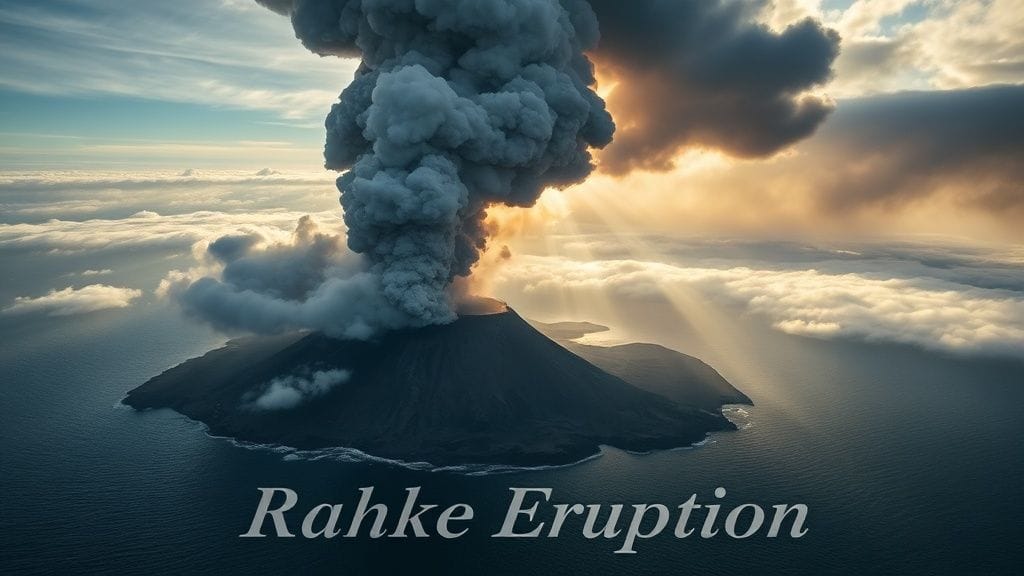
On a quiet summer morning of June 22nd, 2019, far away from the bustling capitals of the world, something extraordinary began to unfold beneath the cold waters of the northwestern Pacific Ocean. A violent burst rocked the isolated island of Raikoke, part of the smoky, windswept Kuril Islands chain belonging to Russia. Without warning, a colossal column of ash and gas erupted, thrusting itself tens of kilometers into the stratosphere, transforming the sky over distant horizons. The sudden plume darkened the day in places thousands of miles away, a vivid reminder of the dormant forces lying just beneath the Earth’s surface.
The eruption was a spectacle of nature’s raw power—beautiful, terrifying, and humbling—all at once. It was one of the most potent volcanic events of the decade, imprinting its mark not just on geology and climatology, but also on the collective memory of a planet that—despite all our advancement—still bends to the will of forces far older than humankind.
2. An Almost Forgotten Giant: The Kuril Islands in the Geologic Spotlight
The Kuril Islands stretch over 1,300 kilometers from Japan’s Hokkaido Island to Russia’s Kamchatka Peninsula, a remote archipelago forged by tectonic drama. These islands form part of the Pacific "Ring of Fire," a horseshoe-shaped zone where the Pacific Plate grinds beneath continental plates, birthing a chain of volcanoes and frequent earthquakes.
Among these lies Raikoke Island, a small volcanic edifice measuring barely two square kilometers. Not widely known to many outside specialist circles, it quietly builds pressure beneath its surface, breathing in its own cyclical rhythm of dormancy and eruption. Prior to 2019, historical records depicted only a handful of eruptions from Raikoke, the last dated to 1924, but scientific analysis suggested it was a volcano capable of more devastating outbursts.
Raikoke epitomizes the paradox of the remote yet perilous: a place where nature’s stirring can ripple outwards far beyond its rocky shores.
3. Quiet Before the Storm: The Precursors of June 2019
The days leading to the eruption bore subtle clues to vigilant volcanologists. Seismic activity near Raikoke increased, registering swarms of small earthquakes—whispers of magma movement deep below. Satellite images showed warming at the crater and minor steam emissions, all indicating that the sleeping giant was stirring.
Yet these signs went unnoticed by the world at large. The Kurils are uninhabited islands, a scattering of rocks in the vast ocean, patrolled only by scientists and military personnel. The global community prepared little for what was about to come.
4. Awakening Beneath the Waves: The Mechanics of Raikoke’s Explosion
Beneath the surface, magma forced its way through fissures, rupturing layers of solid rock. The interaction between molten stone and seawater magnified the eruption’s violence. Water turned instantly to steam, expanding rapidly and converting the eruption into a phreatomagmatic event—where water and magma combine explosively.
This type of eruption is more powerful than a dry one alone, hurling ash and gases to higher altitudes. Witnessing this process, even from afar, gives a glimpse into the elemental warfare beneath the Earth: water, fire, and rock clashing in a volatile ballet.
5. The Day the Sky Went Dark: June 22, 2019, Unfolds
When the eruption finally broke through the surface, the spectacle was immediate and awe-inspiring. Eyewitness accounts from nearby satellites and a few military observers described a towering plume rising with fury from Raikoke’s crater, engulfing the island in thick ash.
The plume stretched above the island’s rim, ascending approximately 15 kilometers into the stratosphere. For hours, the island vanished beneath the thick curtain of smoke and ash.
It was a dramatic reminder of how small and fragile human presence is in the face of geologic awakening.
6. From Earth to Atmosphere: The Plume That Reached Stratospheric Heights
Raikoke’s eruption sent far more than just ash raining down on the craggy island. The column punched into the stratosphere, the atmospheric layer about 10 to 50 kilometers above Earth’s surface, carrying sulfur dioxide (SO₂), fine particles, and volcanic gases far beyond the immediate vicinity.
This injection of aerosols into the stratosphere is crucial—it can affect climate patterns, as sun-blocking particles spread swiftly across the globe. The sulfur dioxide cloud from Raikoke was tracked circling the planet multiple times.
This physical journey from subterranean origins to atmospheric dominance tells a story of interconnected natural systems, from deep Earth to distant skies.
7. Satellite Eyes: Monitoring the Invisible Threat
In 2019, our ability to watch Raikoke’s monstrous plume was thanks to a new generation of advanced scientific instruments orbiting Earth. NASA’s Aqua satellite equipped with MODIS sensors, the European Sentinel-5P satellite, and Japan’s Himawari-8 provided near-real-time data, capturing images and measuring aerosol concentrations.
The eruption became a prime example of how space technology has revolutionized volcanic monitoring, providing a window into otherwise inaccessible regions and allowing scientists to follow the plume’s evolution minute by minute.
Data from these satellites continues to inform climate models and emergency response planning worldwide.
8. Impact on the Kuril Archipelago: Nature’s Fierce Response
The eruption left Raikoke Island scarred and transformed. The violent blast cleared vegetation, blanketed the terrain in ash, and reshaped the landscape.
Nearby islands saw ashfall settling in layers, disturbing local ecosystems but also creating a geological record for future generations. Volcanic eruptions, as destructive as they might seem, also create new habitats, fertilize soil with minerals, and kickstart cycles of ecological renewal.
This duality—cataclysm and creation—defines much of Earth’s rhythmic changes.
9. The Human Element: Russian Responses and Global Awareness
Though no permanent human settlements were directly threatened by Raikoke’s eruption, Russian authorities quickly responded by issuing warnings and restricting air travel around the region to avoid ash hazards.
The event drew international scientific cooperation, as researchers worldwide mobilized to study the plume’s composition and atmospheric effects.
Yet, for the broader public, Raikoke became a symbol of nature’s intermittent interruptions—remote, largely invisible, but no less potent.
10. Ash Clouds and Aviation: Skies Choked with Volcanic Threats
Volcanic ash poses a significant threat to aviation, as fine particles can damage aircraft engines, clog sensors, and cause rapid wear.
Following Raikoke’s eruption, airlines and regional authorities faced the challenge of rerouting flights to steer clear of thick ash clouds. Volcanic ash advisories were issued, helping prevent potential disasters.
This episode underscored the critical intersection between natural disasters and modern infrastructure, spotlighting the need for continuous vigilance.
11. Chemical Signatures: Sulfur Dioxide and Atmospheric Changes
The chemical fingerprint of Raikoke’s eruption was dominated by sulfur dioxide—a gas resulting from magma’s degassing that contributes to the formation of volcanic aerosols when oxidized.
Scientists estimated that Raikoke released about 1 teragram (1 million tons) of SO₂, enough to influence atmospheric chemistry for months. The resulting aerosols have the capacity to slightly cool the Earth’s surface by reflecting sunlight.
Nonetheless, such effects are transient and complex, intertwined with ongoing anthropogenic climate shifts.
12. The Ocean’s Quiet Suffering: Marine Life in the Shadow of Raikoke
Beneath the waters that lap at Raikoke’s flanks lies a rich marine ecosystem. The eruption’s ashfall and underwater explosions perturbed ocean chemistry and temperature.
For marine species adapted to stable environments, such sudden changes can mean stress or displacement. Plankton blooms might have initially surged from nutrient influx but could also be smothered by sediments.
Our knowledge of how such underwater eruptions influence marine life remains patchy; Raikoke thus also highlighted gaps in marine volcanology and ecology.
13. A Global Perspective: Volcanism and Climate Connections
Raikoke’s eruption was a stark reminder of how volcanism can transiently alter climate dynamics. While large eruptions like Tambora (1815) caused “the year without a summer,” smaller events like Raikoke contribute subtle but measurable effects.
By injecting aerosols into the stratosphere, volcanic eruptions can cool global temperatures for months or years, influence weather patterns, and affect ozone chemistry.
Understanding Raikoke contributes to a broader picture of Earth’s climatic rhythms and challenges in forecasting.
14. Stories from the Edge: Local Traditions and Volcanic Reverence
Though Raikoke itself is sparsely inhabited, the Kuril Islands have long been part of indigenous Ainu peoples’ cosmology, who revere volcanic mountains as living spirits.
In a land shaped by fire and ice, volcanoes are more than geological features—they are ancestral deities, caretakers, and sometimes, agents of renewal and destruction.
The 2019 eruption reasserted these ancient narratives, reminding us of humanity’s enduring relationship with Earth’s volatile nature.
15. Scientific Revelations: How Raikoke Changed Volcanology
Raikoke’s eruption spurred several scientific breakthroughs. The detailed monitoring of the plume provided new insights into volcanic plume dynamics, stratospheric aerosol lifecycles, and eruption signatures.
Notably, the interaction of the plume with atmospheric currents gave volcanologists real-world data crucial for improving predictive models.
The eruption underscored how even small, remote volcanoes can yield valuable knowledge about Earth’s processes.
16. The Aftermath: Monitoring Raikoke Six Months On
In the months following the eruption, scientists continually monitored Raikoke’s activity for signs of renewed unrest. While seismic activity returned to background levels, thermal imaging detected residual heat.
Recovery of flora and fauna on the island proceeded gradually, with satellite imagery documenting the slow recolonization by green shoots amidst ash.
Raikoke entered a new interlude, a quieter chapter in its long story of fire and earth.
17. The Legacy of 2019: Comparing Raikoke to Historic Eruptions
Though smaller in overall scale than supervolcanoes like Yellowstone or massive eruptions like Krakatoa, Raikoke’s 2019 event was among the most explosive in the Northern Hemisphere during the decade.
Comparisons to the 2010 Eyjafjallajökull eruption in Iceland illustrated shared challenges: sudden delivery of ash to flight paths, widespread atmospheric effects, and intense scientific scrutiny.
Raikoke’s legacy thus places it among modern, impactful eruptions that test our preparedness and resilience.
18. Volcanic Poetry: The Power of Earth’s Fury in Art and Literature
Volcanic eruptions have long inspired poets, writers, and artists, embodying the sublime interplay of beauty and terror. Raikoke’s towering plume, stark and vast, can be imagined as a tempest of raw emotion released by the Earth itself.
From ancient myths to contemporary narratives, volcanism channels humanity’s awe before nature’s fury. Raikoke’s moment in 2019 adds a new verse to that enduring poem.
19. Lessons from Raikoke: Risk, Resilience, and Preparation
Raikoke’s eruption teaches us about the unpredictability of natural disasters, the urgency of monitoring, and the importance of global collaboration.
Even isolated volcanoes can disrupt economies, climates, and ecosystems beyond their borders. Investing in science, technology, and international cooperation is paramount.
Resilience lies not just in response but in anticipation and understanding.
20. Conclusion: The Ever-Present Breath of the Earth
The 2019 Raikoke eruption offers a compelling chapter in the story of Earth’s restless nature—a fragile world beneath our feet pulsing with energy.
It reminds us that despite our technological advances and global connections, we remain intimately tied to the ancient rhythms of fire and rock.
The plume rising from Raikoke was a breath from the planet itself—both a warning and a wonder, inviting reflection on the place of humanity within this vast, living mosaic.
Conclusion
The Raikoke eruption of June 2019, erupting from an isolated but potent volcano in the Kuril Islands, is far more than a geological event. It is a convergence of nature’s fury, scientific curiosity, and human vulnerability. As ash clouded skies and sulfurous gases wove through the stratosphere, the world glimpsed the invisible threads connecting deep Earth processes with global climate, marine ecosystems, and human society.
Yet amidst the destruction and disruption, Raikoke also epitomizes Earth’s resilience—the capacity for renewal, adaptation, and transformation. Its eruption presses upon us the importance of vigilance supported by cutting-edge technology and ancient wisdom.
This story, still unfolding in the science labs and amid the silent recovery of a remote island, reminds us that our planet, with all its power and poetry, is never quiet for long.
FAQs
Q1: What triggered the 2019 Raikoke eruption?
The eruption was triggered by magma intrusion beneath the island, causing pressure buildup that eventually overcame the overlying rock and seawater, creating a phreatomagmatic explosion.
Q2: How high did the volcanic plume reach?
The plume rose approximately 15 kilometers into the stratosphere, allowing volcanic gases and aerosols to disperse globally.
Q3: Were there any casualties or direct human impacts?
No permanent settlements were near Raikoke, so there were no direct casualties, but nearby air travel was temporarily disrupted due to ash.
Q4: How did scientists monitor the eruption?
Using satellites—NASA’s Aqua MODIS, Sentinel-5P, Himawari-8—and ground seismic sensors, researchers tracked ash plume extent, chemical emissions, and seismicity.
Q5: Did Raikoke’s eruption affect global climate?
The eruption injected significant sulfur dioxide into the stratosphere, contributing temporarily to atmospheric cooling effects, though less pronounced than larger historic eruptions.
Q6: What wildlife was affected on Raikoke and surrounding waters?
Vegetation on the island was covered in ash, altering habitats, and marine life was affected by changes in water chemistry and temperature, but long-term ecological effects require further study.
Q7: How does Raikoke compare to other recent volcanic eruptions?
Though smaller than supervolcanoes, Raikoke’s eruption was one of the largest in the Northern Hemisphere in recent years, drawing parallels with Iceland’s Eyjafjallajökull in terms of aviation impact.
Q8: What lessons have been learned for future monitoring?
Raikoke highlighted the importance of satellite surveillance and international data sharing for early warning and mitigating volcanic hazards, especially in remote regions.

