Table of Contents
- The Calm Before the Inferno: Washington’s Sleeping Giant
- Geological Prelude: The Restless Heart of Mount St. Helens
- Early Signs: Foreshadows of a Cataclysm
- Communities on Edge: The Human Face of Imminent Danger
- The Morning of May 18, 1980: A World Transformed in Minutes
- The Blast Heard Around the World: The Cataclysmic Eruption Unfolds
- Pyroclastic Flows and Ash Clouds: Nature’s Fury Unleashed
- Immediate Aftermath: Smoke, Ash, and Silence
- The Toll in Lives and Livelihoods: Human Cost of the Disaster
- Ecological Devastation: The Landscape Remade
- Scientific Revelations: Understanding Volcanic Power
- Media Frenzy: The Eruption that Captivated the Globe
- Government Response: Emergency Management and Recovery Efforts
- Lessons Learned: Shaping Disaster Preparedness in America
- Mount St. Helens in Memory and Culture: From Mourning to Myth
- Renewed Life: The Slow but Tenacious Return of Nature
- Mount St. Helens Today: A Living Laboratory
- The Volcano’s Legacy: Environmental, Scientific, and Social Impacts
- Reflections on Risk: Living in the Shadow of a Volcano
- Conclusion: The Enduring Voice of the Mountain
- FAQs: Common Questions about the 1980 Eruption
- External Resource
- Internal Link
The Calm Before the Inferno: Washington’s Sleeping Giant
At dawn on May 18, 1980, the quietude of Washington state's verdant Cascade Range concealed an ancient force gathering strength beneath the earth’s crust. Mount St. Helens, a majestic stratovolcano clad in forests and snow, had slumbered peacefully for over a century. To locals, tourists, and scientists alike, this mountain was a serene giant, its beauty and power a backdrop to daily life. But nature’s tranquility was deceptive. The peaceful morning haze would soon be shattered by an explosive fury thrusting ash, rock, and devastation miles into the sky.
Few moments in American environmental and geological history carry the raw drama and profound impact of that morning. At precisely 8:32 AM, a sudden landslide unraveled the mountain’s north face, releasing pent-up volcano fury in a catastrophic eruption that forever altered the landscape and lives below. This was no distant natural spectacle — it was an intimate apocalypse, imprinted on the collective memory of a nation. The story of Mount St. Helens is one of awe, loss, resilience, and the relentless power of nature.
Geological Prelude: The Restless Heart of Mount St. Helens
Mount St. Helens’ history dates back over 40,000 years, a restless sentinel in the Pacific Northwest’s volatile Cascade Range. It is part of the “Ring of Fire,” a horseshoe-shaped belt famed for frequent volcanic and seismic activity due to the Pacific tectonic plate subducting beneath the North American plate. Over millennia, the mountain built itself layer by layer, occasionally erupting, then receding into dormancy.
Before 1980, its last known eruption was nearly 130 years earlier, in March 1857, a modest event compared to what was to come. Yet, deep below, magma was accumulating. The earth’s crust subtly bent and cracked as seismic tremors began to rattle the region, a quiet but unmistakable signal of unrest.
Early Signs: Foreshadows of a Cataclysm
In March 1980, the mountain began to awaken. A series of earthquakes—small but now frequent—marked the magma’s ascent. The most dramatic precursor was the formation of a bulge on the volcano’s north flank, swelling outward at a rate of 5 feet per day. Scientists noted this deformation with a mix of fascination and alarm. This bulge alone was a massive clue: magma pushing the mountain’s skin, making it thin and unstable.
Ash plumes began to appear, coating nearby towns in gray dust. Small eruptions occurred, seemingly giving warnings that the mountain’s temper was rising. The U.S. Geological Survey (USGS) and other agencies tracked these signs closely: seismic data, gas emissions, and ground deformation painted a picture of a growing, dangerous potential.
Communities on Edge: The Human Face of Imminent Danger
Though geologists sounded alerts, local communities faced the complex challenge of balancing normal life with looming threats. Logging camps, summer homes, and small towns like Spirit Lake and Toutle found themselves perched under the ominous shadow of an active volcano.
Evacuation plans were tentative, economic pressures immense — logging was a livelihood many depended on, and the mountain’s beauty drew visitors even in tense times. The ongoing tremors enhanced a growing anxiety; families divided between skepticism and survival. The mountain was a source of pride and fear, an elemental force beyond control.
The Morning of May 18, 1980: A World Transformed in Minutes
The day that will forever haunt the Pacific Northwest began deceptively calm. The sunrise bathed the Cascades in an innocent golden light. Forest rangers, residents, and scientists, some hundreds of feet from the mountain’s north slope, were unaware of the epoch-defining moments to come.
Suddenly, the mountain's north face fractured catastrophically. In the blink of an eye, gravity and geological pressure conspired: a massive landslide, the largest known in recorded history, cascaded downward. Nearly 0.7 cubic miles of debris tore loose, sending a wall of snow, trees, and rock racing toward the valley below at speeds surpassing 100 miles per hour.
The Blast Heard Around the World: The Cataclysmic Eruption Unfolds
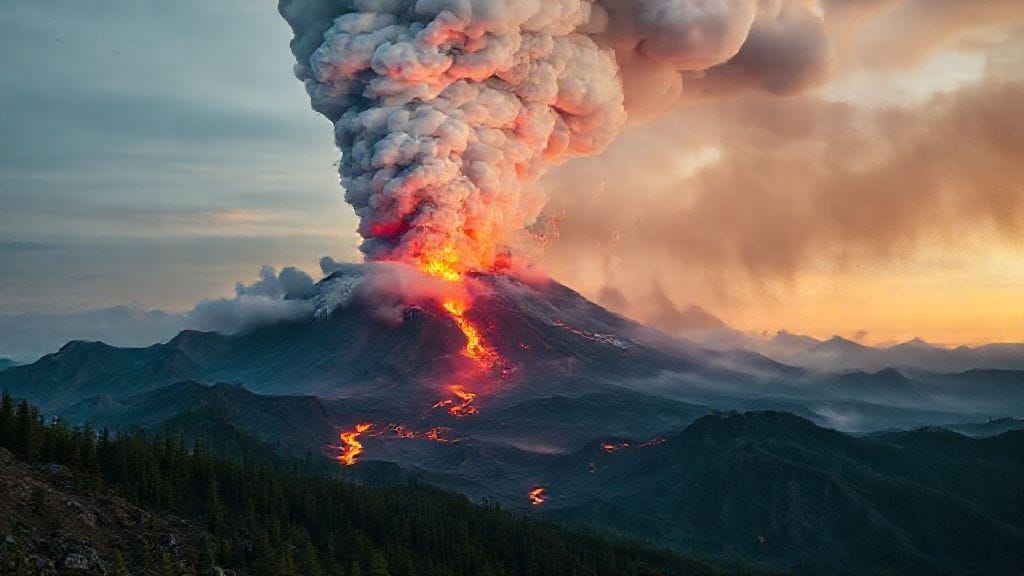
This landslide exposed a sudden breach in the volcano’s magma chamber, triggering a violent lateral blast that unleashed a massive column of steam, ash, and volcanic gases into the atmosphere. Unlike traditional eruptions that pour upward with symmetrical jets, St. Helens exploded sideways in a devastating blast zone over 230 square miles.
Pyroclastic flows—superheated clouds of gas and debris—raced down slopes obliterating everything in their path. Ash shot skyward as far as 15 miles in the air, drifting eastward to darken the skies in states hundreds of miles away. The eruption lasted for about nine hours but left scars that would endure for decades, reshaping both the environment and human perceptions of volcanic danger.
Pyroclastic Flows and Ash Clouds: Nature’s Fury Unleashed
The pyroclastic flows were lethal. Rivers boiled, trees incinerated instantly, and thick ash blanketed the landscape with suffocating weight. Ash fall was so heavy in some areas it caused roofs to collapse and complicated transportation and communication networks.
The volcanic plume soared, disrupting air travel and affecting weather patterns regionally. Cities as distant as Spokane and Seattle experienced ash fallout; people wore masks and closed windows uncertain of the airborne particles’ impact on their health. The eruption’s cadence shifted throughout the day, a relentless and unpredictable force pushing the boundaries of human experience.
Immediate Aftermath: Smoke, Ash, and Silence
When the skies began to clear and the ash settled, a surreal silence took hold. The once lush north side of the mountain was transformed overnight into a moonscape of mud, shattered trees, and jagged rock. Spirit Lake, renowned for its beauty, was overwhelmed by sediment and logs, its ecosystem decimated.
Rescuers and scientists grappled with access as rivers choked with debris and roadways vanished. The scale of destruction was magnified by the mountainous terrain’s isolation compounded by landslides triggered by the eruption itself. Communication lines were severed, and communities felt cut off from the outside world.
The Toll in Lives and Livelihoods: Human Cost of the Disaster
Fifty-seven people lost their lives, including workers and journalists who had ventured too close to the eruption zone. Among the victims was volcanologist David A. Johnston, who had famously reported “Vancouver! Vancouver! This is it!” moments before the blast. The human tragedy underscored the natural disaster’s deadly unpredictability.
Beyond lives, homes, farms, and entire industries suffered. The timber sector lost vast swaths of production capacity, while residents grappled with displacement, economic uncertainty, and emotional scars. Yet amid grief, stories of heroism emerged: firefighters, rescue teams, and scientists who risked everything to save lives and study the volcano.
Ecological Devastation: The Landscape Remade
The eruption eradicated over 230 square miles of old-growth forest, leveling 4 billion board feet of timber. Rivers rerouted, lakes filled with sediment, and wildlife habitats vanished in the space of moments. But nature’s response was paradoxical: destruction was paired with renewal.
Scientists observed the initial colonization of barren land by hardy pioneer species — mosses, lichens, and insects — setting in motion ecological succession. Mount St. Helens became an unprecedented case study in resilience and recovery, an open-air laboratory tracing nature’s ability to heal amid cataclysm.
Scientific Revelations: Understanding Volcanic Power
Mount St. Helens offered geologists and volcanologists an unprecedented opportunity to observe and analyze a violent eruption in detail. New instrumentation and rapid response teams gathered data on volcanic processes, seismic precursors, and eruption dynamics.
This eruption reshaped scientific paradigms of lateral blasts, eruption forecasting, and hazard mapping. The U.S. Geological Survey’s monitoring techniques evolved significantly, influencing global volcano surveillance strategies and emergency preparedness.
Media Frenzy: The Eruption that Captivated the Globe
The 1980 eruption was among the first major natural disasters to be broadcast live and globally via television networks. Dramatic footage of the blast, ash clouds, and decimated forests fascinated millions.
Journalists embedded near the mountain faced dangers but brought the event into American living rooms, promising both warning and spectacle. The eruption spurred widespread awareness of volcanic risks, connecting distant populations to a natural event that transcended geography.
Government Response: Emergency Management and Recovery Efforts
The federal and state governments mobilized emergency agencies following the eruption. The disaster led to the creation and refinement of evacuation plans and disaster-relief frameworks.
Financial aid helped rebuild infrastructure, support displaced families, and restore affected industries. Importantly, the event catalyzed the establishment of the Mount St. Helens National Volcanic Monument in 1982, preserving the area for scientific study and public education.
Lessons Learned: Shaping Disaster Preparedness in America
Mount St. Helens drove home the importance of monitoring volcanic activity and community readiness. Agencies implemented more robust alert systems and public education campaigns.
The eruption also highlighted challenges in balancing economic interests with environmental and human safety. Policies refining land use, logging practices, and hazard zone mapping stemmed directly from lessons learned.
Mount St. Helens in Memory and Culture: From Mourning to Myth
The eruption left a lasting imprint on regional and national identity. Memorials commemorated those lost; art, literature, and film explored themes of nature’s power and human vulnerability.
The mountain became a symbol of both destruction and regeneration in Pacific Northwest culture — a reminder that life persists amid disaster.
Renewed Life: The Slow but Tenacious Return of Nature
Nature’s resilience revealed itself over the following decades. Flora reappeared, animals returned, and Spirit Lake began recovering its aquatic ecosystems. Ecologists continue to marvel at how life finds footholds in the harshest aftermaths.
Scientists study the evolving ecosystem, offering hope and knowledge that guide conservation and restoration efforts worldwide.
Mount St. Helens Today: A Living Laboratory
Today, Mount St. Helens stands vigilant yet alive — not just as a tourist attraction but as one of the world’s most studied volcanoes. Its ongoing seismic activity reminds us of the planet’s restlessness.
Scientists maintain monitoring stations, using the mountain’s continuing rumblings to refine predictive models and safeguard communities in volcanic zones universally.
The Volcano’s Legacy: Environmental, Scientific, and Social Impacts
Beyond visible scars, the eruption’s legacy includes reshaping volcanic risk management, inspiring scientific inquiry, and nurturing a collective respect for nature’s power.
It reminded humanity that beneath our feet lie forces beyond control, compelling us to listen, learn, and prepare.
Reflections on Risk: Living in the Shadow of a Volcano
Mount St. Helens forces us to confront questions about risk tolerance, environmental stewardship, and coexistence with volatile landscapes. The eruption stands as a cautionary tale — but also a narrative of hope, survival, and human curiosity.
Communities around the Cascades live with an awareness born from tragedy, finding balance between reverence and resilience.
Conclusion: The Enduring Voice of the Mountain
Mount St. Helens’ 1980 eruption was not merely a geological event; it was a profound moment that reshaped environments, lives, and scientific horizons. The raw violence of May 18 contrasts starkly with the patient recovery unfolding today. Its story speaks to the duality of nature — capable of obliteration and renewal.
This mountain, once silent, now forever speaks to us about the fragility and tenacity of life, the unpredictability of the earth, and the enduring bond between humans and the natural world they inhabit. Remembering the eruption is remembering our place in a planet alive with dynamic energy, challenging and inspiring us.
FAQs
Q1: What caused the 1980 eruption of Mount St. Helens?
The eruption was triggered by magma intruding beneath the volcano, causing a bulge on the north flank. This led to a massive landslide that uncapped pressurized magma and gas, releasing an explosive lateral blast.
Q2: How many people died during the Mount St. Helens eruption?
Fifty-seven people lost their lives, including scientists and workers caught in the blast zone.
Q3: What was unique about the eruption compared to other volcanic events?
The lateral blast and massive landslide were unusual. Instead of a symmetrical vertical eruption, the side of the volcano exploded outward.
Q4: How did the eruption affect the environment?
It destroyed over 230 square miles of forest, reshaped rivers and lakes, and caused long-term ecological disturbance, but initiated a remarkable natural regeneration process.
Q5: How did the eruption impact disaster management in the U.S.?
It improved volcano monitoring, emergency preparedness, land-use policies, and led to the development of advanced hazard warning systems.
Q6: Are there ongoing risks from Mount St. Helens?
Yes, the volcano remains active with periodic eruptions and seismic activity monitored continuously by scientists.
Q7: How has Mount St. Helens influenced scientific understanding?
It provided vital data on lateral blasts, eruption precursors, and ecological recovery, influencing volcanology worldwide.
Q8: What is the significance of the Mount St. Helens National Volcanic Monument?
Established in 1982, it preserves the eruption site for research, education, and public appreciation of volcanic processes.

