Table of Contents
- The Dawn of Fire: The Okmok Volcano Awakens
- The Aleutian Archipelago: A Land Between Oceans and Time
- Geological Giants: Understanding Okmok’s Volcanic Legacy
- The Calm Before the Storm: Signs of Imminent Eruption
- April 12, 2008: The Sky Ignites Over Unalaska Island
- Nature’s Fury Unleashed: Details of the Eruption Sequence
- Ash Clouds and Atmospheric Drama: A Global Spectacle
- Impact on Local Communities: Fear and Evacuation in the Remote North
- Wildlife Displaced: Ecosystem Responses to Fiery Upheaval
- Aviation Chaos: Navigating Through Volcanic Ash
- Science in Action: Monitoring and Measuring the Eruption
- The Human Story: Eyewitness Accounts and Resilience
- Economic Ripples: From Fisheries to Flight Cancellations
- Satellite Eyes on Fire: The Role of Technology in Observing Okmok
- Comparing Past and Present: Okmok’s Historical Eruptions
- Lessons Learned: Preparedness and Response for Volcanic Hazards
- From Disaster to Dialogue: Community and Scientific Collaboration
- The Aftermath: Landscape Transformed and Recovery Begins
- The Volcano’s Voice Echoes: Cultural Reflections and Mythology
- Broader Implications: What Okmok’s Eruption Teaches the World
- The Continuing Watch: Okmok in the Eyes of Future Generations
The Dawn of Fire: The Okmok Volcano Awakens
In the cold, windswept reaches of the Aleutian Islands, where the North Pacific crashes relentlessly against volcanic rock, a dramatic spectacle unfolded in the spring of 2008. Under a vast, often storm-gray sky, the heart of an ancient mountain stirred back to life with a rumble. This was no ordinary awakening but a cataclysmic breath from deep within the earth: the Okmok Volcano, long dormant, had begun to erupt once again. What began as subtle tremors escalated into a tempest of molten fury that would shape landscapes, skies, and lives in ways few could have predicted.
Imagine the tension in the air as the cold Aleutian breeze mingled with rising ash and smoke, shrouding the sky in a somber twilight. For the scattered communities and remote wildlife, this was a moment of reckoning with a force greater than any human hand—nature’s raw, indomitable power making its voice heard in thunderous explosions and rivers of lava.
The Aleutian Archipelago: A Land Between Oceans and Time
Stretching like a jagged seam between North America and Asia, the Aleutian Islands are a string of more than 300 volcanic outcroppings. This chain, remote and rugged, has been shaped over millennia by the collision of tectonic plates—Earth’s restless skeleton grinding and rebounding beneath the waves. Unalaska Island, home to the Okmok volcano, is a vital node in this vast, wild network.
These islands have witnessed waves of human history—from the resilient Unangan people who have adapted to the harsh conditions for thousands of years to Russian fur traders and finally American military and scientific presence. Throughout, volcanoes have been both creators and destroyers, crafting the land while reminding inhabitants of their precarious existence.
Geological Giants: Understanding Okmok’s Volcanic Legacy
Okmok is no ordinary volcano. It is a caldera volcano, the remnants of a massive magma chamber collapse that left a broad, steep-walled crater nearly 10 kilometers wide. Formed during a colossal eruption thousands of years ago, this caldera now holds smaller cones that sporadically erupt, signifying the restless magma beneath.
Historically, Okmok has been one of the most active volcanoes in the Aleutians. Its eruptions, characterized by heavy ash plumes and substantial lava flows, have shaped the island’s geography and impacted local ecosystems and human settlements. Such eruptions are fueled by the subduction of the Pacific Plate beneath the North American Plate—a tectonic process that creates immense pressure and heat below the Earth's surface.
The Calm Before the Storm: Signs of Imminent Eruption
In the months leading up to April 2008, subtle changes began registering on the scientific instruments monitoring Okmok. Seismic activity hinted at the movement of magma, with swarms of small earthquakes increasing in frequency and intensity—a telltale sign of the volcano’s restlessness.
Residents and researchers alike were vigilant. Volcanologists, armed with seismographs and satellite imagery, watched as gas emissions from fumaroles increased and ground deformation suggested the swelling of the underground magma chamber. It was a waiting game, filled with uncertainty and urgency.
April 12, 2008: The Sky Ignites Over Unalaska Island
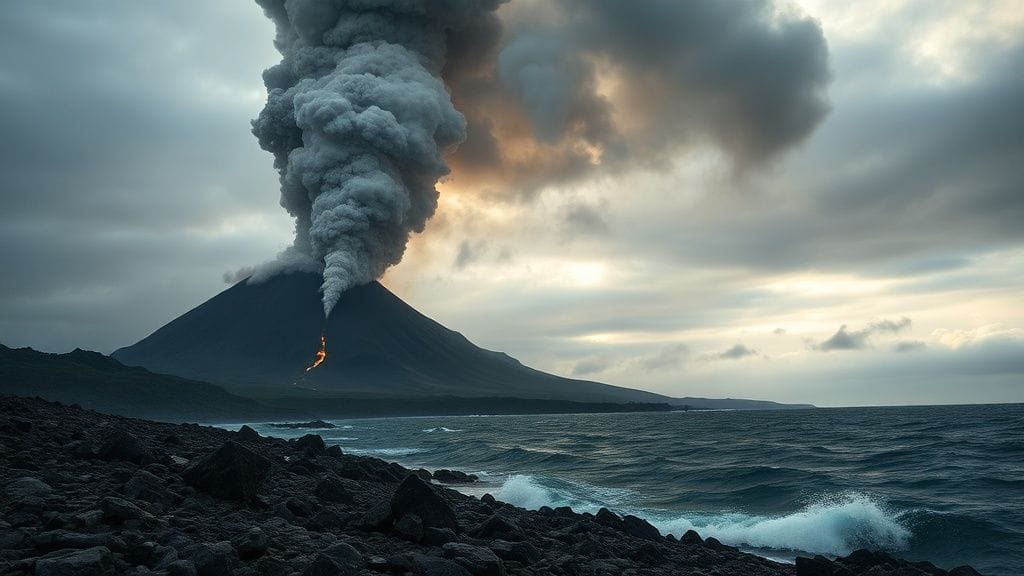
On the cold morning of April 12th, without much public warning, Okmok exploded. A towering plume of ash and volcanic gases shot upward more than 15 kilometers into the atmosphere, visible from miles away—an enormous column of smoke twisting against the pale blue of the Arctic spring.
Local residents saw the sky darken unnaturally as fine ash began to fall like soot over the island. The rumbling escalated in a chaotic symphony of explosive power. Streams of molten lava glowed ominously at night, etching red scars upon snow-capped slopes.
Nature’s Fury Unleashed: Details of the Eruption Sequence
The eruption was not a singular blast but a complex, multi-phase event. Initial seismic activity escalated into explosive eruptions, punctuated by lava effusions and the collapse of volcanic walls. Ash fallout extended over a radius of hundreds of kilometers, carried by erratic winds across the North Pacific.
Volcanic bombs, lapilli, and fine ash blanketed the terrain. The sudden release of magma and gas created violent pyroclastic flows—scorching avalanches of gas and rock—that reshaped parts of the caldera floor. The raw power of the eruption was a vivid reminder of Earth’s dynamic interior.
Ash Clouds and Atmospheric Drama: A Global Spectacle
Though isolated geographically, Okmok’s eruption quickly became a phenomenon affecting the globe. The massive ash cloud injected significant quantities of particles and sulfur dioxide into the upper atmosphere, contributing to temporary climatic cooling effects.
Meteorological satellites tracked the plume as it circled the planet. The eruption riveted atmospheric scientists, who studied the dispersal patterns of volcanic aerosols and their impacts on air travel, weather, and environmental health. For a fleeting moment, the remoteness of the Aleutians was bridged by the eruption’s shadow cast on a global scale.
Impact on Local Communities: Fear and Evacuation in the Remote North
Though sparsely populated, the Aleutians have established communities, particularly on Unalaska Island, including the town of Dutch Harbor, a vital fishing hub. The eruption created immediate concern.
Authorities issued warnings, evacuations were considered, and emergency shelters set up, although the remoteness and limited infrastructure posed challenges. The psychological strain on residents was profound—facing an elemental force that could obliterate livelihoods yet was impossible to fully control or predict.
Wildlife Displaced: Ecosystem Responses to Fiery Upheaval
The eruption’s impact extended beyond humans. Aleutian wildlife, adapted to a precarious balance on these islands, faced displacement and habitat destruction. Sea birds nesting on cliffs struggled as ash blanketed their breeding grounds, while marine life faced both direct and indirect consequences of ash-laden waters.
Interestingly, eruptions also play a vital ecological role over time—depositing nutrient-rich ash that fosters new biological growth. But in 2008, the immediate aftermath was a trial for the delicate biodiversity of the region.
Aviation Chaos: Navigating Through Volcanic Ash
Okmok’s eruption had an outsized effect on aviation. The ash cloud posed a significant hazard to aircraft engines, which can fail catastrophically if volcanic ash is ingested. Air traffic control in the North Pacific and beyond scrambled to adjust flight paths and cancel routes.
This disruption echoed a growing global challenge: balancing the demands of modern air travel with nature’s unpredictable fury. Airlines, governments, and pilot associations were forced to reassess their preparedness in the face of volcanic crises.
Science in Action: Monitoring and Measuring the Eruption
Scientists from the Alaska Volcano Observatory (AVO) and other agencies sprang into action, utilizing a range of technologies—seismometers, GPS stations, satellite radar, and gas analyzers—to monitor Okmok’s ongoing activity.
This eruption became a textbook case for volcano monitoring, providing critical data on eruption dynamics, magma movements, and eruption-driven atmospheric impacts, which have informed global volcanic hazard mitigation efforts.
The Human Story: Eyewitness Accounts and Resilience
Beyond data and ash clouds were individuals living through the eruption. Locals recounted the eerie silence followed by explosions, the dark skies filled with ash, the sudden changes in daily life. Many spoke of fear mingled with awe—witnessing speed and scale of natural forces that dwarf human effort.
Stories of neighbors helping neighbors, emergency teams coordinating responses, and the sober hope rooted in community strength paint a picture of resilience that transcends statistics.
Economic Ripples: From Fisheries to Flight Cancellations
Economically, the eruption disrupted fisheries—central to the Aleutians’ identity and livelihood—as ash contaminated waters, equipment, and logistics. International trade rippled in response to interrupted shipping and air routes.
Moreover, insurance costs, infrastructure repairs, and environmental rehabilitation imposed long-term financial burdens on local and federal governments.
Satellite Eyes on Fire: The Role of Technology in Observing Okmok
Space-based sensors provided real-time visuals of the eruption—from thermal anomalies to ash plume trajectories. Satellites such as NASA’s Aqua and Terra captured fiery images that captivated the world and enhanced scientific understanding.
These orbital vantage points underscored the importance of technology in confronting natural disasters in remote regions where ground access is limited.
Comparing Past and Present: Okmok’s Historical Eruptions
Okmok’s history includes major eruptions in 1945 and 1997, pivotal benchmarks for scientists comparing eruption styles and impacts. The 2008 event, more intense than its recent predecessors, confirmed that the volcano is capable of producing both explosive and effusive activity.
Such comparisons deepen knowledge about recurrence intervals, magma chemistry, and volcanic behavior—vital for risk assessment.
Lessons Learned: Preparedness and Response for Volcanic Hazards
The 2008 eruption underscored the necessity of robust volcano monitoring, early warning systems, and community preparedness programs. It revealed gaps in infrastructure and communication that needed addressing.
Emergency management agencies revised protocols, emphasizing interdisciplinary cooperation among volcanologists, meteorologists, local governments, and indigenous leaders.
From Disaster to Dialogue: Community and Scientific Collaboration
One remarkable outcome was a renewed dialogue between scientific experts and Aleut communities. Respecting centuries-old indigenous knowledge alongside modern science fostered more inclusive and culturally sensitive hazard management.
This collaboration remains a model for other regions confronting natural disasters.
The Aftermath: Landscape Transformed and Recovery Begins
Months after the initial blasts, calm returned, but the island was forever changed. Lava flows cooled into new rock fields, ash-encrusted valleys slowly began to green, and wildlife cautiously reoccupied disturbed areas.
Rehabilitation projects—both ecological and social—commenced, illustrating nature’s resilience and human commitment to recovery.
The Volcano’s Voice Echoes: Cultural Reflections and Mythology
Okmok possesses a place in Aleut mythology, viewed as a powerful spirit manifesting in the land’s fiery outbursts. The 2008 eruption reignited these stories, blending ancient spiritual understandings with contemporary experiences.
Such narratives offer perspective on human connections to the earth—where awe, respect, and fear coexist.
Broader Implications: What Okmok’s Eruption Teaches the World
Beyond the Aleutians, Okmok’s 2008 eruption remains a critical chapter in global volcanic history. It highlights the challenges of remote hazard management, the intersection of natural and human systems, and the ever-present need to respect Earth’s volatile temperament.
Climate scientists also observe its atmospheric effects, advancing research on volcanic influences on weather patterns.
The Continuing Watch: Okmok in the Eyes of Future Generations
Today, Okmok remains under vigilant observation, a reminder that earth’s inner fires seldom rest for long. For future generations—scientists, residents, and global citizens alike—this volcano symbolizes both the beauty and peril of our dynamic planet, calling for humility, preparedness, and reverence.
Conclusion
The 2008 eruption of Okmok volcano was much more than an isolated geological event in the remote Aleutian Islands; it was a vivid, living testament to the profound power and unpredictability of nature. It reminded us how fragile human existence is when faced with forces forged deep within the Earth’s mantle. Yet, it also revealed the incredible strength of community, science, and technology to observe, adapt, and recover.
From the eerie darkening skies over Unalaska to the ripple effects felt in distant air traffic corridors, Okmok’s fiery breath transcended geography and culture. It forged new knowledge about volcanic behavior and altered perceptions of how humanity coexists with dynamic planetary processes. Its story is a powerful narrative of destruction and renewal, fear and resilience — a tale as old as Earth itself.
In embracing this story, we find not only lessons in geology and disaster management but also a deeper human connection to the wild rhythms of our planet. The Okmok eruption challenges us to listen closely to Earth’s own voice, to honor its power, and to prepare wisely, for in the wake of fire, life invariably finds a way forward.
FAQs
Q1: What caused the 2008 eruption of the Okmok volcano?
The eruption was caused by the movement of magma rising due to tectonic activity where the Pacific Plate subducts beneath the North American Plate, building pressure in the magma chamber which eventually breached the surface.
Q2: How severe was the impact of the eruption on local communities?
Though the Aleutian Islands are sparsely populated, the eruption caused significant disruption including ash fallout over settlements, concerns about safety leading to temporary evacuations, and economic impact on fishing industries.
Q3: What role did technology play in monitoring the eruption?
Scientists utilized seismographs, GPS, satellite imagery, and gas analyzers to track seismic activity, ground deformation, ash plumes, and gas emissions, enabling real-time data collection and hazard assessment.
Q4: How did the eruption affect global air traffic?
Volcanic ash posed a severe risk to aircraft engines, causing flight cancellations and rerouted air traffic across the North Pacific, highlighting vulnerabilities in the aviation sector to natural events.
Q5: Has Okmok erupted before 2008?
Yes, notable eruptions occurred in 1945 and 1997. The volcano is known for its periodic explosive activity, marking it as one of the more active volcanoes in the Aleutian chain.
Q6: What ecological effects did the eruption have?
Immediate effects included destruction of habitats and ash contamination affecting birds and marine life. Over time, volcanic ash enriches soils, facilitating new biological growth and ecosystem regeneration.
Q7: How did local indigenous culture interpret the eruption?
Aleut mythology regards the volcano as a powerful spirit, embodying both creation and destruction. The 2008 eruption reinforced these spiritual narratives and cultural connections to the land.
Q8: What lessons have been learned for future volcanic hazard preparedness?
The eruption emphasized the importance of robust monitoring systems, community preparedness plans, scientific and indigenous collaboration, and improved communication infrastructure in remote regions.

