Table of Contents
- The Dawn of Fire: A Volcanic Awakening in Alaska
- Geography and Geology: The Formidable Trident Volcano
- The Precursor Signs: Nature’s Whispers Before the Fury
- The Year 1953: Setting the Stage for an Unforgettable Event
- The First Explosive Shocks: April’s Violent Prelude
- The Eruption Unfolds: A Symphony of Fire and Ash
- Tracking the Lava Flows: Rivers of Molten Rock Reshape the Land
- The Ash Fall: A Dark Blanket over the Alaskan Wilderness
- Human Encounters: Scientists on the Edge of Discovery
- The Impact on Indigenous Communities: Stories of Resilience
- Ecological Consequences: A Landscape Transformed Forever
- The Scientific Breakthroughs Sparked by Trident’s Fury
- International Attention: How the World Viewed Alaska’s Fiery Giant
- The Eruption’s End: A Slow Return to Quietude
- Lessons in Volcanology: What Trident Taught the Experts
- Memory and Myth: How the Eruption Lives On in Local Lore
- Trident Today: A Sleeping Titan of the Aleutian Range
- Comparing Trident: Similar Volcanoes and Their Stories
- The Climate Connection: Did Trident Influence Weather Patterns?
- Modern Monitoring: Technology Meets Ancient Power
- Conclusion: A Story of Nature’s Power and Human Courage
- FAQs: Exploring the Trident Eruption in Depth
- External Resources
- Internal Link
The Dawn of Fire: A Volcanic Awakening in Alaska
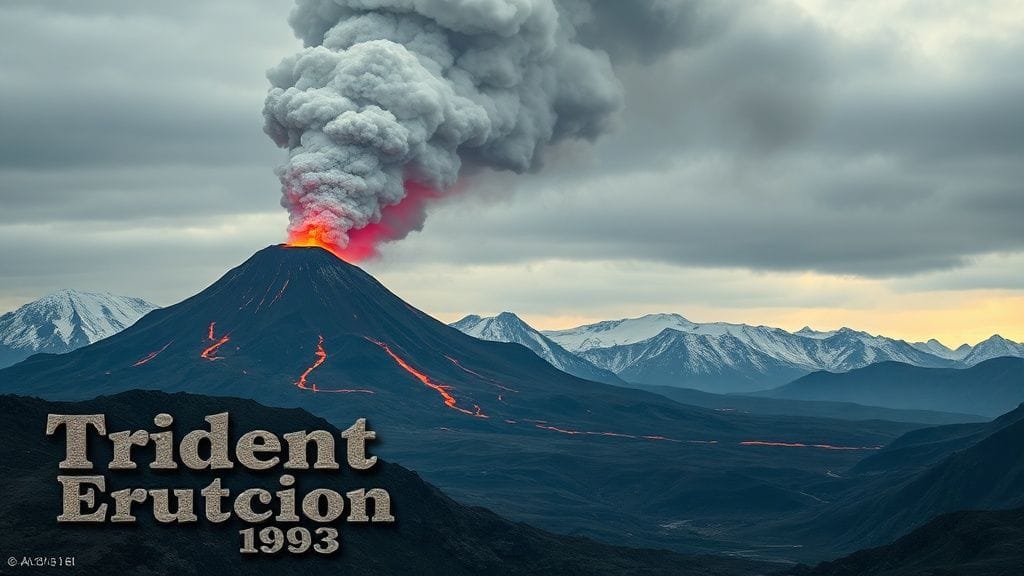
The mist hung low over the Aleutian Range that spring of 1953, a silent witness to nature’s slow shift toward chaos. Deep beneath the quiet, moss-covered rocks of Alaska’s Katmai National Park, the earth began to pulse with a hidden rhythm—vibrations signaling the awakening of Trident Volcano. What followed was not merely a volcanic eruption; it was an elemental ballet of fire and ice, a spectacle that would captivate geologists and reshape landscapes, while echoing through the communities living amidst those frozen hills.
The night sky over the remote wilderness exploded with incandescent light, a dazzling contrast against the polar twilight. Rivers of lava carved new scars across the tundra, while ash clouds climbed kilometers into the cold atmosphere, blurring the boundary between earth and sky. The Trident eruption became an apocalyptic vision wrapped in the wild beauty of Alaska—a reminder that beneath even the most tranquil lands, colossal natural forces lie waiting.
Geography and Geology: The Formidable Trident Volcano
Rising sharply from the rugged terrain of the Aleutian Volcanic Arc, Trident Volcano is a composite stratovolcano characterized by its threesome of domes, hence its name. Part of the Pacific Ring of Fire, it occupies a pivotal spot in one of Earth’s most volcanic active regions, a harsh environment where tectonic plates clash with relentless force.
Formed over hundreds of thousands of years, Trident’s volcanic architecture tells a story of successive eruptions and rebuilding. Subduction of the Pacific Plate beneath the North American Plate fuels its magma chambers, creating an unpredictable heartbeat beneath the surface. Though not the tallest nor most famous volcano in Alaska, Trident’s 1953 eruption ranks as one of the most significant volcanic events in the state’s recorded history, demonstrating the terrifying beauty of nature’s destructive artistry.
The Precursor Signs: Nature’s Whispers Before the Fury
Long before molten rock breached the surface, the region around Trident was restless. Subtle ground tremors began in early 1953, initially dismissed as minor tectonic activity common to the zone. But seismographs recorded increasing frequencies and intensities, hinting at deeper forces at work.
Geothermal anomalies manifested as warm springs shifted temperature, and gentle fumaroles that had been dormant slowly hissed to life. Local hunters and park rangers noticed the wildlife’s uneasy behavior as birds took flight in unusual patterns and fish movements altered in nearby streams.
This chorus of signs – often overlooked in remote wilderness – held the secret prelude to one of Alaska’s most dramatic natural upheavals. Scientists monitoring the area faced the daunting task of interpreting these signals amid a landscape that was as mysterious as it was vast.
The Year 1953: Setting the Stage for an Unforgettable Event
In the early months of 1953, America’s gaze was largely turned toward Cold War anxieties and post-war reconstruction, leaving the quiet Alaskan wilds to their own devices. Yet, beneath the serene snows and budding tundra growth, geological forces readied themselves for action.
Meteorological conditions that spring added complexity: warmer than usual temperatures combined with melting snowpacks increased the weight pressing upon the volcanic edifice. Such factors, paired with magma pressure building deep underground, primed Trident for a dramatic eruption.
The convergence of these natural and climatic elements was not obvious to lay observers, but scientists tracking the mountain’s volcanic activity felt an increasing urgency that something extraordinary would soon break the silence.
The First Explosive Shocks: April’s Violent Prelude
On April 18th, 1953, the earth’s surface cracked open with a series of explosive shocks. What started as intermittent tremors escalated rapidly into violent eruptions that expelled ash and gas with immense force.
The initial explosions fractured the volcanic domes, sending pyroclastic material jetting into the atmosphere. The sound—a terrifying roar—echoed across the isolation of the Aleutians like a primal call to attention.
For those few observing or stationed in the region, it was a moment of awe and dread. Scientists hastily organized monitoring expeditions despite the treacherous landscapes and unpredictable eruptions, determined to bear witness to the unfolding natural phenomenon.
The Eruption Unfolds: A Symphony of Fire and Ash
For months, the volcano remained active. Clouds of volcanic ash rolled across the skies while incandescent lava created new formations with slow, mesmerizing flows.
Trident’s eruptions combined explosive bursts with effusive lava domes—a rare duality that intrigued volcanologists. Dark ash curtains occasionally transformed into dazzling sunsets and eerie daytime shadows, imprinting eeriness on the natural world.
This continuous eruption was a relentless performance of earth’s inner workings. Smoke and fire danced with the wind, altering skies and challenging life around the volcano’s vicinity.
Tracking the Lava Flows: Rivers of Molten Rock Reshape the Land
The molten rivers advanced, consuming rock, trees, and soil in their path, reshaping valleys and generating new landforms. These flows, while slow-moving, were relentless and created a mosaic of fresh volcanic rock that would become home to new ecosystems in time.
As hot as 1000 degrees Celsius when emitted, the lava’s destructive power was total; it obliterated old features but laid the groundwork for geological renewal. Satellite imagery decades later revealed how much the terrain had shifted, confirming the eruption's profound physical impact.
The Ash Fall: A Dark Blanket over the Alaskan Wilderness
Ashfall from the eruption spread across hundreds of square kilometers, blanketing plants, watercourses, and animal habitats. Though inhospitable, this layer also enriched soils with minerals, fostering long-term ecological succession.
Smoke-choked skies impeded daylight, forcing wildlife into altered behavioral patterns, while human visitors faced severe respiratory threats. Communities far from the volcano initially underestimated the reach and power of volcanic ash.
Still, the ashfall was both a symbol of devastation and a testimony to the interconnectedness of ecosystems responding to volcanic forces.
Human Encounters: Scientists on the Edge of Discovery
Though remote, the area attracted increasing attention from volcanologists eager to study Trident’s behavior. Teams braved difficult conditions, tracking seismic activity, sampling gases, and documenting lava and ash characteristics.
Among these was geologist Robert Griggs, whose pioneering research months earlier had helped establish baseline knowledge of Alaskan volcanoes. His colleagues’ field notes from 1953 describe a delicate balance between scientific curiosity and the dangers posed by an unpredictable natural furnace.
These investigations significantly overturned prior assumptions about dome-building eruptions, adding invaluable pieces to volcanology’s expanding puzzle.
The Impact on Indigenous Communities: Stories of Resilience
For Alaska’s Native communities who had lived in harmony with the land for centuries, the eruption brought profound challenges. Some villages experienced disruptions as ash contaminated water sources and traditional hunting grounds.
Yet, oral histories recorded decades later reveal resilience and adaptability. Elders recall the eruption through stories passed down, emphasizing respect for nature’s power and the necessity of vigilance.
This cultural narrative illustrates how indigenous knowledge and modern science intersect in understanding and surviving volcanic events.
Ecological Consequences: A Landscape Transformed Forever
The eruption’s impact extended beyond immediate destruction. Unique ecological niches emerged in the post-eruption landscapes—all shaped by volcanic substrates.
Scientists later observed the colonization of lichens, mosses, and hardy shrubs on fresh lava flows, beginning the slow process of ecological succession. Animal populations adapted or migrated, contributing to a dynamic adaptation cycle.
In essence, the eruption acted as a brutal reset button but also as an engine for biological renewal.
The Scientific Breakthroughs Sparked by Trident’s Fury
The 1953 eruption challenged and refined volcanic theory. It highlighted the complexity of dome-building eruptions and the interplay between explosive and effusive phases.
New techniques in seismic monitoring, gas emission analysis, and geological sampling were developed in response, helping scientists better predict future eruptions worldwide.
Trident became a case study cited in volcanology textbooks and conferences, portraying natural hazard research as not only urgent but profoundly human.
International Attention: How the World Viewed Alaska’s Fiery Giant
Though remote, the eruption drew attention beyond American borders. News coverage in scientific journals and global media portrayed a tableau of raw nature rarely witnessed firsthand.
The event symbolized the volatile power within the Earth’s crust—an important narrative during an era marked by nuclear fears and technological optimism.
International volcanologists eagerly exchanged findings, strengthening cross-border collaborations that prefigured later global volcanic monitoring efforts.
The Eruption’s End: A Slow Return to Quietude
By late 1953, eruptive activity subsided, leaving behind altered landscapes and rivers of cooled lava. The smoke stacks thinned, and seismic tremors eased, signaling a return to relative tranquility.
Yet, the memory of fire beneath ice lingered in scientific minds and local traditions alike. Trident was sleeping, but not gone—its slumber a reminder of the delicate balance between earth’s creative and destructive forces.
Lessons in Volcanology: What Trident Taught the Experts
From the eruption’s nuances emerged lessons about volcanic hazards, eruption prediction, and risk communication, especially regarding dome-building volcanic activity.
Trident underscored the need for continuous monitoring in even the most inhospitable regions, prompting NOAA and USGS to expand their observational networks.
The event deepened understanding that volcanic eruptions are multifaceted processes demanding interdisciplinary investigation.
Memory and Myth: How the Eruption Lives On in Local Lore
Long after the last cinders cooled, stories of Trident’s eruption persisted in local narratives, often couched in mythic language.
Tales of roaring earth, fiery skies, and spirits disturbed by human activity capture the symbolic force of this natural episode.
These oral traditions serve both as cultural heritage and informal historical record, enriching the scientific data with emotional and philosophical dimensions.
Trident Today: A Sleeping Titan of the Aleutian Range
Today, Trident Volcano remains dormant but monitored carefully by geological agencies. Satellite and field surveys ensure early warnings if unrest re-emerges.
While less violent, its presence still commands respect, a reminder that beneath Alaska’s serene wilderness lies a restless force capable of shaping landscapes and human destinies.
Comparing Trident: Similar Volcanoes and Their Stories
Trident’s 1953 eruption shares similarities with other dome-building volcanoes such as Mount St. Helens (1980) and Novarupta (1912). Each provides unique insights into varied magma behaviors and environmental impacts.
Comparative study highlights how regional geological contexts influence eruption styles, underlining the complexity of understanding volcanic phenomena worldwide.
The Climate Connection: Did Trident Influence Weather Patterns?
Volcanic eruptions often inject aerosols and ash into the atmosphere, potentially affecting climate. Though Trident's scale was moderate compared to giant eruptions, scientists have studied its transient effects on local weather.
Analysis shows minor short-lived cooling effects in the region, with no major global climatic disruption—but a useful case study in volcano-climate interactions.
Modern Monitoring: Technology Meets Ancient Power
The legacy of Trident’s eruption informs current volcanic observation techniques—seismic networks, satellite remote sensing, gas analyzers, and drones now watch volcanoes with unprecedented precision.
Alaska’s rugged terrain poses challenges, but technology bridges gaps between inaccessible landscapes and human need for safety.
Such advancements honor the lessons learned from past events like Trident.
Conclusion
The Trident eruption of 1953 stands as a powerful chapter in the ongoing saga of Earth’s dynamism. It was not only a geological event but a deeply human story—of scientists braving unknown dangers, indigenous communities adapting to sudden change, and nature asserting its grandeur and unpredictability.
As we reflect on this fiery display beneath the Alaskan skies, we see the eternal dance of destruction and renewal. The molten rivers and ash clouds remind us how fragile and resilient life is, shaped by forces far beyond individual control.
Trident’s story invites humility and awe, a vivid testament to the planet’s restless heart and humanity’s enduring quest to understand it.
FAQs
Q1: What triggered the 1953 Trident eruption?
A1: The eruption was triggered by increasing pressure from magma due to the subduction of the Pacific Plate beneath the North American Plate, compounded by seasonal snowmelt adding weight and stress on the volcanic edifice.
Q2: How long did the eruption last?
A2: The main eruptive phase lasted several months in 1953, with fluctuating activity of explosive and effusive eruptions before subsiding toward the end of the year.
Q3: Were there any casualties or injuries?
A3: Given the remote location and sparse human presence, there were no recorded casualties or serious injuries during the eruption.
Q4: What were the main scientific outcomes from studying the eruption?
A4: Trident provided crucial insights into dome-building volcanic activity and helped develop monitoring techniques for complex eruptions, influencing global volcanology practices.
Q5: How did the eruption affect local wildlife and ecology?
A5: The eruption disrupted habitats through ash fall and lava flows, but also created new ecological opportunities for species adapted to colonize volcanic landscapes.
Q6: Is Trident Volcano still active today?
A6: Trident is currently dormant but remains closely monitored for signs of renewed activity.
Q7: How is Trident’s eruption remembered in Native Alaskan culture?
A7: Indigenous communities preserve the event through oral tradition, reflecting themes of respect for nature’s power and the importance of coexistence with natural forces.
Q8: Did the eruption affect global climate?
A8: The scale of the eruption was insufficient to cause significant global climate impact, though minor regional atmospheric effects were observed.

