Table of Contents
- A Fiery Dawn: The Kīlauea Iki Eruption Begins
- The Geologic Heart of Hawaiʻi: Understanding Kīlauea
- Islands Forged by Fire: Hawaiʻian Volcanism in Context
- The Calm Before the Blaze: Hawaiʻi in 1959
- The First Tremors: Early Signs of an Imminent Eruption
- July 21, 1959: When the Earth Opened Its Mouth
- Lava Lakes and Volcanic Fury: The Mechanics of Kīlauea Iki’s Eruption
- Fire Meets Forest: The Landscape Transformed
- Volcano Observatories and Pioneering Science in Action
- Voices from the Island: Eyewitness Accounts and Local Reactions
- The Dance of Lava: Tracking the Changing Eruption Phases
- Hazard and Awe: Risk, Disaster Response, and Public Perception
- The Endurance of Nature: How Kīlauea Iki’s Eruption Reshaped Ecology
- Cultural Echoes: The Eruption in Hawaiian Myth and Modern Memory
- Long Shadows: The Eruption’s Lasting Impact on Volcanology
- Reflections on Human Vulnerability and Natural Power
- Hawaiʻi’s Volcanic Story Continues: Lessons from Kīlauea Iki
- Conclusion
- FAQs
- External Resource
- Internal Link
A Fiery Dawn: The Kīlauea Iki Eruption Begins
In the early hours of July 21, 1959, beneath the heavy tropical skies of Hawaiʻi, the ground whispered and then roared. For generations, the islanders had lived with the quiet rhythm of the volcano’s heartbeats—occasional tremors, faint hissing in the earth, subtle shifts that suggested secret motions deep below. But on this day, Kīlauea Iki, the "little Kīlauea" crater adjacent to Hawaiʻi’s famous Kīlauea caldera, unleashed a ferocity that captured the world’s imagination. Fires erupted from the earth’s core, fountains of molten rock arced skyward in a cauldron of incandescent fury, and the very land seemed to pulse with life — or perhaps, with rage.
The eruption, notable for its spectacular lava fountains reaching hundreds of meters high, riveted geologists and laypeople alike. It offered a rare, close-up spectacle of the planet’s primal forces in motion and opened an unparalleled window into volcanic processes.
What followed was not just a natural catastrophe, but an epic story of scientific discovery, local resilience, and the enduring dance between humanity and the volatile earth beneath Hawaiʻi’s volcanic soils.
The Geologic Heart of Hawaiʻi: Understanding Kīlauea
Kīlauea is far from an ordinary volcano. Unlike explosive volcanoes deposited from subduction zones, Kīlauea sits over a hot mantle plume—a volcanic hotspot that has birthed the entire Hawaiian archipelago over millions of years. This shield volcano rises gently but commands immense power, with basaltic lava flows silently, persistently forging new earth.
Kīlauea Iki, a nested crater within the greater Kīlauea caldera, is a geological theater where massive eruptions have played out before. Its name reflects its smaller size relative to Kīlauea’s sprawling form, but its eruptions are no less dramatic. Basaltic lava filling the crater floor to form an ephemeral lava lake reflects the volcano’s restless spirit.
Beneath this volcanic dome, magma from deep within the Earth’s mantle pushes upwards, fed by immense thermal energy that converts solid rock into molten streams. The buildup of pressure, combined with fissures and weaknesses in the earth’s crust, sets the stage for eruptions that can either flow smoothly or burst explosively.
Islands Forged by Fire: Hawaiʻian Volcanism in Context
Understanding the 1959 eruption requires a look back at the broader context of Hawaiʻi’s geological history. The Hawaiian Islands themselves are phoenixes of fire and stone, rising from the abyssal plain of the Pacific Ocean over a stationary hotspot. As the Pacific Plate drifts northwestward over millions of years, a chain of islands and seamounts forms—the oldest to the northwest and the youngest, Hawaiʻi, still actively growing.
Kīlauea’s continuous activity marks it among the youngest and most dynamic volcanoes. It is the lifeblood of Hawaiʻi Island, dripping earth’s molten essence that shapes the island’s fertile soils and coastal contours. While eruptions here rarely bring cataclysms like elsewhere, they remind residents that life and death are perpetually written by fiery pens in this fiery land story.
The Calm Before the Blaze: Hawaiʻi in 1959
The year 1959 was a time of transformation for Hawaiʻi itself. Culturally, politically, and economically, the islands were edging toward statehood, which they would gain later that year in August. The eruption thus unfolded against a backdrop of change, human optimism, and growing international interest in Hawaiian culture and science.
Locals lived largely alongside the volcano peacefully but with a respect born of ancestral knowledge—a reverence for Pele, the goddess of fire and volcanoes, who was said to inhabit Kīlauea’s fiery depths. Scientists, increasingly equipped with modern instruments, had begun to map and monitor the volcano more thoroughly.
Yet, the eruption was anything but expected in its intensity, and when the earth finally cracked open, it pushed both people and science into uncharted territory.
The First Tremors: Early Signs of an Imminent Eruption
In the weeks preceding July 21, subtle signs hinted at mounting unrest. Increased seismic activity—small quakes reverberating through the volcanic system—raised alarms at the Hawaiian Volcano Observatory (HVO), then under the watchful eye of scientists like Thomas A. Jaggar.
Gas emissions rose, ground deformation became measurable, and minor steam bursts were reported. Yet volcanic precursors often mask their true intent with ambiguity. To the casual observer, the lush forests seemed unchanged; no billowing ash clouds marred the sky.
But deep below, molten rock was breaking its bonds.
July 21, 1959: When the Earth Opened Its Mouth
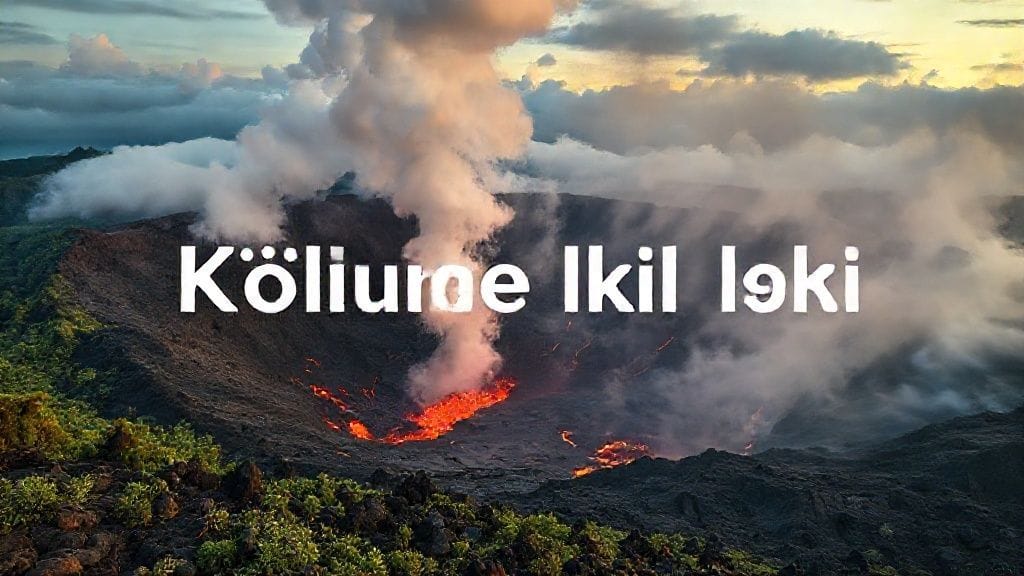
At approximately 10:30 a.m. local time, the earth split open in a dramatic display. A fissure about 1.5 kilometers long erupted along the southeastern wall of the Kīlauea Iki crater. Lava fountains exploded upwards to heights of 190 meters, transforming the sky into a tempest of molten fire.
The eruption was not a single continuous event; rather, it unfolded in pulses. The lava breached the surface violently, spraying volcanic bombs and a relentless cascade of incandescent lava that would fill the crater basin.
Scientists watched with a mixture of awe and professional candor. Cameras clicked, instruments recorded, and logbooks filled with data that would come to inform volcanic science for decades.
Lava Lakes and Volcanic Fury: The Mechanics of Kīlauea Iki’s Eruption
Kīlauea Iki’s lava fountains are an impressive example of Hawaiian-style volcanism—characterized by fluid basaltic lava and relatively non-explosive eruptions. Yet their power intrigued volcanologists because the eruption produced a spectacular lava lake, reaching depths of 140 meters and spanning the entire crater.
This type of eruption unfolds as gas-rich magma rises through fissures, pressure is released, and spectacular “curtains” of lava jets dance skyward. The ensuing lava lake cooled and solidified over months, leaving a patchwork of black basalt and intricate formations—pāhoehoe and ʻaʻā lava flows.
The geologic story of these fountains reveals the inner machinery of volcanic conduits, degassing, and the delicate balance between explosivity and gentle flow.
Fire Meets Forest: The Landscape Transformed
Before the eruption, Kīlauea Iki’s crater floor was a forested depression cradled by steep rocky walls. As the eruption intensified, the fires raged, trees were engulfed, and the landscape was forever transformed.
Where once birds sang and native flora thrived, now lay a molten sea. While ash and gases wafted across the sky, the thick lava flow obliterated portions of the forest instantly, sterilizing the ground and resetting ecological clocks.
Yet nature’s resilience was not far behind. The slow recolonization of flora and fauna on the fresh basaltic rock would become a textbook example of ecological succession in volcanic environments.
Volcano Observatories and Pioneering Science in Action
The eruption of Kīlauea Iki coincided with a watershed moment in volcanic monitoring. The Hawaiian Volcano Observatory, founded by Thomas Jaggar in 1912, was among the first institutions to advance systematic volcanic study.
During the 1959 eruption, scientists deployed seismographs, tiltmeters, and thermometers with growing sophistication. Photographic documentation cataloged lava textures and eruption dynamics.
Notably, Kīlauea Iki became a natural laboratory, pushing volcanic science toward better predictive models. Efforts to understand lava lake behavior, gas emissions, and eruption precursors gained momentum.
The 1959 eruption’s data helped shape hazard mitigation strategies still applied today.
Voices from the Island: Eyewitness Accounts and Local Reactions
The eruption was not just a scientific spectacle—it was a human drama. Local residents shared tales of fiery nights lit by molten glow, tremors felt through floors, and the oppressive smell of sulfur that pervaded the air.
Elders invoked Pele’s wrath with a mixture of reverence and fear, while others marveled at the sheer spectacle. Visitors to Hawaiʻi in 1959 found themselves witnesses to a truly otherworldly event, often recalling the eruption as a defining moment in their lives.
These personal narratives remind us that volcanism is not simply geologic but intensely human.
The Dance of Lava: Tracking the Changing Eruption Phases
Over the months following the first eruption, Kīlauea Iki’s terror began to subside slowly. The lava lake slowly cooled, and lava fountains diminished. Scientists noted distinct phases—from violent jets to quieter lava effusions—as the volcanic engine eventually spent its fury.
This natural transition provided invaluable insight into the lifecycle of Hawaiian eruptions. It also allowed researchers to refine theories about magma supply rates and conduit processes.
The gradual stasis restored a fragile equilibrium, setting the stage for decades of quieter volcanic activity.
Hazard and Awe: Risk, Disaster Response, and Public Perception
Unlike cataclysmic eruptions elsewhere, the 1959 Kīlauea Iki event posed modest direct risks to human settlements due to the crater’s relative isolation. Still, the eruption raised awareness about volcanic hazards in Hawaiʻi.
Emergency services coordinated monitoring, public advisories, and scientific updates—with lessons learned for future volcanic or seismic events. The eruption underscored the duality of awe and danger that volcanism represents.
The volcano, while a giver of fertile lands and cultural identity, remained a force requiring respect and vigilance.
The Endurance of Nature: How Kīlauea Iki’s Eruption Reshaped Ecology
Despite initial destruction, Kīlauea Iki’s eruption created a blank canvas for nature. Within months and years, pioneering species colonized the barren basalt, from hardy lichens to endemic plants.
This slow yet relentless process illustrates ecological succession’s grace in volcanic contexts, turning death into rebirth. For scientists and conservationists, Kīlauea Iki became a natural observatory for studying life’s persistence amid adversity.
Today, new generations of flora and fauna thrive where fire once reigned supreme.
Cultural Echoes: The Eruption in Hawaiian Myth and Modern Memory
To Hawaiians, Kīlauea is not merely a geological feature but the sacred home of Pele, the fire goddess who commands volcanic fury. The 1959 eruption reaffirmed these spiritual ties.
Stories and chants recall Pele’s dual nature of destructive wrath and creative power—a living reminder that the land and its people coexist with these fiery forces.
In modern Hawaiʻi, the eruption remains etched in collective memory and serves as a symbol of nature’s grandeur and unpredictability.
Long Shadows: The Eruption’s Lasting Impact on Volcanology
The Kīlauea Iki eruption was transformative for earth sciences. Its detailed documentation helped advance knowledge around lava lake dynamics and basaltic eruptions, influencing volcano monitoring worldwide.
Subsequent decades of research built upon lessons learned in 1959. The eruption is frequently cited in textbooks and research papers, and its geologic record continues to be examined by new generations of scientists.
Reflections on Human Vulnerability and Natural Power
There is a humbling lesson beneath Kīlauea Iki’s fire: the earth beneath us is a living, restless entity. Human beings, despite technology and progress, remain spectators and participants within vast natural cycles.
The eruption echoed through communities’ lives and imaginations, reminding all that power oscillates between creation and destruction, and survival depends on respect, understanding, and adaptation.
Hawaiʻi’s Volcanic Story Continues: Lessons from Kīlauea Iki
Though the 1959 eruption ended, the story of Kīlauea did not. The volcano remains active, with eruptions continuing into the 21st century.
Kīlauea Iki’s eruption laid the groundwork for ongoing research, hazard management, and cultural dialogue. It urged Hawaiʻi—and the world—to consider how to live alongside one of nature’s most spectacular phenomena.
It remains a reminder that the earth is always in motion, reshaping the very ground beneath our feet.
Conclusion
The 1959 Kīlauea Iki eruption remains a luminous chapter in the story of Earth’s fiery soul. It combined nature’s awe-inspiring spectacle with human curiosity and resilience, a dance of molten rock and quiet observation. This eruption was more than a geological event—it was a story of transformation: of land, people, and knowledge.
Its legacy endures not only in the rugged basalt that now blankets the crater floor but in the hearts and minds of those who witnessed fire’s terrible beauty and those who continue to study and revere Hawaiʻi’s volcanic powerhouse.
In the timeless conflict of earth and fire, the Kīlauea Iki eruption stands as a vivid symbol: raw power, sublime creation, and the unending cycle of destruction and renewal.
FAQs
Q1: What caused the 1959 Kīlauea Iki eruption?
The eruption was caused by the movement of magma rising from the Earth’s mantle through fissures in the volcano’s crust, driven by a mantle hotspot beneath the Hawaiian Islands.
Q2: How long did the eruption last?
The eruption began on July 21, 1959, and continued with varying intensity for three months, creating a sizable lava lake within the crater.
Q3: Were there any casualties or significant damage?
Due to the remote location of the crater, there were no direct casualties or damage to settlements, although the eruption altered the local landscape and ecosystems dramatically.
Q4: Why is the eruption scientifically significant?
It provided unprecedented insight into basaltic lava fountains, lava lake formation, and magma conduit dynamics, contributing valuable data that have guided volcanic monitoring and research globally.
Q5: How did the eruption affect local communities culturally?
It reinforced Hawaiian cultural narratives about Pele, the goddess of volcanoes, deepening the spiritual connection between the people and the land’s volcanic power.
Q6: What ecological effects followed the eruption?
Initially destructive, the eruption’s lava flows created a fresh substrate for ecological succession, allowing study of how life returns to barren volcanic landscapes.
Q7: How did the eruption influence volcanic hazard awareness?
It heightened local and scientific awareness of volcanic hazards, leading to improved monitoring and disaster preparedness strategies in Hawaiʻi.
Q8: Can Kīlauea Iki erupt again?
While Kīlauea Iki has not erupted since 1959, the greater Kīlauea volcano remains active, and future eruptions in or near the crater area are always possible.

