Table of Contents
- The Awakening of a Giant: The Puʻu ʻŌʻō Eruption Begins
- The Birth of a Volcanic Phenomenon: Early Days of the 1983 Eruption
- A Landscape in Flux: Changing Geography and New Landmass
- Kīlauea’s Fire and Ice: The Interplay of Lava and Local Environment
- The Human Face of Disaster: Communities on the Edge
- Scientists at the Frontier: Monitoring and Understanding the Eruption
- The Great Fissure 8 Eruption: A New Phase of Fury
- The Flow of Destruction: Destroyed Homes and Altered Paths
- Pele’s Power: Cultural and Spiritual Dimensions of the Eruption
- Economic Tremors: Tourism, Infrastructure, and Recovery Efforts
- Media and the Volcano: Global Attention on Puʻu ʻŌʻō
- A Changing Ecosystem: Flora and Fauna Amidst the Lava Fields
- Lessons from the Volcano: Advances in Volcanology through Puʻu ʻŌʻō
- The Longest Eruption in Modern History: 35 Years of Activity
- The 2018 Summit Collapse and the End of an Era
- What Remains: New Landscapes and Enduring Legacies
- Puʻu ʻŌʻō in the Global Imagination: Volcano in Art and Literature
- The Resilience of Hawaiʻi: Communities Rebuilding After the Lava
- Conclusion: Fire, Creation, and the Indomitable Spirit of Kīlauea
- FAQs: Understanding the Puʻu ʻŌʻō Eruption
- External Resource
- Internal Link
The Awakening of a Giant: The Puʻu ʻŌʻō Eruption Begins
On the morning of January 3, 1983, the earth beneath Hawaiʻi shifted with a sudden, terrifying energy. Far from the bustling streets of Hilo and the serene beauty of the Big Island’s verdant landscape, a new volcanic vent opened quietly but ominously in the East Rift Zone of Kīlauea. Known as Puʻu ʻŌʻō, meaning “Hill of the ʻŌʻō bird” in Hawaiian, this fissure’s eruption marked the birth of one of the longest and most significant volcanic events of the modern age.
As the first droplets of molten lava squeezed through the crust and trickled down the slopes, the air filled with sulfurous smoke, and the distant rumble of subterranean fire echoed through the valleys. It was an awakening—a power that would reshape landscapes, disrupt lives, and, paradoxically, birth new lands over a period spanning more than three decades. The people of Hawaiʻi watched in awe and apprehension, witnessing a spectacle at once violent and creationist on the raw edge of the earth.
The Birth of a Volcanic Phenomenon: Early Days of the 1983 Eruption
Before 1983, Kīlauea had already carved a terrifying and fascinating reputation. Its persistent activity had fascinated scientists and locals alike, but the Puʻu ʻŌʻō eruption was different. It began with a fissure opening in the tropical forest, emitting lava fountains that reached tens of meters into the air. The initial flows were slow, allowing local inhabitants to observe and appreciate the raw intensity of nature’s artistry.
Puʻu ʻŌʻō itself began to grow rapidly as the eruption’s primary vent, ejecting lava that built a cinder cone rising hundreds of feet. The landscape began to change day by day, the forests melting into deadly rivers of molten rock. This eruption was not a quick display of force; instead, it was a slow-burn that demanded patience and vigilance. Scientists rushed to install monitoring equipment, understanding early that this was the start of a monumental event.
A Landscape in Flux: Changing Geography and New Landmass
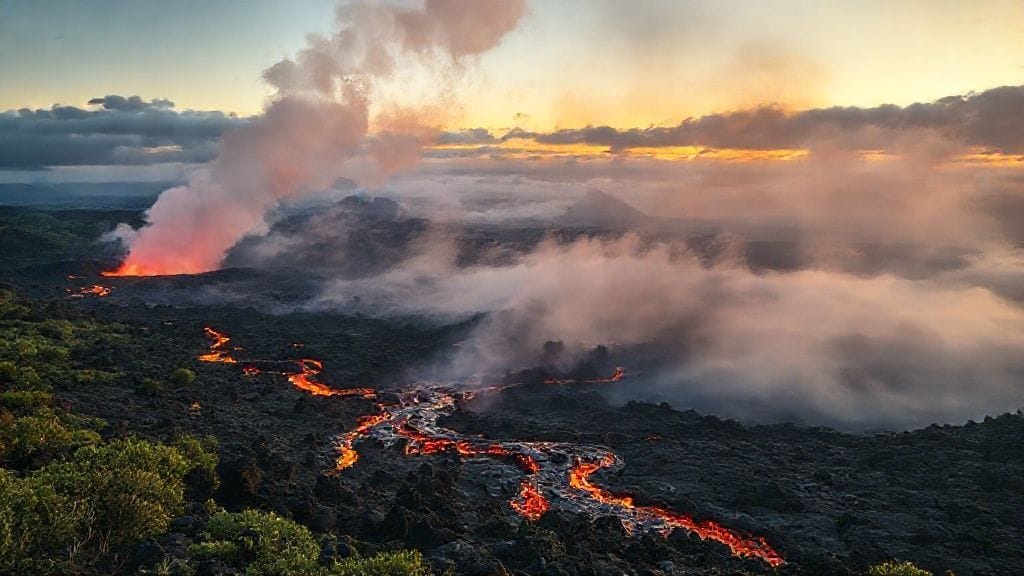
The lava flows from Puʻu ʻŌʻō relentlessly advanced towards the ocean, rewriting maps as they moved. Over 500 million cubic meters of lava were produced in the early years alone, covering thousands of hectares of forest and farmland. Entire villages found themselves under threat, and eventually, parts of the coastline melted into the sea, adding new landmass measured in square kilometers.
With startling invisibility, the flows extended the island’s borders seaward, a paradoxical creation amid destruction. This geological phenomenon fascinated researchers and challenged traditional concepts about the impermanence of land. A new Hawaiʻi was being forged from fire—a living laboratory for scientists and a powerful symbol for locals.
Kīlauea’s Fire and Ice: The Interplay of Lava and Local Environment
The climate of Hawaiʻi, with its lush flora and fragile ecosystems, collided dramatically with the persistent fires of Puʻu ʻŌʻō. Rainfall interacted with lava creating thick plumes of steam laden with hydrochloric acid—a hazardous mix known as "laze." This deadly fog posed new environmental concerns besides the more visible threat of molten rock.
Ancient trails, sacred sites, and native habitats became battlegrounds between elemental titan forces. Yet, in this destruction, life found ways to endure. Pioneer species adapted rapidly to the new volcanic soils, beginning the slow rebirth of ecosystems that alternated destruction with renewal in a cruel but continuous cycle.
The Human Face of Disaster: Communities on the Edge
While the eruption transformed the natural world, the human consequences were immediate and profound. Entire neighborhoods—Kalapana, Kaimū, and others—were consumed, their homes swallowed by the advancing lava. Residents faced harrowing decisions; some evacuated early, others stayed, driven by a bond to the land and a stoic acceptance of nature’s power.
Stories emerged of resilience and tragedy, of families displaced and cultural sites lost to an unrelenting tide of fire. Yet amidst the hardships, community solidarity and deep spiritual reflection took hold. The eruption illustrated not just the vulnerability of human settlement but also the determination to adapt and rebuild.
Scientists at the Frontier: Monitoring and Understanding the Eruption
From the outset, Puʻu ʻŌʻō presented scientists with an unprecedented opportunity and challenge. The U.S. Geological Survey’s Hawaiian Volcano Observatory (HVO) expanded its efforts, pioneering new monitoring technologies: infrared imaging, aerial reconnaissance, ground deformation sensors, and real-time gas measurements.
Scientists like Don Swanson and Tina Neal became household names in volcanology, dedicating decades to decoding the eruption’s mysterious pulses, predicting lava flows, and issuing crucial warnings. Their work not only saved lives but pushed the boundaries of volcanology, turning Puʻu ʻŌʻō into a case study for effusive basaltic eruptions worldwide.
The Great Fissure 8 Eruption: A New Phase of Fury
In May 2018, after 35 years of relentless activity, Puʻu ʻŌʻō’s era shifted dramatically with the birth of Fissure 8, a spectacular and devastating new vent nearly two miles down the rift zone. Fissure 8 unleashed a massive lava flow, marked by spectacular fountains reaching heights of 300 feet, posing an unprecedented threat to communities such as Leilani Estates and Lanipuna Gardens.
This phase of the eruption was devastatingly fast and powerful. Lava surged through neighborhoods, engulfing hundreds of structures in a matter of weeks, disrupting roadways, utilities, and lives. It was a vivid reminder that beneath Hawaiʻi’s beauty lay a volatile heartbeat, unpredictable and formidable.
The Flow of Destruction: Destroyed Homes and Altered Paths
The 2018 lava flows razed 700+ homes, reshaping towns and altering lives irreversibly. Streets disappeared underneath blackened moonscapes, and entire communities vanished. The struggling efforts of emergency services highlighted the human cost of geological forces.
But these minutes of destruction also gave rise to awe-inspiring images of nature’s destructive beauty—rivers of burning rock illuminating night skies, the earth literally reclaiming its terrain. For many Hawaiians, this was Pele—goddess of fire at work—demanding respect and empathy.
Pele’s Power: Cultural and Spiritual Dimensions of the Eruption
The eruption of Puʻu ʻŌʻō resonated deeply within Hawaiian culture. Pele, the goddess of volcanoes and fire, is central to native beliefs, embodying destruction and creation. Many Hawaiians saw the lava flows as manifestations of Pele’s will—her anger, her renewal.
Oral histories and rituals intertwined with scientific observation, forming a unique dialogue between tradition and modernity. The eruption rekindled spiritual reflection on the relationship between humans and the land, blending reverence, respect, and a profound sense of place.
Economic Tremors: Tourism, Infrastructure, and Recovery Efforts
The eruption’s impact extended beyond nature and culture, rippling through Hawaiʻi’s economy. Tourism—which depends heavily on the island’s volcanic allure—saw shifts as national parks and lava viewing areas fluctuated in accessibility. Infrastructure damage required costly repairs, and insurance claims surged as homeowners struggled to rebuild.
Yet, the event also galvanized new opportunities. Volcanic tourism evolved, bringing visitors fascinated by the fiery phenomenon, while recovery initiatives employed locals and boosted community solidarity. For Hawaiʻi, the eruption was both a challenge and a catalyst for change.
Media and the Volcano: Global Attention on Puʻu ʻŌʻō
Puʻu ʻŌʻō’s eruption captivated global audiences. News outlets, filmmakers, and scientists broadcast images of flowing lava and collapsing craters, making the volcano a symbol of natural power worldwide. Dramatic footage of lava flows meeting the ocean, explosions of steam, and night skies aflame flooded television screens, social media, and print.
The media’s portrayal helped raise awareness but also sparked debates on disaster preparedness, land policies, and indigenous rights. The world watched, mesmerized by the relentless dance of fire and earth unfolding on Hawaiʻi’s shores.
A Changing Ecosystem: Flora and Fauna Amidst the Lava Fields
In the wake of fiery ruin, life’s stubborn persistence shone. Pioneer plants—lichens, ferns, and hardy shrubs—began colonizing the fresh lava, setting in motion an ecological succession that could take centuries. Insects, birds, and even native snails found niches in this evolving environment.
Researchers marveled at how swiftly biological communities adapted to the new landscapes, studying these volcanic rebirths as nature’s ultimate experiment. Puʻu ʻŌʻō’s legacy, it turns out, was not just destruction but renewal—an ongoing story of survival.
Lessons from the Volcano: Advances in Volcanology through Puʻu ʻŌʻō
Puʻu ʻŌʻō transformed scientific understanding of effusive volcanic eruptions. Continuous observation provided key insights into magma chamber dynamics, rift zone mechanics, and eruption forecasting. Innovations in remote sensing and geochemistry emerged, creating new predictive models.
These advances extended benefits globally, helping manage volcanic hazards in other regions. The eruption became a natural classroom, illustrating the complex interplay of geologic forces and enriching humanity’s knowledge of Earth’s inner workings.
The Longest Eruption in Modern History: 35 Years of Activity
Few natural events span generations as visibly as Puʻu ʻŌʻō’s eruption. Its unbroken activity from 1983 to 2018 stands as the longest-lived eruption of Kīlauea in recorded history. Over these 35 years, the volcano’s behavior changed and evolved, reflecting shifting subterranean pressures and magma supply.
For local communities, the eruption was a constant—a formidable presence shaping daily life, inspiring both fear and fascination. Globally, Puʻu ʻŌʻō became a symbol of nature’s enduring power and unpredictability.
The 2018 Summit Collapse and the End of an Era
The eruption’s dramatic finale came in 2018, when a powerful earthquake triggered the collapse of Kīlauea’s summit crater, Halemaʻumaʻu. This event sent shockwaves through Hawaiʻi, closing an intense chapter. Lava flows stopped at Puʻu ʻŌʻō, and the volcano entered a new, quieter phase.
Scientists and locals alike pondered the future. Had Pele rested, or was this the quiet before another awakening? Amid loss and reflection, the end of the eruption symbolized both closure and anticipation.
What Remains: New Landscapes and Enduring Legacies
Today, the scars and creations of Puʻu ʻŌʻō remain etched in Hawaiʻi’s landscape. Vast lava fields stretch where forests once stood, now mossy and green with the first signs of rebirth. New coastline lines frame the island’s silhouette, a visible reminder of recent geological youth.
The eruption shaped policy, culture, and science, leaving legacies in every realm. Its story continues to inspire respect for the earth’s power and the resilience of those living in its shadow.
Puʻu ʻŌʻō in the Global Imagination: Volcano in Art and Literature
The eruption captured imaginations beyond Hawaiʻi. Poets, filmmakers, and artists immortalized its fiery dance—portraying lava’s sensual flow, the night skies on fire, and humanity’s fragile presence. In documentaries and novels, Puʻu ʻŌʻō serves as a metaphor for force, transformation, and survival.
This cultural footprint enriches the eruption’s significance, merging science with human experience and creative expression.
The Resilience of Hawaiʻi: Communities Rebuilding After the Lava
Despite devastation, Hawaiʻi’s communities displayed remarkable resilience. Reconstruction efforts balanced respect for the land with modern needs, healings intertwined with honoring tradition. The eruption’s lessons fostered stronger emergency responses and deeper community solidarity.
Hawaiʻi emerged not just as a witness to disaster but as an example of endurance and adaptation—embracing Pele’s fire as part of its identity.
Conclusion
The Puʻu ʻŌʻō eruption of Kīlauea is more than a geological event; it is a story of transformation etched in fire and spirit. For 35 years, the earth breathed molten fury at Hawaiʻi, testing the balance between destruction and creation, nature and humanity. Through this long volcanic hymn, landscapes changed, lives were upheaved, and cultures deepened their bonds with the sacred land.
This eruption teaches us that the earth is alive and unpredictable—and that in the fiery heart of the planet lie stories of both loss and hope. The eruption shaped not only Hawaiʻi’s terrain but the collective imagination of a world witnessing the relentless pulse of an ancient volcano’s fire. As the lava cools and new life blooms, the legacy of Puʻu ʻŌʻō endures—reminding us that destruction and renewal are inseparable forces, always intertwined, always potent.
FAQs
Q1: What caused the Puʻu ʻŌʻō eruption to start in 1983?
A1: The eruption began due to rising magma in Kīlauea’s East Rift Zone, where fractures in the Earth’s crust allowed molten rock to surface. This was a result of continuous magma supply from the volcano’s hotspot beneath Hawaiʻi.
Q2: How did the eruption impact local communities?
A2: The eruption destroyed hundreds of homes, altered landscapes, and forced evacuations. Communities faced emotional loss but also showed resilience by rebuilding and adapting to new volcanic realities.
Q3: Who were key scientists involved in monitoring Puʻu ʻŌʻō?
A3: Scientists like Don Swanson and Tina Neal of the U.S. Geological Survey’s Hawaiian Volcano Observatory played crucial roles, pioneering monitoring techniques that revolutionized understanding of effusive volcanic eruptions.
Q4: What cultural significance does Puʻu ʻŌʻō have for Hawaiians?
A4: The eruption is deeply tied to Pele, the Hawaiian goddess of fire and volcanoes, symbolizing destruction and creation. Many Hawaiians view the volcano as sacred and interpret eruptions within spiritual frameworks.
Q5: How did the eruption affect Hawaiʻi’s economy?
A5: While damaging homes and infrastructure, the eruption also boosted volcanic tourism and scientific research. Recovery efforts created jobs, though insurance and rebuilding costs were significant.
Q6: Why is the 2018 phase of the eruption particularly notable?
A6: The 2018 Fissure 8 eruption was unprecedented in scale and destruction, endangering populated areas and leading to a dramatic summit collapse that ended Puʻu ʻŌʻō’s long lava output.
Q7: What environmental changes resulted from the eruption?
A7: Vast areas of forest were buried under lava; however, new ecosystems emerged as pioneer species colonized fresh volcanic soil, starting a slow process of ecological renewal.
Q8: What legacy has Puʻu ʻŌʻō left in the field of volcanology?
A8: The eruption provided extensive data on rift zone eruptions and lava flow dynamics, improving eruption forecasting and hazard mitigation strategies worldwide.

