Table of Contents
- The Dreadful Awakening: February 1600 and the Birth of a Catastrophe
- The Land Before the Fury: Geological and Cultural Landscape of 16th Century Peru
- Signs in the Sky and Earth: Early Warnings of Huaynaputina’s Threat
- The Day the Earth Roared: The Eruption Unfolds in All Its Horror
- Volcanic Clouds and Ash Storms: Atmospheric Impact and Immediate Devastation
- The Silent Killers: Poisonous Gases and the Tragedy that Followed
- Into the Darkness: The Human Toll Across the Viceroyalty of Peru
- The Once Vibrant Valleys Turned Barren: Effects on Agriculture and Economy
- A Plague in Disguise: The Connection between Huaynaputina and the Russian Famine
- Cultural Echoes: Contemporary Chronicles and Indigenous Oral Traditions
- European Eyes on an American Catastrophe: The Global Perception of the Eruption
- Scientific Rediscovery: From Colonial Reports to Modern Volcanology
- The Geochemical Fingerprint: Tracing Huaynaputina’s Ash Across Continents
- Lessons from the Past: How Huaynaputina Shaped Disaster Preparedness
- Modern Volcanoes in the Shadow of Huaynaputina: Ongoing Threats in Peru
- The Legacy of Silence: Why Huaynaputina is Less Known Today
- Conclusion: Remembering Huaynaputina—A Testimony of Nature's Power and Human Resilience
- FAQs: Unveiling the Mysteries of the Huaynaputina Eruption
- External Resource
- Internal Link
1. The Dreadful Awakening: February 1600 and the Birth of a Catastrophe
It was an ordinary early summer morning in the southern highlands of Peru, a landscape sculpted by ancient Andean civilizations and dotted with small colonial settlements. Yet, beneath this serene surface, deep within the earth’s crust, something sinister stirred. On the 19th of February 1600, the unassuming Huaynaputina volcano, a seemingly dormant giant, erupted with a violence that would echo across continents and centuries. The sky turned a roiling gray-black, blanketing the sun, and a fiery plume hissed into the cold upper atmosphere. Villages were buried under ash, rivers poisoned, seas darkened by particulate fallout. But this was only the beginning of a disaster far more complex than immediate destruction.
The eruption of Huaynaputina is not merely a story of volcanic fury; it is an epic testament to the interplay of natural forces and human fragility. The catastrophic event reshaped environments, economies, and even global climates. It would take hundreds of years for science to unravel the full scope of its effects, and the scars left behind continue to remind us of our planet’s volatile genius.
2. The Land Before the Fury: Geological and Cultural Landscape of 16th Century Peru
To comprehend the cataclysm that followed, we must first step back into the world in which Huaynaputina slumbered. Nestled in the volcanic belt of the Andes, Huaynaputina was a relatively obscure mountain rising near the city of Arequipa. Peru in the late 16th century was an intersection of indigenous Andean cultures—descendants of the Inca and other civilizations—and the Spanish colonizers, whose control was turbulent and tenuous but relentless.
This region was shaped by a restless geology. The Andes Mountains, the longest continental mountain range, formed by the subduction of the Nazca Plate beneath the South American Plate, are dotted with hundreds of volcanoes, many active and deadly. Huaynaputina itself had remained quiet for centuries, perhaps millennia, leaving no reason for concern. Its peak was snow-capped, its slopes covered with scrub and farmland. Small communities farmed maize, potatoes, and quinoa, venerating the earth and mountains in a delicate harmony.
Spanish settler towns, with their churches and mining operations—especially silver mines, the jewel of New World wealth—had started to dot the landscape, bringing new economies, social structures, and tensions. The union of two worlds in a volatile landscape created a fragile setting for disaster.
3. Signs in the Sky and Earth: Early Warnings of Huaynaputina’s Threat
Long before the main blast, indigenous peoples and settlers witnessed strange phenomena. Earthquakes trembled through the foothills; animals acted nervously; skies occasionally glowed in ominous hues. Chroniclers from the city of Arequipa documented unusual seismic activity and distant rumblings—an early, albeit cryptic, herald of the violent awakening.
Oral histories preserved by native communities speak of “the mountain awakening,” a spiritual disruption as profound as the physical. Priests and shamans interpreted these signs, issuing warnings that were often dismissed or misunderstood by the Spanish authorities, entangled in their colonial administration.
Was it hubris or ignorance that led to a failure in heeding these omens? Perhaps. Scientific understanding was in its infancy, but natural philosophy of the time did not distinguish between volcanic gas emissions, seismic precursors, and meteorological phenomena as we do today. The clouds that would soon darken skies were foreshadowed only faintly, yet unmistakably, by nature itself.
4. The Day the Earth Roared: The Eruption Unfolds in All Its Horror
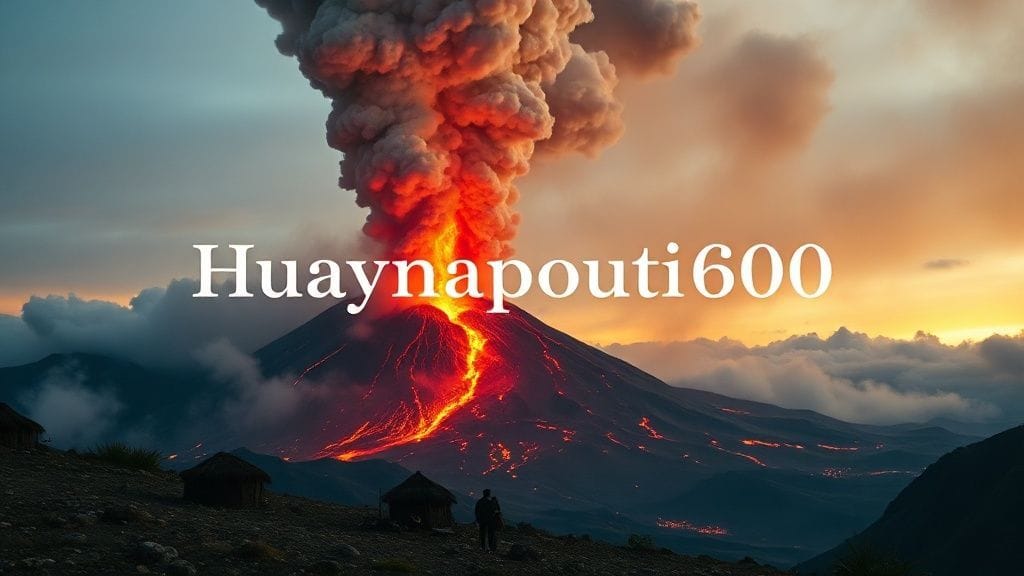
On February 19th, 1600, the calm shattered. Huaynaputina’s eruption began in the pre-dawn hours, with explosions so powerful they were heard hundreds of kilometers away. Columns of ash shot kilometers into the atmosphere, darkening the Andean sky and cutting sunlight for days.
The initial blast destroyed Huaynaputina's summit and sent pyroclastic flows tearing down its flanks, obliterating everything in their paths. Lava rarely played the main role—it was the ash, pumice, and toxic gases that wrought havoc. The eruption column pulsed like a monstrous heart, expelling an estimated 30 cubic kilometers of tephra.
Villagers fled in desperation, many succumbing to roof collapses from ash loads or suffocation as ash choked the air. Rivers turned acidic and clogged with volcanic debris, destroying fish populations and contaminating water supplies. The landscape was transformed overnight: forests exacted, valleys buried, fertile soil turned toxic.
5. Volcanic Clouds and Ash Storms: Atmospheric Impact and Immediate Devastation
One cannot underestimate the scale of the atmospheric impact. Ash plumes reached the stratosphere, circling the globe and dimming sunlight for months. Historians note that winters in the Northern Hemisphere following the eruption were particularly harsh. Snow fell early and lasted long, crops failed, and famine loomed.
While ashfall devastated Peru’s surroundings, atmospheric particles spread worldwide. Eyewitness accounts from Europe describe blood-red sunsets, eerie twilight, and cold summers unfit for agriculture. The “volcanic winter” phenomenon became an unintentional collateral of Huaynaputina’s outburst, an early chapter in the story of how one eruption could ripple through global climate.
6. The Silent Killers: Poisonous Gases and the Tragedy that Followed
Beyond the visible destruction, invisible gases wrought their own calamity. Sulfur dioxide and other acidic compounds poured out in massive quantities. These gases, mixing with atmospheric moisture, fell as acid rain, poisoning rivers and soils and undermining crops vital for subsistence.
Many deaths were due not to the initial blast but to respiratory diseases caused by inhaling volcanic ash and toxic gases. Starvation compounded the suffering, as granaries were buried or ruined, livestock perished, and soon, epidemics of malnutrition-related illnesses swept through.
7. Into the Darkness: The Human Toll Across the Viceroyalty of Peru
While colonial records are fragmentary, scholars estimate that tens of thousands perished in the immediate region, and many more suffered from starvation and disease in the months and years after. The densely populated valleys near Arequipa and the mining towns, crucial to the Spanish colonial economy, were hardest hit.
Indigenous populations, already dispossessed and weakened by conquest, bore a disproportionate burden. Survivors described “a sky turned to fire and ash,” a darkness so absolute it disoriented even the brave. Entire families vanished, villages disappeared under feet of tephra.
Yet, stories of resilience persisted: communities rebuilding terraces, planting new crops adapted to volcanic soils, and incorporating the disaster into their worldviews.
8. The Once Vibrant Valleys Turned Barren: Effects on Agriculture and Economy
The agricultural consequences were ruinous. Peru’s highlands depended on a delicate balance of altitude and climate to gain two harvests annually. Ash rendered fields infertile and tangled irrigation canals. Crops failed in succession, silver mines slowed down as workers perished or fled, and the entire economy of the Viceroyalty contracted.
Moreover, food shortages inflated prices, sparking social unrest among both indigenous and colonial populations. The Spanish crown, oscillating between neglect and emergency relief, found its colonial wealth reservoir threatened in an era already marked by European conflicts and crises.
9. A Plague in Disguise: The Connection between Huaynaputina and the Russian Famine
One of the most astonishing explorations into Huaynaputina’s global impact is its link to the Great Russian Famine of 1601–1603. Historians and climatologists have pieced together evidence suggesting that volcanic winter conditions propagated by Huaynaputina’s eruption led to crop failures far beyond South America.
Russia’s worst famine in centuries unfolded in the wake of unprecedentedly cold summers, devastating harvests across Siberia and European Russia, and killing approximately two million people. The realization that a remote Andean volcano could catalyze such a catastrophe underscores the fragile interconnectedness of early modern global climate systems.
10. Cultural Echoes: Contemporary Chronicles and Indigenous Oral Traditions
While official Spanish colonial documents provide grim statistics and dry notices of damage, indigenous accounts are steeped in spirituality and tragedy. For Andean peoples, Huaynaputina was more than a natural event—it was a sign of cosmic imbalance, an awakening of Pachamama's wrath.
Oral traditions recount visions of fire mountains, blackened skies, and the mourning of the earth. These narratives preserved the memory of the eruption long after the ash settled, influencing religious practices, rituals, and cultural identities.
11. European Eyes on an American Catastrophe: The Global Perception of the Eruption
News of the eruption traveled slowly but captivated European courts and scholars who began to connect the dots between strange atmospheric phenomena and calamities abroad. Accounts reaching Spain and Italy spoke of “the sky aflame,” shortened growing seasons, and omens of divine displeasure.
In intellectual circles, the event contributed indirectly to early climatological thought, questioning long-held beliefs about the stability of heaven and earth and the relationship between natural disasters and human destiny.
12. Scientific Rediscovery: From Colonial Reports to Modern Volcanology
By the 20th century, Huaynaputina had become a subject of renewed interest for volcanologists unraveling the history of catastrophic eruptions in the Andes. Continuing studies of ash layers, tephra deposits, and sulfur isotopes allowed scientists to reconstruct the mechanics and magnitude of the eruption.
Notably, Huaynaputina represents the largest eruption in South America in recorded history—a benchmark for understanding regional volcanic hazards. Advances in satellite technology and geochemical analysis have confirmed its role in global climate disturbances.
13. The Geochemical Fingerprint: Tracing Huaynaputina’s Ash Across Continents
A remarkable scientific achievement has been tracing Huaynaputina’s volcanic ash across thousands of kilometers—from the Peruvian Highlands to Antarctic ice cores and even tree rings in Europe and Asia.
These deposits act as time capsules, preserving clues about atmospheric circulation patterns and the eruption’s chemical signatures. This global fingerprinting binds ancient Peru to far-flung corners of the planet, telling a story of transcontinental environmental impact.
14. Lessons from the Past: How Huaynaputina Shaped Disaster Preparedness
Though centuries removed from our modern era, Huaynaputina’s eruption offers timeless lessons in preparation, response, and respect for nature’s force. It reminds us how vulnerable societies are to cascading disasters triggered by geological events.
Today, Peru and Andean nations integrate historical knowledge with modern monitoring systems aimed at mitigating volcanic risks. The eruption stands as both a warning and a guidepost in building resilience amid the Earth’s restless crust.
15. Modern Volcanoes in the Shadow of Huaynaputina: Ongoing Threats in Peru
Peru remains a land of volcanoes, many active and potentially dangerous. Misti, Sabancaya, and Ubinas stand as reminders of the latent threats. The memory of Huaynaputina’s fury informs geological risk management and civil preparation.
Communities living beneath these mountains are heirs of a legacy marked by both catastrophe and renewal—a testament to endurance amid uncertainty.
16. The Legacy of Silence: Why Huaynaputina is Less Known Today
Despite its magnitude, Huaynaputina fades from popular historical memory outside academic and regional circles. Several factors contribute: the remote location, limited contemporary written records, and overshadowing by better-known eruptions like Krakatoa or Tambora.
Yet this silence challenges us to recover forgotten histories, appreciating how even distant events shape human destiny. Huaynaputina compels us to listen closely to Earth’s warnings before they become tragedies.
17. Conclusion: Remembering Huaynaputina—A Testimony of Nature's Power and Human Resilience
The eruption of Huaynaputina in 1600 was not merely a geological event but a human drama writ large across continents and generations. In its ashes lie stories of loss and courage, despair and recovery.
It reminds us that nature’s forces operate on scales beyond immediate comprehension, entwining climate, society, and memory. Yet, amid destruction, humanity’s flame endures, learning to coexist with the restless world beneath our feet.
Huaynaputina’s tale is an invitation to humility and vigilance—a silent but persistent echo from the heart of the Andes.
FAQs
Q1: What caused the Huaynaputina eruption in 1600?
The eruption was triggered by magma from beneath the earth rising explosively due to tectonic activity in the Andes’ volcanic arc, resulting in a massive eruption column and pyroclastic flows.
Q2: How large was the Huaynaputina eruption compared to other historic volcanoes?
It is considered the largest volcanic eruption in South America during historical times, ejecting about 30 cubic kilometers of tephra—comparable to the 1815 eruption of Tambora.
Q3: What immediate effects did the eruption have on local populations?
Thousands died from ash fallout, roof collapses, poisoning, and subsequent famine. Many settlements near the volcano were destroyed or abandoned.
Q4: Did the eruption impact global climate?
Yes, ash and sulfur aerosols entered the stratosphere, leading to colder temperatures and failed harvests in both hemispheres, contributing to famines such as the Great Russian Famine.
Q5: How is Huaynaputina remembered in Peru today?
It is recognized by scientists and local communities as a historic disaster, informing modern volcanic monitoring and disaster preparedness programs.
Q6: Why is Huaynaputina less known internationally than other eruptions?
Its remote location, sparse contemporary records, and overshadowing by other famous eruptions have limited its global prominence despite its magnitude.
Q7: How did indigenous cultures interpret the eruption?
Many saw it as an expression of divine or cosmic anger, integrating the event into their spiritual narratives as a warning and a lesson about harmony with nature.
Q8: What lessons can modern societies learn from Huaynaputina?
The importance of early warning, respecting natural signs, preparing for long-term climatic effects, and integrating scientific knowledge with cultural heritage.

