Table of Contents
- The Night the Mountains Roared: Awakening of Lascar
- Setting the Stage: Geological and Historical Context of Lascar
- A Long Silence Broken: Prelude to the 1993 Eruption
- Beginning of the Fury: April 18, 1993 – The First Explosions
- The Veil of Ash: How the Sky Turned Dark Over Antofagasta
- Voices in the Chaos: Eyewitness Accounts from Locals and Miners
- The Surge of Fire and Smoke: Chronology of the Initial Eruptive Phase
- Environmental Toll: Ash, Lava, and the Threat to High-Altitude Ecosystems
- Scientific Response: Monitoring, Predictions, and Emergency Measures
- Human Resilience against Nature’s Wrath: Community and Authorities’ Reaction
- Economic Tremors: Impact on Mining Operations and Regional Economy
- The Ash Clouds over the Pacific: Regional and Global Atmospheric Effects
- Lessons from the Past: Comparing the 1993 Lascar Eruption to Previous Events
- The Aftermath: Recovery, Rehabilitation, and Remediation Efforts
- Lasting Legacy: The 1993 Lascar Eruption in Chilean Environmental Policies
- Cultural Reflections: The Eruption in Chilean Art, Memory, and Identity
- How Lascar Changed Volcanology: Advances Triggered by the 1993 Event
- Nature’s Warning: The Ongoing Volcanic Activity and Preparedness Today
- The Human Story Beneath the Ashes: Profiles of Survivors and Scientists
- Conclusion: Between Destruction and Renewal, Lascar’s Enduring Tale
- FAQs: Understanding the 1993 Lascar Eruption
- External Resource
- Internal Link
The Night the Mountains Roared: Awakening of Lascar
In the heart of the Atacama Desert, beneath a sea of startlingly clear stars, a distant but thunderous rumble awakened the restless giant. On the evening of April 18, 1993, the tranquil skies above northern Chile were shattered as Lascar volcano, often silent and inconspicuous, unleashed a violent eruption. Plumes of smoke and ash surged skyward, blotting out constellations, blurring the horizon, and sending waves of hot ash racing down its flanks. The eruption was not just a geophysical event; it was a moment suspended between awe and dread, a confrontation between human lives and the timeless forces of the earth.
For the inhabitants of Antofagasta and the nearby mining towns, the eruption signaled upheaval and disruption. The mountain’s roar carried ancient memories, deeply etched in local communities who had long respected—and feared—the volatile landscape. As night grew darker with ash and embers, a narrative of survival, scientific intrigue, and profound transformation began to unfold.
Setting the Stage: Geological and Historical Context of Lascar
Lascar sits in a geologically volatile zone—one of the most active volcanic regions on Earth, shaped by the relentless subduction of the Nazca Plate beneath the South American Plate. Nestled within the Central Volcanic Zone of the Andes, Lascar had a history punctuated more by quiet dormancy than devastating eruption. Before 1993, it was widely regarded as a moderately active stratovolcano, its rhythmic yet predictable activity mapped in past decades by volcanologists.
Yet the region had its own living memory of volcanoes—harsh landmarks etched into the indigenous Atacameño culture and the historical fabric of the Atacama Desert. The extreme dryness and high altitudes had preserved countless clues of ancient eruptions, forming a landscape as fragile as it was dramatic. The mining industry, a backbone of Chile’s economy here, was oblivious to the looming threat. The vast copper deposits attracted thousands, while Lascar kept its secrets dormant, waiting for the moment to remind the world of its power.
A Long Silence Broken: Prelude to the 1993 Eruption
For months before April 1993, scientists had detected subtle tremors under the volcano. Seismic stations monitored minor earthquakes and harmonic tremors deep within the magma reservoir. Gas emissions fluctuated, hinting at buoyant magmatic movement. Yet, these signs were sporadic and inconclusive, a puzzle difficult to decode amidst the harsh desert environment.
The communities nearby noticed faint sulfurous smells and occasional rumbling, but such phenomena had long been part of living near a volcano. No one anticipated the scale of what was to come. Then, in the days leading to April 18, thermal anomalies increased, satellite images revealed swelling, and the volcano’s restless murmurs escalated—not enough to cause alarm but certainly enough to intrigue volcanologists.
Beginning of the Fury: April 18, 1993 – The First Explosions
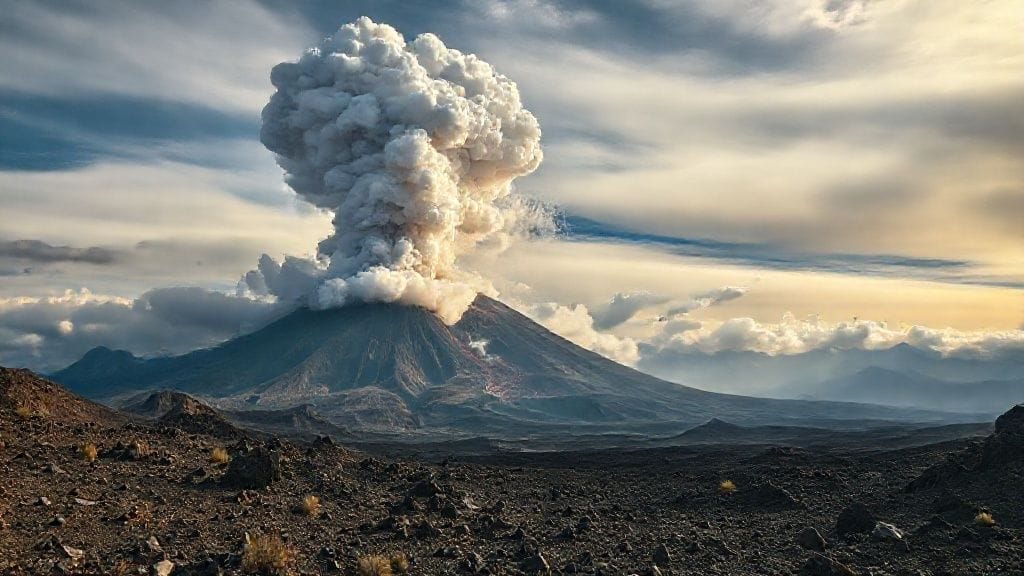
On the night of April 18, a sharp, deep explosion shattered the usual quiet. Witnesses reported bright flashes lighting up the desert sky, followed by the rapid ascent of an ash column that outgrew the volcano’s peak within minutes. The initial eruption comprised violent vulcanian explosions, ejecting incandescent fragments and a dense ash plume swelling above 15 kilometers.
The eruption was spectacular and terrifying—a volcano suddenly alive with a fiery breath. Pyroclastic flows tore down steep slopes, engulfing gullies and vaporizing anything in their path. The sharp scent of sulfur and the arrival of dark ash clouds created an apocalyptic atmosphere in an otherwise arid, serene landscape.
The Veil of Ash: How the Sky Turned Dark Over Antofagasta
Antofagasta, a coastal city roughly 120 kilometers from Lascar, soon found itself under a veil of ash. Fine grains of volcanic glass and rock drifted with the wind, covering streets, rooftops, and machinery. Daylight faded to twilight, and visibility dropped perilously. Airports temporarily closed, and health concerns mounted quickly, as ash inhalation posed risks to respiratory health.
Residents recalled the eerie feeling of being trapped under a gray canopy, the quiet punctuated only by emergency sirens and the muffled thuds of ash hitting the ground. For miners high in the Andes, conditions became extraordinarily dangerous, forcing evacuations and halting production.
Voices in the Chaos: Eyewitness Accounts from Locals and Miners
The eruption was more than a geological event—it was a human story. María, a schoolteacher from a small village near Lascar, remembered watching the sky turn orange with fear. “The night felt alive, like the mountain was screaming,” she said years later. “We didn’t know what to do, but we knew we had to get to safety.”
Miners working in nearby sites described the abrupt halt of their routines and the surreal sight of ash settling on their equipment. “It was like a nightmare,” recalled Alberto, a foreman. “The machines stopped, the sky was black, and all we could hear was the mountain’s roar.”
Emergency responders faced a logistical nightmare, needing to balance the unpredictable volcanic hazards with the imperative to protect lives and infrastructure.
The Surge of Fire and Smoke: Chronology of the Initial Eruptive Phase
Over the first two days, Lascar’s eruptions oscillated between explosive bursts and steady ash plumes. Geologists documented episodic pyroclastic flows, incandescent avalanches, and the steady emission of volcanic gases. The volcano released millions of cubic meters of ash and rock fragments, altering the local topography and draining lava from newly formed domes.
This initial phase was chaotic, with sudden explosions that challenged predictions. Yet, thanks to Chile’s expanding volcanic monitoring networks, scientists could provide timely warnings, a relatively new advancement that saved countless lives.
Environmental Toll: Ash, Lava, and the Threat to High-Altitude Ecosystems
The 1993 eruption inflicted lasting damage on the fragile ecosystems surrounding Lascar. The high-altitude desert flora, adapted to extreme aridity, suffered from ash fallout that smothered delicate vegetation and disrupted soils. Water sources, scarce even before the eruption, were contaminated with volcanic sediments, threatening wildlife dependent on these rare springs.
Bird species, including some endemic to the region, experienced stress and displacement. Yet, paradoxically, volcanic activity also created zones of nutrient-rich deposits that would seed ecological renewal in subsequent years, a testament to nature’s cycles of destruction and rebirth.
Scientific Response: Monitoring, Predictions, and Emergency Measures
The eruption catalyzed a leap forward in Chilean volcanic monitoring. Already equipped with seismic stations and gas analyzers, Chilean volcanologists accelerated efforts to understand Lascar’s unusual behavior. Satellite remote sensing provided new perspectives, allowing near-real-time tracking of plume movement and thermal anomalies.
Emergency agencies coordinated evacuation routes and public information campaigns, utilizing radio broadcasts and community meetings. Though challenges persisted, the rapid scientific response diminished potential casualties and emphasized preparedness for future eruptions.
Human Resilience against Nature’s Wrath: Community and Authorities’ Reaction
Communities demonstrated remarkable solidarity in the face of uncertainty. Local authorities worked alongside scientists to distribute masks, deliver clean water, and provide shelters for displaced families. Traditional knowledge merged with modern science as elders offered wisdom about the mountain’s moods and rituals to protect against volcanic wrath.
Businesses adapted quickly, with mining companies investing in protective measures and verifying the integrity of their operations. The eruption was a trial by fire—one that tested endurance and the power of collective action in a remote but vital region.
Economic Tremors: Impact on Mining Operations and Regional Economy
The Atacama Desert’s economic lifeblood, mining, was profoundly affected. Copper output dropped sharply as mines shut down or scaled back amid ash hazards. Dust accumulated on conveyor belts, machinery needed constant cleaning, and workers faced health risks.
Insurance claims escalated, and logistics slowed as transport routes were disrupted. However, Chile’s long-term economic resilience allowed recovery within months, demonstrating the robustness of the mining sector and the importance of volcanic risk assessment in industrial planning.
The Ash Clouds over the Pacific: Regional and Global Atmospheric Effects
Volcanic ash and gases did not confine themselves to the desert. Winds carried the ash plume above the Pacific Ocean, where aviation warnings spread across South America and beyond. The fine particles influenced atmospheric albedo, causing localized cooling effects detected by meteorologists.
While the 1993 Lascar eruption was not large enough to cause global climate disruption, it served as a crucial reminder of how volcanic events link earth systems and human activity in unexpected ways.
Lessons from the Past: Comparing the 1993 Lascar Eruption to Previous Events
Chile’s volcanic history is storied—from the great Ancash quake-triggered eruptions of Peru in 1970 to the explosive Calbuco events decades later. Lascar’s 1993 eruption was unique in scale and style, more explosive and ash-rich than previous recorded activity at this volcano.
Scientists studied these contrasts intensively, refining eruption classification methods and harnessing lessons about magma chamber dynamics, eruption precursors, and risk management in populated volcanic regions.
The Aftermath: Recovery, Rehabilitation, and Remediation Efforts
In the months following the eruption, efforts focused on restoring infrastructure, cleaning ash from towns, and rehabilitating natural water sources. Chilean government programs funneled resources into affected communities, guaranteeing assistance to vulnerable populations.
Research teams returned repeatedly to monitor volcanic gases and ecosystem recovery, mapping areas most affected and documenting re-colonization by plants and animals. Infrastructure improvements included strengthening inspection protocols for mining and transportation, embedding volcanic risk into regional development policies.
Lasting Legacy: The 1993 Lascar Eruption in Chilean Environmental Policies
Politically and socially, the eruption sparked a reevaluation of environmental governance in Chile. Laws were reinforced to integrate emergency preparedness, resource management, and environmental impact assessments in regions vulnerable to volcanic hazards.
Lascar became a case study in balancing economic development with ecological stewardship, influencing national dialogues about sustainability, scientific funding, and community engagement.
Cultural Reflections: The Eruption in Chilean Art, Memory, and Identity
The eruption inspired poets, painters, and filmmakers who sought to capture the raw power and melancholy of the event. Local festivals incorporate storytelling about the “Mountain’s Cry,” weaving geology into cultural identity.
Survivors’ narratives became an oral archive—testimonies blending natural wonder, fear, and hope. Through these expressions, Lascar transcended its physical presence to become a symbol of nature’s indomitable influence on human life.
How Lascar Changed Volcanology: Advances Triggered by the 1993 Event
The unpredictable character of the Lascar eruption pushed volcanology forward. Techniques in satellite monitoring, gas emission analysis, and seismic interpretation were refined due to experiences gathered during the crisis.
International collaboration increased as Chilean scientists partnered with global experts, contributing to a broader understanding of stratovolcano behavior, eruption forecasting, and hazard communication.
Nature’s Warning: The Ongoing Volcanic Activity and Preparedness Today
Lascar did not retreat into silence after 1993. Continued occasional eruptions in following decades prompt an ongoing vigilance from both scientists and authorities. The volcano remains a potent reminder that living alongside such forces demands respect, preparedness, and continual learning.
Community education programs and scientific monitoring maintain a fragile balance between risk and coexistence, embodying a modern dialogue between humanity and the wild earth.
The Human Story Beneath the Ashes: Profiles of Survivors and Scientists
Behind instruments and data sets lie human stories—of families displaced, miners returned to work, and volcanologists whose careers were defined by the eruption. Interviews recount how fear catalyzed courage, how scientific curiosity fought uncertainty, and how a young generation inherited both the scars and the lessons.
These personal histories deepen our understanding, ensuring that the eruption is remembered not just as natural history, but as a shared human experience.
Conclusion: Between Destruction and Renewal, Lascar’s Enduring Tale
The 1993 eruption of Lascar stands as a vivid chapter in the story of nature’s volatile dialogue with humanity. It was a moment of startling upheaval—a mountain waking from slumber to remind the world of geological power. Yet it also marked resilience: of ecosystems regenerating, communities adapting, and science advancing.
Lascar’s eruption teaches us humility and respect for the forces shaping our planet. It invites reflection on how we live with uncertainty, harness knowledge, and reimagine our place within nature’s grand theatre. Between the ashes and the stars, the story of Lascar continues—a testament to the fragile beauty of life on a restless Earth.
FAQs: Understanding the 1993 Lascar Eruption
Q1: What caused the 1993 eruption of Lascar?
The eruption was triggered by the movement of magma within the volcano’s chamber, combined with tectonic pressure from the Nazca Plate subducting beneath South America. This pressure built up until explosive release occurred in April 1993.
Q2: How dangerous was the eruption for local populations?
While the eruption produced significant ashfall and some pyroclastic flows, early warnings and quick evacuations minimized casualties. Respiratory issues and disruption to daily life were major concerns, especially in mining communities.
Q3: How did the eruption impact mining in the region?
Ashfall forced many mines to halt operations temporarily. Equipment was damaged, and workforces faced health risks, leading to economic losses. However, the mining sector recovered relatively swiftly due to contingency planning.
Q4: What scientific advancements arose from studying this event?
New methods in satellite monitoring, gas emission analysis, and eruption prediction were advanced. The eruption enhanced international collaboration and enriched understanding of stratovolcano behavior.
Q5: How is the eruption remembered culturally in Chile?
It is commemorated through art, storytelling, and local festivals that integrate natural memory with cultural identity, highlighting the intersection of human experience and geological forces.
Q6: Is Lascar still active today?
Yes, Lascar remains active with intermittent eruptions and fumarolic activity. Ongoing monitoring and preparedness efforts continue to protect the surrounding regions.
Q7: What was the environmental impact of the eruption?
The eruption caused ash deposition that affected vegetation, water sources, and wildlife in the high-altitude desert ecosystem. Yet it also contributed to long-term soil enrichment and ecological succession.
Q8: Can such eruptions occur again in the region?
Given the tectonic setting, volcanic eruptions remain a possibility in northern Chile. Monitoring systems and emergency protocols aim to mitigate future risks.

