Table of Contents
- The Awakening of a Sleeping Giant: The Puyehue–Cordón Caulle Volcano
- The Chilean Landscape Before the Eruption
- Tremors in the Earth: Early Signs of Unrest
- The Great Eruption Begins: June 1960
- Nature’s Fury Unleashed: Explosive Power and Volcanic Clouds
- Lives Disrupted: The Human Cost of the Eruption
- The Ashes that Darkened the Sky: Atmospheric and Climate Impact
- The Chilean Government’s Response and Emergency Efforts
- Stories of Survival and Tragedy: Voices from the Ash
- Scientific Frontiers: What the Eruption Taught Volcanologists
- The Puyehue–Cordón Caulle Eruption in the Context of the Great Chilean Earthquake
- Economic Reverberations: Agriculture, Industry, and Recovery
- The Landscape Transformed: Geographical and Ecological Changes
- International Reaction and Aid: A Global Moment
- Memory and Myth: The Eruption in Chilean Culture and History
- The Volcano’s Quiet Resumption and Continued Activity
- Scientific Advancements Sparked by 1960’s Chaos
- Lessons for Today: Managing Volcanic Catastrophes in a Changing World
- The Puyehue–Cordón Caulle in Modern Volcano Monitoring
- Conclusion: The Enduring Legacy of a Fierce Awakening
- FAQs: Understanding the Puyehue–Cordón Caulle Eruption
- External Resource
- Internal Link
The Awakening of a Sleeping Giant: The Puyehue–Cordón Caulle Volcano
At dawn on an unassuming June morning in 1960, a deep rumble shook the Chilean soil beneath the vast expanse of the Andes. Far from the bustling cities and into the wilderness, the Puyehue–Cordón Caulle volcanic complex stirred from a long slumber. Hidden for centuries beneath silent ice and dense forests, this volcanic system was poised to announce its formidable presence to the world, in a terrifying spectacle of fire, ash, and devastation. The air grew heavy with heat and tension as the earth began to crack, heralding an eruption that would change the lives of thousands and reshape scientific understanding of volcanic phenomena.
The Chilean Landscape Before the Eruption
Southern Chile in the mid-20th century was a mosaic of small rural communities, vast forests, and rugged mountains. The Puyehue–Cordón Caulle volcanic complex, nestled within the Andean mountain range, was a striking black scar across the verdant landscape. Although known locally, the volcano had long been dormant, allowing the region’s economy—fueled by agriculture, timber, and small-scale mining—to flourish undisturbed.
For generations, the volcano’s slumber had lulled residents into a false sense of security, though local indigenous Mapuche communities carried ancestral stories of past eruptions, rivers of lava, and ashfalls. Even scientists had classified the region’s volcanoes as inactive or at best “resting,” underestimating the energy simmering beneath.
Tremors in the Earth: Early Signs of Unrest
In the months leading to June 1960, subtle earthquakes began to ripple through the area. These weren’t new; this strip along the Pacific “Ring of Fire” constantly muttered under tectonic strain. However, these quakes grew noticeably in frequency and intensity. Villagers reported mysterious noises—booming, cracking sounds—as if the mountain itself was breaking apart.
As week after week passed, geologists noted a pattern: the seismic activity was focused below Puyehue and Cordón Caulle, indicating magma movement beneath the surface. Yet, in this era prior to modern satellite monitoring, warnings remained insufficient, messages slow, and many residents unaware of the looming catastrophe.
The Great Eruption Begins: June 1960
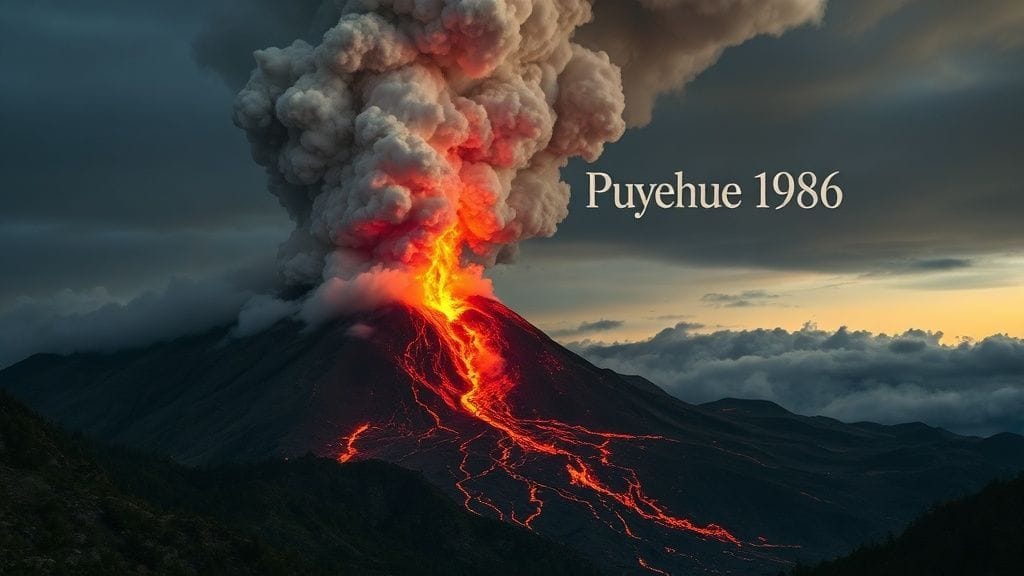
On June 4, 1960, the tension underground translated into an eruption that shook the earth and lit the skies ablaze. What started as violent earthquakes culminated in a colossal explosion, as pressurized magma breached the earth. Fire and molten rock spewed into the air, feeding vast plumes of ash that soared kilometers high, transforming daytime into an eerie twilight.
Unlike many eruptions confined to a single peak, the Puyehue–Cordón Caulle complex unleashed its fury across a 15-kilometer fissure. This fissure eruption brought rivers of lava and clouds of ash cascading down slopes, swallowing forests and farms with a relentless advance.
Nature’s Fury Unleashed: Explosive Power and Volcanic Clouds
The eruption was a textbook example of a Plinian-style blast—immense columns of incandescent ash erupted violently into the atmosphere, propelled by an explosive force unmatched in recent decades. Ash and sulfur gases engulfed the surrounding provinces, darkening skies for days and depositing meters of ash on the ground.
Thermal updrafts carried volcanic material into the stratosphere, traveling thousands of kilometers. These clouds, laced with sulfur dioxide and fine particulates, had notable effects on weather patterns far beyond Chile’s borders—a reminder that local disasters can ripple globally.
Meanwhile, lava flows, reaching temperatures exceeding 1,000°C, bulldozed through the terrain, igniting wildfires and erasing roads. Witnesses recall the night skies glowing crimson and the ground trembling with an almost apocalyptic intensity.
Lives Disrupted: The Human Cost of the Eruption
The eruption wasn’t just a geophysical marvel; it was a human tragedy. Thousands were displaced. Entire villages near the volcano were abandoned as ashfall destroyed crops, contaminated water sources, and made breathing perilous.
Communities downwind faced collapsing roofs under ash load and disruptions to communication and transportation. Livestock perished, deepening the hardship for farming families. The emotional trauma, compounding economic losses, left scars that would last generations.
Yet, amid the despair, tales of resilience emerged: neighbors helping neighbors, spontaneous evacuation efforts, and a collective resolve to confront an uncontrollable foe.
The Ashes that Darkened the Sky: Atmospheric and Climate Impact
The Puyehue–Cordón Caulle eruption sent an estimated 0.25 cubic kilometers of material into the atmosphere—a volume capable of altering regional climate temporarily. Sulfur aerosols injected into the stratosphere reflected solar radiation, causing a measurable cooling effect in the months that followed.
Photos taken from aircraft and early weather satellites showed a ghostly veil of ash drifting over the Pacific Ocean, reaching as far as Argentina and New Zealand. Scientists tracked this “volcanic veil,” gaining insight into how eruptions contribute to atmospheric dynamics and short-term climate modulation.
The Chilean Government’s Response and Emergency Efforts
Faced with the enormity of the catastrophe, the Chilean government mobilized swiftly, albeit with limited resources. Emergency shelters were established, public health warnings disseminated, and efforts to clean streets and secure water supplies were launched.
Aid stations treated respiratory illnesses caused by ash inhalation, while police and military personnel assisted in evacuation and crowd control. In many ways, the response highlighted both the capacity and limits of mid-20th-century disaster management in a developing nation.
Stories of Survival and Tragedy: Voices from the Ash
Amid the statistics lay deeply personal stories. A Mapuche elder recounted fleeing his burned ancestral land with only what he could carry. Farmers spoke of midnight escapes, hauling cattle through choking ash to safety.
Survivors described the eerie silence between eruptions, punctuated by the sudden roar of explosions and the surreal sight of ash-covered forests transformed into ghostly wastelands. These testimonies humanize what might otherwise feel like abstract geological data—reminders that history is lived through flesh and breath, hope and despair.
Scientific Frontiers: What the Eruption Taught Volcanologists
The Puyehue–Cordón Caulle eruption rapidly became a case study for volcanologists worldwide. It underscored the complexities of fissure eruptions—a hybrid between explosive terror and slow lava effusion.
Scientists learned more about magma chambers, gas emissions, eruption precursors, and the interactions between tectonic and volcanic processes. It also emphasized the necessity of real-time monitoring and community preparedness—messages that resonate painfully in volcanically active regions today.
The Puyehue–Cordón Caulle Eruption in the Context of the Great Chilean Earthquake
The 1960 eruption was part of an unprecedented geological event. Just hours earlier, Chile had been struck by the Great Valdivia Earthquake—the most powerful earthquake ever recorded, with a magnitude of 9.5.
Though the volcano and earthquake were distinct phenomena, their proximity and timing sparked debates on tectonic interactions. Did the earthquake trigger the eruption? Could their combined forces have amplified destruction? These questions spurred decades of research into the complex relationship between seismicity and volcanism.
Economic Reverberations: Agriculture, Industry, and Recovery
The eruption’s impact rippled through Chile’s economy. Rich agricultural lands were buried in ash, halting crop production and meat supply. Roads connecting rural areas were washed out or overwhelmed by volcanic debris, severing supply chains.
Timber industries grieved loss of forested land. Recovery took years, requiring government investment and international aid. Yet, reconstruction also prompted modernization of infrastructure and agricultural practices, a silver lining amid devastation.
The Landscape Transformed: Geographical and Ecological Changes
Volcanic activity is an agent of change, and Puyehue–Cordón Caulle was no exception. The eruption reshaped fertile valleys, created new lava plains, and altered river courses.
In the immediate aftermath, ash and lava sterilized soils, but over time, nature began reclaiming the land. Scientists observed new ecological successions—pioneer plants, insect colonization, and eventual return of fauna—an unfolding drama of life born from destruction.
International Reaction and Aid: A Global Moment
Chile’s volcanic disaster garnered international attention. Several countries offered aid in the form of food, medical supplies, and scientific expertise.
Briefings at geological conferences across continents shared insights from Puyehue–Cordón Caulle, expanding scientific cooperation. Meanwhile, global media coverage brought the plight of affected Chilean communities into public consciousness, illustrating how natural disasters transcend borders.
Memory and Myth: The Eruption in Chilean Culture and History
Over decades, the 1960 eruption has entered collective memory and national identity. Folk songs, literature, and art capture the drama of ash and fire.
For the Mapuche and other local peoples, the eruption is woven into oral histories—a reminder of nature's power, respect for the earth, and resilience. Museums and memorials preserve artifacts and stories, teaching new generations about the past while nurturing preparedness for future events.
The Volcano’s Quiet Resumption and Continued Activity
Although long quiet after 1960, Puyehue–Cordón Caulle has never truly rested. Smaller eruptions, fumarole activity, and seismic tremors have periodically reminded Chileans and volcanologists that beneath the calm surface, fire still sleeps.
Monitoring technologies today keep vigilant watch, benefiting from lessons learned in 1960. The volcano’s story is ongoing—a dynamic, living chapter in Earth's geological history.
Scientific Advancements Sparked by 1960’s Chaos
The dramatic events of 1960 accelerated advances in volcanology: seismograph networks expanded, remote sensing technologies developed, and eruption forecasting matured.
Chile itself became a hub for volcanic research, contributing valuable data that inform hazard mitigation in active volcanic regions worldwide. The tragedy thus catalyzed scientific progress with enduring benefits.
Lessons for Today: Managing Volcanic Catastrophes in a Changing World
As climate change alters weather patterns and population growth increases exposure, the lessons of Puyehue–Cordón Caulle resonate profoundly. Early warning systems, public education, and infrastructure resilience are critical.
Understanding the complex dance of tectonics and volcanism helps governments and communities to prepare for inevitable awakenings beneath the earth’s surface.
The Puyehue–Cordón Caulle in Modern Volcano Monitoring
Today, Puyehue–Cordón Caulle is among the most closely watched volcanoes. Seismic sensors, gas analyzers, and satellite imagery provide a layered understanding of subsurface activity.
When renewed eruptions erupted decades later (notably 2011), the response was informed by sophisticated forecasts and coordinated evacuations—a testament to investment in science and preparedness.
Conclusion: The Enduring Legacy of a Fierce Awakening
The Puyehue–Cordón Caulle eruption of 1960 was more than a geological event—it was a profound confrontation between humanity and the forces that shape our planet. It forced Chile, and the world, to reckon with nature’s dual capacity to destroy and renew.
From shattered homes and buried fields to the scientific breakthroughs it inspired, the eruption’s mark endures. It reminds us, in poetic and humbling ways, of our place on a restless Earth—an emplacement of wonder, resilience, and hope amid fire and ash.
FAQs: Understanding the Puyehue–Cordón Caulle Eruption
Q1: What caused the Puyehue–Cordón Caulle eruption in 1960?
A1: The eruption was primarily caused by rising magma breaching the Earth’s crust along a volcanic fissure. It occurred shortly after the massive 1960 Valdivia earthquake, which may have altered subsurface magma pathways, potentially triggering the eruption.
Q2: How severe was the eruption compared to other volcanic events?
A2: While not the largest eruption in history, the Puyehue–Cordón Caulle event was significant—involving a major fissure eruption with extensive ashfall, lava flows, and atmospheric impact. It ranks among the most important 20th-century eruptions due to its scale and scientific implications.
Q3: What were the main consequences for local populations?
A3: Thousands were displaced, agricultural land was devastated by ash and lava, and essential infrastructure was damaged. Respiratory illnesses due to ash inhalation were widespread, and economic hardship lasted years after the eruption.
Q4: How did the eruption affect global climate?
A4: Sulfur dioxide and ash injected into the upper atmosphere caused a temporary cooling effect regionally, illustrating how volcanoes can influence weather and climate beyond immediate vicinity.
Q5: How is Puyehue–Cordón Caulle monitored today?
A5: Modern monitoring employs seismic instruments, gas analyzers, satellite data, and ground deformation measurements. This multilayered approach detects early warning signs of potential eruptions to protect communities.
Q6: What lessons did the 1960 eruption teach scientists?
A6: It highlighted the unpredictable nature of fissure eruptions, the interplay between earthquakes and volcanism, and the urgent need for monitoring and community preparedness to mitigate volcanic disasters.
Q7: Are there cultural commemorations of the eruption?
A7: Yes, Chilean culture honors the eruption through museums, literature, oral histories (especially among indigenous groups), and public education programs emphasizing resilience and awareness.
Q8: Could Puyehue–Cordón Caulle erupt again?
A8: Yes, the volcano remains active, having erupted again in 2011. Continuous monitoring continues to guard against unexpected activity, reflecting its ongoing potential for future eruptions.

