Table of Contents
- The Awakening of Karthala: Prelude to a Fiery Outburst
- Grande Comore: A Volcanic Island on the Edge of Calm
- Early Signs: Tensions Beneath the Surface
- January 2005: A Community on Alert
- The Day Karthala Roared: February 16, 2005
- Flames in the Sky: The Anatomy of the Eruption
- Rivers of Fire: Lava, Ash, and Their Path of Destruction
- The People of Grande Comore: Between Fear and Resilience
- The Immediate Response: Government and International Aid
- Scientific Observations: What Did Volcanologists Learn?
- The Environmental Toll: Ecosystems Under Fire
- Socio-Economic Impacts: Displacement, Agriculture, and Livelihoods
- The Aftermath: Recovery and Reconstruction Efforts
- Memory of the Volcano: Oral Histories and Cultural Imprints
- Lessons from Karthala: Preparedness and Future Risks
- Karthala in a Global Context: Comparing Volcanic Eruptions
- The Volcano’s Persistent Breath: Activity Since 2005
- Legacy and Reflection: The Human Spirit Against Nature’s Fury
The sun had barely risen over the Indian Ocean when the skies above Grande Comore darkened ominously with plumes of thick smoke. Locals emerged from their homes, faces etched with both curiosity and dread. The ground beneath their feet, usually steady and familiar, rumbled softly — a sinister murmur that would soon crescendo into a deafening cry from Karthala, the island’s colossal volcano. On February 16, 2005, Karthala, one of the most active volcanoes in Africa, awoke from a slumber that had both mesmerized and frightened the inhabitants of the Comoros islands for centuries. What began as a faint tremble turned quickly into a dramatic spectacle of fire, ash, and molten rock that carved new stories into the island’s landscape and lives.
Grande Comore stood at the precipice of a fiery transformation.
Grande Comore: A Volcanic Island on the Edge of Calm
To understand the 2005 eruption, one must first grasp the unique character of Grande Comore. The largest island in the Comoros archipelago, located strategically between the northern tip of Madagascar and the eastern coast of Africa, Grande Comore is dominated by Karthala, an imposing stratovolcano rising majestically to over 2,360 meters. Formed by a hotspot beneath the Earth's crust, Karthala has been a persistent force of geological change for hundreds of thousands of years, shaping the island’s fertile soils as well as its peril.
The Comoros archipelago, often described as a “volcanic paradise,” harbors a fragile balance of luxuriant biodiversity and geological volatility. The island’s population, largely rural and dependent on agriculture and fishing, has coexisted with Karthala’s periodic outbursts long enough for volcanic activity to be woven into local folklore, culture, and identity. But beneath this coexistence, there always lurked the threat of disaster.
Early Signs: Tensions Beneath the Surface
In the months leading up to February 2005, subtle tremors were felt by the islanders, initially dismissed as minor earth movements. But seismological instruments installed by the Comorian government and international geological teams noted a rising frequency and intensity of volcanic earthquakes beneath Karthala's summit. This increase in seismic activity hinted at magma movement—a silent but potent prelude to eruption.
Local residents began reporting sulfuric odors and faint fumes from fumaroles near the volcano’s peak, signals often associated with unrest. Volcanologists expressed cautious concern, issuing alerts but reminded that predicting exact eruption times was an art of probabilities rather than certainties.
January 2005: A Community on Alert
January saw the tension ratchet higher. Schools and government offices received warnings. Families were urged to prepare emergency kits and have evacuation routes in mind. The Comorian government, supported by the United Nations and French aid agencies, developed contingency plans to relocate the most vulnerable — particularly those residing near the volcano’s lower slopes and in the capital city of Moroni, just 15 kilometers away.
Yet, life on Grande Comore did not come to a halt. Markets buzzed as usual, mosques called to prayer, and children played under skies that still held the distant echo of rumbling earth. For many, the volcano was a distant threat, almost a myth. For others, it was a looming specter.
The Day Karthala Roared: February 16, 2005
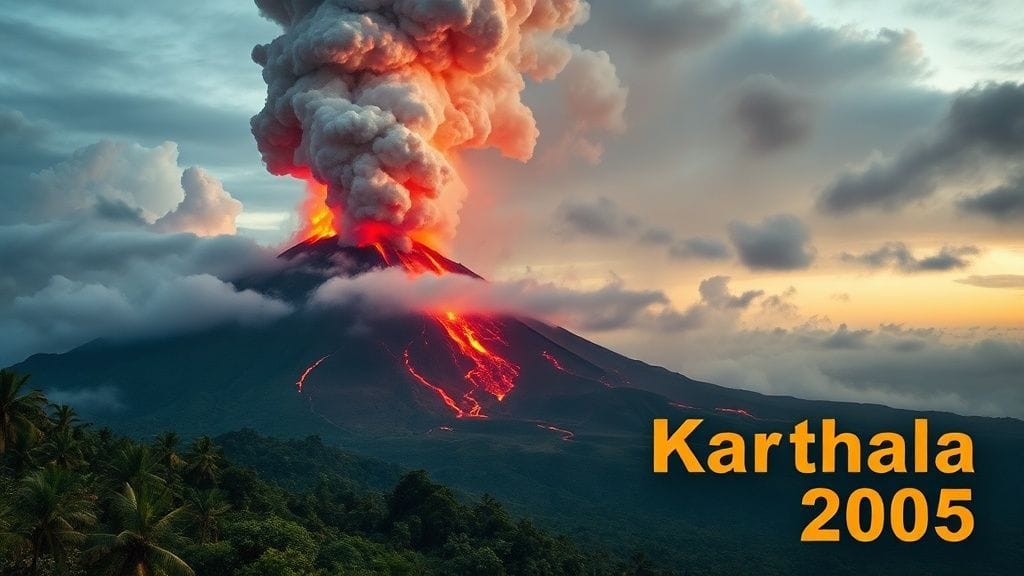
At dawn on February 16, a deep subterranean explosion shattered the morning calm, sounding like thunder rolling uninterrupted for minutes. Within hours, a towering column of ash and volcanic gases spewed violently into the air, reaching altitudes of over 10 kilometers and turning day into an eerie twilight. The eruption was powerful, yet not entirely unexpected; it was the crescendo of months of warning signs.
Inhabitants of Moroni and surrounding villages watched with a mixture of awe and terror as the volcano expelled incandescent lava flows down its flanks. Ashfall blanketed roofs, fields, and roads, while clouds of noxious gases drifted over populated areas, forcing the evacuation of tens of thousands.
Flames in the Sky: The Anatomy of the Eruption
Karthala’s 2005 eruption was characterized by both explosive and effusive phases—a duality that exemplified the volatile nature of stratovolcanoes. The initial explosions fragmented solid rock and propelled ash cloud miles upwards, while subsequent phases saw slow-moving flows of molten lava advancing over the fertile terrains.
Volcanologists identified multiple vents along the summit crater that burst open, indicating a complex subterranean plumbing feeding the eruption. The temperature of the lava was estimated around 1,100 degrees Celsius, melting everything in its path.
Rivers of Fire: Lava, Ash, and Their Path of Destruction
Lava tongues snaked down the steep slopes, crossing villages and farmland. The destruction was uneven: some communities were engulfed entirely, while others narrowly escaped. Ashfall contaminated water sources and damaged crops, threatening food security in the months to come.
Smoke and ash clouds forced flights to be rerouted or canceled, disrupting the already fragile transport network of the Comoros and neighboring Madagascar and East African countries. Yet, despite the destruction, no immediate fatalities were reported—a testament to the vigilant preparedness efforts and community response.
The People of Grande Comore: Between Fear and Resilience
Behind every plume of smoke were human stories—families frantically packing possessions, farmers staring helplessly at ruined crops, children gazing upwards, unsure if the earth beneath their feet would remain trustworthy. The eruption tested the resilience and unity of Grande Comore’s inhabitants.
Local leaders and elders took active roles in coordinating evacuations, sharing knowledge passed down through generations. Traditional beliefs and modern science intersected here—rituals to appease the volcano blended with the latest warnings broadcast over radio and cell phones.
The Immediate Response: Government and International Aid
The Comorian government’s swift action minimized casualties. Approximately 12,000 people were relocated to shelters set up in schools and community centers. Humanitarian agencies, including the Red Cross and the United Nations Office for the Coordination of Humanitarian Affairs (OCHA), arrived with food, medicine, and materials to support displaced populations.
Budget constraints and logistical challenges hampered relief somewhat, but the shared urgency galvanized both local and international efforts. French volcanological experts co-operated closely with Comorian scientists, sharing data and expertise.
Scientific Observations: What Did Volcanologists Learn?
The 2005 event became a critical case study for understanding volcanic activity in the Western Indian Ocean region. Deployments of seismic networks, gas sampling tools, and satellite imaging painted a fuller picture of Karthala’s internal dynamics.
Scientists observed that magma chamber pressurization, magma composition, and vent behavior all contributed to the eruption’s scale and style. It also shed light on how hotspot volcanism in this region behaves differently from subduction zone volcanism found elsewhere.
The Environmental Toll: Ecosystems Under Fire
Beyond human impacts, the eruption scarred the island’s rich ecosystems. Forests around the volcano’s summit were burned extensively. Ash deposition altered soil chemistry, impacting endemic plant species. Wildlife faced displacement and habitat loss.
Yet nature’s resilience showed in surprising ways. Studies in the years following recorded early signs of ecological succession, with hardy pioneer species colonizing fresh lava fields, symbolizing renewal amidst destruction.
Socio-Economic Impacts: Displacement, Agriculture, and Livelihoods
The eruption’s ash and lava fall disrupted agriculture, the backbone of Grande Comore’s economy. Yields of vanilla, bananas, and spices—which are major exports—declined sharply. Fishing communities were affected by ash contaminating coastal waters.
Economic losses were compounded by displacement and infrastructure damage. Poverty, already widespread, deepened, prompting renewed calls for sustainable development and disaster preparedness.
The Aftermath: Recovery and Reconstruction Efforts
In the months after the eruption, national and international agencies focused on rebuilding. Roads were cleared, water systems repaired, and homes reconstructed. Agricultural extension programs helped farmers adopt new techniques to cope with volcanic soils and climatic shifts.
Educational campaigns emphasized disaster risk reduction, strengthening community resilience. Despite limitations, these efforts paved the way for incremental recovery, blending modern aid with local ingenuity.
Memory of the Volcano: Oral Histories and Cultural Imprints
The Karthala eruption of 2005 entered local memory not just as a natural disaster but as a defining moment in island identity. Elders recounted stories of ash clouds turning skies red, of communal shelters filled with neighbors sharing stories and songs.
Cultural expressions—poems, songs, and artwork—emerged, capturing themes of loss, hope, and nature’s might. This collective memory plays a crucial role in ongoing vigilance and community cohesion.
Lessons from Karthala: Preparedness and Future Risks
The eruption revealed both strengths and vulnerabilities in Comoros’ disaster preparedness systems. Improvements in volcanic monitoring, early warning systems, and community education since 2005 have saved lives and property.
Yet Karthala remains restless. Its geological heartbeat reminds locals and scientists alike that another eruption is inevitable—when, nobody knows for sure. The 2005 event underscored the importance of continued vigilance, investment, and respect for the island’s natural forces.
Karthala in a Global Context: Comparing Volcanic Eruptions
While not as globally devastating as eruptions like Mount St. Helens (1980) or Eyjafjallajökull (2010), Karthala’s 2005 eruption offers valuable insights into island volcanism in the tropics. Its impact on a small population and fragile economy illustrates the disproportionate risks island nations face from natural hazards.
It also highlights how regional cooperation and scientific advances can mitigate disaster effects in such settings.
The Volcano’s Persistent Breath: Activity Since 2005
Since the 2005 eruption, Karthala has exhibited fluctuating activity levels — increased seismicity, minor ash emissions, and ground deformation. Each episode rekindles public attention and scientific inquiry, reinforcing the volcano’s status as a magnificent yet threatening neighbor.
Legacy and Reflection: The Human Spirit Against Nature’s Fury
The story of Karthala in 2005 is ultimately a tale of human resilience facing nature’s unpredictable fury. From the trembling earth beneath their feet to the advancing rivers of lava, the people of Grande Comore stood steadfast, adapting, learning, and rebuilding.
Their experience serves as a poignant reminder that across the globe, communities at the frontline of natural hazards embody a blend of courage, tradition, and scientific intelligence — weaving narratives that transcend disaster to celebrate survival.
Conclusion
Karthala's eruption in 2005 was more than a geological event; it was a profound human experience etched in fire, ash, and memory. The skies darkened, the earth trembled, and lives were uprooted, but from the ashes arose resilience and hope. Grande Comore, an island sculpted by volcanic power, faced once more the volatile majesty of nature and reaffirmed its place in the ongoing dialogue between humanity and the restless earth beneath.
This episode underscores a universal truth — disaster and recovery are intertwined, each testifying to the fragile yet indomitable spirit of communities living on the edges of elemental forces. Karthala’s story is a beacon, illuminating the importance of respect, preparation, and unity in the face of nature’s unpredictable outbursts.
FAQs
Q1: What caused the Karthala eruption in 2005?
A1: The eruption was triggered by magma rising through fractures beneath the volcano, driven by hotspot activity beneath Grande Comore. Increased seismicity and gas emissions signaled this magma movement before the eruption.
Q2: How were residents prepared for the eruption?
A2: Months before the eruption, government officials issued warnings and evacuation plans. Community leaders facilitated relocations, and international agencies provided support, which helped prevent fatalities.
Q3: What was the extent of the damage caused by the eruption?
A3: The eruption destroyed homes, farmland, and infrastructure, contaminated water supplies, and displaced around 12,000 people. Agriculture and fishing sectors suffered significant disruption.
Q4: How did the eruption affect the environment?
A4: Large forested areas burned, ash altered soil chemistry, and wildlife habitats were disturbed. However, ecological succession has since initiated regrowth on fresh lava fields.
Q5: What role did science play in managing the volcanic crisis?
A5: Volcanologists monitored seismic activity and gas emissions, helping to forecast the eruption. Post-eruption, scientific studies improved understanding of Karthala’s behavior and informed future preparedness.
Q6: Are eruptions likely to occur again at Karthala?
A6: Yes. Karthala is an active volcano with a history of recurrent eruptions. Monitoring continues to provide early warning, but the exact timing of future eruptions remains unpredictable.
Q7: How is the eruption remembered culturally in Grande Comore?
A7: The eruption remains a vivid part of local oral traditions, music, and art, symbolizing both the destructive power and the resilience of the island’s people.
Q8: What lessons does the Karthala eruption offer to other volcanic regions?
A8: It highlights the critical importance of early warning systems, community preparedness, international cooperation, and integrating indigenous knowledge with scientific data to mitigate volcanic hazards.

