Table of Contents
- The Fiery Awakening: Nyiragongo’s 1977 Eruption
- Setting the Stage: The Geology and Geography of Nyiragongo
- The Heartbeat of the Earth: Volcanic Activity in the Virunga Region
- The Human Landscape: Goma and the Surrounding Communities
- Tensions Beneath the Surface: Predicting the Unpredictable
- The Night the Mountain Roared: Early Signs and Initial Explosions
- Rivers of Fire: The Lava Flow Engulfs Goma
- The Drama of Flight: Human Stories Amidst Ash and Flame
- International Aid and the Response to the Disaster
- A City Forever Transformed: Aftermath and Reconstruction in Goma
- Ecological Impact: The Scars Left on the Land and Wildlife
- The Political Context: Mobutu’s Zaire and the Challenges of Crisis
- Scientific Insights: What the 1977 Eruption Taught Volcanologists
- Lessons in Resilience: How Communities Rebuilt Amid Uncertainty
- Remembering Nyiragongo: Memory, Culture, and Education
- Ongoing Threats: Nyiragongo in the 21st Century
- The Global Significance of Local Disaster
- Conclusion: Flames that Reshape History and Humanity
- FAQs: Understanding the Nyiragongo 1977 Eruption
- External Resource
- Internal Link
1. The Fiery Awakening: Nyiragongo’s 1977 Eruption
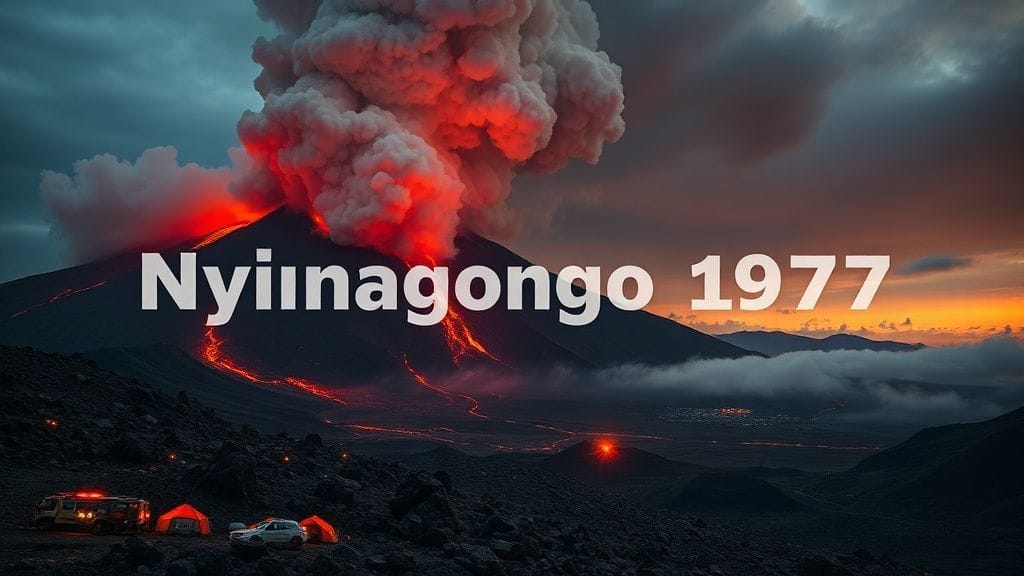
On the evening of January 10, 1977, the ground beneath northeastern Zaire, today’s Democratic Republic of Congo, began to tremble—a deafening rumble announcing the awakening of one of Africa’s most volatile forces of nature. Nyiragongo, a towering stratovolcano notorious for its almost perpetual lava lake, suddenly unleashed one of the deadliest volcanic eruptions of the 20th century. Flames and molten rivers burst forth, obliterating villages in their path and engulfing the bustling town of Goma, home to tens of thousands. Families were caught mid-flight, children crying, homes consumed by a glowing, terrifying inferno that changed the region’s landscape and history forever.
This was not a distant natural calamity—it was a catastrophic event that forced the world to confront the primal fury of the earth, reshaping lives and raising urgent questions about human vulnerability and resilience. Nyiragongo’s eruption is a story of destruction and survival, of the volatile interface between geology and human life, set against a backdrop of political complexity and scientific curiosity.
2. Setting the Stage: The Geology and Geography of Nyiragongo
Nyiragongo is no ordinary volcano. Towering at 3,470 meters within the Virunga volcanic chain, it commands a dramatic presence near the western shore of Lake Kivu. Situated along the East African Rift System, a massive fracture where the African continent is slowly splitting apart, this volcano’s unique geology puts it in a league of its own. Its basaltic lava is as fluid as honey, allowing it to flow rapidly—sometimes at speeds up to 100 km/h—granting Nyiragongo the deadly reputation encapsulated in local oral traditions.
To understand the eruption of 1977, one must appreciate Nyiragongo’s restless nature. Unlike typical volcanoes that erupt with thick, slow-moving lava, Nyiragongo’s poison is swift and fiery. Beneath its calm, almost serene summit lake, dark forces churn, with magma chambers poised to unleash chaos without much warning.
3. The Heartbeat of the Earth: Volcanic Activity in the Virunga Region
The Virunga Mountains are a volcanic hotspot, a rugged terrain carved from millennia of lava and ash. They serve as a natural frontier between the Democratic Republic of Congo, Rwanda, and Uganda. Despite their ruggedness, these mountains have been home to diverse human populations and remarkable biodiversity, including mountain gorillas.
The area’s volcanic activity is more than a natural curiosity—it's an ongoing dialogue between creation and destruction, with eruptions having devastating but also creatively renewing effects on soil fertility and fresh landscapes. By the late 20th century, local populations had learned to coexist cautiously with the unpredictable mountain guardian, aware that a quiet moment meant little when measured against the planet’s deep internal heat.
4. The Human Landscape: Goma and the Surrounding Communities
The town of Goma, nestled on the northern arm of Lake Kivu, was quickly expanding in the 1970s, a melting pot of traders, refugees, farmers, and officials under Mobutu’s regime. With roughly 30,000 inhabitants at that time, it was a place where life was vibrant despite the shadow of the nearby volcano.
Surrounding villages were smaller but tightly knit, their inhabitants intimately tied to the land. Farming, fishing, and trade defined their days, while local beliefs intertwined with respect and fear of Nyiragongo’s fiery temperament. The communities lived in a paradox: the volcano brought fertile soils, but also an omnipresent threat that neither geography nor politics could fully tame.
5. Tensions Beneath the Surface: Predicting the Unpredictable
Scientists had long studied Nyiragongo but always faced challenges in prediction. Unlike many volcanoes that offer clear warning signs—significant seismic activity, gas emissions, or ground deformation—Nyiragongo’s eruptions could begin with minimal notice, partly due to its unique lava lake dynamics.
By 1977, monitoring technologies and regional geological understanding were still rudimentary. The absence of a systematic alert system meant that communities were vulnerable when the mountain stirred. The tension between human risk and natural unpredictability was palpable, like a ticking clock in an otherwise routine day of life.
6. The Night the Mountain Roared: Early Signs and Initial Explosions
On the night of January 10, something extraordinary and terrifying occurred. Residents of Goma reported seeing fissures opening near the mountain’s summit, accompanied by explosive roars and seismic tremors. The immense lava lake that had sat quietly began feeding vast streams of molten rock down Nyiragongo’s flanks.
Lava fountains illuminated the night sky, and rivers of fire began their inexorable flow toward the town below. Within hours, what had been mere hills transformed into a perilous inferno, the scorched earth glowing ominously under an angry sky. Panic spread as the eruption defied expectations, overrunning early hopes for evacuation.
7. Rivers of Fire: The Lava Flow Engulfs Goma
The lava descended with terrifying speed and ferocity, racing down the slopes and engulfing villages in its incandescent path. The town of Goma bore the brunt of this fiery assault. Streets once bustling with life filled with thick, suffocating smoke. Scores of homes, markets, and public spaces succumbed to the relentless advance of molten rock.
Witnesses later recounted moments of horror: families fleeing, some climbing trees to escape, others narrowly stepping over cracks where the earth tore asunder. The lava moved in unpredictable tongues, splitting paths and destroying anything in its way, leaving behind a landscape unrecognizable—turned into blackened rubble.
8. The Drama of Flight: Human Stories Amidst Ash and Flame
In the midst of chaos, countless personal dramas unfolded. Among the thousands affected were elderly couple Nzanzu and Muntu, who, despite the danger, helped neighbors flee—carrying children and elderly alike. Their courage contrasted with tragic stories of families trapped and separated.
There was also the story of Jean-Baptiste, a young boy who witnessed his home consumed, yet found refuge in an abandoned church. These stories humanize the eruption, illustrating the desperation, solidarity, fear, and hope that twined through the disaster like two threads of the same cloth.
9. International Aid and the Response to the Disaster
As dawn broke, the scale of the disaster became clear, and the international community mobilized. Aid arrived from neighboring countries, the United Nations, and organizations like the Red Cross. Yet logistical challenges, combined with political instability under Mobutu Sese Seko’s authoritarian regime, complicated relief efforts.
Many survivors struggled with insufficient shelter, food shortages, and health risks from ash inhalation and contaminated water. The eruption forced renewed attention on the capacity for disaster response in one of Africa’s most geopolitically sensitive regions.
10. A City Forever Transformed: Aftermath and Reconstruction in Goma
The lava’s flow had buried roughly 14 square kilometers of land, including half of Goma. Approximately 70,000 people were displaced, their homes and livelihoods obliterated. Reconstruction programs began, but the city’s geography had permanently shifted.
Urban planning had to adapt to the new terrain—roads rerouted, new settlements built on safe ground, and infrastructure redesigned to mitigate future risks. The eruption’s imprint was not only physical but psychological, as a collective scar that shaped Goma’s identity and development for decades.
11. Ecological Impact: The Scars Left on the Land and Wildlife
The eruption’s destruction extended beyond human settlements. The lush vegetation was charred; animal habitats, including those of endangered species like the mountain gorilla, were disrupted. Lake Kivu’s ecosystems faced altered chemical dynamics due to volcanic deposits.
Yet, nature’s resilience was also evident. Over time, vegetation regrew, soil fertility improved in former lava flow zones, and wildlife slowly returned. The duality of destruction and renewal underscored the complex interplay between volcanic forces and ecology.
12. The Political Context: Mobutu’s Zaire and the Challenges of Crisis
The eruption occurred within a volatile political climate. President Mobutu’s regime was marked by authoritarian control, economic instability, and fragile national unity. The disaster added pressure to a government grappling with limited resources and international criticism.
Disaster management became enmeshed with political narratives, with Mobutu initially downplaying the eruption’s severity before international pressure mounted. The eruption exposed gaps in governance and prompted debates about state responsibility and disaster preparedness in post-colonial Africa.
13. Scientific Insights: What the 1977 Eruption Taught Volcanologists
Nyiragongo’s 1977 eruption captivated the scientific community. Its rapid lava flows and unique eruption dynamics challenged existing volcanic models. Researchers gained crucial data about basaltic lava behavior and magma chamber mechanics.
The eruption also underscored the urgency of developing better monitoring tools. Technological advancements in seismology, gas analysis, and remote sensing have since helped create early warning systems for Nyiragongo and similar volcanoes globally, potentially saving countless lives.
14. Lessons in Resilience: How Communities Rebuilt Amid Uncertainty
Despite devastation, communities demonstrated remarkable resilience. Fishermen resumed operations on Lake Kivu, farmers reclaimed fields, and traders rebuilt markets. Social bonds reinforced solidarity, cultural rituals evolved to incorporate remembrance, and local knowledge about living with the volcano deepened.
These responses highlight humanity’s capacity to adapt to natural threats, even in contexts of poverty and political instability.
15. Remembering Nyiragongo: Memory, Culture, and Education
Nyiragongo’s eruption entered local folklore and collective memory. Annual commemorations honor victims and emphasize disaster preparedness. Schools incorporated volcanic risk education, blending science with traditional wisdom.
Artists and writers recounted the event through various media, preserving its human and environmental saga. This cultural memory fosters awareness but also a form of healing—a testament to human strength amid elemental fury.
16. Ongoing Threats: Nyiragongo in the 21st Century
Nyiragongo remains one of the world’s most active and dangerous volcanoes. Subsequent eruptions in 2002 and as recently as 2021 reawaken fears and test existing infrastructure and preparedness.
Continued volcanic activity poses threats to over a million residents in Goma and surrounding areas. Monitoring efforts have intensified, but political tensions and resource limitations complicate risk management, underscoring the fragile balance between nature and society.
17. The Global Significance of Local Disaster
Though geographically remote, Nyiragongo’s 1977 eruption resonates globally. It serves as a potent reminder of how natural disasters intersect with human vulnerabilities—governance, poverty, infrastructure, and social cohesion.
The event informs broader discourse on disaster risk reduction, climate resilience, and sustainable urban development—issues increasingly urgent as the planet faces multiple environmental crises.
18. Conclusion: Flames that Reshape History and Humanity
Nyiragongo’s 1977 eruption was more than a geological event; it was a profound human drama etched in earth and memory. Flames that devoured villages also illuminated human courage, resilience, and the quest to understand the violent beauty of nature.
This eruption catalyzed change—socially, scientifically, and politically—forcing a young nation to reckon with vulnerability and hope. The story of Nyiragongo is a timeless testament to the delicate dance between destruction and renewal, between the earth's deep fury and the indomitable spirit of its people.
FAQs
Q1: What caused the 1977 eruption of Nyiragongo?
The eruption was caused by the sudden release of highly fluid basaltic magma from Nyiragongo’s lava lake, which flowed rapidly due to the volcano's unique geological structure along the East African Rift.
Q2: How many people were affected or displaced by the eruption?
Approximately 70,000 people were displaced, with many homes and villages destroyed, particularly in the town of Goma and surrounding areas.
Q3: Why is Nyiragongo’s lava so deadly compared to other volcanoes?
Its lava has an exceptionally low viscosity, allowing it to flow faster than typical lava, sometimes reaching speeds of up to 100 km/h, which caused rapid destruction.
Q4: How did the political environment affect the disaster response?
Mobutu’s authoritarian regime faced significant challenges in disaster management due to limited resources, political priorities, and bureaucratic inefficiencies that delayed aid distribution.
Q5: What scientific lessons were learned from the eruption?
The 1977 eruption provided critical data on fast-moving lava flows and the behavior of Nyiragongo, prompting advancements in volcanic monitoring and early warning systems.
Q6: How have local communities adapted to living near Nyiragongo since 1977?
Communities have developed indigenous knowledge systems, combined with scientific preparedness, and rebuilt infrastructure to mitigate risks while coexisting with the volcano.
Q7: Has Nyiragongo erupted since 1977?
Yes, notable eruptions occurred in 2002 and 2021, reinforcing ongoing concerns about safety and the need for continuous monitoring.
Q8: How is the 1977 eruption remembered today?
Through cultural commemorations, education programs, literature, and art that highlight both the tragedy and the resilience of affected populations.

