Table of Contents
- The Sleeping Giant Beneath the Aegean: Introduction to Kolumbo
- The Aegean Sea in the 17th Century: A World on the Brink
- Ancient Whisperings: Early Signs of Volcanic Restlessness
- The Year 1650: A Date Etched in Fire and Water
- The Day Kolumbo Awoke: An Explosive Prelude
- The Cataclysm Unfolds: Fire, Steam, and Tearing Earth
- Tsunami on the Horizon: Waves of Destruction
- The Human Toll: Lives Lost and Communities Shattered
- The Ecological Aftermath: Sea and Land Transformed
- The Political and Social Turmoil: How Venice and the Ottomans Responded
- Survivors’ Tales: Stories from the Depths of Tragedy
- Scientific Understandings: 17th-Century Perceptions vs. Modern Science
- Kolumbo in Historical Memory: Forgotten or Remembered?
- Geological Legacy: Unraveling Kolumbo’s Impact Through Modern Research
- The Eruption's Place in Global Volcanic History
- Natural Hazards and Human Vulnerability in the Aegean
- Lessons from Kolumbo for Today’s World
- Conclusion: Between Earth’s Fury and Human Resilience
- FAQs about the Kolumbo Eruption
- External Resource
- Internal Link
1. The Sleeping Giant Beneath the Aegean: Introduction to Kolumbo
The shimmering waters of the Aegean Sea have long cradled countless islands, each a jewel set in the fabric of mythology, trade, and ancient civilizations. Yet, beneath these tranquil waves lurks a more ominous presence—Kolumbo, a submarine volcano just north of Santorini, Greece. In 1650, this seemingly silent giant unleashed a force that would ripple through history, reshaping both sea and land, lives, and legends. The eruptions of Kolumbo were not just geological phenomena—they were catastrophic upheavals that enthralled and terrified the coastal inhabitants, shaking the foundations of their world.
2. The Aegean Sea in the 17th Century: A World on the Brink
The mid-17th century Aegean was a vibrant mosaic of cultures, dominated by the strategic tensions between the Venetian Republic and the Ottoman Empire. Thriving maritime trade routes crisscrossed these waters, connecting East and West, carrying commodities, ideas, and armies. Yet, lurking beneath this delicate socio-political balance was nature’s unpredictable force: volcanic activity was neither fully understood nor feared as it should be—until Kolumbo’s wrath in 1650.
3. Ancient Whisperings: Early Signs of Volcanic Restlessness
Kolumbo’s story predates 1650, hidden in the annals of local folklore and early seismic reports. Fishermen spoke of unusual boils in the sea’s surface, strange rumblings beneath their boats, and bursts of sulfurous steam curling ominously over the water. Though the memory of Santorini’s calamitous eruption some two centuries earlier lingered, Kolumbo’s submarine nature rendered it alarming yet enigmatic. Local inhabitants were caught between ancient superstition and burgeoning awareness as earth tremors sent ripples of unease through the coastal communities.
4. The Year 1650: A Date Etched in Fire and Water
The summer of 1650 dawned like any other, with fishermen preparing nets and merchants loading goods for the distant markets of Crete and Constantinople. But deep below, pressures were building. Unseen to the human eye, magma churned and gases expanded within Kolumbo’s submerged chambers, priming a violent display destined to rend the sea and sky alike.
5. The Day Kolumbo Awoke: An Explosive Prelude
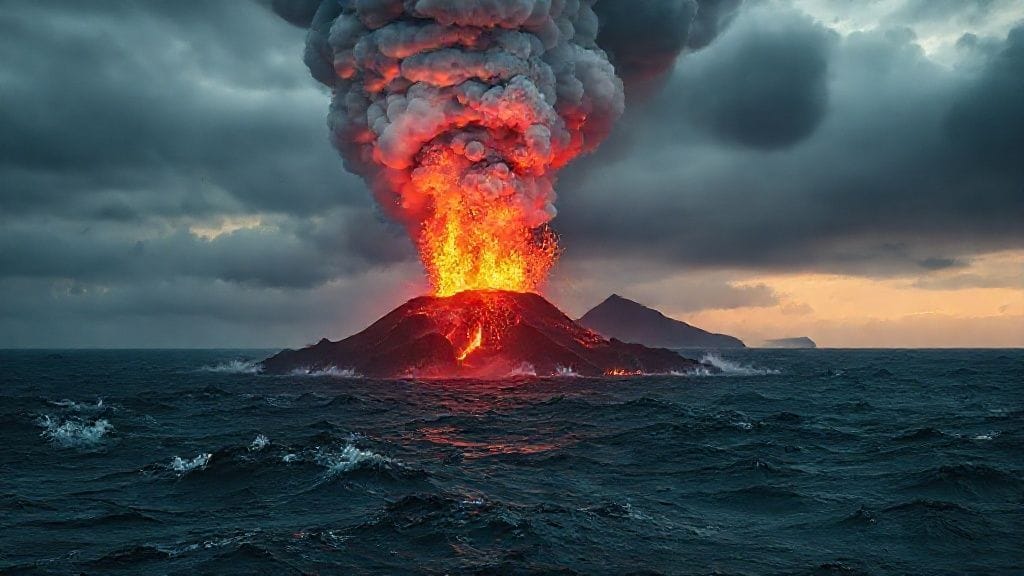
It began with distant thunder—low rumbles that grew into violent shakes shaking the hulls of anchored ships and rattling shutters in coastal villages. Fishermen testified to violent surges in water temperature and discolored plumes marbling the sea. Then, without warning, the first explosive bursts shattered the surface, sending steamy jets and molten rock skyward. The normally benign waters became a frothing, boiling cauldron, signaling the birth of one of the region's most fearsome natural disasters.
6. The Cataclysm Unfolds: Fire, Steam, and Tearing Earth
From beneath the waves, Kolumbo erupted with a deafening force. Plumes of ash and gas pierced the blue sky while underwater explosions caused violent cavitations, sending shockwaves propagating across the Aegean. The eruption column reached miles into the atmosphere, blotting the sunlight in a grim shroud of ash. The volcanic activity carved out new underwater craters and forced the seabed to rupture—altering the maritime landscape irrevocably.
7. Tsunami on the Horizon: Waves of Destruction
Perhaps the most devastating gift of Kolumbo’s fury came not from fire, but from water. The violent displacement of sea floor and the eruption’s explosive energy triggered a colossal tsunami. Waves towering over ten meters crashed onto nearby shores with unstoppable momentum. Shoreline villages were obliterated in minutes; boats, homes, and crops were swept away with merciless force. Coastal towns like Santorini and Anafi faced a cataclysmic assault that would haunt their histories forever.
8. The Human Toll: Lives Lost and Communities Shattered
Exact figures are lost to time, but chroniclers lamented the staggering loss of life—fishermen, traders, families—all victims of nature’s sudden wrath. Survivors spoke of the harrowing escape from drowning, the agonizing cries amidst the ruins, and the profound mourning of communities ripped apart. Fragile economies reliant on the sea went into steep decline, as entire populations grappled with grief and displacement.
9. The Ecological Aftermath: Sea and Land Transformed
The eruption rippled beyond human suffering. The surrounding marine ecosystems endured drastic shifts, as ash and sulfur altered the water chemistry, devastating fish populations and coral reefs critical to local biodiversity. Landmasses adjacent to the eruption bore scars—tectonic shifts reshaped coastlines, and underwater volcanic buildups created new submarine topographies that would puzzle geologists for centuries.
10. The Political and Social Turmoil: How Venice and the Ottomans Responded
As the natural disaster unfolded, political players observed with grim concern. The Venetian Republic, controlling several Aegean islands, scrambled relief efforts while fearing a weakening of their strategic hold. Meanwhile, the Ottoman Empire sought to exploit any perceived chaos to extend their influence. The eruption cocooned the region in uncertainty, amplifying diplomatic tensions already fraught by centuries of rivalry.
11. Survivors’ Tales: Stories from the Depths of Tragedy
In the aftermath, eyewitness accounts surfaced—letters and reports from sailors, priests, and local officials—each bearing witness to the horror and awe of Kolumbo’s wrath. One fisherman's daughter recounted how her father’s boat was capsized, yet miraculously, a schoolteacher clung to drifting debris and swam ashore. Such personal stories lent a haunting humanity to the event, reminding us that history is not only recorded by dates but by lived experience.
12. Scientific Understandings: 17th-Century Perceptions vs. Modern Science
At the time, volcanic eruptions were often explained through the lens of astrology, religious wrath, or humoral theories. The eruption of Kolumbo was interpreted as an ominous divine sign, a manifestation of cosmic upheaval linked to human sin. Today, volcanologists understand Kolumbo as part of the Hellenic volcanic arc—a dynamic zone where tectonic plates collide and fuel intense geological activity. Modern underwater exploration and seismography have revealed the eruption’s true scale and underlying mechanisms.
13. Kolumbo in Historical Memory: Forgotten or Remembered?
Despite its magnitude, Kolumbo’s eruption faded into relative obscurity, overshadowed by more famous catastrophes such as the Santorini eruption and later volcanic disasters in Europe. Only recent scientific interest and local oral traditions have revived awareness. The event serves as a poignant reminder of how natural disasters can be both central and invisible to collective historical memory, depending on their documentation and cultural framing.
14. Geological Legacy: Unraveling Kolumbo’s Impact Through Modern Research
The ongoing underwater explorations around Kolumbo have yielded invaluable data about submarine volcanism. Core samples and acoustic mapping have traced the eruption’s deposits, underwater landslides, and the formation of new volcanic cones. These findings contribute to the broader understanding of volcanic hazards in tectonically active maritime zones, providing insights critical for regional disaster preparedness.
15. The Eruption's Place in Global Volcanic History
While not as globally renowned as Vesuvius or Krakatoa, Kolumbo’s 1650 eruption stands as one of the significant 17th-century chaotic natural events. Its submarine explosions, tsunami generation, and cross-cultural impact make it a unique case study about the interface of geology, human societies, and geopolitics. The event also helped shape early European interest in geological science.
16. Natural Hazards and Human Vulnerability in the Aegean
Kolumbo’s tragedy exemplifies an age-old tension between natural power and human vulnerability. The dense population centers along volcanic islands, the importance of seafaring, and limited communication technologies compounded the disaster’s severity. It invites reflection on modern vulnerabilities in a world where volcanism remains unpredictable.
17. Lessons from Kolumbo for Today’s World
In an era of climate change and increasing natural disasters, Kolumbo’s eruption underscores the imperative of understanding, preparing, and educating. Monitoring underwater volcanoes, enhancing tsunami warning systems, and respecting the fragile balance between human settlements and geological forces remain paramount. Kolumbo is a timeless teacher—its fiery past illuminating the path toward resilience.
Conclusion
The eruption of Kolumbo in 1650 was not simply a geological event; it was a human tragedy writ large across the Aegean's serene waters. It encapsulates the endless dialogue between Earth’s restless power and humanity’s fragile existence. Though centuries have passed, the echoes of Kolumbo’s fury persist in geological records, survivors’ memories, and the legacy it left on the region’s culture and science. This story reminds us that beneath the quiet beauty of the sea may lie slumbering giants, waiting to remind us of our shared vulnerability—and resilience—in the face of nature’s astonishing might.
FAQs about the Kolumbo Eruption
Q1: What caused the Kolumbo eruption in 1650?
A1: The eruption was triggered by tectonic activity along the Hellenic subduction zone, where the African plate thrust beneath the Eurasian plate, creating magma that accumulated in Kolumbo’s volcanic chambers until pressure caused a violent release.
Q2: How large was the Kolumbo eruption compared to other volcanic events?
A2: While not as large as the famous Santorini (Thera) eruption, Kolumbo’s explosive power and tsunami generation were significant, marking it as one of the major submarine eruptions of the 17th century.
Q3: What areas were most affected by the eruption?
A3: The immediate vicinity north of Santorini, nearby islands such as Anafi, and coastal settlements along the Aegean Sea experienced the most profound impacts, including tsunami damage and ashfall.
Q4: How did the political powers at the time react to the disaster?
A4: Venice and the Ottoman Empire both reacted with strategic concern, launching limited relief operations while wary of regional instability caused by the disaster’s aftermath.
Q5: Why did Kolumbo’s eruption fade from popular history?
A5: The event's submarine nature, combined with limited documentation and overshadowing by other dramatic eruptions, led to its marginalization in popular and historical narratives.
Q6: What modern techniques are used to study Kolumbo?
A6: Scientists employ underwater mapping, seismic monitoring, core sampling, and remote sensing technology to analyze the eruption’s deposits and understand ongoing volcanic activity.
Q7: Could Kolumbo erupt again?
A7: Yes, as an active submarine volcano in a tectonically volatile region, Kolumbo remains a potential hazard, necessitating continuous monitoring.
Q8: What lessons can contemporary society learn from the Kolumbo eruption?
A8: The importance of preparedness for volcanic and tsunami hazards, investment in monitoring systems, and respect for the delicate interaction between human communities and natural forces are essential takeaways.

