Table of Contents
- The Roar from Beneath: An Introduction to Soufrière’s Awakening
- The Calm Before the Storm: Life on St Vincent before 1902
- Geological Roots: Understanding La Soufrière’s Volcanic Nature
- Early Signs: The Subtle Murmurs of a Sleeping Giant
- The First Tremors: Initial Earthquakes and Warnings
- April 6, 1902: The Cataclysm Unfolds
- Clouds of Ash and Rivers of Fire: The Eruption’s Fury
- Human Drama Amidst Chaos: Stories of Survival and Loss
- The Aftermath: A Landscape Transformed and a Society Shaken
- The Wider Caribbean Context: Impact Beyond St Vincent
- Scientific Observations: What 1902 Taught Volcanology
- Comparisons with Contemporary Eruptions: Lessons and Parallels
- Government and Colonial Response: Relief Efforts and Challenges
- Cultural Reverberations: Memory and Myth in Vincentian Society
- Environmental Consequences: Forest, Soil, and Climate
- Economic Costs and Recovery: Agriculture and Trade in Ruins
- The Volcanic Legacy: How Soufrière Shapes St Vincent Today
- New Warnings: Modern Monitoring and Preparedness
- Remembering 1902: Commemorations and Historical Scholarship
- Conclusion: Volcanoes, Vulnerability, and Human Resilience
- FAQs about the 1902 La Soufrière Eruption
- External Resources
- Internal Link
The Roar from Beneath: An Introduction to Soufrière’s Awakening
On a quiet spring morning in 1902, the island of St Vincent, nestled in the lush embrace of the Windward Caribbean, awoke to a new reality. The ground trembled; the skies darkened as thick columns of ash billowed from the summit of La Soufrière, the towering volcano that dominates the island’s northern horizon. The eruption that followed was not just a geological event; it was a moment of profound human drama and historical consequence shaping the fate of thousands and echoing through Caribbean history.
Imagine standing at the edge of a green valley when suddenly the earth groans beneath your feet, the skies turn an ominous gray-black, and waves of ash cascade down mountainsides like deadly snow. This was St Vincent in the spring of 1902—amid hope and tradition, thrust violently into catastrophe and survival.
But the story of La Soufrière is more than the eruption itself. It is about an island, its people, and the volatile relationship humanity holds with nature’s most destructive forces. To understand this tale fully, one must delve into the island’s history, its geology, and the human experience interwoven with fire and ash.
The Calm Before the Storm: Life on St Vincent before 1902
At the dawn of the 20th century, St Vincent was a modest colonial outpost within the British Empire, its economy largely dependent on agriculture—sugar, arrowroot, and bananas flourishing in the fertile volcanic soil. The island’s landscape, vivid with rolling hills and tropical forests, belied its darker power lurking just beneath the surface.
The population, a mixture of descendants of enslaved Africans, indigenous peoples, and European settlers, lived in small, dispersed communities. Life was often precarious, but there was a rhythm to existence—a seasonal pattern of planting, harvesting, local festivals, and religious observances.
Yet, while daily life proceeded with an almost deceiving tranquility, the mountain loomed, an ever-present sentinel. The islanders’ relationship with La Soufrière was complex — respect, fear, and folklore intertwined. Tales passed down from generation to generation spoke of eruptions in the distant past, of rivers of fire and ash showers—warnings that the volcano was never truly dormant, only asleep.
Geological Roots: Understanding La Soufrière’s Volcanic Nature
La Soufrière is a stratovolcano, part of the volcanic arc formed by the subduction of the Atlantic plate beneath the Caribbean plate. This tectonic movement produces the kind of highly explosive volcanic activity that can alter landscapes and lives in dramatic fashion.
The volcano’s eruptive history is marked by cyclical phases of intense activity separated by centuries of quiescence. Prior to the 1902 eruption, historical records and oral histories indicated notable eruptions in the 18th century — particularly in 1780 — which left scars on both the island’s geography and collective memory.
Beneath the forested slopes, volatile magma chambers and hydrothermal systems had slowly accumulated pressure over decades. The geology of La Soufrière was an ominous prelude: fumaroles venting sulfurous gases, small tremors too subtle for many to notice, yet unmistakable to geologists and local observers attuned to the mountain’s moods.
Early Signs: The Subtle Murmurs of a Sleeping Giant
In the months leading up to the catastrophic eruption, residents of St Vincent noticed a series of unsettling signs: slight earth tremors, an increase in volcanic gases venting near the summit, and animals behaving erratically. For many villagers, these phenomena sparked unease but not outright panic.
The colonial administrators received reports but had limited scientific capacity or experience to identify the threat’s magnitude. The technology of the early 1900s meant that volcanic prediction was more art than science, relying significantly on eyewitness testimony and rudimentary seismographs.
Despite these early murmurs, many interpreted the signs through cultural lenses—folk wisdom and superstition—and often downplayed the impending disaster. This tragic underestimation would soon cost dearly.
The First Tremors: Initial Earthquakes and Warnings
By late March 1902, the island experienced a series of increasingly violent tremors, signaling that the volcano was awakening from its long slumber. The ground shook with a persistent rumble that unsettled people and livestock alike.
Some observant residents began to prepare, moving livestock away from the mountain’s base and gathering supplies. Local clergy and leaders held emergency meetings. However, contradictory reports and the absence of official warnings led to confusion.
In the colonial capital Kingstown, anxiety mounted but there was no full-scale evacuation order. Partly, this was due to logistical challenges—roads were limited, and communication across the island was imperfect. The limits of early 20th-century colonial governance became starkly apparent in this moment of crisis.
April 6, 1902: The Cataclysm Unfolds
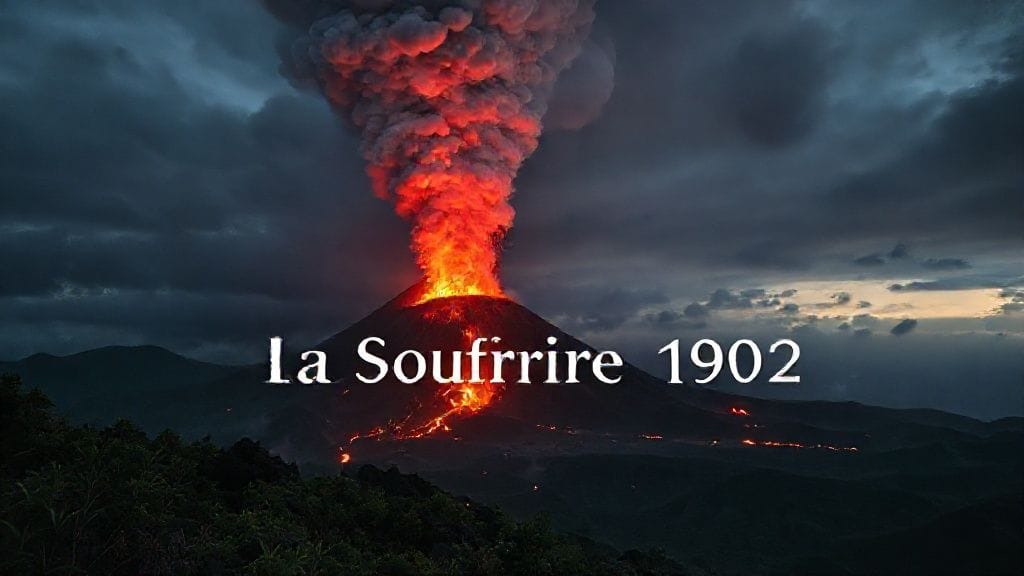
At approximately 8 a.m. on April 6, the atmosphere changed abruptly. A deafening explosion tore through the morning air, followed by a massive ash plume that shot kilometers into the sky. Within minutes, fiery pyroclastic flows thundered down the volcano’s slopes, incinerating everything in their paths.
Witnesses described a hellscape of fire and smoke, where dark skies blotted out the sun and a burning wind wiped the earth clean. Villages near the mountain vanished; forests were transformed into ash deserts.
The eruption was part of a regional frenzy—with the nearby island of Martinique experiencing simultaneous disaster from Mount Pelée just days before—underscoring the volatility of the Caribbean volcanic belt.
Clouds of Ash and Rivers of Fire: The Eruption’s Fury
For the next several days, La Soufrière unleashed a sequence of violent eruptions. Ash rains coated the island; poisonous gases permeated the air; mudflows and lahars swept through river valleys destroying crops, homes, and lives.
The scale of the eruption surpassed most expectations. Scientists who arrived post-eruption estimated the ejected material volume to be several cubic kilometers—a marked release of pent-up geological fury.
Yet, amid the destruction, natural phenomena exhibited eerie beauty. Night skies were lit by glowing volcanic bombs; ash clouds painted sunsets in surreal hues. But the dazzling display was a stark reminder of nature’s indifferent power.
Human Drama Amidst Chaos: Stories of Survival and Loss
Behind the statistic of thousands displaced or dead, the eruption of La Soufrière was a deeply human tragedy. Families torn apart; heroic acts of rescue and sacrifice; desperate flight into uncertain futures.
Accounts from survivors speak of frantic escapes by sea and over treacherous terrain, neighbors helping one another, and the profound grief of those left behind. One remarkable story is that of Desmond Thomas, a local farmer who, despite losing his home, stayed to lead relief efforts and later documented vital eyewitness testimonies.
For many, the disaster upended their identity and sense of security. The trauma of loss etched itself into family histories, reshaping community narratives forever.
The Aftermath: A Landscape Transformed and a Society Shaken
As the eruption subsided, the island was unrecognizable. Valleys once fertile lay barren under blankets of ash and pumice. Rivers changed course; volcanic cones emerged, and the vegetation took years to recover.
Society faced not just physical rebuilding but psychological healing. The trauma, poverty, and displacement tested social cohesion and the colonial administration’s resolve.
A mass exodus ensued, with some inhabitants emigrating to neighboring islands or overseas. Others clung to their ancestral lands, forging resilient new livelihoods amid adversity.
The Wider Caribbean Context: Impact Beyond St Vincent
The 1902 eruption was not an isolated incident but part of a series of volcanic disasters that year, with the devastating eruption of Mount Pelée in Martinique occurring mere days prior, which annihilated the town of Saint-Pierre and with it nearly 30,000 lives.
These twin catastrophes captured worldwide attention, emphasizing the Caribbean’s precarious geological location and vulnerability. They also galvanized scientific inquiry into volcanic activity, prompting international collaboration.
Moreover, the disasters influenced colonial policies on disaster management and prompted early instances of regional disaster preparedness.
Scientific Observations: What 1902 Taught Volcanology
Though scientific instrumentation was limited, observations made during and after the eruption proved foundational for volcanology. Researchers noted the mechanics of explosive eruptions, the characteristics of pyroclastic flows, and the role of gas emissions.
The eruptions highlighted the need for systematic observation and monitoring of active volcanoes, inspiring the establishment of more permanent observatories in volcanic regions worldwide.
The 1902 Soufrière event remains a case study in the hazards of stratovolcanoes and risk mitigation—lessons echoed in modern volcanic crises.
Comparisons with Contemporary Eruptions: Lessons and Parallels
When placed alongside other volcanic tragedies—such as the 1980 Mount St. Helens eruption or the 1991 Mount Pinatubo event—the 1902 Soufrière eruption reveals common threads: underestimation of risk, slow institutional responses, and tremendous human cost, but also remarkable resilience.
Contemporary advances in monitoring, early warning systems, and disaster response owe much to the hard lessons learned from such historic eruptions.
Government and Colonial Response: Relief Efforts and Challenges
The British colonial administration faced enormous challenges responding to the disaster, compounded by limited resources and infrastructure. Relief efforts involved food distribution, temporary shelters, and medical aid, but these were hampered by scattered populations and communication difficulties.
Criticism emerged over the speed and scale of the response, highlighting colonial administration’s limitations in protecting vulnerable populations.
Yet, these efforts laid foundations for future disaster management policies in the Caribbean, influencing governance in natural hazard-prone colonies.
Cultural Reverberations: Memory and Myth in Vincentian Society
The eruption indelibly marked the island’s collective consciousness. Oral histories preserved stories of fire and survival, shaping local folklore.
Art, music, and literature from and about St Vincent often reference the volcano as a symbol of both destruction and regeneration—a powerful force shaping identity.
Every eruption ripples through generations, influencing how Vincentians relate to their environment and history.
Environmental Consequences: Forest, Soil, and Climate
Volcanic ash devastated ecosystems but also enriched soils over time, paradoxically boosting agricultural potential in subsequent decades.
However, the immediate environmental damage was severe—deforestation, river contamination, and loss of biodiversity.
The eruption also temporarily altered local climate patterns, with ash clouds affecting rainfall and temperatures, affecting agriculture and daily life.
Economic Costs and Recovery: Agriculture and Trade in Ruins
Agriculture, the backbone of St Vincent’s economy, bore the brunt of destruction. Crops destroyed, livestock lost, and arable land covered in ash led to food shortages and economic hardship.
Trade, both local and colonial, was disrupted, with ripple effects through Caribbean markets.
Recovery was slow and uneven, requiring new investment, labor shifts, and adaptation to altered landscapes. Migration and diversification of livelihoods became part of the post-eruption story.
The Volcanic Legacy: How Soufrière Shapes St Vincent Today
Over a century later, La Soufrière continues to define St Vincent—not just physically but culturally and economically.
Tourism now embraces the volcano as a site for education and adventure. Modern monitoring systems stand sentinel, reminders of past tragedy and hopes for safety.
The volcano is a living symbol of the island’s resilience, environment, and community.
New Warnings: Modern Monitoring and Preparedness
The eruption shaped how authorities today manage volcanic risk. Advances in seismology, gas emission analysis, and remote sensing allow for earlier warnings.
Community education programs have been established, and evacuation plans regularly rehearsed.
Yet, challenges remain, particularly with urban expansion and climate change introducing new complexities.
Remembering 1902: Commemorations and Historical Scholarship
Every decade, the island holds memorial events honoring those lost and celebrating survival. Schools teach the eruption’s history in detail, ensuring youth remain connected to this defining chapter.
Academic research continues to shed new light, coupling volcanic science with social history to fully understand the eruption’s impact.
Conclusion: Volcanoes, Vulnerability, and Human Resilience
The eruption of La Soufrière in 1902 starkly reminds us of nature’s unpredictable power and humanity’s vulnerability. Yet, it also testifies to resilience: the strength of communities to endure, rebuild, and transform tragedy into identity.
History does not merely record disasters; it chronicles human spirit, adaptation, and hope. In the ashes of 1902, St Vincent found renewed life—an enduring testament to the intertwined fate of people and their environment.
FAQs
Q1: What caused the 1902 eruption of La Soufrière?
A1: The eruption was triggered by the buildup of pressure within La Soufrière’s magma chamber due to tectonic subduction beneath the Caribbean plate, leading to explosive release of gas and magma.
Q2: How many people were affected by the eruption?
A2: Thousands were displaced or perished during the eruption and its aftermath, with estimates of casualties varying due to limited records, but the human impact was devastating.
Q3: How did the eruption affect the Caribbean region?
A3: Beyond St Vincent, the eruption occurred alongside Mount Pelée’s explosion in Martinique, drawing international attention to volcanic hazards in the Caribbean and influencing regional disaster preparedness.
Q4: What were the main challenges in responding to the disaster?
A4: Limited infrastructure, communication difficulties, and colonial administration constraints hampered effective evacuation and relief efforts.
Q5: How has La Soufrière influenced modern volcanology?
A5: The eruption provided critical data on explosive stratovolcano eruptions and pyroclastic phenomena, shaping monitoring techniques and risk assessment.
Q6: How is the eruption remembered culturally in St Vincent?
A6: Through oral histories, commemorations, art, and education, the eruption remains a powerful symbol in Vincentian identity and resilience.
Q7: What are the environmental legacies of the eruption?
A7: While initially destructive to ecosystems, volcanic soils facilitated eventual agricultural recovery and influenced local biodiversity.
Q8: How prepared is St Vincent today for potential volcanic activity?
A8: Modern monitoring technology, community education, and emergency planning have greatly improved preparedness, although challenges remain.

