Table of Contents
- The Roar of a Sleeping Giant: Introduction to the Cerro Azul Eruption
- The Galápagos Archipelago: A Remote Ecological Marvel
- Before the Fire: Geological Origins of Cerro Azul
- The Global Stage of the 1940s: War and Nature's Fury
- First Tremors: The Initial Signs of Rising Tension
- April 1943: The Breaking Point of Cerro Azul
- Lava Rivers and Ash Clouds: A Day-by-Day Account
- Eyewitnesses from Afar: The Human Narrative despite Isolation
- Ecological Shockwaves: Impact on Galápagos Flora and Fauna
- Scientific Discoveries Born from Crisis
- The Lettered Earth: Geological Mapping after the Eruption
- Nature’s Contrast: Recovery and Resilience in the Decades After
- The Eruption’s Place in Volcanic History: Comparisons and Contrasts
- An Unseen Struggle: The Human Spirit in Remote Isolation
- Cultural Echoes: How the Eruption Shaped Galápagos Identity
- Modern Monitoring: Preventing the Next Sudden Fury
- Lessons Learned: Volcanoes, Humans, and Fragile Ecosystems
- Conclusion: Fire Beneath the Waves – Legacy of Cerro Azul
- FAQs: Insights into the 1943 Cerro Azul Eruption
- External Resource
- Internal Link
The Roar of a Sleeping Giant: Introduction to the Cerro Azul Eruption
The Galápagos Islands lay like emerald jewels scattered in the cold vastness of the Pacific Ocean, their volcanic peaks piercing the misty horizon with timeless patience. Among them, Cerro Azul stood as a silent titan on Isabela Island—majestic, dormant, almost otherworldly. In early 1943, nature’s stillness was shattered as this slumbering giant unleashed a powerful eruption that would reshape the island’s landscape and etch itself into the annals of geological history. Imagine the ground trembling beneath your feet, the air thickening with sulfurous smoke, rivers of molten rock carving new paths where life once flourished. This was no gentle reminder of Earth’s power—it was an elemental upheaval, raw and unyielding.
For those who study the Earth’s rumblings, the 1943 eruption of Cerro Azul offers a profound story of geological force intertwined with ecological fragility and human curiosity. It happened in a place inaccessible and remote, yet its echoes resound through time, inviting us to reflect on the dance between destruction and creation. The tale of Cerro Azul’s fiery awakening is as much about the island’s breathtaking isolation as it is about the relentless energy bubbling beneath our feet.
The Galápagos Archipelago: A Remote Ecological Marvel
To understand the eruption's full impact, one must first appreciate the Galápagos Islands’ extraordinary isolation and ecological singularity. Located nearly 1,000 kilometers off the coast of Ecuador, these islands are volcanic in origin and home to species found nowhere else on Earth. They inspired Charles Darwin’s theory of evolution, famously shaped by their unique biodiversity. Cerro Azul, the southernmost volcano on Isabela Island, is one of the largest and most active in the archipelago. With a summit reaching over 1,500 meters, it commands an imposing presence in this fragile ecosystem composed of finches, giant tortoises, marine iguanas, and a myriad of other creatures adapted to volcanic soil and harsh winds.
Before the Fire: Geological Origins of Cerro Azul
The Galápagos Islands rest atop the Nazca tectonic plate, reclining over a hot spot in the Earth’s mantle—an undersea furnace forging islands and mountains through relentless volcanic activity. Cerro Azul’s origin dates back hundreds of thousands of years, its broad shield and gently sloped shape revealing the nature of its basaltic, low-viscosity lava flows. These flows can travel great distances before cool and solidify, sculpting vast lava plains and creating complex underground volcanic systems. Despite long periods of rest, Cerro Azul is far from extinct; it has erupted repeatedly over the millennia, plumbing deep reservoirs of magma beneath the surface.
The Global Stage of the 1940s: War and Nature's Fury
In 1943, the world was gripped by the devastation of the Second World War. While battles raged across continents and seas, the quiet Pacific islands remained distant and mostly untouched by human conflict. But amid this global tumult, nature too kept its own inexorable calendar—one not bound by politics or human affairs. The Galápagos, remote and largely unpopulated, stood poised for upheaval without the usual human narrative that war imparts. This eruption was a reminder that even when humanity’s attention is fixed elsewhere, Earth’s forces abide by their own rhythms.
First Tremors: The Initial Signs of Rising Tension
Scientists and sailors who occasionally made their way to the Galápagos noted subtle but unmistakable signs in late 1942 and early 1943. Seismic activity beneath Cerro Azul intensified: low rumbles vibrating through the island, tiny tremors shaking the volcanic slopes. Dark smoke began to seep from fumaroles near the summit, signaling magma’s restless ascent. Though sparse, the few residents and transient visitors—usually scientists or sailors—felt an undercurrent of expectation mixed with unease. This bubbling unrest culminated suddenly as the volcano prepared to violate its silence.
April 1943: The Breaking Point of Cerro Azul
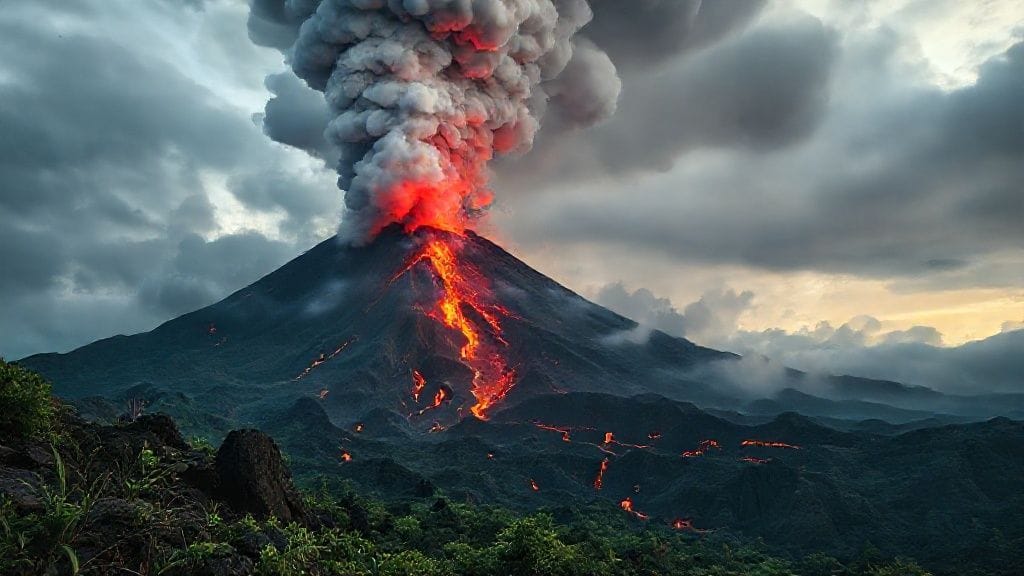
On April 13, 1943, the calm was ruptured. Without much advance warning, Cerro Azul erupted in a violent display of fire and ash. Billowing clouds of sulfurous gas spewed skyward, turning day into night beneath the volcanic plume. Lava fountains channeled molten rock onto the slopes, and flows of lava began their inexorable journeys downward, swallowing valleys and reshaping coastal areas.
The eruption was primarily effusive, propelling fluid lava in vast streams rather than explosive ash clouds like some other volcanoes. Still, the scale was immense—the lava covered nearly 60 square kilometers, making it one of the largest eruptions in Galápagos history. Ashfall darkened skies as far as neighboring islands, and the tremors shook ships passing hundreds of kilometers away.
Lava Rivers and Ash Clouds: A Day-by-Day Account
For days and weeks after April 13th, Cerro Azul’s fiery heart continued its tumultuous beating. The eruption waxed and waned—a dynamic, unpredictable force. Lava flowed relentlessly, creating new landforms and altering coastlines. Pyroclastic activity sent clouds of ash higher into the atmosphere, disrupting the fragile air and depositing fertile, yet toxic, layers on the island’s vegetation.
Reports collected from scientific expeditions document the eruption’s progression with almost poetic detail. Observers described glowing rivers of fire moving like liquid talons, consuming everything in their path yet paradoxically laying the foundations for future life. The stench of sulfur was pervasive; the skies glowed eerie colors at night. For those few present, it was a spectacle both terrifying and mesmerizing, a vivid reminder of Earth’s latent fury.
Eyewitnesses from Afar: The Human Narrative despite Isolation
Though few humans dwelled permanently on Isabela Island in 1943, sailors, naturalists, and Ecuadorian naval vessels encountered firsthand the eruption’s grandeur and danger. Letters and journals from these observers provide invaluable insights into the eruption’s immediate effects and the emotions it stirred. One botanist wrote of watching the tortoises flee from lava flows, the sadness mingling with awe at the raw power of destruction intertwined with creation.
Despite its remoteness, news of the eruption slowly spread. Ecuadorian authorities expressed concern for scientific and conservation reasons, recognizing the island’s fragile ecosystem and international importance. Yet the limited human presence meant casualties were zero—a striking contrast to volcanic disasters elsewhere. This relative safety underscores the paradox of volcanic islands: their dangers are tremendous, yet their isolation often shields many from catastrophe.
Ecological Shockwaves: Impact on Galápagos Flora and Fauna
Cerro Azul’s eruption was a pulse of destruction in the living heart of one of the world’s most unique ecosystems. Lava flows buried habitats, ash choked plant surfaces, and volatile gases altered air quality. Yet life, remarkably, clings tenaciously in the Galápagos. In the aftermath, scientists noted a mosaic of devastation punctuated by patches of survival—smaller plants persevered in lava cracks, animals found refuge in unaffected zones.
One of the most affected species were the giant tortoises and land iguanas, iconic symbols of the archipelago. Displacement was temporary but disruptive; some populations experienced stress, but their hardiness ensured eventual recovery. Ecologists saw the eruption as a natural reset, clearing old vegetation and allowing succession to unfurl anew.
Scientific Discoveries Born from Crisis
The 1943 eruption helped transform scientific understanding of Galápagos volcanism. Researchers rapidly organized expeditions to map lava flows, measure ash layers, and analyze eruptive styles. These efforts gave unprecedented gas, rock, and seismic data. The eruption’s scale provided rare opportunities to study shield volcano dynamics firsthand—a process only possible due to the eruption’s timing amidst scarce local infrastructures.
In many ways, Cerro Azul’s 1943 tempest became a laboratory for volcanologists and ecologists alike. Their observations refined models of how oceanic hotspot volcanoes behave, influencing hazard mitigation efforts and adding to global volcanology literature. Through this lens, the eruption was more than destruction—it was a doorway to understanding Earth’s fundamental inner workings.
The Lettered Earth: Geological Mapping after the Eruption
Post-eruption surveys painstakingly charted Cerro Azul’s changed geography. New lava fields were marked, old valleys partially buried. Geological maps showed the zigzagging rivers of basalt that cooled into jagged black plains over months. These updated maps remain invaluable, providing baseline data for future eruptions and studies.
Scientists found the crystalline structures of the lava flows distinct, revealing cooling rates and magma chemistry that tied Cerro Azul’s activity to deep mantle processes. This geological “fingerprint” allowed volcano watchers to predict potential eruptive behaviors decades later. Mapping thus married Earth’s fiery history to the promise of future knowledge.
Nature’s Contrast: Recovery and Resilience in the Decades After
The decades that followed illustrated nature’s incomparable resilience. Vegetation slowly reclaimed scorched grounds as mosses, lichens, and pioneer plants stabilized soils. Birds nested along newly formed cliffs; marine life flourished near shores reshaped by the volcanic outpourings. The ecosystem’s adaptive dance with destruction became apparent—a reminder of nature’s cyclical mastery over time.
Isabela Island today shows geological strata carved by multiple eruptions, with Cerro Azul remaining active but more subdued since 1943. This eruption was a defining moment, shaping both the physical face of the island and the evolving ecological tapestries upon it.
The Eruption’s Place in Volcanic History: Comparisons and Contrasts
Compared to colossal eruptions like Krakatoa or Mount St. Helens, Cerro Azul’s 1943 event was modest yet significant, introducing unique insights into shield volcano behavior. Its primarily effusive nature contrasts with violently explosive eruptions, teaching how magma chemistry and tectonic settings dictate volcanic temperament.
In the broader Pacific “Ring of Fire,” Cerro Azul underscored the diversity of volcanic activity, reminding us that even gentle lava flows alter landscapes profoundly over time. The eruption remains a benchmark for oceanic hotspot volcanism alongside Hawaii and Iceland.
An Unseen Struggle: The Human Spirit in Remote Isolation
Though seldom emphasized, the human dimension during and after the eruption is poignant. The few who witnessed it faced isolation, awe, and vulnerability to Earth’s whims. Their stories—scientists recording, sailors observing, locals adapting—echo the universal human experience confronting nature’s uncontrollable power.
In the absence of mass casualties, emotional impacts still lingered: uncertainty, fascination, fear interlaced with discovery. This eruption became a silent monument to humanity’s fragile place in the natural world, especially in remote frontiers.
Cultural Echoes: How the Eruption Shaped Galápagos Identity
The volcano’s awakening embedded itself in the cultural memory of Ecuador and the Galápagos, symbolizing the islands’ wildness and ongoing geological youth. For generations of islanders and Ecuadorians, Cerro Azul’s 1943 eruption is a testament to nature’s dual character—creator and destroyer.
It motivated conservation efforts, heightened scientific interest, and inspired stories passed down from those who bore witness—even indirectly. Today, the eruption remains part of the narrative that defines the archipelago, reminding locals and visitors alike of the fiery genesis from which life springs.
Modern Monitoring: Preventing the Next Sudden Fury
Learnings from 1943 have influenced how authorities and scientists monitor Galápagos volcanoes today. Seismographs, gas sensors, and satellite imaging form a network designed to catch early warning signs, safeguarding fragile ecosystems and any human presence. This vigilance honors both the eruption’s legacy and a commitment to coexist with the Earth’s restless heart.
The lessons etched in molten stone continue to inform policies on risk, research, and preservation, balancing respect for nature’s forces with human endeavor.
Lessons Learned: Volcanoes, Humans, and Fragile Ecosystems
Cerro Azul teaches that volcanic eruptions, while cataclysmic, are integral to the cycles shaping Earth’s surface. Its 1943 event highlights the necessity of understanding planetary forces within their ecological and human contexts. It reveals the complexity of predictability, the resilience of species, and the profound interconnection between geological activity and the evolution of life.
Conclusion: Fire Beneath the Waves – Legacy of Cerro Azul
The 1943 eruption of Cerro Azul stands as a vivid chapter in the story of the Galápagos—a tale of fire and earth meeting in a remote corner of the world. It reminds us not only of the power lying beneath our feet but also of the enduring resilience of nature and of humanity’s capacity to observe, learn, and preserve. Though the ground once quaked with destructive fury, the island has since healed and thrived, a living testament to the relentless interplay of destruction and creation.
Volcanic eruptions such as this are profound mirrors reflecting the planet’s raw vitality. As we study Cerro Azul’s fiery past, we also glimpse the fragile future of ecosystems shaped by ancient and ongoing volcanic forces. The story of the 1943 eruption is thus both a caution and a celebration—a call to understand the Earth’s volatile heart and respect life’s tenacity in even the most extreme places.
FAQs
Q1: What triggered the 1943 eruption of Cerro Azul?
A1: The eruption resulted from increased magma pressure beneath the shield volcano, caused by the movement of the Nazca tectonic plate over a hotspot. Prior seismic activity signaled magma rising, culminating in the eruption.
Q2: How dangerous was the eruption to humans?
A2: Due to the island’s sparse human population, the eruption caused no direct casualties. The main danger was the volcanic gases and lava flows, which were devastating to local ecosystems but posed limited risk to people.
Q3: Which species were most affected by the eruption?
A3: Giant tortoises, land iguanas, and various endemic plants suffered habitat disruption. However, most species showed remarkable resilience, with life rebounding over subsequent decades.
Q4: How did the eruption influence scientific understanding?
A4: It provided unique data on effusive eruptions of shield volcanoes, improving volcanic hazard models and advancing knowledge of Galápagos volcanic systems.
Q5: Has Cerro Azul erupted since 1943?
A5: Yes, Cerro Azul has erupted multiple times since then, though none were as voluminous or impactful as the 1943 event.
Q6: What measures are in place to monitor Cerro Azul today?
A6: Ecuadorian geological agencies and international partners use seismic monitoring, gas analysis, and satellite imagery to track volcanic activity and provide early warnings.
Q7: How did the eruption shape Galápagos conservation?
A7: The eruption underscored the islands’ ecological fragility, fueling conservation initiatives that balance natural volcanic activity with species protection.
Q8: Why is the Galápagos archipelago volcanically active?
A8: The islands form over a mantle hotspot beneath the Nazca Plate, causing continuous volcanic activity as tectonic movements bring magma to the surface.

