Table of Contents
- The Trembling Dawn: March 3, 1933, in Sanriku
- Geological Prelude: Japan’s Place on the Pacific Ring of Fire
- The Birth of a Seismic Giant: Tectonic Setting of the Sanriku Coast
- Human Stories Beneath the Waves: Coastal Communities Before the Quake
- The Earth Moves: Unfolding the Sanriku Earthquake
- The Tsunami’s Wrath: Giant Waves Transform the Shoreline
- Witnessing the Chaos: Eyewitness Accounts and Immediate Responses
- The Scale of Destruction: Lives Lost and Properties Shattered
- The Government’s Reaction: Emergency Measures and Aid Efforts
- Scientific Discoveries: Understanding the 1933 Quake and Tsunami
- Comparing Calamities: The 1933 Earthquake versus the 1896 Sanriku Disaster
- The Psychological Impact: Trauma and Resilience in the Aftermath
- Reconstruction and Adaptation: How Sanriku Redefined Its Future
- The Evolution of Tsunami Warning Systems: Lessons Learned
- Cultural Reflections: The Earthquake in Japanese Literature and Memory
- Global Awareness: The Sanriku Earthquake’s Place in World Seismic History
- Advances in Seismology Triggered by the Disaster
- Modern Sanriku: Memorials and Continued Seismic Vigilance
- The 1933 Disaster’s Legacy on Disaster Preparedness in Japan
- Epilogue: Sanriku’s Enduring Story — Nature’s Fury and Human Courage
1. The Trembling Dawn: March 3, 1933, in Sanriku
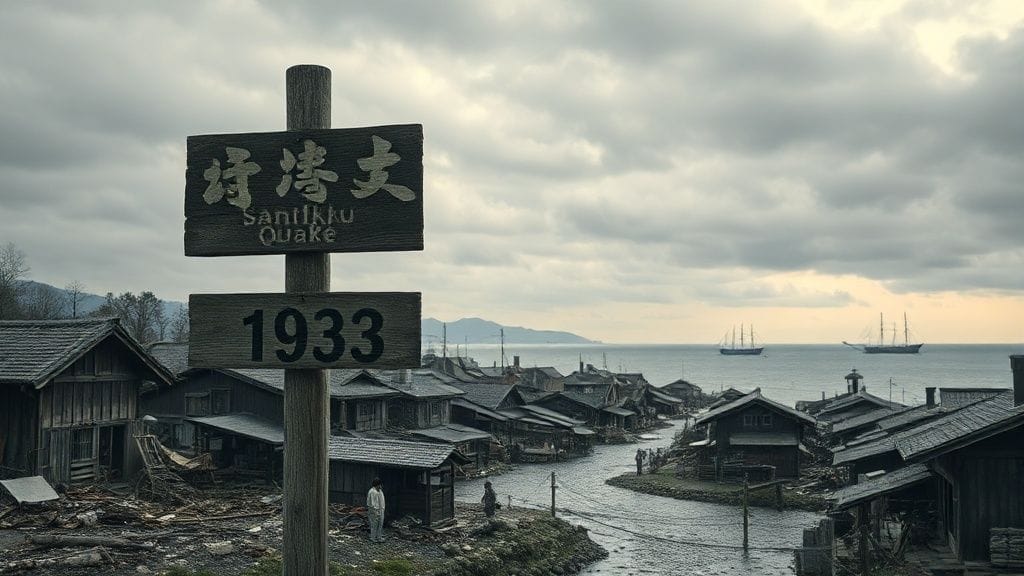
On the early morning of March 3, 1933, the serene landscapes of Japan’s Sanriku coast were shattered in an instant. Beneath a silvery sunrise, a violent tremor burst from the earth’s depths, transforming tranquil fishing villages into scenes of devastation and despair. Men, women, and children—busy with their daily routines—were thrown into chaos. The earth beneath them heaved violently, the waters of the Pacific Ocean recoiling and then surging back in an unimaginable force, wiping out everything in their path. This was no ordinary earthquake; it was a seismic event so intense it would make history and change the region’s destiny forever.
The horror was immediate; homes that had sheltered generations collapsed like fragile dolls, the sea swallowed the shoreline, and thousands were left homeless or worse. Yet amid the ruin, stories of survival, human kindness, and resilience emerged—such is often the paradox of nature’s greatest disasters. To understand the full weight of this tragedy and its enduring impact, we must delve deeper into the story of the Sanriku Earthquake of 1933.
2. Geological Prelude: Japan’s Place on the Pacific Ring of Fire
Japan rests precariously on the Pacific Ring of Fire, a horseshoe-shaped belt of volcanoes and fault lines stretching around the basin of the Pacific Ocean. This geological hot zone is notorious for its severe seismic activity, making Japan one of the world’s most earthquake-prone nations. The peninsula’s placement over four tectonic plates—the Pacific, Philippine Sea, Eurasian, and North American Plates—creates an ongoing struggle beneath the surface that fuels frequent and sometimes catastrophic quakes.
The Sanriku coast, located in the northeastern part of Honshu island, lies atop one of these volatile interfaces. Here, the Pacific Plate plunges beneath the North American Plate—a process known as subduction—slowly but inexorably building pressure deep within the earth’s crust. This immense tension releases periodically in the form of earthquakes and the devastating tsunamis that often accompany them.
3. The Birth of a Seismic Giant: Tectonic Setting of the Sanriku Coast
The precise location of the 1933 Sanriku Earthquake was on the subduction zone off the Sanriku coast in the Pacific Ocean. This area had previously been host to another cataclysmic event decades earlier in 1896, a tragic eerie reminder of the region’s vulnerability. The earthquake itself registered a magnitude of 8.4 on the Richter scale—a reminder of the raw power slumbering beneath the ocean floor.
The quake's epicenter was estimated to be around 290 miles offshore, but the massive displacement of seabed sediment triggered tsunami waves that raced inland with terrifying speed and force. Depths of up to 15 kilometers of ocean floor suddenly buckled, unleashing kinetic energy equivalent to thousands of nuclear bombs used in the decades to come. This was the geological stage upon which human lives would be devastated in mere minutes.
4. Human Stories Beneath the Waves: Coastal Communities Before the Quake
Long before March 1933, the Sanriku coast was a proud and vibrant tapestry of fishing villages and small towns. Its people, largely reliant on the bounties of the sea, lived in harmony with the ocean’s rhythms—both its generosity and its peril. Simple wooden homes perched precariously on narrow strips of land, their inhabitants holding dear to traditions rooted in centuries of coexistence with natural forces.
The region’s economy was tightly intertwined with fishing industries: trawlers, fish auctions, and sea-faring families formed the backbone of daily existence. Yet life here was marked by a quiet acceptance of vulnerability, underscored by memories of the 1896 tsunami that had claimed tens of thousands of lives but was still within living memory.
5. The Earth Moves: Unfolding the Sanriku Earthquake
At exactly 7:30 in the morning on March 3, 1933, a deep rumble reverberated beneath the Sanriku coast as the fault ruptured violently. For a brief moment, the earth seemed to groan, then suddenly convulsed. The tremor lasted over 40 seconds—an eternity in the lives of those caught without warning.
Buildings collapsed, roads cracked open like shattered glass, and thousands ran blindly in panic.
People reported seeing the ocean pull back unusually far from the shore—an ominous sign seen too often before a tsunami’s arrival. It was this eerie pause, the ocean’s breath before the storm, which would presage a far graver catastrophe than the tremors alone. And as the earth ceased its shaking, a new terror began to manifest.
6. The Tsunami’s Wrath: Giant Waves Transform the Shoreline
The earthquake’s underwater disruption triggered a monstrous tsunami that would devastate the Sanriku coast. Waves reaching up to 28 meters (approximately 92 feet) raced inward, destroying everything in their path with unforgiving force. Entire villages were submerged as the ocean claimed the land once thought secure.
The Sanriku's irregular coastline, with its narrow bays and inlets, acted as a natural funnel, magnifying the tsunami’s power and making these waves higher and deadlier than elsewhere. The waves tore through the landscape with swift lethality. Boats capsized, homes were swept away, and countless lives were lost in the blink of an eye.
7. Witnessing the Chaos: Eyewitness Accounts and Immediate Responses
Survivors recounted the horror with shocking clarity years later. “The earth roared beneath us, and then the sea rushed in like a beast,” said one fisherman from Ofunato. Others spoke of a surreal silence just before the tsunami struck—a brief moment that allowed a frantic few to climb hills and avoid total destruction.
Relief efforts began immediately, but were hampered by isolation and destroyed infrastructure. The scale of the disaster overwhelmed local authorities. Villagers who survived banded together, attempting to locate the missing and create makeshift shelters amid the wreckage.
8. The Scale of Destruction: Lives Lost and Properties Shattered
The official death toll from the 1933 Sanriku Earthquake and tsunami stands at approximately 3,000 people—a vast human toll that marks it as one of the deadliest natural disasters of early 20th-century Japan. Thousands more were injured or displaced.
Entire fishing fleets were lost at sea; homes and schools were reduced to rubble. The economic blow was staggering: industries that supported these coastal communities vanished almost overnight, plunging the region into poverty. The psychological scars, however, were equally devastating, leaving a deep imprint that lasted generations.
9. The Government’s Reaction: Emergency Measures and Aid Efforts
The Japanese government, still navigating the upheavals of the interwar period, responded swiftly though not without challenges. Emergency supplies were dispatched, and rescue teams sent to aid survivors. Tent cities and temporary housing became home to thousands.
Funds were allocated for reconstruction, emphasizing the need for improved infrastructure resilient to future seismic events. The disaster would catalyze broader public awareness of earthquake preparedness, leading to legislative changes aimed at mitigating such calamities.
10. Scientific Discoveries: Understanding the 1933 Quake and Tsunami
Though the instruments of 1933 were primitive by modern standards, the Sanriku Earthquake contributed significantly to the field of seismology and tsunami science. Researchers gathered data on wave timing, height, and distance, refining predictive models and hazard maps.
The event also inspired Japanese scientists to develop early tsunami warning systems and study coastal topography’s role in wave amplification. A notable figure, Dr. Kiyoo Mogi, would later build upon the findings from Sanriku to advance earthquake prediction theories.
11. Comparing Calamities: The 1933 Earthquake versus the 1896 Sanriku Disaster
The 1933 quake rekindled memories of the terrible 1896 Sanriku tsunami, which had killed over 22,000 people. While smaller in loss of life, the 1933 event served as a grim reminder that this coastal region was vulnerable to repeated devastations.
Comparisons brought attention to advances made in response and preparedness, highlighting both progress and areas needing urgent improvement. Scientists and policymakers alike studied the two events to craft better mitigation strategies.
12. The Psychological Impact: Trauma and Resilience in the Aftermath
The emotional toll on survivors was immense. Many suffered from “disaster syndrome”—a form of psychological trauma inducing anxiety, nightmares, and withdrawal. Yet amid despair, remarkable acts of resilience emerged.
Families reunited, communities rebuilt, and folklore grew about heroes who saved neighbors from watery graves. These narratives became an essential part of Sanriku’s shared identity—testaments to the human spirit’s endurance in the face of nature’s indifference.
13. Reconstruction and Adaptation: How Sanriku Redefined Its Future
Recovery was a painstaking process stretching over years. Efforts focused not only on rebuilding structures but on rethinking coastal development. Elevated embankments, wider evacuation routes, and sturdier construction methods were among the implemented changes.
Community education about earthquake and tsunami preparedness gained momentum, transforming disaster memory into active vigilance. This shift laid foundational principles that would save countless lives in later seismic events.
14. The Evolution of Tsunami Warning Systems: Lessons Learned
The 1933 disaster became a pivotal milestone in tsunami detection and warning. Before this, Japan had no formal system to alert coastal populations. Post-1933, investments were made to establish seismic monitoring networks and communication protocols.
While rudimentary at first, these systems evolved over decades, ultimately culminating in Japan’s world-leading tsunami warning capabilities today—an enduring legacy of tragic sacrifice.
15. Cultural Reflections: The Earthquake in Japanese Literature and Memory
The Sanriku Earthquake permeated Japanese arts and literature, inspiring poems, novels, and films retelling the tragedy. The event became a symbol of nature’s double-edged gift—its ability to nurture and to annihilate.
Memorial ceremonies honor the victims annually, binding generations to a collective memory infused with gratitude, grief, and respect for the natural world’s power.
16. Global Awareness: The Sanriku Earthquake’s Place in World Seismic History
Internationally, the Sanriku Earthquake brought attention to subduction zone hazards and tsunami risks worldwide. It contributed to global seismic research networks and heightened awareness in other coastal regions, from the Pacific shores of the Americas to Southeast Asia.
The disaster underscored the need for cross-border cooperation in disaster science, a principle that guides current global seismic monitoring.
17. Advances in Seismology Triggered by the Disaster
Through painstaking analysis of Sanriku’s tremors and aftershocks, scientists refined understanding of megathrust earthquakes—a class involving vast fault planes capable of triggering powerful tsunamis.
These insights influenced future hazard maps and building codes, cementing the 1933 earthquake as a critical learning point in earthquake science.
18. Modern Sanriku: Memorials and Continued Seismic Vigilance
Today, the Sanriku coast is dotted with memorials—stone monuments, museums, and peace parks—that honor those lost. Modern towns embrace technology and education, using lessons from 1933 as daily reminders that vigilance against disaster is a continuous effort.
Communities conduct regular drills, showcasing a collective determination not to be unprepared again.
19. The 1933 Disaster’s Legacy on Disaster Preparedness in Japan
Japan’s modern approach to earthquake and tsunami preparedness owes much to lessons learnt from the Sanriku Earthquake. Structural reinforcements, emergency drills, early warning centers, and public education programs have roots tracing back to the trauma of 1933.
The government’s evolving policies continue to prioritize lives saved, reflecting a commitment born from harsh experience.
20. Epilogue: Sanriku’s Enduring Story — Nature’s Fury and Human Courage
The Sanriku Earthquake of 1933 remains a poignant chapter in the chronicles of natural disasters—a powerful reminder of the fine line between everyday calm and catastrophic change. Though overwhelmed by nature’s fury, the people of Sanriku displayed remarkable courage and compassion in its wake, sowing seeds for a safer and more prepared future.
Their story resonates well beyond Japan’s shores, inviting us all to respect the planet we inhabit, to understand its rhythms, and to prepare with humility and resolve for the challenges it may yet unleash.
Conclusion
The Sanriku Earthquake of March 3, 1933, stands as a testament to nature’s tremendous power and humanity’s enduring spirit in the face of disaster. Beyond the raw statistics of death and destruction lies a narrative rich with human experience: of panic and loss but also of heroism, recovery, and hope. The event reshaped scientific understanding, public policy, and cultural memory in Japan and influenced the global approach to seismic risk.
Crucially, the tragedy serves as a living lesson that preparedness is not merely about technology or infrastructure—but about community awareness, resilience, and the collective will to survive and rebuild. As we reflect on Sanriku’s past, we are reminded that our relationship with the Earth is inseparable from our future, demanding respect, vigilance, and compassion.
FAQs
Q1: What caused the Sanriku Earthquake of 1933?
A1: The earthquake was caused by the subduction of the Pacific Plate beneath the North American Plate along the Sanriku Trench, resulting in a megathrust earthquake offshore.
Q2: How powerful was the 1933 Sanriku Earthquake?
A2: It registered a magnitude of approximately 8.4, making it one of the strongest earthquakes in Japanese history at the time.
Q3: How many people died during the earthquake and subsequent tsunami?
A3: Approximately 3,000 people lost their lives due to the earthquake and tsunami.
Q4: What made the tsunami caused by the Sanriku Earthquake so devastating?
A4: The unique coastal geography amplified the waves, generating heights up to 28 meters which swept far inland, destroying communities.
Q5: How did the 1933 disaster influence Japan’s tsunami warning systems?
A5: It prompted the development of early warning systems and improvements in seismic monitoring to better protect coastal populations.
Q6: How does the 1933 earthquake compare to the 1896 Sanriku tsunami?
A6: The 1896 disaster was deadlier, causing over 22,000 deaths, but both events highlighted the region’s vulnerability and shaped disaster preparedness.
Q7: What psychological effects did survivors experience?
A7: Many suffered from trauma-related conditions, known at the time as “disaster syndrome,” but communities also demonstrated strong resilience.
Q8: Are there memorials commemorating the Sanriku Earthquake victims today?
A8: Yes, numerous memorials, museums, and annual ceremonies honor the victims and keep the memory of the disaster alive.