Table of Contents
- The Tremor That Shook Limón: April 22, 1991
- A City on Edge: Limón Before the Quake
- Geological Forces Beneath Costa Rica’s Shores
- The Night the Earth Shook: A Timeline of the Earthquake
- Voices from the Rubble: Eyewitness Accounts and Personal Stories
- Immediate Aftermath: Chaos and Courage in Limón
- National Response: Mobilization Amid Disaster
- International Aid and Solidarity: A Global Reaction
- The Science of the 1991 Limón Earthquake: Seismological Analysis
- Infrastructure Under Siege: Damage to Roads, Buildings, and Ports
- The Human Toll: Lives Lost, Injuries, and Displacement
- Economic Shockwaves: How the Earthquake Disrupted Costa Rica’s Economy
- Rebuilding Limón: From Rubble to Resurrection
- Long-term Urban and Social Consequences
- Environmental Impact: Nature’s Fragility Revealed
- Cultural Memory and Commemoration in Costa Rica
- Lessons Learned: Disaster Preparedness and Policy Changes
- A Catalyst for Change: How 1991 Reshaped Costa Rica’s Approach to Natural Hazards
- Comparing the Limón Earthquake to Other Central American Quakes
- Scientific Advances Post-1991: Enhancing Seismic Monitoring in Costa Rica
- The Quake’s Place in Costa Rican History
- Voices from the Present: Survivors Reflect Thirty Years Later
- Conclusion: The Resilience of Limón and Its People
- FAQs: Understanding the 1991 Limón Earthquake
- External Resource
- Internal Link
On the evening of April 22, 1991, the earth beneath the coastal city of Limón in Costa Rica betrayed the calm that residents had known for so long. A sudden rupture below the waves unleashed a violent tremor that sent waves of panic rushing through the streets, forever altering the city’s skyline and the lives of its people. The night sky, usually serene with a warm tropical darkness, was cracked open by the terrifying roar of shifting tectonic plates and collapsing infrastructure. For many, it was a moment etched in memory — the earth’s reminder that beneath even the most peaceful facades lies the powerful caprice of nature.
A City on Edge: Limón Before the Quake
Limón, a bustling Caribbean port city, thrived as Costa Rica’s gateway to the Atlantic. Known for its vibrant Afro-Caribbean culture, lush tropical surroundings, and vital economic importance, the city had long enjoyed a rhythm defined by trade and community. Yet despite its lively streets and colorful markets, Limón rested at the confluence of geologic volatility, a fact often overlooked in daily life. The people who called it home knew the tropics’ moods — storms and hurricanes — but a sudden earthquake of this magnitude was something few had imagined.
Geological Forces Beneath Costa Rica’s Shores
Set against the tectonic interplay of the Caribbean Plate and the Cocos Plate, Costa Rica sits astride one of Central America’s most geologically active regions. The subduction of the Cocos Plate beneath the Caribbean Plate creates tremendous stress along fault lines and trenches off the country’s Pacific and Caribbean coasts.
Though Costa Rica is more frequently rattled by quakes on its Pacific side, the Caribbean region, including Limón, is not immune. On that fateful spring night, the strain built up over decades found release in a deep underwater earthquake — a reminder that nature’s deep workings remain ceaselessly dynamic.
The Night the Earth Shook: A Timeline of the Earthquake
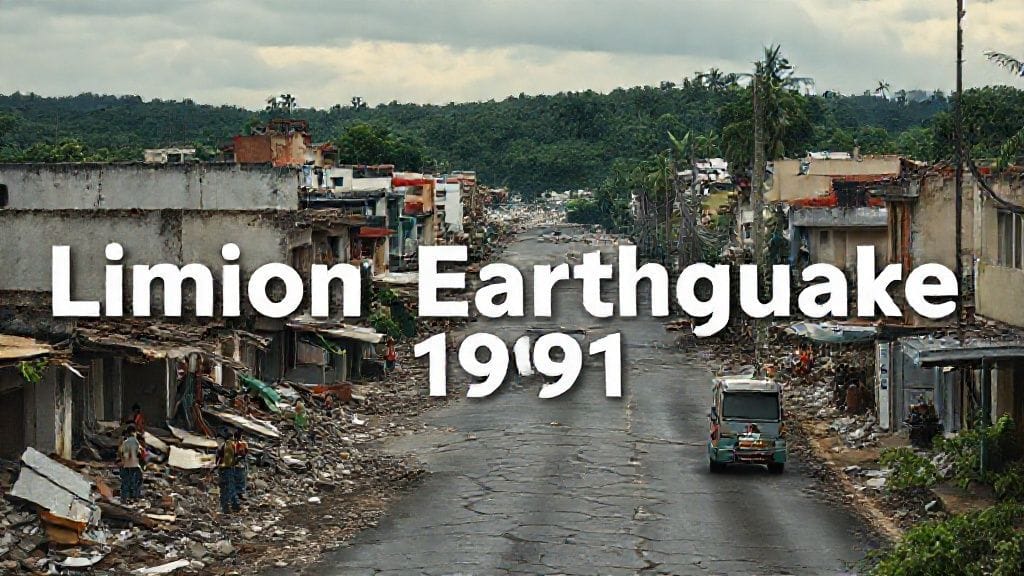
At precisely 9:57 PM local time, April 22, the earthquake struck, registering a magnitude of approximately 7.7 on the Richter scale. The epicenter lay just off the northern Caribbean coast, about 7 kilometers northeast of Limón. The intensity of shaking lasted nearly a minute, long enough to send people fleeing into the streets as buildings swayed perilously.
Within moments, panic rippled across Limón’s neighborhoods. The port’s vital infrastructure quivered violently, cranes and cargo containers toppling with thunderous crashes. Power lines sparked and fell, plunging the city into darkness. Communications faltered, uncertainty spreading alongside physical devastation.
Voices from the Rubble: Eyewitness Accounts and Personal Stories
Maria González, a textile worker, recounted that terrifying night: “I was at home when everything started shaking like never before. The walls cracked, my chair toppled, and I thought — this is it. I grabbed my children and ran outside. The streets were filled with dust, cries, and voices calling for help.”
Diego Martínez, a dockworker, described the chaos at the port: “I saw containers falling into the ocean, and the cranes swinging like trees in a hurricane. It was unbelievable. Some of my coworkers were trapped beneath the rubble.”
These stories remind us that amid the statistics and scientific data lies a shared human experience — the fear, resilience, and solidarity forged in moments of crisis.
Immediate Aftermath: Chaos and Courage in Limón
In the quake’s immediate wake, Limón was enveloped by darkness and confusion. Roads cracked, buildings collapsed. Emergency services scrambled to assess damage and tend to victims. Hospitals were quickly overwhelmed, and makeshift shelters sprang up in open spaces.
Yet the darkness also revealed an indomitable spirit — neighbors helping neighbors, volunteers joining rescue efforts, locals laying down resources to save lives. Despite the chaos, courage shone.
National Response: Mobilization Amid Disaster
Costa Rica’s government, under President Rafael Ángel Calderón Fournier, swiftly declared a state of emergency. Military units, the national police, and civil protection agencies mobilized to assist Limón. Resources were dispatched, but logistical challenges complicated relief efforts: damaged roads hindered access, communications remained spotty.
Funding was limited, and political pressure mounted as the nation grappled with the quake’s magnitude. The government faced criticism for not previously implementing more robust seismic preparedness measures, yet the immediate response reflected an earnest commitment to aid those affected.
International Aid and Solidarity: A Global Reaction
News of the earthquake resonated beyond Costa Rica’s borders. Neighboring countries and global relief organizations extended support. The United States, the United Nations, and NGOs sent financial aid, medical supplies, and expert teams specialized in disaster response.
This outpouring of international solidarity underscored how natural disasters transcend national boundaries, evoking a collective humanity.
The Science of the 1991 Limón Earthquake: Seismological Analysis
Seismologists analyzed the event intensively. The quake was classified as a megathrust earthquake due to the subduction zone activity offshore. The rupture zone extended over tens of kilometers, producing not only intense shaking but also significant tsunamigenic risk — although the tsunami generated was limited in scope.
The earthquake’s magnitude and depth provided critical data for refining seismic hazard models in Central America, catalyzing improvements in earthquake detection networks within Costa Rica.
Infrastructure Under Siege: Damage to Roads, Buildings, and Ports
The limelight’s economic lifeblood was hard hit. Key bridges along Highway 32, connecting Limón to the Central Valley, suffered structural damage, impairing logistical links for weeks. Residential buildings from colonial to modern styles crumbled or became uninhabitable, displacing thousands.
Limón’s port, essential for national exports like bananas and coffee, faced disruptions as cranes were rendered inoperable, warehouses damaged, and shipping schedules thrown into disarray.
The Human Toll: Lives Lost, Injuries, and Displacement
Despite disaster preparedness efforts, the quake claimed approximately 46 lives and injured hundreds more. Thousands were left homeless, abandoned or damaged dwellings rendered unsafe by aftershocks.
Public health emergencies loomed in the quake’s aftermath, with risks of water contamination and disease outbreak looming. Psychosocial trauma among survivors became a pressing concern, with community support networks vital to recovery.
Economic Shockwaves: How the Earthquake Disrupted Costa Rica’s Economy
Costa Rica’s economy, tied closely to Limón’s port activity, suffered short- and mid-term shocks. Export volumes temporarily declined, and repair costs strained the government’s budget.
Tourism in the Caribbean region also experienced downturns due to perceived safety risks. Yet the earthquake also catalyzed infrastructure improvements and investments that would benefit long-term economic resilience.
Rebuilding Limón: From Rubble to Resurrection
Recovery efforts extended over years. Reconstruction prioritized resilient architecture and infrastructure reinforced to withstand future seismic events.
International funds and expertise helped modernize Limón’s port and public services. Community-driven initiatives emphasized preserving cultural heritage while advancing urban planning.
Long-term Urban and Social Consequences
The earthquake transformed Limón beyond physical destruction. Migration patterns shifted, with some residents relocating to San José or abroad.
Social cohesion was tested yet ultimately strengthened as shared adversity fostered solidarity. Urban density regulations were revised, and informal settlements received increased attention to mitigate future risks.
Environmental Impact: Nature’s Fragility Revealed
The seismic event caused landslides and shoreline alterations, impacting local ecosystems. Wetlands and mangrove areas faced disruptions, affecting biodiversity and fisheries.
Recovery efforts incorporated environmental considerations, recognizing the intimate link between human and ecological health.
Cultural Memory and Commemoration in Costa Rica
The 1991 Limón Earthquake occupies a solemn place in Costa Rican collective memory. Annual commemorations recall the lives lost and celebrate resilience.
The event inspired works of art, literature, and public discourse, helping a nation process trauma and commemorate survival.
Lessons Learned: Disaster Preparedness and Policy Changes
Costa Rica enhanced its seismic monitoring networks, improved urban codes, and expanded community education on earthquake preparedness.
The quake acted as a catalyst, exposing gaps in disaster risk management that required urgent addressing.
A Catalyst for Change: How 1991 Reshaped Costa Rica’s Approach to Natural Hazards
Government agencies coordinated more closely. Civil defense structures gained funding and influence.
The earthquake’s lessons contributed to Costa Rica’s reputation today for progressive environmental and disaster policies.
Comparing the Limón Earthquake to Other Central American Quakes
While overshadowed internationally by quakes in neighboring countries, the 1991 event provided invaluable regional learning.
It contrasted with Pacific coast quakes by its Caribbean origin, adding nuance to seismic risk understanding in Central America.
Scientific Advances Post-1991: Enhancing Seismic Monitoring in Costa Rica
Post-quake scientific initiatives deployed new seismographs, GPS stations, and ocean-bottom sensors.
These advances have improved earthquake early-warning capabilities and public safety.
The Quake’s Place in Costa Rican History
The 1991 Limón Earthquake is remembered not only as a tragedy but as a turning point in national consciousness, urban development, and disaster management.
It marks a chapter of loss but also regeneration and hope.
Voices from the Present: Survivors Reflect Thirty Years Later
Survivors today speak of wounds both healed and open.
They recount how the quake altered their lives, their families, and the fabric of their city. Their stories continue to teach future generations.
Conclusion
The earthquake that shook Limón on that April night in 1991 remains a defining moment in Costa Rica’s history. It revealed the powerful, unseen forces that lie beneath a serene tropical façade and challenged a vibrant community to rise from destruction. But beyond physical damage and loss, the quake awakened a nation to the urgent need for resilience—of buildings, systems, and human hearts alike.
From the rubble, Limón’s spirit emerged stronger, its story speaking to the boundless human capacity to rebuild, remember, and renew. The earthquake left scars, certainly, but also lessons of solidarity and preparedness that continue to resonate across Costa Rica and beyond. It is a testament to the fragile dialogue between humanity and nature and the enduring will to withstand nature’s fiercest tests.
FAQs
1. What caused the 1991 Limón Earthquake in Costa Rica?
The earthquake was caused by the subduction of the Cocos Plate beneath the Caribbean Plate along a fault zone off the northern Caribbean coast, leading to a powerful release of seismic energy.
2. How strong was the earthquake, and how long did it last?
The quake had an estimated magnitude of 7.7 and shaking lasted nearly one minute, producing widespread damage in Limón and surrounding areas.
3. What were the immediate effects on Limón’s infrastructure?
Bridges, roads including Highway 32, residential and commercial buildings, and port equipment were heavily damaged, disrupting transportation and economic activities.
4. How did the Costa Rican government respond to the disaster?
The government declared a state of emergency, mobilized military and emergency services, and sought international aid to assist with rescue and reconstruction efforts.
5. Were there any significant long-term changes in disaster preparedness in Costa Rica following the earthquake?
Yes, the quake spurred improvements in seismic monitoring, urban planning for earthquake-resistant infrastructure, and enhanced public education on disaster response.
6. How many people were affected by the earthquake?
Approximately 46 people died, hundreds were injured, and thousands were displaced or faced homelessness due to damaged homes.
7. Did the earthquake trigger a tsunami?
While the quake had the potential to generate a tsunami, any waves produced were minimal and did not cause significant damage.
8. How is the 1991 Limón Earthquake remembered today in Costa Rica?
It is commemorated through annual memorials, cultural expressions, and continues to influence disaster risk management policies, remaining a poignant chapter in the nation’s history.