Table of Contents
- The Fateful Morning: Sicily Awakens to Disaster
- Beneath the Surface: Geological Origins of the Belice Earthquake
- A Region on Edge: Socioeconomic Realities of 1960s Sicily
- January 15, 1968: The Earth Trembles — First Shocks and Panic
- The Nighttime Ravages: Aftershocks Multiply the Horror
- Witnesses to Destruction: Voices from Belice Valley
- The Human Toll: Death, Injuries, and Displacement
- Emergency Response and Challenges in a Remote Landscape
- Italy’s Government Faces a Crisis: Political Debates and Bureaucracy
- Media Coverage and Public Awareness: The World Watches Sicily
- Reconstruction Efforts: Dreams, Delays, and Controversies
- Cultural Losses: Vanished Heritage and the Struggle to Remember
- The Earthquake’s Economic Impact on an Already Fragile Region
- Scientific Advances Sparked by Belice: Lessons in Seismology
- Long-Term Social Consequences: Migration and Community Disruption
- The Belice Earthquake in Italian Collective Memory
- Comparative Analysis: Belice in the Context of Global Seismic Disasters
- The Role of International Aid: Solidarity Across Borders
- Personal Stories of Survival: Rebuilding Lives Against All Odds
- Sicily Today: Echoes of the 1968 Earthquake in Modern Times
- Reflecting on Resilience: What Belice Teaches Us About Disaster
- Conclusion: The Enduring Shadow of Belice — A Testament to Human Spirit
- FAQs — Everything You Should Know About the 1968 Belice Earthquake
- External Resource
- Internal Link
On a cold January morning in 1968, the quiet valleys of western Sicily were brutally awakened—not by the usual cacophony of rural life but by a deep, terrifying rumble beneath their feet. The very earth betrayed them, rupturing with a force that shattered centuries of peace and countless homes. The Belice Earthquake, one of the most devastating tragedies in modern Italian history, swept through the region with a merciless grip, leaving in its wake a tableau of destruction and human suffering that would mark generations to come. This was not just a natural disaster; it was a crucible in which the resilience, failures, and hopes of communities and governments alike were fiercely tested.
Beneath the Surface: Geological Origins of the Belice Earthquake
Italy, perched precariously on the converging boundary of the African and Eurasian tectonic plates, is no stranger to seismic activity. Sicily, the largest island of the Mediterranean, sits atop a complex geological tapestry woven from centuries of tectonic stress and volcanic restlessness. The Belice Earthquake was rooted in this volatile underworld—a sudden release of strain along previously unknown fault lines in the Belice Valley, a fertile and largely rural area nestled between Palermo and Agrigento.
Geologists later confirmed the quake registered a magnitude between 6.1 and 6.4, with the epicenter located near the towns of Gibellina, Montevago, and Salaparuta. The earthquake’s relatively shallow depth amplified its destructive energy, making it particularly catastrophic for the fragile masonry structures that dotted the landscape.
A Region on Edge: Socioeconomic Realities of 1960s Sicily
In 1968, Sicily represented one of the poorest and most underdeveloped regions of Italy. The post-war economic boom that had transformed the industrial north scarcely touched these rural communities, where dependency on agriculture was total and infrastructure minimal. Traditional ways of life coexisted precariously with slow modernization. Roads were few, communication limited, and public services stretched thin. This socioeconomic reality not only rendered the population vulnerable but also complicated emergency response efforts once the earth began its deadly dance.
January 15, 1968: The Earth Trembles — First Shocks and Panic
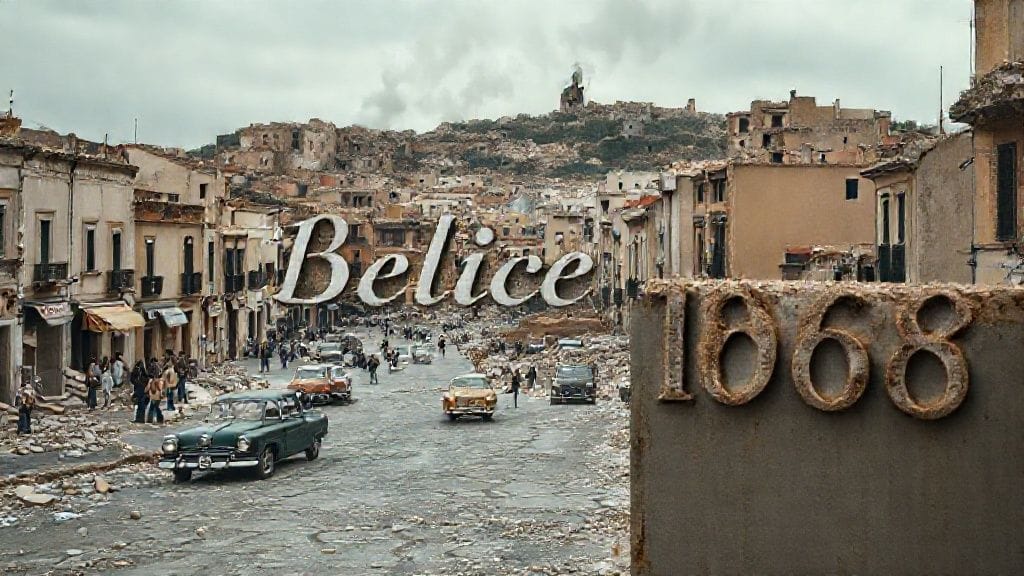
It was around 3:00 AM when the first violent tremor awakened the inhabitants of the Belice Valley. The earth shifted beneath them like a living beast, houses groaned and cracked, and terracotta roofs cascaded like broken waves. Panic took hold quickly as families fled into cold streets, many barefoot and in nightclothes.
The small towns—Gibellina, Montevago, Poggioreale, and Salaparuta—experienced near-total collapse. Buildings dating back centuries, monuments, churches, and homes turned to rubble within moments. The initial shock was only a prologue to what would become a relentless sequence of aftershocks.
The Nighttime Ravages: Aftershocks Multiply the Horror
As the night unfolded, a harrowing symphony of aftershocks continued to rattle the region. Each tremor brought renewed destruction, hampering rescue efforts and plunging survivors into cycles of fear and exhaustion. Makeshift shelters were scarce, and the bitter winter only deepened the misery.
Witnesses spoke of a landscape transformed—roads cracked open, hillsides shifted, and entire neighborhoods vanished without a trace. It was as though the earth itself had rewritten the geography overnight.
Witnesses to Destruction: Voices from Belice Valley
Amid the chaos, testimonies emerged—harrowing accounts that humanized the tragedy. An elderly woman in Montevago recalled clutching her grandchildren as their home crumbled, only to escape into the cold night. A young schoolteacher from Gibellina recounted how the local church, a sanctuary for generations, was utterly destroyed with no warning.
These voices remind us that the earthquake was not just a geological event but a human catastrophe marked by loss, resilience, and community bonds tested to their limits.
The Human Toll: Death, Injuries, and Displacement
Official records estimate the death toll between 370 and 400, but some accounts suggest the number was higher due to the difficulty in registering casualties in such isolated areas. Thousands were seriously injured, and nearly 70,000 people were left homeless.
Displacement was massive and traumatic. Entire towns were evacuated, and survivors faced the grim reality of living in tents or overcrowded shelters amid harsh winter conditions, grappling with loss and uncertainty.
Emergency Response and Challenges in a Remote Landscape
Despite the scale of destruction, emergency response was painfully slow. The rugged terrain and underdeveloped infrastructure delayed the arrival of rescue teams and medical personnel. The Italian Civil Protection Department faced logistical nightmares, from delivering supplies to coordinating aid.
Moreover, communication with the affected areas was crippled, leaving many communities isolated during the critical first hours after the quake.
Italy’s Government Faces a Crisis: Political Debates and Bureaucracy
The Belice earthquake exposed glaring weaknesses not only in infrastructure but also in governmental preparedness and responsiveness. Pressed by public outcry, Rome dispatched military and civilian rescue units, but bureaucratic inertia and political infighting hampered efficient relief.
Opposition parties and local leaders criticized the central government for neglect and slow intervention, highlighting longstanding tensions between Sicily and the Italian state—a divide rooted in issues of autonomy and neglect.
Media Coverage and Public Awareness: The World Watches Sicily
For the first time, television broadcast the raw images of devastation to a national audience. Italian newspapers devoted front pages to the disaster, and international media began to pick up the story, putting an unfamiliar spotlight on the region.
This surge in media coverage galvanized public sympathy and contributed to the mobilization of aid, both domestically and internationally. Yet, it also laid bare the disparities between the north and south of Italy in terms of development and public attention.
Reconstruction Efforts: Dreams, Delays, and Controversies
Post-earthquake reconstruction became a prolonged saga. The government proposed ambitious plans to rebuild towns on safer grounds, but bureaucratic hurdles, funding shortages, and corruption scandals plagued the process.
Some villages, like Gibellina, were relocated entirely, and renowned artists and architects were invited to create new urban landscapes, turning tragedy into an opportunity for cultural reinvention. Others languished in ruins for years, the scars palpable decades later.
Cultural Losses: Vanished Heritage and the Struggle to Remember
The destruction extended beyond bricks and stone; centuries-old churches, artworks, and historical monuments were reduced to rubble. The loss of tangible heritage struck a deep cultural wound, severing connections to local identity and history.
Efforts to document and preserve memories emerged, but many lament that the earthquake's cultural losses remain underappreciated on broader national and international levels.
The Earthquake’s Economic Impact on an Already Fragile Region
Sicily’s economy, heavily reliant on agriculture, suffered severely. Irrigation systems, olive groves, and vineyards were damaged, compromising livelihoods. The scarcity of jobs triggered waves of internal migration, as many survivors left for northern industrial cities in search of work.
These shifts altered the social fabric of the region, accelerating trends that would redefine Sicily’s demographic landscape for decades.
Scientific Advances Sparked by Belice: Lessons in Seismology
The Belice earthquake catalyzed important seismic research in Italy. Scientists revisited fault mapping and promoted improved building codes, especially for rural regions previously overlooked. It became a case study emphasizing the need for preparedness in moderate-magnitude but high-impact quakes.
Over time, advances in seismology and engineering took inspiration from this event to better mitigate future disasters.
Long-Term Social Consequences: Migration and Community Disruption
The earthquake fractured communities as many survivors found themselves forced to abandon ancestral homes. Families dispersed across Italy or emigrated abroad, particularly to North America and Australia, seeking stability and opportunity.
This diaspora diluted traditional social networks but also contributed to Sicily’s global cultural presence.
The Belice Earthquake in Italian Collective Memory
Despite its scale, the Belice earthquake occupies a complex place in Italian memory—often overshadowed by other calamities like the 1908 Messina earthquake. However, among survivors and Sicilians, it remains a poignant chapter signifying loss and endurance.
Commemorations, museums, and literature keep its memory alive, reminding Italians of nature’s unpredictability and society’s responsibilities.
Comparative Analysis: Belice in the Context of Global Seismic Disasters
When compared with other major earthquakes worldwide, Belice stands out for its impact on underdeveloped regions within a developed country context. It is often cited as an example of how socioeconomic factors exacerbate the consequences of natural disasters.
This perspective informs disaster studies and international humanitarian approaches.
The Role of International Aid: Solidarity Across Borders
The international response, though limited compared to other disasters, included offers of medical teams and financial assistance. UNESCO and non-governmental organizations helped raise awareness of the region’s plight.
This solidarity emphasized the universal nature of disaster suffering and the interconnectedness of humanitarian efforts.
Personal Stories of Survival: Rebuilding Lives Against All Odds
Amid the ruins, stories of hope emerge—families reunited, towns rebuilt with modern designs, and new generations born carrying the legacy of survival. A carpenter who lost his workshop rebuilt it piece by piece, while a young woman who studied social work dedicated her life to community recovery.
These narratives underscore human resilience—the quiet courage that emerges amid catastrophe.
Sicily Today: Echoes of the 1968 Earthquake in Modern Times
Today, Sicily bears visible and invisible scars from the Belice earthquake. Some towns preserve ruins as memorials; others thrive in their new incarnations. Residents remain acutely aware of seismic risks, living in a land where history and nature intertwine endlessly.
Modern Sicily also embodies lessons in disaster preparedness born from past tragedy.
Reflecting on Resilience: What Belice Teaches Us About Disaster
The Belice earthquake teaches harsh but vital truths: nature strikes without warning, but human preparedness, solidarity, and adaptability can shape the aftermath. It exposes vulnerabilities but highlights enduring strengths—local knowledge, cultural identity, and the indomitable spirit of communities tied to their land.
It is a solemn reminder—and an inspiration.
Conclusion
The Belice earthquake of January 1968 was more than a seismic event—it was a crucible of human endurance amid unimaginable loss. It exposed systemic societal fragilities, galvanized scientific progress, and reshaped Sicilian society. The ruins and memories it left behind are a testament not only to destruction but to resilience.
In the cold light of history, Belice challenges us to honor the past, to build sustainably, and to never underestimate the enduring power of community in the face of nature’s fury. This tragedy, etched deeply into Italy’s heart, remains a solemn chapter reminding us of our shared vulnerability—and strength.
FAQs
1. What caused the Belice earthquake in Sicily in 1968?
The earthquake was triggered by tectonic movements along fault lines in the Belice Valley, related to the complex convergence of the African and Eurasian plates beneath Sicily.
2. How severe was the damage caused by the Belice earthquake?
The quake caused near-total destruction to several towns, killed around 370–400 people, injured thousands, and left over 70,000 homeless, with widespread damage to infrastructure and cultural sites.
3. How did the Italian government respond to the disaster?
The government mobilized military and civilian rescue teams but faced criticism for delayed response, bureaucratic inefficiencies, and political infighting that hindered effective aid distribution.
4. What were the social consequences of the earthquake on Sicily?
The disaster prompted massive displacement, triggering migration within Italy and abroad, altering community structures and demographics in affected areas.
5. How did the earthquake influence seismic research and building regulations?
Belice highlighted the need for improved seismic mapping and construction standards, especially in rural areas, influencing subsequent scientific studies and policy reforms in Italy.
6. Why is the Belice earthquake less well-known than other Italian earthquakes?
While devastating, it affected a relatively poor and isolated region, and its memory has often been overshadowed by more catastrophic events like the Messina earthquake of 1908.
7. What cultural heritage was lost during the Belice earthquake?
Hundreds of historic buildings, churches, artworks, and monuments from centuries of Sicilian history were destroyed, creating lasting cultural wounds.
8. Are there any memorials or commemorations dedicated to the earthquake?
Yes, several towns maintain memorials, and cultural projects, including museums and artistic initiatives, have been undertaken to preserve the memory and lessons of the earthquake.