Table of Contents
- A Summer Morning in Constantinople: The Day an Old Soldier Became Emperor
- An Empire in the Shadow of Anastasius: Crises Before the Turning Point
- From Thracian Peasant to Palace Guard: The Early Life of Justin
- The Death of Anastasius and the Vacuum of Power
- The Night of Intrigue: How the Palace Guards Chose an Emperor
- The Crowd, the Circus, and the Church: Public Acclamation in the Hippodrome
- Oil, Diadem, and Proclamation: The Formal Accession of Justin I
- Justin and Justinian: An Uncle’s Crown and a Nephew’s Ambition
- Faith and Policy: Religious Settlements Under the New Emperor
- Governing an Empire He Could Not Read: Ministers, Bureaucrats, and Power
- At the Frontiers of Byzantium: Wars, Treaties, and the Persian Threat
- Streets, Markets, and Taverns: How Ordinary People Lived Justin’s Reign
- Whispers in the Palace: Succession Plots and the Rise of Justinian
- The Old Emperor’s Final Years: Frailty, Piety, and the Weight of Office
- From Humble Soldier to Architect of an Age: Historical Judgments on Justin I
- Legacy in Stone and Parchment: How Later Generations Remembered Justin
- Conclusion
- FAQs
- External Resource
- Internal Link
Article Summary: On 9 July 518, in the swirling heat of a Constantinopolitan summer, an aging peasant-turned-soldier named Justin was lifted onto a shield and hailed as emperor, in what history remembers as the accession of Justin I. This article follows that unlikely ascent from the dusty fields of Thrace to the glittering, incense-laden halls of the Great Palace. It examines the political uncertainty that followed the death of Emperor Anastasius, and how the accession of Justin I reshaped imperial politics, religious policy, and dynastic fortunes. We explore the delicate balance between street crowds, palace guards, bishops, and bureaucrats that made his election possible. The narrative then tracks how this illiterate veteran relied on sharper minds—above all his nephew Justinian—to govern a fractious empire. Throughout, we dwell on the human emotions of fear, hope, ambition, and piety that colored every decision in those pivotal years. By the end, the accession of Justin I appears not as an isolated event but as the hinge on which the so‑called “Age of Justinian” would swing into motion. Seen through the eyes of both chroniclers and modern historians, his reign reveals how a single July morning in Constantinople quietly redirected the course of Byzantine and Mediterranean history.
A Summer Morning in Constantinople: The Day an Old Soldier Became Emperor
The dawn of 9 July 518 rose over Constantinople in a haze of dust, incense, and rumor. The city’s thousand windows caught the first pink light as the Bosporus shimmered below the heights of the imperial capital. Fishermen were already hauling in their nets near the harbors of the Golden Horn, and bakers were pulling flat loaves from their ovens in the crowded streets of the Augusteion. Yet in the Great Palace, the air was heavier, stiller, as if the marble corridors themselves were holding their breath. In a city that prided itself on ceremony and continuity, the throne of the Roman Empire was suddenly, perilously empty.
Only days before, Emperor Anastasius I, a cautious and parsimonious ruler, had died without a clear heir. The city buzzed with speculation. Senators whispered in porticoes; bishops muttered prayers mingled with political calculations; palace guards weighed the value of loyalty against opportunity. On that charged morning, the accession of Justin I was not yet inevitable; it was almost unthinkable. He was a man of advanced age, of obscure birth, known more for his sturdy arms and scarred face than for any trace of learning or refinement. He could barely sign his own name. And yet, by the end of the day, he would be emperor of the Romans, ultimate master of the imperial lands stretching from the walls of Carthage to the rugged passes of the Caucasus.
The story of the accession of Justin I is, on its surface, a tale of a miraculous rise: a peasant recruited into the army, hardened by decades of campaigning, ending his life clad in purple robes. But beneath the surface it is something else entirely: a story of institutional improvisation, religious conflict, dynastic design, and the power of spectacle in the late Roman world. To understand how this July day unfolded, one must step back into a world haunted by theological schisms, budgetary stresses, and military threats at the frontier—a world where the empire’s survival was not guaranteed, and where the choice of one man could bend the trajectory of centuries.
Eyewitnesses did not leave detailed hour-by-hour accounts of that morning in the palace, yet later chroniclers and historians have preserved enough fragments to reconstruct a vivid narrative. They tell us that the imperial bodyguard, the excubitors, gathered in the heart of the palace complex, their armor catching the light, their voices echoing under painted ceilings. Among them stood their commander, an old Thracian veteran named Justin. He had risen through the ranks by sheer endurance and battlefield courage, not by pedigree. As the army and court searched for a successor willing and able to shoulder the purple, the accession of Justin I would emerge from a mixture of hesitation, calculation, and a kind of desperate consensus. It is astonishing, isn’t it, that the fate of an empire might turn, at such a moment, on the instincts of a few anxious men in a guarded hall?
But this was only the beginning. The accession of Justin I in Constantinople did not merely fill a vacancy; it lit the fuse of a new era. The man who would be crowned that day did not come alone: behind him, almost in his shadow, walked his ambitious, razor‑intelligent nephew, Justinian. Between them, uncle and nephew would redirect the religious policies of the empire, reshape relations with Persia, and lay the ground for the campaigns that would later reclaim North Africa and Italy. In the narrow streets outside the palace, however, the common people knew nothing of these looming transformations. For them, the day’s drama was simpler: who would feed the city, keep the peace, and, above all, please God?
An Empire in the Shadow of Anastasius: Crises Before the Turning Point
To grasp why the accession of Justin I mattered so profoundly, we must linger for a moment in the shadow of his predecessor. Anastasius I, who ruled from 491 to 518, had presided over a complex, often uneasy peace. An efficient administrator, he had left the imperial treasury swollen with reserves—some ancient sources speak of millions of solidi, a staggering hoard of gold. This fiscal prudence, however, came at a political cost. Anastasius was widely suspected of favoring Monophysite theology, a Christological position that alarmed many in the more rigidly Chalcedonian faction. This tension had already exploded once into open revolt: the Isaurian War in the early years of Anastasius’s reign, and later the bloody uprising of the general Vitalian, who cloaked his rebellion in the language of religious orthodoxy.
Constantinople itself was not immune to the ripples of religious and political strain. In the taverns near the Forum of Constantine, men argued heatedly about the nature of Christ while casting nervous glances at imperial informers. Blue and Green circus factions, which were ostensibly racing teams, often became lightning rods for deeper loyalties and resentments. Senators of impeccable classical lineage resented the stretching authority of imperial bureaucrats, many of whom were provincial upstarts or former civil servants promoted for loyalty more than talent. It was a city of simmering tensions, masked by marble and ritual.
Beyond the walls, the empire’s position looked, at first glance, strong. The eastern frontier with the Sasanian Persians had seen moments of strain but no catastrophic war in Anastasius’s later years. A line of fortifications, including the massive fortress at Dara, had begun to redefine the balance of power in the region. In the Balkans, persistent raids by Slavic and other tribes were a chronic nuisance rather than an existential threat. The empire’s coinage was stable; trade still flowed through the Aegean and the eastern Mediterranean. Yet this facade of stability hid a central fragility: there was no accepted, undisputed successor to Anastasius.
He had no surviving sons. His nephews were numerous enough, but none commanded the mixture of military and political support required to inherit the throne without challenge. The court had spent years circling around potential heirs, including Anastasius’s own kinsmen and the powerful rebel Vitalian, who, astonishingly, had been reconciled and invited to Constantinople in 515. Rumor had it he was still a favorite candidate in some circles on the very eve of Anastasius’s death. At such a moment, the accession of Justin I would seem almost absurdly unlikely. He was not counted among the imperial relatives; he was not yet the figure around whom either religious party or aristocratic clan rallied. He was, in the blunt assessment of later writers, a “rustic” in the palace.
Yet behind the celebrations that would later frame Justin’s rise lay a stark reality: the Roman Empire of the early sixth century could not easily weather a long vacuum at the top. The machinery of tax collection, military logistics, and legal adjudication required an acknowledged emperor. Tribes on the Danube watched Constantinople carefully for signs of weakness. Envoys in the Sasanian court sent home notes heavy with subtext, weighing whether the time had come to press for concessions. Each day without an emperor multiplied the chances of a coup, a civil war, or a foreign invasion. In such a climate, the accession of Justin I, for all its improbabilities, answered a desperate need: it offered a name, a body, a face to which the empire’s fractured energies might attach themselves.
From Thracian Peasant to Palace Guard: The Early Life of Justin
Justin’s story begins far from the marble colonnades of Constantinople. He was born, according to later tradition, in the rugged hills of Dardania or Thrace—regions corresponding roughly to modern North Macedonia or Bulgaria. His family were peasants, bound to the soil and the caprices of weather and tax collector alike. There was no library in his village, no rhetorician to train his tongue. The tools of his youth were the plow, the sickle, and the hoe. Hunger and cold were teachers as harsh as any drillmaster.
Sometime in his early adulthood, around the later years of the fifth century, Justin, like many young men from the Balkans, was recruited into the imperial army. Sources speak of him trudging, almost barefoot, to Constantinople with a small group of kinsmen, carrying little more than a sack of bread and a head full of half‑formed hopes. The empire needed soldiers—especially sturdy, loyal, provincial men who could be molded into defenders of the throne. Justin was precisely the sort of recruit the army craved: physically resilient, unencumbered by aristocratic pride, and desperate for advancement.
His early campaigns are only dimly recorded, but we can imagine the pattern familiar to many late Roman soldiers. He would have served in frontier garrisons, perhaps in the Balkans or along the eastern frontier, enduring long marches, rough barracks, and the constant threat of disease and skirmish. When the wind howled through the wooden palisades of a frontier fort, Constantinople must have seemed impossibly distant, almost mythical. Yet every year of service brought him pay, connections, and the attention of superiors. He survived—no small achievement in an age when sword wounds and infections could end a life overnight.
His rise within the army appears to have been steady rather than spectacular. By middle age he commanded respect from his men and sufficient trust from his superiors to be summoned to the imperial capital as a member of the elite guard unit known as the excubitors. This was not merely a ceremonial post. The excubitors guarded the emperor in person and patrolled the most sensitive spaces of the palace. To be promoted into their ranks was a mark of both reliability and proximity to power. It brought Justin into daily contact with the choreography of rule—processions, councils, receptions of foreign envoys. For the first time, he could watch emperors at close range, study how they walked, how they spoke, how they wielded authority.
Yet even here Justin remained, in many ways, an outsider. He was illiterate, unable to read the law codes or theological treatises that animated debate among the educated elites of the city. Orders and letters had to be read aloud to him. He signed with a clumsy mark. But he possessed other talents: a memory honed by years of oral instruction, an instinctive sense of discipline, and a rugged, straightforward piety. He frequented churches; he made gifts to monasteries when he could. The priests and monks who came to know him may well have seen in him a kind of ideal lay believer—simple, obedient, reverent.
As decades passed, the peasant recruit grew into a seasoned officer, then into the very commander of the excubitors. It was a position that combined military command with direct access to the emperor and his bedchamber. The accession of Justin I in 518 would later be explained, in part, by his control of this formidable unit. Yet this explanation alone is too simple. Many commanders before him had failed to turn their proximity to the throne into a crown of their own. What Justin had, in addition to command, was an unthreatening persona. He was old; he had no children; he did not possess a powerful faction of noble relatives. He seemed a safer choice to many anxious eyes—a stopgap, perhaps, behind whom cleverer, younger men might effectively rule.
The Death of Anastasius and the Vacuum of Power
The trigger for Justin’s rise came, abruptly, with the death of Anastasius I on the night of 8–9 July 518. The emperor was in his eighties, and age had begun to weigh heavily on him. According to later accounts, he had gone to bed in apparent health and died suddenly in his sleep, perhaps of a stroke or heart failure. The news spread through the palace corridors in hushed waves. First the chamberlains, then the household eunuchs, then the excubitors were informed. Outside the palace walls, the city still slept, ignorant of the imperial bed now occupied only by a corpse and the soft murmur of prayers.
There were formal procedures for such moments. The body had to be prepared; the patriarch of Constantinople had to be notified; the Senate would have to be summoned. Yet behind this liturgy of transition lurked a more urgent, less orderly question: who would wear the purple next? Names began to circulate almost immediately. Anastasius had three nephews—Hypatius, Pompeius, and Probus—who might plausibly lay claim to the throne. Each had a circle of supporters, a cluster of allies in the bureaucracy and among the aristocracy. But none commanded the unquestioned support of the army, nor did they present a clear religious stance that could reassure the powerful Chalcedonian faction.
Vitalian, the once‑rebellious general whose forces had marched menacingly close to Constantinople only a few years earlier, remained a terrifying possibility. Though recently reconciled with Anastasius, he was still a symbol of armed dissent. Some thought he might march again, this time not to pressure an emperor but to claim the purple outright. Others feared that any move in his favor would trigger another civil war. Foreign observers, too, must have watched with interest. The Sasanian shah Kavadh I, ruling in Ctesiphon, surely received the news with a careful, calculating gaze. An empire without a strong emperor was an opportunity.
Within the Great Palace, attention fixed quickly on those who controlled the levers of immediate force: the guards. The excubitors, with Justin at their head, were poised at the key junction between the bedchamber and the throne room. Without their cooperation, no candidate could be safely proclaimed. At the same time, their very power made some courtiers nervous. Would these soldiers, mostly provincials, seek to impose one of their own upon the throne? Or would they allow a senatorial or imperial‑kin candidate to emerge?
The hours following Anastasius’s death were drenched in uncertainty. The patriarch and leading bishops worried that a Monophysite‑leaning ruler might continue or intensify theological policies that had already divided the empire. Senators feared that a ruler overly favored by the army might crush their privileges. Courtiers calculated how best to preserve their positions and fortunes. As historian J. B. Bury would later summarize with stark simplicity, “The accession of Justin I was the outcome of a military election in the barracks of the palace,” but that phrase compresses into one sentence a storm of fear, debate, and frantic maneuvering.
The Night of Intrigue: How the Palace Guards Chose an Emperor
As the first light crept across the palace roofs, the excubitors were summoned to conference. These were men who had marched under banners, not under philosophical slogans; yet in that moment they found themselves as kingmakers. The accession of Justin I would be their most dramatic act, but it emerged from a series of unsure steps and partially remembered conversations. Later chroniclers speak of money changing hands—bribes, gifts, urgent “loans”—offered by those who dreamed of the purple. Some candidates or their envoys tried to win over key officers; others attempted to appeal to the collective body of guards.
Justin, old and weathered, was not immediately the favorite. He lacked the sheen of aristocratic polish that many senators preferred, and he did not command distant armies the way Vitalian did. What he did have, however, was control of the barracks at that critical hour. As commander, he could influence who entered or left the precincts, whose voice was heard, whose name could be floated without fear of immediate reprisal. Some sources imply that he allowed himself to be nominated reluctantly, as though pushed forward by circumstances he had not quite sought. Whether this reluctance was genuine or later pious fiction remains unclear.
One vivid anecdote, recorded in later Byzantine tradition, tells of a moment when the guards, having rejected various more obviously ambitious candidates, turned as one to Justin and lifted him up upon a shield. This ancient Germanic and imperial gesture, as old as the days of the Roman legions on the Rhine, signaled an almost visceral acclamation. The heavy weight of the aging soldier on their shoulders was more than symbolic; it was physical proof that they were ready to bear him as emperor. As they held him aloft, voices rang out, calling him Augustus, invoking Christ and the saints as witnesses.
Money certainly played a role in securing the final consensus. A chest of gold, drawn from Anastasius’s well‑stocked treasury, was reportedly used to reward the guards and key supporters. Election by acclamation was rarely, if ever, entirely free of material inducement. Yet to reduce the accession of Justin I merely to bribery is to miss the deeper currents at play. For many of the guards, he embodied a kind of rough justice. He was one of them, in origin and career, and his piety was uncomplicated. He promised, or seemed to promise, to protect the orthodoxy of the Council of Chalcedon, which had become a rallying point for many in the army dismayed by Anastasius’s perceived theological experiments.
Outside the inner circles of the barracks, not everyone greeted his emergence as candidate with enthusiasm. Certain senators and relatives of Anastasius reportedly sulked or plotted, contemplating whether the day might yet be reversed by some sudden strike of fortune. But the logic of events moved quickly. Once the excubitors had settled upon Justin, hesitation became dangerous. To oppose a man backed by the guards was to risk immediate arrest or worse. For some, reluctant acceptance became the only sensible path. For others, the realization dawned that this old soldier might prove the perfect figurehead for their own ambitions. Among those who thought this way was almost certainly his nephew Justinian.
The Crowd, the Circus, and the Church: Public Acclamation in the Hippodrome
No accession in Constantinople was complete without the voice of the people—or at least, of a crowd that could convincingly be presented as the voice of the people. After the initial decision in the palace, attention turned to the Hippodrome, that vast U‑shaped arena where chariot races, imperial ceremonies, and political theater collided. Thousands could gather there, packed onto stone benches, watching the emperor in his kathisma box, a balcony that opened directly from the Great Palace. From that box, an emperor could wave to his subjects; from those benches, the Blues and Greens could shout acclamations, petitions, or veiled threats.
On 9 July 518, messengers and heralds were dispatched to rally citizens to the Hippodrome. The news spread rapidly: the emperor was dead; a new one was to be proclaimed. Shopkeepers closed their shutters, and workers abandoned their tasks to jostle toward the arena. In the churches, priests whispered hurried blessings and, in some cases, discreet instructions to their congregants about which slogans to shout. The accession of Justin I would be played out not just in gilded halls but before the rough‑voiced masses.
When Justin appeared in the imperial box, flanked by officers and courtiers, the scene must have been electric. He wore, perhaps for the first time, the purple cloak of the emperor, though not yet the full regalia that a formal coronation would provide. The patriarch and senior clergy, having been hastily summoned, stood nearby, their presence lending sacred weight to the unfolding ritual. The crowd, seeing this constellation of power, erupted in shouts. Some cried “Justin Augustus, God‑crowned!”; others demanded assurances that he would uphold the Chalcedonian faith. Acclamations in Constantinople were never entirely spontaneous; they were choreographed, encouraged by officials who knew what phrases the new regime wished to hear.
Yet behind the orchestrated excitement lay genuine emotion. For the average citizen, the accession of Justin I meant, above all, continuity. The empire would not fragment; the grain doles would not cease; the feared chaos of an open succession struggle had, for the moment, been averted. The Hippodrome crowd, swirling with colors, banners, and dust, became the living seal on the decision made in the guarded rooms of the palace. Here the emperor could see his subjects, and they could see him—a moment of mutual recognition that bound ruler and ruled in a fragile yet powerful contract.
The church, too, played its part. After the acclamations in the Hippodrome, Justin processed—whether that very day or soon thereafter—to one of the great churches of the city, likely Hagia Sophia or the Church of the Holy Apostles. There, amid clouds of incense and the chanting of psalms, he received religious blessing for his new role. The patriarch’s hand on his head, the anointing with holy oil, and the prayers for wisdom and justice transformed a military election into something more numinous. The accession of Justin I thus unfolded across three stages: the barracks, the Hippodrome, and the church. Together, they created a layered legitimacy, appealing in turn to soldiers, citizens, and God.
Oil, Diadem, and Proclamation: The Formal Accession of Justin I
Ritual mattered intensely in the sixth‑century Roman Empire. Empire itself was a kind of theater, and the accession of Justin I was staged with all the care that centuries of tradition prescribed. Once chosen by the guards and acclaimed by the people, he needed to be crowned in a manner that linked him to the long line of emperors stretching back to Constantine and, symbolically, to Augustus himself.
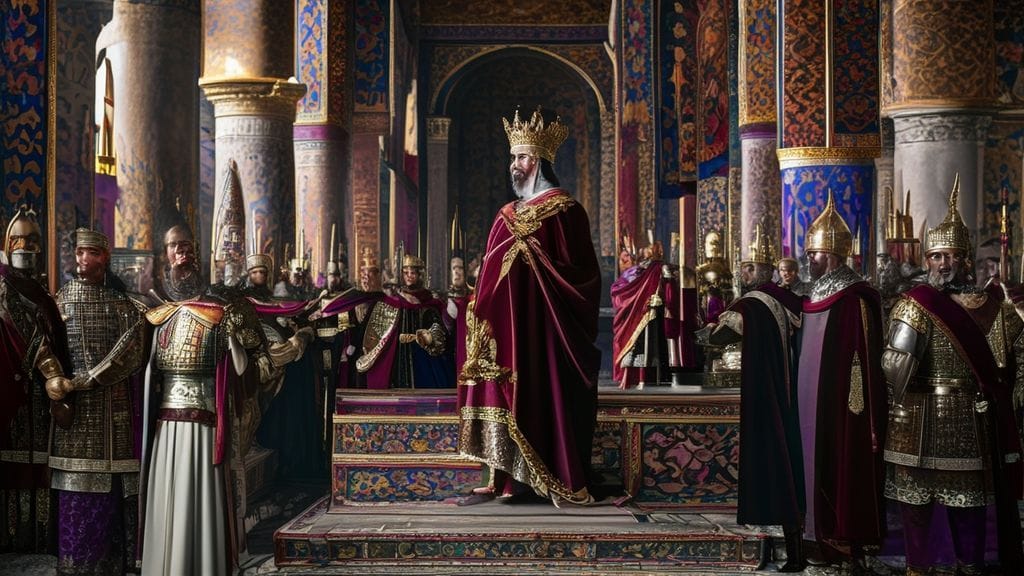
In the throne room of the Great Palace, beneath glittering mosaics and hovering chandeliers of gold and glass, Justin was led to the imperial seat. The diadem, a jeweled band signifying sovereignty, was brought forth. Whether placed on his head by the patriarch or by a high palace official (accounts vary), the gesture was unmistakable: a peasant’s brow now bore the symbol of supreme authority. Courtiers prostrated themselves; military officers saluted; senators, some barely able to hide their amazement, bowed deeply. Formal proclamations were drafted, announcing to the cities and provinces of the empire that Justin, chosen by God and people, now reigned.
Messengers fanned out from Constantinople like spokes from a wheel. To Antioch and Alexandria, to Carthage and Thessalonica, they carried scrolls bearing news of the accession. Governors and bishops would read these aloud in public assemblies, prompting local celebrations and prayers. In some cities, statues of Anastasius would be removed or relocated; in others, images of Justin would begin to appear, first crudely, then with increasing refinement. Coins, those tiny ambassadors of imperial power, would soon bear his name and likeness, spreading his face into every market and village where money changed hands.
Yet even amid the grandeur, there were moments of quiet vulnerability. Justin was old. When he stood in full regalia, weighted down by robes and diadem, his shoulders stooped slightly. He knew that he had never studied law, rhetoric, or theology. The men bowing before him—senators, jurists, bishops—commanded libraries of knowledge to which he had no direct access. It is not hard to imagine a flicker of doubt passing through his mind: could he truly rule such a sprawling, complex state?
He did not have to rule alone. Formally, he was now emperor; practically, he would need advisers, scribes, generals, and diplomats to enact his will. Prominent among these would be his nephew Justinian, already a rising star in the administration. But this distribution of tasks did not diminish the symbolic weight of the accession of Justin I. When an envoy from a distant tribe or kingdom arrived in Constantinople, it was Justin whom he would greet as “Emperor of the Romans.” When prayers were offered in church for “our pious and Christ‑loving emperor,” it was Justin’s name that filled the silence. The man who once trudged to the city with bread in his bag now sat at the apex of a world.
Justin and Justinian: An Uncle’s Crown and a Nephew’s Ambition
Behind the throne of Justin, almost from the first day, moved the figure who would one day overshadow him: his nephew Justinian. Born in the same rough Balkan world as his uncle, Justinian had been brought to Constantinople as a youth when Justin’s fortunes began to rise. Unlike his uncle, he received an education, studying law, theology, and the intricacies of court procedure. Where Justin’s hands bore the calluses of long soldiering, Justinian’s fingers gradually learned to trace the lines of legal codices and theological commentaries.
The accession of Justin I opened a huge space for Justinian’s ambitions. He understood, perhaps better than anyone, the limits of his uncle’s capacity. Justin could inspire loyalty; he could personify the soldier‑emperor ideal; but he could not himself draft intricate legal reforms or steer complex theological negotiations. Justinian stepped into this gap with energy and subtlety. He became, in effect, the empire’s chief strategist and administrator, even before he was formally designated as successor.
Contemporary sources, such as the chronicler John Malalas and later Procopius, hint at Justinian’s growing influence in the years following 518. He began to appear in official ceremonies; he participated in diplomatic missions; he was involved in the selection of key bishops and officials. Some decisions formally issued in Justin’s name likely originated from Justinian’s desk. The accession of Justin I thus served as the prelude to a remarkable political duet: an older emperor whose legitimacy stabilized the regime, and a younger statesman whose intellect and ambition pointed toward future expansion.
Their relationship, though, was more than a cold arrangement of convenience. Family ties mattered in the late Roman world, and by all accounts Justin was genuinely fond of his nephew. He had, after all, plucked him from obscurity and brought him into the heart of the empire. Justinian, in turn, showed a measure of filial piety, carefully presenting himself as the loyal helper rather than impatient heir. But beneath the surface of affection lay a hard political calculus. Justinian’s rise meant that other potential successors—including Anastasius’s nephews—were gradually sidelined, exiled, or neutralized. The accession of Justin I had not only brought a new emperor to the throne; it had shifted the entire axis of dynastic power from the house of Anastasius to a new family of Thracian peasants made good.
This transformation would have enormous consequences. Policies initiated under Justin, often shaped by Justinian, would later be credited to Justinian alone once he himself became emperor. The famous reconquests of the West, the grand building projects in Constantinople, the codification of Roman law—all these lay in the future. Yet their possibility was born in 518, when the empire accepted, perhaps with some surprise, that power could flow not merely along old aristocratic lines but also upward from the humblest of origins.
Faith and Policy: Religious Settlements Under the New Emperor
Religion was the fault line that could crack an empire apart in the sixth century. The bitter disputes over the nature of Christ—the Chalcedonian formula of two natures versus various Monophysite positions emphasizing Christ’s single, divine nature—had riven churches and communities for decades. Anastasius’s perceived tilt toward Monophysitism had alienated many in the capital and the West, contributing to uprisings and political instability. For many bishops and believers, the accession of Justin I offered a precious chance to recalibrate the empire’s religious compass.
Justin, a simple and earnest believer, instinctively leaned toward the Chalcedonian camp. Almost immediately after his accession, he began moves to repair the rift with the Church of Rome, which had long been at odds with Constantinople over both theology and the so‑called Acacian Schism. In 519, just one year after his rise, a solemn reconciliation took place. Envoys from Pope Hormisdas arrived in Constantinople, and, after intense negotiation, Justin accepted conditions that effectively affirmed the authority of Rome and condemned certain eastern bishops of the past. In a moving ceremony, the pope’s formula was read in Hagia Sophia, and the names of previously condemned popes were restored to the diptychs, the lists of those commemorated in prayer.
This act had both spiritual and political ramifications. It signaled to the Latin West that the empire, under Justin, now stood firmly within the Chalcedonian fold, offering a measure of doctrinal unity. It also reassured many in the capital who feared the spread of what they saw as heresy. Yet the move alienated Monophysite believers in Syria and Egypt, regions essential to the empire’s economic and strategic health. The accession of Justin I thus marked not a settlement of religious conflict but a reshaping of its lines. A Chalcedonian triumph in Constantinople would, in time, provoke deeper resentments in Alexandria and Antioch.
Within the city, however, the immediate effect was euphoric among Chalcedonian circles. Processions of thanksgiving wound through the streets; bishops preached sermons praising the piety of the new emperor. One contemporary homilist exulted that “God has raised up Justin, a man of simple heart but strong faith, to heal the wounds of the Church.” This assessment, recorded in later paraphrase, captures the mood of those who saw in the accession of Justin I a divine correction of Anastasius’s errors. For them, the old soldier’s rough hands seemed less important than his ready assent to orthodoxy.
These religious policies, however, were not merely the product of Justin’s instincts. Justinian, well schooled in theological disputes, played a major role in drafting formulas and shaping negotiations. He envisioned an empire knit together by a unifying orthodoxy that could sustain his future political and military ambitions. The stage was being set, under Justin’s name but with Justinian’s guidance, for decades of both reconciliation and repression in the religious life of the empire.
Governing an Empire He Could Not Read: Ministers, Bureaucrats, and Power
The daily work of empire—tax assessments, legal judgments, diplomatic correspondence, infrastructure maintenance—flowed through an intricate bureaucracy. At its apex now sat a man who could not personally read the documents that crossed his desk. The accession of Justin I therefore raises a fundamental question: how does an illiterate ruler govern a literate state?
The answer lies in the webs of delegation and trust that characterize many pre‑modern regimes. Justin surrounded himself with a cadre of officials who could translate his broad intentions into precise legal and administrative acts. The quaestor of the sacred palace drafted laws; the magister officiorum oversaw the palace staff and official communications; the comes sacrarum largitionum managed the imperial finances. Each of these positions was filled by men whose careers depended on balancing personal ambition with loyalty to the emperor—or, more precisely in this reign, to the emperor and his increasingly prominent nephew.
Justin’s inability to read did not mean he could not judge character. Decades in the army had trained him to assess men quickly: to sniff out cowardice, loyalty, and cunning. He may not have been able to follow the intricate Latin phrases of a new law code, but he could look into the eyes of the man presenting it and sense whether he was being manipulated. In audiences, when petitions were read aloud, Justin could listen to tone as well as content, reading the emotional currents of those who pleaded before him.
Conflicts inevitably arose. Some aristocrats sneered, in private, at the idea of being governed by a man they considered barely civilized. Others attempted to exploit his simplicity, twisting complex matters into forms that would serve their interests. Justinian played a crucial role here, serving as both filter and amplifier. He could explain issues to his uncle in straightforward terms, then translate the emperor’s decisions back into the ornate and precise language of Roman law. Over time, the boundary between Justin’s will and Justinian’s influence blurred. When a decree was issued in the emperor’s name, whose intention did it truly represent?
Yet the regime remained, on the whole, stable. Taxes continued to be collected; armies remained paid and provisioned; roads and aqueducts were maintained as before. The accession of Justin I had not broken the machinery of the state. If anything, his reputation for honest frugality and personal piety reassured many taxpayers that the treasury, so carefully accumulated by Anastasius, would not be squandered on frivolity. Corruption and mismanagement persisted, as they did in every reign, but they did not spiral out of control.
Modern historians, drawing upon the works of Procopius and other writers, tend to see Justin’s government as a transitional one—competent, sometimes harsh, but fundamentally overshadowed by what was to come under Justinian. Yet this perspective, as Averil Cameron has noted, risks underestimating the significance of the period 518–527 as an era in which critical institutional and ideological adjustments were made. The accession of Justin I did not merely bridge two reigns; it reoriented the empire’s political and religious direction in ways that would define Justinian’s options a decade later.
At the Frontiers of Byzantium: Wars, Treaties, and the Persian Threat
No emperor of the sixth century could afford to ignore the frontiers, especially the volatile border with the Sasanian Persian Empire. When Justin took the throne, relations with Persia were strained but not yet explosive. The fortress of Dara, recently completed under Anastasius, had shifted the military balance in the Roman favor, provoking deep unease in Ctesiphon. The accession of Justin I forced both sides to reevaluate their positions. Would this new emperor be a dove, eager to preserve peace, or a hawk tempted by the prospect of glory in war?
Initially, Justin sought to maintain stability. The empire’s internal religious and political adjustments demanded attention; an immediate large‑scale war would have been unwise. Diplomatic contacts with the Persians continued, and for a time, uneasy peace prevailed. Yet underlying tensions remained. Enclaves of Arab foederati on both sides of the frontier conducted raids and counter‑raids. Local governors pushed the limits of treaties. Each incident had the potential to flare into broader conflict.
In the north, along the Danube and in the Balkans, other threats simmered. Slavic and other tribal groups tested the empire’s defenses with sporadic incursions. Justin’s military background made him keenly aware of these dangers. He authorized fortification efforts and troop deployments designed to deter large‑scale invasions. The prestige of a new emperor, especially one hailed as a soldier, also helped maintain discipline among commanders who might otherwise have been tempted to indulge in local adventurism.
It was toward the end of Justin’s reign that tensions with Persia escalated. Disputes over religious converts, as well as Persian concerns about Roman interventions in the Caucasus, led to the outbreak of what would become the Iberian War in the early years of Justinian’s own tenure. The decisions made under Justin—where to station troops, how to manage the treasury, which alliances to cultivate with Arab and Caucasian groups—shaped the strategic landscape his nephew would inherit. The accession of Justin I thus stands as an inflection point in the long, grinding contest with Persia: not a moment of dramatic victory or defeat, but a reconfiguration of resources and priorities.
In the West, the picture was more static. The Ostrogothic kingdom in Italy, under Theodoric the Great, loomed large. The relationship between Constantinople and Ravenna (Theodoric’s capital) was complex: formally, the Ostrogothic king acknowledged the nominal overlordship of the emperor, but in practice he ruled his domains independently. Justin maintained this uneasy modus vivendi, exchanging embassies and gifts with Theodoric while avoiding direct confrontation. Once again, the accession of Justin I provided continuity: Rome, as a city and a symbol, remained outside direct imperial control, but its status as a theoretical possession of the emperor was preserved in letters and ceremonial formulas.
Streets, Markets, and Taverns: How Ordinary People Lived Justin’s Reign
For the inhabitants of Constantinople’s crowded tenements and bustling markets, the accession of Justin I was both remote and intimately present. Remote, because their daily struggles with rent, food prices, and neighborhood quarrels continued much as before. Intimately present, because changes at the top often translated into subtle shifts in their environment: new slogans chanted in the Hippodrome, different saints emphasized in sermons, the occasional appearance of the emperor’s image on banners or processional shields.
Imagine a cobbler in the district of the Mese, the city’s main thoroughfare. On the morning of 9 July 518, he hears the distant clangor of troops and the rising murmur of a crowd. A customer, breathless, bursts into his shop with the news: “Anastasius is dead. There is to be a new emperor.” The cobbler’s first thought may not be of theology or foreign policy but of whether the next emperor will keep the price of bread stable, whether he will pay the army on time (soldiers who go unpaid are dangerous neighbors), and whether he will favor the Blues or the Greens in the circus.
In the port district, merchants from Syria, Egypt, and beyond weighed the implications of a new regime. Would customs officials grow greedier or more lenient? Would Roman coinage remain stable? For them, the accession of Justin I was a question mark stamped across their ledgers. Many watched closely for signs in the first months of his rule: were new taxes announced, or old ones enforced more strictly? Anastasius had been known, sometimes resented, for his fiscal rigor. If Justin chose to relax certain duties to curry favor with the populace, this could bring short‑term relief but long‑term uncertainty.
The poor, crammed into insulae—multi‑story apartment blocks prone to fire and collapse—felt the reverberations of imperial decisions through the rhythms of church and circus. Sermons lauded the new emperor’s piety, perhaps emphasizing his humble origins as proof that God could raise the lowly. In some churches, special prayers were inserted for Justin and, increasingly, for Justinian as well. In the Hippodrome, chants were adjusted to incorporate the emperor’s name alongside demands for bread distributions or the removal of unpopular officials.
Yet life went on. Festivals were celebrated; marriages arranged; children born and buried. The accession of Justin I did not overturn the social order in which senators, merchants, artisans, and laborers each occupied their accustomed niches. It did, however, inject a new note of possibility into the city’s imagination. Stories circulated of Justin’s peasant background, embroidered with details that might or might not have been true. Some told with satisfaction how a man “from the plow” now wore the purple—proof that God’s providence could overturn human hierarchies. For the ambitious, especially among the provincial soldiers and lower bureaucrats, Justin’s story offered a dangerous hope: if he, why not I?
Whispers in the Palace: Succession Plots and the Rise of Justinian
Even as Justin settled into his role, the question that had haunted the final years of Anastasius’s reign appeared again in a new form: who would follow Justin? He was already old when he took the throne; each passing year made the issue more urgent. The accession of Justin I had resolved one crisis of succession but had not abolished the underlying structural problem of uncertain transmission of power in the Roman Empire.
Within the palace, factions formed around potential heirs. Some senators and courtiers continued to toy with the idea of Anastasius’s relatives making a comeback. Others, more realistically, recognized that the real center of gravity now lay with Justinian. Step by step, often through carefully staged honors, Justin elevated his nephew. Justinian was granted high titles, including that of nobilissimus and later Caesar. Each title came with public ceremonies, accompanied by acclamations in the Hippodrome and proclamations posted on city walls. For the attentive observer, the message was unmistakable: the accession of Justin I was gradually evolving into the rise of Justinian.
Not everyone was pleased. Rival officers, jealous of Justinian’s influence, muttered in corridors. Religious opponents, particularly those alienated by the regime’s Chalcedonian policies, saw in Justinian a potential hardliner who might enforce orthodoxy with even greater vigor. Plots were whispered, if not always realized. The palace, with its labyrinth of rooms and courtyards, became a hive of rumor. Eunuchs, chamberlains, and servants carried news and gossip between factions, sometimes exaggerating, sometimes inventing entire conspiracies.
One of the most significant obstacles to Justinian’s smooth succession was the lack of direct dynastic legitimacy. He was Justin’s nephew, not his son. In a world where biological continuity mattered, this could be a weakness. Justin moved decisively to repair it. In 525 or 526, he formally adopted Justinian as his son, thereby creating a legal bond that reinforced their political alliance. This act, accompanied by religious blessing, encapsulated the transformation begun in 518: a humble family from the Balkans was now positioning itself as a legitimate imperial dynasty.
By the mid‑520s, Justinian was effectively co‑ruler in all but name. He presided over some ceremonies in Justin’s stead; he received foreign envoys; he signed documents alongside or beneath Justin’s signature. The accession of Justin I had opened a door; Justinian was now striding through it, carrying with him an ambitious program of legal reform, religious consolidation, and, ultimately, military expansion that would only fully unfold after 527.
The Old Emperor’s Final Years: Frailty, Piety, and the Weight of Office
As Justin aged, the physical cost of emperorship began to show. The ceremonies that had once thrilled him became taxing. Standing in the blazing light of the Hippodrome, acknowledging the crowd’s chants, left him visibly exhausted. In private, he suffered from ailments common to his time and age—perhaps gout, perhaps chronic pain from old wounds. The armor he had once worn so easily in the field now rested mostly in storerooms, exchanged for the heavy yet less lethal burden of purple robes.
Yet his piety deepened. He sponsored church building and renovation, endowed monasteries, and made generous offerings to holy places. Pilgrims visiting shrines in Palestine or the tombs of martyrs closer to home prayed for him by name, seeing in his reign a providential restoration of orthodoxy. The accession of Justin I, for these believers, had been not merely a political event but a spiritual turning point. Each additional year he lived and reigned was, to them, further proof of God’s favor.
In the council chambers, however, the tone grew more subdued. Justinian’s voice increasingly dominated discussions; Justin’s contributions, though still respected, became less frequent. Some decisions—especially those involving intricate legalisms or distant diplomatic subtleties—were quietly redirected to Justinian’s purview. This gradual shift did not occur in a single moment; it was the slow accumulation of many days when the old man chose to rest rather than preside, to listen rather than speak.
Despite his frailty, Justin remained symbolically essential. Foreign envoys sought audiences with him, recognizing that, for all Justinian’s power, the formal imperial dignity still resided in Justin’s person. When he appeared on feast days in Hagia Sophia, the congregation burst into loud, affectionate acclamations. The man who had once been lifted on a shield by soldiers was now upheld by the prayers and gratitude of his people.
Eventually, in 527, his health deteriorated to the point that a formal transition became necessary. In April of that year, Justin, with the consent of the Senate and church, crowned Justinian as co‑emperor. It was a poignant moment: the old soldier placing the diadem upon the younger man who had long been his partner in rule. The accession of Justin I, nine years earlier, now came full circle, culminating in the orderly transfer of power to the nephew who would later define the age. Justin himself died a few months later, on August 1, 527, leaving behind a treasury still rich, borders intact, and a political and religious framework carefully prepared for his successor.
From Humble Soldier to Architect of an Age: Historical Judgments on Justin I
How should we judge Justin I? For centuries, historians tended to treat him as a minor prelude to the main act of Justinian, a sort of necessary prologue before the drama of reconquest, codification, and grand construction began. Edward Gibbon, in his sweeping Decline and Fall of the Roman Empire, described Justin as “a fortunate peasant” whose only real claim to fame was that he raised Justinian to power. This verdict, though not entirely unfair, flattens the complexity of his reign.
More recent scholarship has tried to restore some depth to the portrait. Justin was, undeniably, limited in education. He did not draft theological treatises or personally design legal reforms. But he possessed qualities that were, in that moment of imperial uncertainty, just as vital: steadiness, an unshakeable commitment to what he understood as orthodoxy, and a capacity to inspire loyalty among soldiers and commoners alike. The accession of Justin I in 518 stabilized a system that might otherwise have tipped into prolonged civil strife.
Moreover, Justin’s reign set key precedents. His reconciliation with Rome helped mend a century‑old schism, enabling the empire to present a more united religious front just as new challenges loomed. His cautious yet firm handling of the treasury ensured that Justinian would inherit not a bankrupt state but one capable of funding enormous military and building campaigns. His decision to adopt and elevate Justinian, while surely influenced by personal affection, also reflected a pragmatic understanding that the empire needed a vigorous and educated leader to face the future.
Certainly, there were costs. His alignment with Chalcedonian orthodoxy exacerbated tensions in Monophysite regions, laying groundwork for future alienation in Egypt and Syria that would, in later centuries, ease the spread of Arab conquest. His regime did not resolve the deep structural challenges confronting the empire’s frontiers and economy; indeed, some of these pressures intensified. Yet to expect Justin to have solved in nine years what centuries of rulers could not entirely master is to demand too much.
In the end, the accession of Justin I appears as one of those quietly decisive moments in history. It did not involve a spectacular overturning of institutions, but rather a re‑anchoring of them in a new social class and a new religious settlement. The humble soldier on the throne was, in his own way, an architect of the age that bears his nephew’s name. Without Justin’s improbable elevation, Justinian’s brilliant, tumultuous reign would have been unimaginable.
Legacy in Stone and Parchment: How Later Generations Remembered Justin
Long after Justin’s body was laid to rest in an imperial mausoleum, his memory lived on in stone, metal, and ink. Coins bearing his portrait continued to circulate long after his death, being hoarded, melted, or passed down as heirlooms. On these small discs, his face—stern, heavy‑browed, often with a diadem and military cloak—projected the image of continuity and power the empire wanted to remember. In mosaics and inscriptions, his name appeared alongside that of Justinian, a reminder of the dynastic link between the two.
Chroniclers preserved stories of his rise, sometimes embellishing them with miraculous details. A particularly popular motif, repeated and reworked, was the contrast between his illiteracy and his success. Some writers framed this as testament to divine favor: God, they suggested, had elevated a man untainted by the sophistries of worldly learning, proving that piety and humility outweighed bookishness. Others used it to underscore the importance of wise counselors and institutions. The accession of Justin I thus became a kind of moral tale, adaptable to the needs of different audiences.
Legal and ecclesiastical documents also bore his mark. Rescripts and edicts issued under his name, preserved in later compilations, testify to the mundane yet essential business of his government: decisions about property disputes, church appointments, and provincial governance. Even when Justinian later overshadowed these with his grand codification, the earlier acts of Justin remained part of the living legal tradition, cited by jurists who cared less about imperial prestige than about precedent.
In the modern era, historians have continued to debate Justin’s significance. Some, like the twentieth‑century historian George Ostrogorsky, emphasized the transitional nature of his reign, seeing in the accession of Justin I the moment when the Eastern Roman Empire firmly embraced its Byzantine character: Greek‑speaking, Christian, centered on Constantinople, and increasingly distanced from the old Roman aristocracy of Italy. Others have focused on the social implications of his rise from peasant to emperor, viewing it as evidence that, in times of crisis, the imperial system could still draw new blood from the provinces.
Walking today through the remains of Constantinople—modern Istanbul—one can still sense, in the broken arches and scattered columns, the echo of that July morning in 518. The Hippodrome’s outline remains visible; the site of the Great Palace, though largely buried beneath later buildings, yields occasional fragments of mosaic floor. In these stones, as in the parchment of old chronicles, the story of the accession of Justin I continues to whisper: of a man who began his life pushing a plow and ended it, improbably, holding an empire.
Conclusion
The accession of Justin I as emperor in Constantinople on 9 July 518 was more than a curious episode of a peasant’s rise to power; it was a hinge between worlds. In the suspense‑filled hours after Anastasius’s death, soldiers, bishops, and courtiers converged around an aging Thracian veteran, finding in him a figure who could steady the ship of state while deeper transformations unfolded beneath the surface. His election by the excubitors, his acclamation in the Hippodrome, and his anointing in the church fused military, popular, and sacred legitimacy into a new imperial image. Over the ensuing nine years, Justin’s reign recalibrated the empire’s religious stance, reinforced its fiscal stability, and opened the path for Justinian’s epoch‑making rule.
Yet behind the grandeur lay a profoundly human story. Justin’s illiteracy, his soldier’s instincts, his evident piety, and his reliance on his brilliant nephew revealed an emperor who was neither a mere puppet nor a towering genius, but something more ordinary and therefore more relatable: a man thrust into a role larger than himself, doing his best with the tools at hand. The accession of Justin I reminds us that history often turns not only on grand designs but on improvisation, chance, and the complex interplay of personality and institution. From the dust of a Thracian field to the marble of the Great Palace, Justin’s journey encapsulates the strange alchemy by which late Rome—now unmistakably Byzantine—found new forms of legitimacy and continuity in an age of uncertainty.
FAQs
- Who was Justin I before he became emperor?
Justin I was born into a poor peasant family in the Balkans (Dardania or Thrace) and spent most of his life as a professional soldier. He rose through the ranks to become commander of the palace guard (the excubitors) in Constantinople, a position that gave him both prestige and proximity to the emperor, paving the way for his unexpected accession. - How did the accession of Justin I actually happen?
After Emperor Anastasius I died without a clear heir in July 518, a power vacuum emerged. The palace guard, over which Justin presided, played a decisive role: they rejected other candidates, lifted Justin onto a shield in a traditional acclamation, and presented him to the people in the Hippodrome and to the church for formal recognition, turning a military choice into a fully sanctioned imperial accession. - Why was Justin I’s accession so important for religious policy?
Justin I strongly supported the Chalcedonian definition of Christ’s nature, in contrast to Anastasius’s perceived Monophysite leanings. Under Justin, the Eastern Roman Empire reconciled with the papacy in Rome, ending the Acacian Schism in 519 and strengthening Chalcedonian orthodoxy, though this also deepened tensions in Monophysite regions like Egypt and Syria. - What role did Justinian play during Justin I’s reign?
Justinian, Justin’s nephew, was highly educated and politically astute. During Justin’s reign he became the key adviser and de facto co‑ruler, shaping religious settlements, legal measures, and diplomatic strategy. Over time, Justin formally adopted him and elevated him to Caesar, ensuring that the accession of Justin I would lead smoothly into Justinian’s own celebrated reign. - Was Justin I really illiterate, and did it affect his rule?
Sources agree that Justin I was illiterate or nearly so, unable to read the documents presented to him. Nevertheless, he ruled effectively by relying on a network of skilled ministers and on Justinian’s guidance, using his own strengths—military experience, judgment of character, and simple piety—to set broad directions for policy. - How did ordinary people in Constantinople experience Justin I’s accession?
For commoners, the accession was most visible in public ceremonies: acclamations in the Hippodrome, sermons praising the new emperor, and the appearance of his image on coins and banners. While their daily lives changed little at first, many drew hope from stories of Justin’s humble origins and watched closely for signs of stability in food supply, taxes, and public order. - What foreign challenges did Justin I face during his reign?
Justin I had to manage a tense but mostly peaceful relationship with the Sasanian Persian Empire, maintain defenses along the Danube against various tribes, and preserve a fragile modus vivendi with the Ostrogothic kingdom in Italy. His cautious approach helped avoid catastrophic wars while preparing the strategic ground for Justinian’s later campaigns. - How did Justin I’s reign end?
As Justin aged, his health declined and Justinian took on more of the day‑to‑day governance. In April 527, Justin crowned Justinian as co‑emperor, formalizing the transfer of power. Justin died a few months later, on August 1, 527, leaving Justinian as sole ruler of a relatively stable and well‑funded empire. - Why do historians see Justin I as more than just a prelude to Justinian?
While Justinian’s achievements often overshadow his uncle’s, modern historians emphasize that the accession of Justin I stabilized the empire after a risky succession crisis, realigned religious policy with Rome, preserved the treasury, and established the very dynasty that made Justinian’s later ambitions possible. Without Justin’s reign, Justinian’s age‑defining projects might never have been launched.
External Resource
Internal Link
Other Resources
- Encyclopaedia Britannica – general search for the exact subject
- Google Scholar – academic search for the exact subject
- Internet Archive – digital library search for the exact subject

