Table of Contents
- The Final Hours: Berlin Encircled and a Führer’s Last Refuge
- The Nazi Regime’s Twilight: From Triumph to Total Collapse
- Adolf Hitler’s Psychological State: Desperation Amidst Defeat
- The Soviet Onslaught: The Battle for Berlin in Flames
- Inside the Führerbunker: A World Condemned Beneath the City
- Eva Braun: The Shadow Beside Hitler in His Last Days
- The Reich Chancellery and Bunker: Fortress Under Siege
- The Decision to Die: Hitler’s Suicide and Its Preparations
- The Moment It Happened: April 30, 1945, in the Führerbunker
- The Aftermath Within the Bunker: Chaos and Collapse
- Soviet Discovery and the Mysterious Fate of Hitler’s Remains
- The End of the Third Reich: Political Repercussions and Surrender
- Global Reactions: Shockwaves Across a War-Weary World
- Myths and Conspiracies: The Legacy of Hitler’s Death
- Historical Perspectives: Understanding Suicide Under Siege
- The Psychological Toll on the German People and Soldiers
- The Cultural Impact: Postwar Memory and Representation
- Lessons from Collapse: Dictatorship, Desperation, and Defeat
- The War’s End and the Birth of a New World Order
- Conclusion: The End of an Era Marked by Darkness
- FAQs: Unraveling the Final Chapter of Adolf Hitler’s Life
- External Resource
- Internal Link
1. The Final Hours: Berlin Encircled and a Führer’s Last Refuge
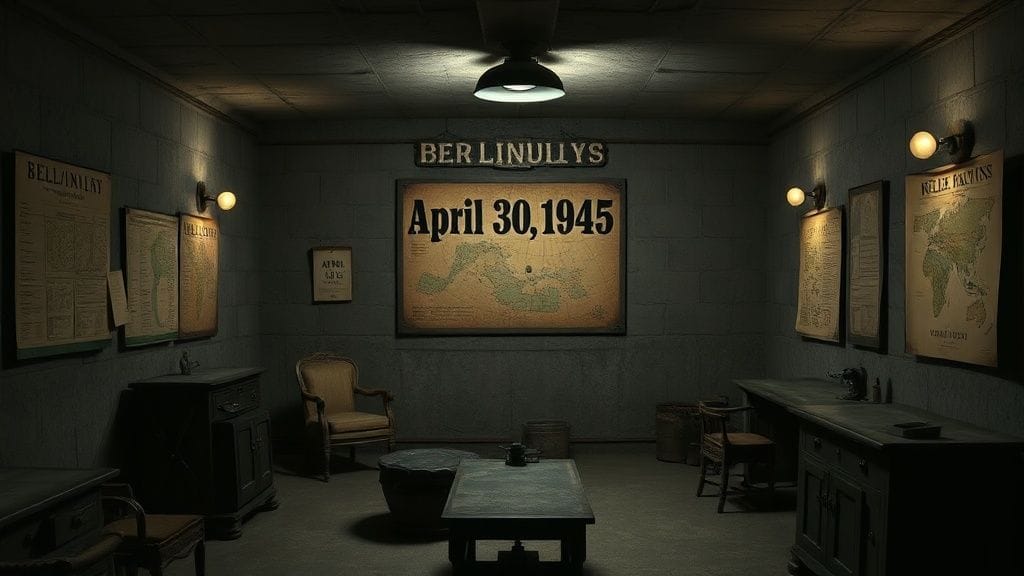
The air in Berlin was thick with smoke and despair. The once-grand capital, symbol of a regime that plunged the world into catastrophic conflict, had shrunk into a burning ruin surrounded by enemy forces. Somewhere deep beneath the battered surface, in a claustrophobic concrete bunker, Adolf Hitler—the architect of this devastation—was preparing to end it all. It was April 30, 1945, and with Soviet artillery punctuating the city’s final throes, a man once considered unstoppable was ready to vanish into the shadows of history forever.
As heavy footsteps echoed in the corridors of the Führerbunker, the heavy inevitability of fate weighed on everyone’s shoulders. Soldiers, secretaries, and the dictator himself understood what had come: the Third Reich was collapsing from within, its charismatic commander now utterly alone, staring at oblivion. But this was no mere military defeat. It was a psychological and existential rupture, a violent cleaving of a world built on fanaticism and terror. Hitler’s suicide was not simply the end of one man—it was the last act of a drama that had consumed millions of lives.
2. The Nazi Regime’s Twilight: From Triumph to Total Collapse
The Third Reich’s rise was meteoric: a once-modest politician transformed into a demagogue whose vision of Aryan supremacy reshaped the European continent. By 1941, Hitler had plunged Europe into a war unprecedented in scale and horror. Yet by early 1945, the tide had irrevocably turned. The Allied forces were advancing from West and East, and the German war machine was crumbling. Cities fell, morale plummeted, and the ideology that had once united men around a myth of strength was now unraveling before despair and death.
The ideological fervor, racial hatred, and unyielding will to power brought initial triumphs but led eventually to overreach and ruin. The invasion of the Soviet Union had backfired disastrously; the relentless Soviet counteroffensive was a steel hammer that crushed the Wehrmacht’s battered divisions and drove relentlessly westward. The once-proud capital, Berlin, was now an island under siege—surrounded, isolated, bleeding.
3. Adolf Hitler’s Psychological State: Desperation Amidst Defeat
By April 1945, Hitler’s mental and physical health were in steep decline. Eyewitnesses and aides described him as increasingly erratic and detached. His famous fiery speeches had given way to bitter rants and bouts of depression. Years of drug dependency, combined with the crushing burden of failure, had corroded the man who once enthralled millions.
He clung to a warped hope that victory was not yet lost, envisioning miraculous counterattacks even as his generals begged him to flee or surrender. Yet a fatal stubbornness chained him to the bunker, refusing to face humiliation or capture. For Hitler, surrender was unthinkable—it was better to die on his own terms, to choose death over disgrace.
His personal secretary, Traudl Junge, later recounted the surreal atmosphere: “There was a silence in the bunker that was almost unbearable… The Führer was a man marked by doom, a man who sank into himself, as if he already lived in another world.”
4. The Soviet Onslaught: The Battle for Berlin in Flames
In the days leading to April 30, the Red Army encircled Berlin with crushing force. The Battle of Berlin was a hellish urban conflict: artillery shells ripping through buildings, snipers lurking at every corner, civilians caught in the crossfire. The streets were littered with rubble and bodies, while the relentless roar of tanks and planes drowned out all but screams and shouted orders.
The Germans fought fiercely, but it was a hopeless defense. The Soviets knew the city was symbolic—the capture of Berlin meant the definitive end of Nazi hegemony in Europe. Stalin had declared nothing less than unconditional victory. Historic streets like Unter den Linden and the Reichstag became battlegrounds, monuments were reduced to ruins, and hope was a fleeting phantom.
5. Inside the Führerbunker: A World Condemned Beneath the City
Beneath the city’s shell-shocked surface lay the Führerbunker, a sprawling underground complex designed to protect Hitler and his inner circle from Allied bombing raids. This airless fortress was where the last decisions were made, the last decrees stamped—and the last breath drawn.
Security was tight, communications sparse. The bunker was a claustrophobic world of mutation for those trapped within—the echo chamber of dwindling Nazi power. Former grandiose ambitions now seemed laughable in this confined, bombed-out cellar.
Hitler’s daily routine involved military briefings, rare moments of solitude, and meetings with a shrinking cadre of loyal followers. As Soviet artillery rattled overhead, the bunker inhabitants lived in a surreal bubble where reality and denial intermingled dangerously.
6. Eva Braun: The Shadow Beside Hitler in His Last Days
Eva Braun, once a young photographer’s assistant, had long been Hitler’s companion in a private world largely unknown to the public. In the bunker’s final chapter, their relationship emerged not just as a political footnote but as a tragic human element.
On April 29, 1945, Hitler and Eva Braun were married in a small ceremony—an almost surreal act of normalcy amidst apocalypse. She remained by his side until the bitter end, understanding the inevitability of their demise, yet choosing loyalty in the shadow of destruction. Eva’s presence humanized the hushed, tense atmosphere—not with hope, but with poignant fatalism.
7. The Reich Chancellery and Bunker: Fortress Under Siege
The Reich Chancellery, once a symbol of Nazi power and propaganda, was now little more than a strategic ruin. Aboveground, the city was a battlefield; underground, Hitler’s bunker was a tomb.
The layers of security and fortification gave way to a suffocating prison. Generals came and went; messengers carried orders that no longer mattered. Supplies dwindled; morale plummeted. The juxtaposition of immense destructive power and pitiable human desperation was stark—an empire drained to its last breath.
8. The Decision to Die: Hitler’s Suicide and Its Preparations
By April 29, it was clear to Hitler himself that all was lost. He dictated his final political testament, excoriating enemies and declaring loyalty to his vision, casting blame on those he deemed guilty for his downfall.
He communicated his decision: death, by his own hand, was the only path remaining. Preparations were meticulous. Poison capsules were prepared; a pistol was readied. Accompanying Hitler and Eva Braun were close aides who would witness and assist in their final moments, respecting a pact where survival meant capture or death.
9. The Moment It Happened: April 30, 1945, in the Führerbunker
Shortly after midday, in the spartan, dimly lit room, Adolf Hitler and Eva Braun took poison. Historical accounts vary slightly, but the consensus is that Hitler then shot himself in the head. Eva Braun died alongside him.
The sound, the silence that followed, marked an epoch’s end. The Führer who had once dominated Europe with iron will and terrifying propaganda was gone—not in triumph, but in a quiet, desperate act beneath the crumbling city.
10. The Aftermath Within the Bunker: Chaos and Collapse
Hitler’s death did not immediately end the battle; the bunker’s occupants grappled with shock, disbelief, and urgency. His secretary radioed the news; loyal officers struggled with succession and survival.
The order was given to cremate the bodies hurriedly in the Reich Chancellery garden, to prevent Soviet capture and humiliation. Confusion reigned, and not all of the Nazi leadership escaped or surrendered in an orderly fashion—many met violent deaths in the days following.
11. Soviet Discovery and the Mysterious Fate of Hitler’s Remains
When Soviet forces finally seized the bunker, what they found was a scene of ruin and silence. The bodies of Hitler and Braun had been partially burned, their remains hastily buried.
For years, the Soviet regime obscured many details, leading to speculation and conspiracy theories. Later forensic investigation confirmed the death but certain mysteries remained—like the exact whereabouts of all remains—fueling rumors that persist in popular culture.
12. The End of the Third Reich: Political Repercussions and Surrender
Hitler’s suicide marked the symbolic and practical end of the Third Reich. Soon after, German forces officially surrendered unconditionally. Europe, devastated and exhausted, faced the monumental task of reconstruction and reckoning.
Political structures shifted dramatically—occupation zones, tribunals for war crimes, and the onset of the Cold War reshaped the continent’s future landscape.
13. Global Reactions: Shockwaves Across a War-Weary World
News of Hitler’s death was met with a mixture of relief, disbelief, and grim reflection. For the Allied powers, it was the closure of a grim chapter; for survivors and victims, a bitter vindication mingled with sorrow.
Newspapers across the world oscillated between triumphalist headlines and cautious analysis, conscious that the death of a dictator was only the beginning of rebuilding peace.
14. Myths and Conspiracies: The Legacy of Hitler’s Death
Almost immediately, rumors erupted—“Is Hitler really dead?” tales of escape and survival proliferated, fueled by Cold War intrigue and popular fascination.
These myths, while largely debunked by historians, are instructive in understanding how societies process trauma, denial, and the need for concrete closure.
15. Historical Perspectives: Understanding Suicide Under Siege
Historians have long analyzed Hitler’s suicide not only as an act of personal despair but also as a political statement—a refusal to submit, an ultimate assertion of control.
Suicide under extreme circumstances invites complex interpretations: human fragility, ideological fanaticism, and psychological unraveling entangled in the final acts of a destroyed regime.
16. The Psychological Toll on the German People and Soldiers
Beyond the Führerbunker, millions of Germans faced the aftermath of total defeat—displacement, shame, loss. Soldiers surrendered; civilians faced occupation and survival challenges.
The death of Hitler symbolized not just an end but also a collective reckoning with guilt and responsibility, a long road toward remembering and healing.
17. The Cultural Impact: Postwar Memory and Representation
The image of Hitler dying in his bunker has permeated films, literature, and academia, taking a permanent place in cultural memory. It serves as a cautionary tale about dictatorship, fanaticism, and moral collapse.
Such representations probe deeply into the nature of evil and the human capacity for destruction and redemption.
18. Lessons from Collapse: Dictatorship, Desperation, and Defeat
The Führerbunker’s final days embody the catastrophic consequences when power becomes unmoored from reality and ethics. Hitler’s demise teaches about the perils of absolute ideology and unyielding authority in the face of humane catastrophe.
Historical reflection here is not just academic but an urgent reminder across generations.
19. The War’s End and the Birth of a New World Order
With the Nazi regime extinguished, the world entered a new, tense phase: rebuilding shattered nations, defining justice, and grappling with ideological divisions that would spawn the Cold War.
Hitler’s death thus closed one violent chapter while opening another uncertain era.
20. Conclusion: The End of an Era Marked by Darkness
April 30, 1945, is more than a date—it is a symbol. The last breath of a man who altered history irrevocably, epitomizing both human cruelty and the limits of power. The echo of that day reminds us how fragile civilization is, and how vigilance against tyranny is perpetual.
In the bunker’s shadows, history whispered its darkest secret, urging future generations never to forget.
Conclusion
Adolf Hitler’s suicide under the ruins of Berlin was a watershed moment, the culmination of catastrophic ambition and total defeat. The scene in the Führerbunker—marked by secrecy, despair, and finality—offers a stark window into the collapse of one of history’s most brutal regimes. But it is more than just an endpoint; it is a reminder of the human costs of hatred and fanaticism, as well as the resilience needed to rebuild after unimaginable destruction.
This event, shrouded in myth yet meticulously documented, obliges us to remember not just the man but the millions who suffered because of him. It is a solemn lesson that evil, no matter how overwhelming, can—and must—be confronted and ultimately defeated.
FAQs
Q1: Why did Adolf Hitler choose to commit suicide instead of surrendering?
A1: Hitler refused to surrender, viewing defeat as dishonorable and believing death was preferable to capture, humiliation, or trial. His ideological fanaticism and psychological state reinforced this fatal choice.
Q2: Who was present in the Führerbunker when Hitler died?
A2: Several close aides and secretaries were there, including his personal secretary Traudl Junge, his adjutant Otto Günsche, and others who witnessed or assisted in his final moments.
Q3: How did the Soviet forces discover Hitler's remains?
A3: The Soviets seized the bunker days after Hitler’s death. His and Eva Braun’s partially burned bodies were found, though the Soviets kept many details secret for years, fostering speculation.
Q4: What immediate impact did Hitler’s suicide have on World War II?
A4: It symbolically ended the Nazi leadership and accelerated Germany’s unconditional surrender, effectively signaling the collapse of the Third Reich and the end of the European theater of the war.
Q5: Why do conspiracy theories about Hitler’s death still persist?
A5: Soviet secrecy, incomplete information, and the impossibility of accepting the demise of such a figure led to rumors of escape and survival, which have been discredited by historical evidence.
Q6: How is Hitler’s death remembered in Germany today?
A6: It is a significant historical moment symbolizing the fall of Nazism and is approached with solemnity, reflection, and education efforts to prevent similar atrocities.
Q7: What role did Eva Braun play in Hitler’s final days?
A7: Eva Braun remained a devoted companion, marrying Hitler shortly before their joint suicide. Her presence added a personal and tragic dimension to the bunker’s final hours.
Q8: What lessons do historians draw from the fall of Berlin and Hitler’s suicide?
A8: Historians see the event as a warning about unchecked power, ideological extremism, and the human consequences of war, emphasizing the importance of vigilance and democracy.