Table of Contents
- The Last Sunrise of an Emperor: Akbar’s Final Day
- Agra in the Early 17th Century: The Mughal Empire's Glimmering Heart
- The Great Mughals: From Humble Beginnings to Imperial Zenith
- Akbar’s Journey: A Visionary Leader’s Rise and Reign
- The Setting Sun: Signs and Portents Before the Emperor’s Passing
- October 27, 1605: The Day Akbar Breathed His Last
- Reactions from the Imperial Court: Grief and Uncertainty
- Jahangir Ascends: The Heavy Crown of Succession
- The Political Landscape Post-Akbar: Stability or Fragility?
- Akbar’s Reforms: Seeds That Survived Beyond Death
- Cultural Flourishing Under Akbar and the Shadow of His Legacy
- Akbar’s Religious Policies: Tolerance Tested by Time
- The Mughal Empire After Akbar: Continuities and Changes
- Agra’s Transformation Post-1605: From Imperial Capital to Historic Symbol
- Akbar in Memory: The Making of a Myth and Historical Icon
- Lessons from Akbar’s Death: Leadership and Mortality in Mughal India
- The Echo of an Era: How Akbar’s Legacy Influenced Future Generations
- Conclusion: The End of an Epoch and the Dawn of a New Chapter
- FAQs About Akbar’s Death and Legacy
- External Resource
- Internal Link
The Last Sunrise of an Emperor: Akbar’s Final Day
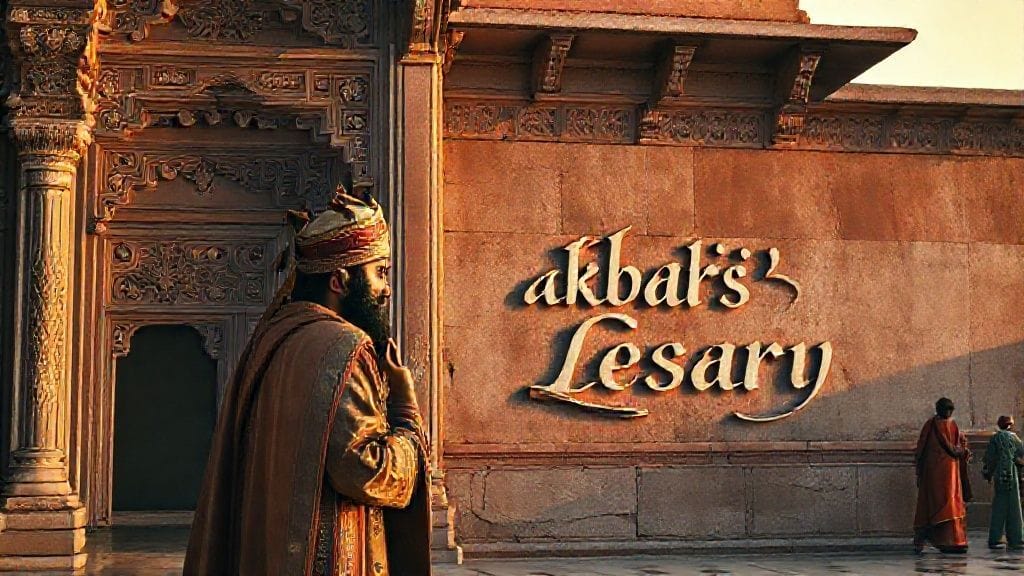
October 27, 1605, dawned quietly in the sprawling palace complex of Agra, the jewel city nestled on the banks of the Yamuna river. Yet within the corridors of the Agra Fort, a palpable tension pervaded the thick, fragrant air. The great emperor Akbar—once a towering figure whose vision and might shaped the very soul of Mughal India—lay grievously ill, ensnared by the final grip of mortality. The morning light, soft and amber, filtered through the intricately latticed windows, illuminating the stoic faces of courtiers and physicians alike, who gathered silently around the imperial bed.
Akbar’s breaths were shallow, each one a whispered farewell to a world he had transformed. His piercing gaze, once fierce and commanding, now flickered between lucidity and the haze of impending death. Outside, the city was waking, unaware that its greatest master was on the verge of passing into history.
This was more than the death of a ruler. It was the crumbling of an epoch, the closing of a chapter that had seen an empire blossom into a mosaic of cultures, languages, and faiths under one golden standard. And yet, amid the solemnity and the sorrow, the pulse of succession began to beat—Jahangir, the chosen heir, prepared to step into his father’s colossal shadow.
Agra in the Early 17th Century: The Mughal Empire’s Glimmering Heart
To understand the profound significance of Akbar’s death, one must first immerse oneself in the grandeur of Agra circa 1605. As the capital of the Mughal Empire, Agra was not merely a city, but a microcosm of imperial power, culture, and architectural marvels. The Yamuna River curved gracefully past the city’s fortified walls, reflecting minarets, pavilions, and lush gardens that seemed woven out of dreams.
The Mughal court was a glittering assembly of nobility, poets, generals, and artists—each drawn to the emperor’s magnetic vision. Akbar had transformed Agra into the beating heart of his realm, a symbol of unification amidst the tumult of diverse religions, ethnicities, and traditions that stretched from the Hindukush mountains to the lush Deccan plateau.
Yet, beneath this veneer of splendor lay simmering political undercurrents. The bureaucracy was vast and complex; loyalty was often tested and intrigue never far. Agra was a palace of paradox—beauty and danger entwined.
The Great Mughals: From Humble Beginnings to Imperial Zenith
Akbar was not born an emperor destined for greatness in an obvious way. His birth in 1542 came in a time of turmoil—his grandfather Babur had laid the fragile foundations of Mughal rule in northern India, but survival was anything but assured. Akbar ascended to the throne at the tender age of 13, in circumstances fraught with peril and uncertainty.
His early reign was marked by battles, rebellions, and challenges to his authority. Yet, by sheer force of will, strategic brilliance, and a rare gift for diplomacy, Akbar forged an empire that would leave an indelible mark on world history. His vision was not simply about territorial conquest but about crafting a new socio-political order—one that embraced religious plurality and promoted cultural synthesis.
Akbar’s empire was a jewel in the making, an exemplar of governance that blended Persianate culture with indigenous Indian traditions, producing a unique civilization.
Akbar’s Journey: A Visionary Leader’s Rise and Reign
At the core of Akbar’s rule was relentless innovation. He was a leader who listened to scholars, poets, and mystics alike. Under his patronage, the arts flourished: Persian poetry merged with Sanskrit epics, architecture reached soaring new heights, and new forms of administration were established.
His ambitious reforms reshaped agrarian relations, abolished cruel taxes on non-Muslims, and fostered dialogue between competing religious ideologies. The institution of the “Din-i Ilahi” symbolized his quest for spiritual unity—though it ultimately held little sway beyond his own court.
As he matured, Akbar sought not only to rule but to understand the soul of his people. His court was an intellectual crucible, debating theology, philosophy, and science. This intellectual openness stood as a stark contrast to the often brutal realities of empire-building.
The Setting Sun: Signs and Portents Before the Emperor’s Passing
In the months leading to October 1605, whispers of Akbar’s declining health threaded through Agra’s palace corridors. The emperor, once the epitome of vigor, had grown frail, his robust frame succumbing to unknown ailments—suspected by some as a lingering fever or internal weakness, possibly tuberculosis.
Prophets and seers sensed the shifting tides. The astrologers of the court interpreted celestial omens: eclipses inauspiciously aligning with Akbar’s natal chart. Courtiers prepared for an inevitable end, oscillating between despair and poised calculation—knowing the death of a ruler was also the birth of a new power struggle.
There are stories—perhaps embellished—of Akbar’s serene acceptance of his mortality. He reportedly ordered that his work and explorations of art, language, and statecraft remain his true legacy.
October 27, 1605: The Day Akbar Breathed His Last
On that fateful day, the imperial court gathered in hushed reverence. Physicians hovered, whispering prayers and remedies, while Akbar’s family, including his sons, circled the bed with heavy hearts.
It is said that when Akbar’s breathing finally ceased, a profound silence followed, as if the entire empire held its breath. The emperor’s death was not sudden but a gentle slipping away—a slow extinguishing of a once roaring flame.
Jahangir, his eldest son, stood solemnly, ready to inherit the legacy. His accession was a crucial moment—not a mere succession of power but a challenge to sustain the empire’s unity. The passing of Akbar was felt as the end of an era—the Emerald Age of Mughal India.
Reactions from the Imperial Court: Grief and Uncertainty
While publicly the court was monochrome with grief and ritual mourning, beneath the surface stirred anxious whispers. Akbar had been a towering force who held fractious nobles in delicate balance. The question on everyone’s lips: would the empire fracture under the weight of his absence?
Loyalists mourned deeply, their loyalty genuine but tinged with fear for the future. Meanwhile, ambitious courtiers began jockeying for position, reflecting the eternal drama of royal courts.
Jahangir’s promise was tested early, his ability to command respect and authority proving critical in these turbulent moments. The mourning period was as much a political theater as a genuine expression of loss.
Jahangir Ascends: The Heavy Crown of Succession
Nur Jahan would later captivate Jahangir and the court, but at the moment of his father’s death, Jahangir’s priority was consolidation. His early reign showed both continuity and departure from Akbar’s policies. Unlike his father’s relative moderation, Jahangir adopted a harder stance at times, especially on rebellions.
Yet, Jahangir also inherited the enormous cultural patrimony of Akbar. The empire he ruled was larger, more diverse, and infinitely more complex. His personal struggles—battling addiction, family conflicts, and asserting his authority—humanized a ruler often overshadowed by his father’s legend.
The Political Landscape Post-Akbar: Stability or Fragility?
The immediate aftermath of Akbar’s death posed questions about the Mughal Empire’s resilience. Would twelve decades of imperial expansion and reform survive a transition that often doomed dynasties?
Fortunately, the political machinery Akbar crafted—the Mansabdari system, the robust bureaucracy, and military organization—offered a framework of continuity. Jahangir’s reign, though imperfect, maintained internal stability and extended the empire’s cultural flowering.
Yet this era also planted the seeds of future conflicts: noble rivalries, religious tensions, and provincial autonomy challenges would test the empire’s cohesion over the centuries.
Akbar’s Reforms: Seeds That Survived Beyond Death
Akbar’s death did not mark the death of his ideas. His reforms in administration, taxation, and religious tolerance endured. His abolition of the jizya (tax on non-Muslims), although reversed later, set an early example of religious inclusivity.
The land revenue system, called “Zabt,” was systematized under Akbar and remained the backbone of Mughal finances. His patronage of arts and culture became institutionalized, inspiring generations of artists, poets, and architects.
This legacy was far more durable than any palace or monument: it was a vision of an empire that embraced diversity and governance innovation.
Cultural Flourishing Under Akbar and the Shadow of His Legacy
Akbar’s court was an unparalleled cultural crucible. Artists like Abu’l Hasan, poets like Faizi and Birbal, and musicians thrived under his patronage. The Mughal miniature painting style reached new heights, blending Persian finesse with Indian themes.
Even Akbar’s death became a subject of poetic elegies and historiographical reflections. His reign was immortalized in the “Akbarnama,” commissioned by Jahangir, an elaborate chronicle that both celebrated and mythologized the emperor.
The shadow of his majesty shaped not just the politics but the very imagination of South Asia.
Akbar’s Religious Policies: Tolerance Tested by Time
Akbar’s spiritual curiosity was legendary. He convened religious debates among Muslims, Hindus, Jains, Christians, and Zoroastrians, seeking a universal truth beyond dogma. His foundation of the “Din-i Ilahi” espoused syncretism, though it garnered few adherents.
These policies challenged orthodox religious authorities and sometimes sparked backlash. Yet, for decades, this atmosphere of relative tolerance enabled coexistence seldom seen before or after in the subcontinent.
Following Akbar’s death, his successors had to navigate the delicate balance between pluralism and orthodoxy—often with varying success.
The Mughal Empire After Akbar: Continuities and Changes
Even as Jahangir ascended, Akbar’s policies set the tone for the 17th century Mughal state. The military remained formidable. Trade connections expanded, incorporating European powers like the Portuguese and English.
Yet subtle shifts occurred—central authority became more personalized, court intrigues deepened, and religious dynamics grew more complex. Akbar’s death was both a break and a continuum.
His reign marks a pinnacle; the post-Akbar period would see the empire’s gradual transformation and eventual challenges, but the foundations of greatness he laid were undeniable.
Agra’s Transformation Post-1605: From Imperial Capital to Historic Symbol
Though Agra continued as the seat of power under Jahangir and later Shah Jahan, its role evolved. The city’s royal gardens, forts, and palaces became monuments not just of power but of memory.
The Taj Mahal, commissioned later by Shah Jahan, cast a new glow on the city, but it was in the shadows of Akbar’s reign that this grandeur found its roots. Agra turned into a testament of imperial vision and ambition that outlived its great emperor.
Over centuries, Agra’s story intertwined with the memory of Akbar as a place where India’s medieval zenith was both realized and mourned.
Akbar in Memory: The Making of a Myth and Historical Icon
From the moment of his death, Akbar was more than a man; he became a symbol. Mughal historians crafted narratives emphasizing his wisdom, justice, and magnanimity. British colonial chroniclers later reinterpreted his reign through the lens of “enlightened despotism.”
In contemporary India, Akbar is celebrated as a secular icon, emblematic of pluralism and tolerance. His life story resonates as a lesson in leadership beyond fanaticism—a rare glimmer in history’s often brutal tableau.
Lessons from Akbar’s Death: Leadership and Mortality in Mughal India
The death of Akbar brings to the fore eternal themes: the fragility of power, the human fate behind imperial grandeur, and the passing of visionary leadership. His decline and demise remind us that even the mightiest are vulnerable, and their legacies shaped as much by death as life.
Leadership, as seen in Akbar’s reign and death, is a mix of resilience, innovation, and adaptability. How the empire adapted post-Akbar teaches the importance of institutions alongside individual rulers.
The Echo of an Era: How Akbar’s Legacy Influenced Future Generations
Centuries after his death, Akbar’s model of rulership continues to inspire. His experiments in governance, cultural syncretism, and religious tolerance echo in modern debates on India’s plural identity.
His life is studied as an example of enlightened authority, often contrasted with later rulers who pursued orthodoxy or despotism. The balance he struck between power and benevolence remains a profound lesson for rulers and citizens alike.
Conclusion: The End of an Epoch and the Dawn of a New Chapter
Akbar’s death on that October day in 1605 was more than the passing of a man—it was the sunset of a dazzling age. In its wake came uncertainty, hope, and the challenge of succession. Yet through the tears and trials, the foundations he laid endured.
The story of Akbar’s final moments and their aftermath invites us to reflect on the impermanence of power, the enduring weight of legacy, and the human heart behind the crown. His reign reminds us that true greatness is measured not only by conquest but by the vision to unite, create, and inspire.
The Mughal Empire would journey on, shaped by his shadow, forever anchored by the imprint of his extraordinary life.
FAQs About Akbar’s Death and Legacy
Q1: What were the main causes of Akbar’s death?
While precise medical details remain uncertain, Akbar’s final decline is believed to have involved chronic illness—possibly tuberculosis or a prolonged fever—that weakened his robust health over months leading to October 1605.
Q2: How did Akbar’s death impact the Mughal Empire politically?
His death posed an immediate test of imperial stability. Thanks to his structured administration and Jahangir’s firm succession, the empire survived potential fragmentation, although it faced new political and religious challenges.
Q3: Who succeeded Akbar, and what challenges did he face?
Jahangir, Akbar’s eldest son, succeeded him. His reign was marked by efforts to consolidate power amid noble rivalries, rebellions, and the challenge of living up to his father’s legacy.
Q4: What was Akbar’s most enduring reform?
Among many, Akbar’s land revenue reforms (Zabt system) and his policies of religious tolerance had the most lasting impact, influencing Mughal governance long after his death.
Q5: How is Akbar remembered in modern India?
Akbar is celebrated as a symbol of secular governance and cultural synthesis. His policies of tolerance and patronage of the arts are held up as exemplars of enlightened leadership.
Q6: Did Akbar’s religious policies survive his death?
While his specific initiatives like the Din-i Ilahi faded, the ethos of religious tolerance he championed influenced successors, though later rulers sometimes reverted to orthodox policies.
Q7: What role did Agra play after Akbar’s death?
Agra remained the imperial capital for decades, becoming a living museum of Mughal grandeur and the stage for subsequent rulers’ projects, including the Taj Mahal.
Q8: How did Akbar’s death influence Mughal cultural production?
His death prompted considerable literary and artistic homage, notably in court chronicles like the Akbarnama, securing his mythic status and shaping Mughal cultural identity.