Table of Contents
- Introduction
- Birth in Umarkot and Ancestry
- Early Struggles and Ascension
- Military Expansion and Strategy
- Establishing Mughal Supremacy
- Capital and Imperial Administration
- Akbar’s Court and Navaratnas
- Policy of Religious Tolerance
- Social and Cultural Integration
- Art, Architecture, and Innovation
- Language, Literature, and Education
- Reforms in Taxation and Governance
- Legacy of Secularism and Leadership
- Death and Succession
- Global Historical Impact
- Conclusion
- External Resource
- Internal Link
1. Introduction
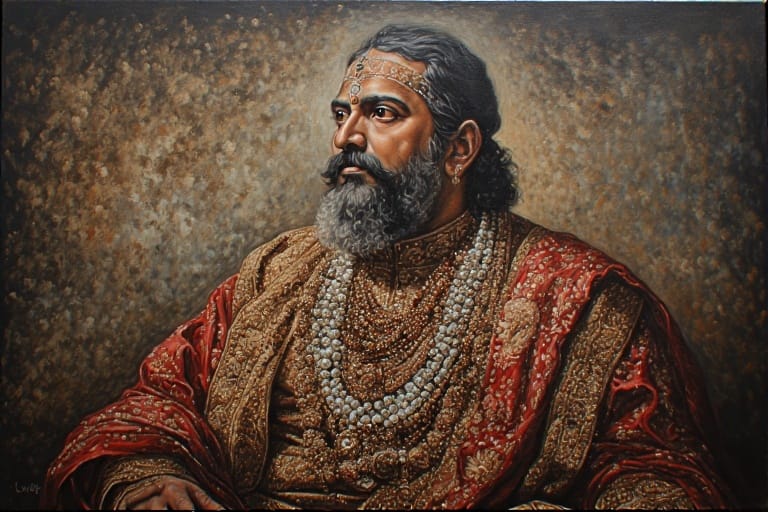
Akbar the Great is one of the most prominent figures in South Asian history. Crowned emperor at the tender age of 13, he expanded the Mughal Empire across vast territories and forged a powerful, culturally diverse, and administratively sophisticated realm. More than a conqueror, Akbar was a reformer and visionary who redefined governance and religious tolerance in pre-modern India.
2. Birth in Umarkot and Ancestry
Akbar was born on October 15, 1542, in Umarkot, located in present-day Pakistan, during a period of Mughal political instability. He was the son of Emperor Humayun and Hamida Banu Begum, and the grandson of Babur, the founder of the Mughal dynasty.
Shortly after Akbar’s birth, his father was forced into exile by Sher Shah Suri, leaving the infant prince under the care of loyal followers in Rajput territory. This tumultuous start shaped Akbar’s resilience and diplomatic acumen.
3. Early Struggles and Ascension
In 1555, Humayun briefly regained the throne but died in a tragic fall soon after. Akbar ascended the throne in 1556, at just 13 years old, under the guidance of his regent Bairam Khan. Almost immediately, he faced a major challenge—the Battle of Panipat (1556) against Hemu, a general of the Suri dynasty. Akbar’s forces prevailed, securing his hold on the throne.
4. Military Expansion and Strategy
Akbar embarked on a vast campaign of expansion that brought most of northern and central India under Mughal control. His military conquests included:
- Malwa (1561)
- Gujarat (1572)
- Bengal (1574–76)
- Rajasthan, including the siege of Chittorgarh and the subjugation of several Rajput states
- Deccan territories (late in his reign)
Akbar’s military strength was not just brute force—it involved skilled diplomacy, the use of war elephants and artillery, and clever alliance-building.
5. Establishing Mughal Supremacy
Rather than ruling by fear alone, Akbar practiced suzerainty with tolerance, incorporating defeated rulers into his administration and often marrying into their families. His Rajput alliances were pivotal in stabilizing his rule and expanding imperial unity.
He established his capital at Fatehpur Sikri, a city that embodied his political and spiritual vision, though later it was abandoned due to water shortages.
6. Capital and Imperial Administration
Akbar reorganized the Mughal government using a system known as mansabdari, a hierarchical structure that assigned ranks and responsibilities based on merit and loyalty. His court became a center of cosmopolitan administration, welcoming Persians, Rajputs, and even Europeans.
He built Fort Agra and improved Delhi and Lahore, establishing administrative centers, roads, and rest houses.
7. Akbar’s Court and Navaratnas
Akbar’s court was renowned for its brilliance and intellectual vigor. His Navaratnas, or “nine gems,” included:
- Birbal, the witty advisor
- Tansen, the legendary musician
- Abul Fazl, author of the Akbarnama
- Raja Todar Mal, finance minister
These figures played key roles in shaping the empire’s culture, policy, and historical record.
8. Policy of Religious Tolerance
Akbar is most admired for his progressive religious policies. He abolished the jizya tax on non-Muslims and encouraged interfaith dialogue through his creation of the Ibadat Khana (House of Worship).
He even established a new syncretic faith, Din-i Ilahi, seeking to harmonize religious doctrines. While it did not become a widespread movement, it symbolized Akbar’s philosophical quest for unity.
9. Social and Cultural Integration
Akbar promoted intercultural harmony, employing Hindus in high offices and respecting local customs. His inclusive governance created a sense of loyalty among diverse populations, from Punjabis to Rajputs, Marathas, and Bengalis.
He also supported widow remarriage and discouraged child marriage, indicating his interest in social reform.
10. Art, Architecture, and Innovation
Akbar’s patronage led to a golden age of Mughal architecture and art:
- The construction of Buland Darwaza, a 54-meter high gateway in Fatehpur Sikri
- Commissioning of grand forts and palaces across the empire
- Development of Mughal miniature painting, which fused Persian and Indian styles
He also supported advances in astronomy, cartography, and weaponry.
11. Language, Literature, and Education
Akbar promoted Persian as the court language but encouraged translations of Hindu epics into Persian, including the Mahabharata and Ramayana. He supported public education and established libraries filled with manuscripts.
His court chronicler, Abul Fazl, authored the Ain-i-Akbari, an encyclopedic record of imperial policy, economy, and culture.
12. Reforms in Taxation and Governance
Akbar implemented a fair and efficient revenue system called Zabt, calculated on the basis of crop productivity and land quality. Tax collectors were trained and accountable, reducing corruption and increasing imperial income.
This system was admired and imitated by later administrators, including the British.
13. Legacy of Secularism and Leadership
Akbar’s rule represents a rare model of secular, benevolent autocracy in a time of religious strife. His ability to manage ethnic, religious, and linguistic diversity remains a blueprint for inclusive governance.
He is remembered as a unifier rather than a divider, and his era is often idealized as a golden age of harmony and progress.
14. Death and Succession
Akbar died in 1605 in Agra, after nearly five decades on the throne. He was succeeded by his son Jahangir, who inherited a powerful and stable empire.
Akbar’s mausoleum in Sikandra, near Agra, is a masterpiece that reflects his grandeur and humility.
15. Global Historical Impact
Akbar’s reputation reached far beyond India. European travelers and emissaries marveled at his court’s sophistication. He became a symbol of Oriental monarchy in the Western imagination—wise, tolerant, and absolute.
Today, he is studied as a model of religious pluralism and enlightened rule.
16. Conclusion
Akbar the Great remains a towering figure in world history. His reign united diverse peoples, expanded imperial borders, and initiated a legacy of tolerance, innovation, and reform that has rarely been matched.
From his birth in Umarkot to his final days in Agra, Akbar’s journey was marked by vision, courage, and humanity—traits that make his legacy timeless.