Table of Contents
- The Final Sunset Over Baghdad: The Death of Al-Khwarizmi
- A City at the Heart of the World: Baghdad in the 9th Century
- The Abbasid Caliphate: An Empire of Knowledge and Power
- Muhammad ibn Musa al-Khwarizmi: The Man Behind the Mathematics
- From Khwarezm to Baghdad: The Journey of a Scholar
- The House of Wisdom: A Beacon of Learning
- Al-Khwarizmi’s Contributions: Algebra and Algorithms
- The Intellectual Climate: Science, Philosophy, and Faith
- The Last Days: Baghdad in the Year 850
- Mourning a Genius: The Reaction to Al-Khwarizmi’s Death
- The Immediate Legacy: Teachers and Texts
- Algebra through the Ages: How His Work Transformed Mathematics
- Algorithms and the Dawn of Computation
- Transmission to the West: From Arabic to Latin Europe
- The Abbasid Golden Age: A World of Blossoming Sciences
- Baghdad’s Cultural Meltdown: Prelude to Changing Dynasties
- The Human Side of a Historical Icon
- How Al-Khwarizmi’s Death Marked the End of an Era
- Memory and Myth: Al-Khwarizmi in Modern Scholarship
- Conclusion: The Everlasting Echoes of a Baghdad Scholar
- FAQs: Demystifying Al-Khwarizmi and His Times
- External Resource
- Internal Link
The Final Sunset Over Baghdad: The Death of Al-Khwarizmi
On an autumn evening in Baghdad, around the year 850, the fading light cast long shadows over the banks of the Tigris River. It was a city buzzing with life, a hub where traders, poets, and philosophers mingled beneath the golden domes and towering minarets. Yet amid the scholarly chatter and the hum of daily commerce, the news quietly spread — Muhammad ibn Musa al-Khwarizmi, the brilliant mathematician and polymath, had passed away. His death was not a public outcry; it was less like a thunderclap and more like the closing of a great book, one whose pages held transformative knowledge about numbers and the cosmos. But his departure from this world marked the end of a profound chapter in Baghdad's golden age and the history of human knowledge.
A City at the Heart of the World: Baghdad in the 9th Century
Baghdad was more than just a capital — it was the radiant jewel of the medieval world, the pulsating heart of a civilization stretching from the Iberian Peninsula to Central Asia. Founded in 762 CE by Caliph al-Mansur, the city was designed to be a cosmopolitan center, a nexus where culture, science, and governance intermingled.
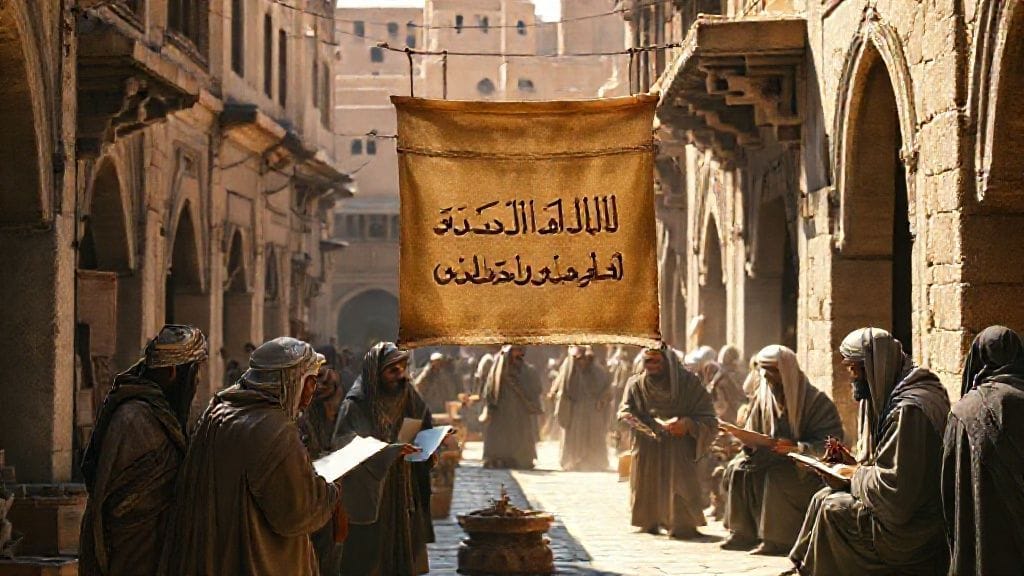
The 9th century marked Baghdad’s apogee. It was the locus of the Abbasid Caliphate’s power, a melting pot where scholars translated Greek, Indian, Persian, and Egyptian texts into Arabic. Medical treatises, philosophical dialogues, astronomical charts—everything converged here. The streets clattered with merchants’ carts; the air filled with the scents of spices from distant lands, and the calls to prayer punctuated the eternal rhythm of a city alive with knowledge and commerce.
The Abbasid Caliphate: An Empire of Knowledge and Power
The Abbasid Caliphate emerged in 750 CE, overthrowing the Umayyads and establishing Baghdad as their capital. This dynasty was deeply committed to knowledge and cultural patronage. The caliphs—particularly al-Ma’mun, who reigned from 813 to 833—were more than sovereigns; they were ardent scholars and patrons of learning.
Al-Ma’mun founded the Bayt al-Hikma, or House of Wisdom, which was not only a library but a vibrant center of research where mathematicians, astronomers, linguists, physicians, and philosophers gathered. The Abbasid rulers fostered a unique intellectual atmosphere rooted in curiosity and synthesis—melding Islamic theology with the knowledge inherited from conquered lands.
Muhammad ibn Musa al-Khwarizmi: The Man Behind the Mathematics
Al-Khwarizmi was born around 780 CE in the region of Khwarezm, near the Aral Sea (modern-day Uzbekistan). Though humble details about his early life remain shadowy, his intellectual impact is monumental. His actual name, Muhammad ibn Musa al-Khwarizmi, nods to his origin, but history remembers him simply as Al-Khwarizmi.
Renowned as “the father of algebra,” al-Khwarizmi was more than a mathematician; he was a polymath who revolutionized arithmetic, geography, astronomy, and cartography. His pioneering treatise on algebra, "Kitab al-Mukhtasar fi Hisab al-Jabr wal-Muqabala", introduced systematic methods of solving linear and quadratic equations—an innovation that forever altered mathematical thought.
From Khwarezm to Baghdad: The Journey of a Scholar
It is believed al-Khwarizmi traveled to Baghdad, the epicenter of knowledge, sometime during the reign of Caliph al-Ma’mun. His scholarly journey was fueled by the treasures of learning amassed in the House of Wisdom. Here, he studied Greek mathematical works, the Indian numeric system (which later became our decimal system), and Babylonian astronomy.
The integration of these diverse intellectual streams birthed original contributions merging various cultural legacies into a cohesive scientific language. Baghdad’s welcoming scholarly environment allowed al-Khwarizmi to flourish, surrounded by translators, mathematicians, and thankful patrons.
The House of Wisdom: A Beacon of Learning
The Bayt al-Hikma was more than an academic library—it was an incubator of human progress. At a time when much of Europe lay in the early Middle Ages, Baghdad’s scholars were deciphering Euclid, Ptolemy, and Aristotle, translating their works into Arabic. Against this backdrop, al-Khwarizmi’s projects took shape.
Working alongside other luminaries, his mathematical treatises were both deeply rooted in Islamic intellectual tradition and profoundly innovative. The House of Wisdom became a sanctuary where the thirst for knowledge transcended borders and dogma.
Al-Khwarizmi’s Contributions: Algebra and Algorithms
“Al-jabr,” the Arabic word for "reunion" or "completion," gave birth to the modern term algebra, a field al-Khwarizmi founded. Prior to him, mathematics was largely practical: arithmetic for trade, geometry for land surveying. Al-Khwarizmi introduced abstraction, transforming equations into problems solvable by systematic rules.
His works explained how to reduce equations by “completing the square,” an approach that unlocked solutions to intricate mathematical puzzles. Beyond algebra, his elaboration of the Indian numeral system formed the basis for the digits we use today and gave rise to the concept of algorithms—named after “Algoritmi,” the Latinized form of his name—which underpin modern computing.
The Intellectual Climate: Science, Philosophy, and Faith
Abbasi Baghdad was a crossroads where knowledge and spirituality coexisted uneasily but fruitfully. Scholars sought not only to understand the natural world but to reconcile it with Islamic teachings. Al-Khwarizmi exemplified this harmony—his scientific rigor was matched by religious devotion.
The decade during which he worked was steeped in inquiry but also occasional theological tension, as scholars debated the use of Greek rationalism versus Islamic revelation. Yet the pursuit of scholarly truth flourished, driven by curiosity and the state’s enthusiastic support.
The Last Days: Baghdad in the Year 850
By the time of al-Khwarizmi’s death c. 850, Baghdad was reaching both a zenith and a precipice. The city remained a bustling center of administration and learning, but within decades, political fragmentation and invasions would alter its fate irrevocably.
We can imagine the scholarly circles gathered quietly to mourn the loss of a giant whose work had shaped the very notion of mathematics—a figure whose written words had already begun to cross cultural and geographical boundaries, even as the city around him thrived.
Mourning a Genius: The Reaction to Al-Khwarizmi’s Death
Historical records do not lavish details on the immediate aftermath, but given al-Khwarizmi’s stature in the House of Wisdom, his passing must have been met with profound respect and sorrow. Scholars who had benefited from his teachings mourned the loss of a mentor and visionary.
The narrative of his death is emblematic of many medieval scholars whose lives blended anonymity with towering influence—their death a silent closing note to a symphony of intellectual progress.
The Immediate Legacy: Teachers and Texts
Following al-Khwarizmi, his texts continued to be studied and expanded upon by subsequent generations of scholars. Treatises on algebra inspired mathematicians in Baghdad and beyond. His work on mathematics became a cornerstone in Islamic education, preserved in manuscripts and further developed by thinkers like Al-Karaji and Omar Khayyam.
Moreover, his geographical writings enriched the era’s cartographic knowledge, influencing explorations and mapping far beyond the Islamic world.
Algebra through the Ages: How His Work Transformed Mathematics
Algebra as a discipline owes a debt to al-Khwarizmi’s methodologies—the systematic solution to equations opened avenues to physics, engineering, and astronomy. But algebra’s real legacy was to frame mathematics as a symbolic language, an abstract tool with universal application.
Centuries after his death, scholars in medieval Europe rediscovered his works through Latin translations, which catalyzed the Renaissance’s scientific revolution. Algebra became essential to fields ranging from architecture to economics; without al-Khwarizmi, modern mathematics would be unimaginable.
Algorithms and the Dawn of Computation
Equally profound was the origin of the term “algorithm,” derived from his name. While al-Khwarizmi’s algorithms were manual procedures for arithmetic and problem-solving, the concept foreshadowed modern computer science.
Some historians trace the roots of computational logic back to these methods, underscoring al-Khwarizmi as perhaps one of the earliest progenitors of algorithmic thinking. In an age where computers shape every facet of life, his intellectual legacy reverberates powerfully.
Transmission to the West: From Arabic to Latin Europe
Between the 12th and 13th centuries, al-Khwarizmi’s works were translated from Arabic into Latin by scholars in Spain and Italy, notably Adelard of Bath and Gerard of Cremona. This transmission flowed through Toledo’s multicultural milieu.
The Latin “Algoritmi de numero Indorum” introduced Europeans not only to algebra but also to the Indian numeral system, which replaced the cumbersome Roman numerals and revolutionized arithmetic practices across the continent.
The Abbasid Golden Age: A World of Blossoming Sciences
Al-Khwarizmi’s life and death fall squarely within the Abbasid Golden Age, a time when Baghdad flourished as a beacon of science, culture, and intellectual achievement. From medicine to mechanics, poetry to philosophy, this era rekindled a human thirst for understanding.
Though the political might of the Abbasids would eventually wane, the intellectual foundations laid then shaped countless civilizations, proving that ideas often outlive empires.
Baghdad’s Cultural Meltdown: Prelude to Changing Dynasties
Al-Khwarizmi did not witness the future devastations of Baghdad—such as those wrought by the Mongol invasions in 1258—but his death occurred only decades before the Abbasid decline began in earnest. Internal strife, court intrigues, and regional revolts slowly eroded Baghdad’s preeminence.
Yet, even as dynasties changed, the legacy of Baghdad’s scholars, including al-Khwarizmi, remained a shining testament to the city’s intellectual heritage.
The Human Side of a Historical Icon
It’s tempting to envision al-Khwarizmi as a distant, inscrutable figure of legend—yet behind the foundational contributions was a man immersed in the daily life of Baghdad’s ateliers and libraries, navigating the complex interplay of patronage, religion, and scholarship.
His work, painstaking and meticulous, was propelled by a genuine wonder at the order of the cosmos and a desire to bring clarity to the abstract chaos of numbers. A scholar deeply human, striving not for fame but understanding.
How Al-Khwarizmi’s Death Marked the End of an Era
Al-Khwarizmi's passing symbolizes more than the loss of a scholar—it marks the closing of an era characterized by rapid scientific synthesis and openness. Soon after, Baghdad would face political instability and external threats that chipped away at its intellectual dominance.
Though his works endured, the direct lineage of this flourishing intellectual culture became fragmented, underscoring the precariousness of human achievement.
Memory and Myth: Al-Khwarizmi in Modern Scholarship
Modern historians and scientists view al-Khwarizmi as an essential bridging figure linking ancient knowledge to the medieval world and the modern age. His name echoes not only in textbooks but also in the foundational vocabulary of mathematics and computer science.
Yet his life remains cloaked in historical mystery, inviting both admiration and speculation—a reminder that many voices in history, though lost in detail, leave enduring legacies.
Conclusion: The Everlasting Echoes of a Baghdad Scholar
Al-Khwarizmi’s death in Baghdad around 850 was less an end than a beginning. His contributions planted seeds that grew into the vast forests of modern mathematics, science, and technology. Through turmoil and time, his work crossed cultures and centuries, embodying the human pursuit of knowledge.
Baghdad, once the vibrant milieu stimulating his genius, still whispers his name in its ancient stones, calling us to remember that every quest for truth is a bridge from past to future—a narrative woven by souls like al-Khwarizmi, whose intellect transcended the ages.
FAQs
Q1: What were the main contributions of Al-Khwarizmi to mathematics?
Al-Khwarizmi pioneered algebra, introducing systematic methods to solve linear and quadratic equations. He also popularized the Indian numeral system in the Islamic world and laid foundations for algorithms, modern computation’s conceptual bedrock.
Q2: Why was Baghdad such an important center during Al-Khwarizmi’s life?
Baghdad was the capital of the Abbasid Caliphate and home to the House of Wisdom, attracting scholars who translated and built upon knowledge from Greek, Persian, and Indian traditions, making it a global intellectual hub in the 9th century.
Q3: How did Al-Khwarizmi’s works reach Europe?
His Arabic texts were translated into Latin in the 12th and 13th centuries, particularly in Spain and Italy, spreading his algebraic methods and the decimal numeral system across medieval Europe, sparking significant scientific developments.
Q4: What impact did Al-Khwarizmi’s death have at the time?
While specific records are scant, his death was likely mourned within scholarly circles in Baghdad. It symbolized the loss of a leading figure in a vibrant intellectual age, even as his works self-propagated through teaching and writing.
Q5: How does ‘algorithm’ relate to Al-Khwarizmi?
The term ‘algorithm’ derives from the Latinized version of Al-Khwarizmi’s name. His step-by-step procedures for calculation introduced a new way of problem-solving, ultimately influencing the development of modern computer science.
Q6: What was the Abbasid Caliphate’s role in scientific progress?
The Abbasids, especially under caliphs like al-Ma’mun, sponsored translation movements, educational institutions, and scholarly inquiry, fostering a ‘Golden Age’ where many ancient sciences were preserved, expanded, and integrated.
Q7: How did Al-Khwarizmi balance religion and science?
As a devout Muslim, Al-Khwarizmi’s work harmonized faith and reason, illustrating that scientific pursuit did not contradict religious belief but complemented it, reflecting the intellectual milieu of the Abbasid era.
Q8: Why is Al-Khwarizmi often called the ‘father of algebra’?
Because his book systematically treated solving equations as a science, introducing methods and terminology that formed the foundation of algebra as an independent mathematical discipline, later influencing educational curricula worldwide.