Table of Contents
- Dawn over Samarra: The Day a New Caliph Rose
- From Heir in the Shadows to Chosen Ruler
- The Abbasid World on the Eve of 847: An Empire on Edge
- Samarra, Stage of Power: City of Soldiers and Palaces
- The Death of al-Muʿtasim and the Turbulent Succession
- 10 August 847: The Oath, the Crowd, and the Quiet Tremor of Change
- The New Court of al-Mutawakkil: Rituals, Ceremonies, and Masks
- Guardians or Jailers? The Turkish Military Elite and Their Caliph
- A Return to Orthodoxy: Theology, the Mihna, and the Scholars
- Baghdad and the Provinces: Echoes of a New Reign
- Jews, Christians, and Others: Changing Tides for Dhimmis
- The Shia and the City of ʿAli: Al-Mutawakkil’s Policy toward Karbala
- Palaces, Canals, and Gardens: The Imperial Dream at Samarra
- Intrigue in the Corridors: Princes, Ministers, and Family Rivalries
- From Confidence to Paranoia: The Caliph and His Turkish Guard
- Night of Knives: The Assassination of al-Mutawakkil
- Aftermath of a Murder: The Anarchy at Samarra
- Legacy of a Contested Reign: Faith, Power, and Fragmentation
- How Historians Remember al-Mutawakkil Today
- Conclusion
- FAQs
- External Resource
- Internal Link
Article Summary: On 10 August 847, in the purpose-built garrison city of Samarra, a relatively underestimated prince named Jaʿfar ibn al-Muʿtasim was elevated as al-mutawakkil abbasid caliph, inaugurating one of the most dramatic and controversial reigns of the Abbasid era. This article traces the world he inherited: a vast but fragile empire dominated by a powerful Turkish military elite and riven by theological and social tensions. It follows his ascent, the ceremonies of his enthronement, and his early attempts to reassert caliphal authority over soldiers, scholars, and subjects alike. We explore his dramatic reversal of the rationalist inquisition, his promotion of Sunni traditionalism, and his increasingly harsh policies toward religious minorities and the Shia. Yet behind the official chronicles lies a more human story—of a man both devout and suspicious, capable of generosity and cruelty, who built great palaces even as he sowed the seeds of his own downfall. The narrative culminates in his violent assassination at the hands of the very guards meant to protect him, and the descent of the caliphate into the so-called “Anarchy at Samarra.” By blending eyewitness-like narrative with careful historical analysis, the article assesses how the reign of al-mutawakkil abbasid caliph reshaped Abbasid politics, Sunni theology, and the long-term fragmentation of imperial power.
Dawn over Samarra: The Day a New Caliph Rose
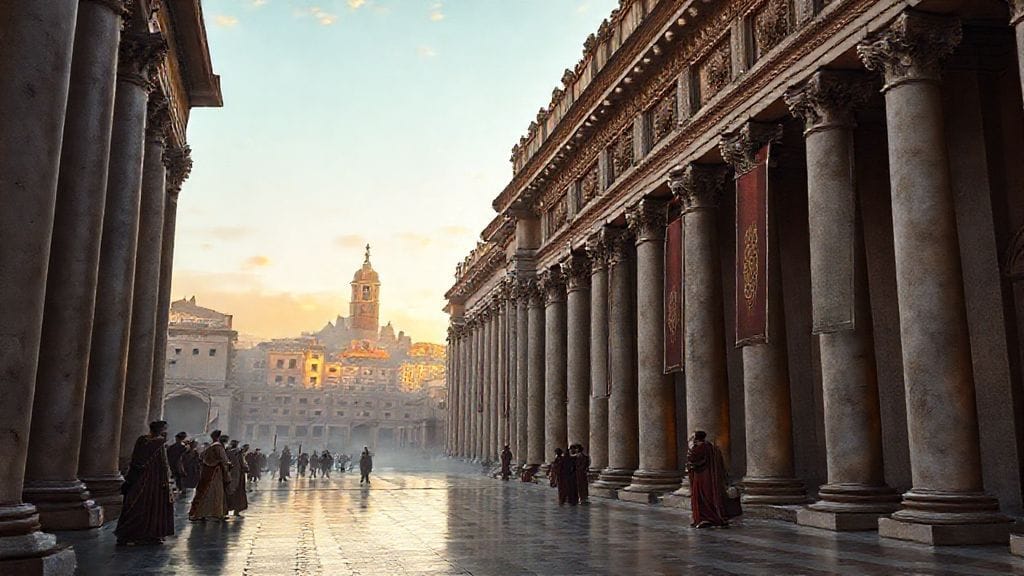
The sun that rose over Samarra on 10 August 847 did not simply illuminate streets and domes; it fell upon an empire standing at a crossroads. The Tigris shimmered with the early light, its waters carrying whispers of the old capital, Baghdad, now up the river, half eclipsed by this younger, sharper city of soldiers and stone. Courtyards were swept, banners unfurled, and courtiers summoned, for on that day a new Abbasid caliph was to take the throne. His name was Jaʿfar ibn al-Muʿtasim, but history would call him al-Mutawakkil—“the one who trusts in God.”
Yet even as trumpets sounded and robes of honor were donned, there was an unease that no ceremony could quite silence. The army—largely Turkish slave-soldiers and their commanders—had grown used to kingmaking. The civilian bureaucracy feared that each new caliph might be only a gilded mask for military rule. Scholars murmured about the end of the mihna, the inquisition that had tested creed at the point of a whip. In the markets, in homes of brick and mud, and in distant provinces from Khurasan to Ifriqiya, many wondered: would this new sovereign bring stability or more turmoil?
To step into that morning is to stand on the balcony of history and look down upon a drama both intimate and imperial. Here is a man raised in the inner chambers of power, watching brothers rise and fall, feeling the glacial weight of a dynasty’s expectations. Here is an empire, flush with memories of Harun al-Rashid’s golden age, but already cracking along lines of ethnicity, doctrine, and province. When al-Mutawakkil walked into the gathering that would proclaim him caliph, he bore not only the honor of the Prophet’s house, but also the heavy, invisible burden of a faltering world order.
From Heir in the Shadows to Chosen Ruler
Al-Mutawakkil’s journey to that decisive day began long before, in the hushed chambers of the Abbasid palace. Born as Jaʿfar, one of the sons of Caliph al-Muʿtasim (r. 833–842), he was not the obvious heir. His older brother al-Wathiq, a cultured ruler with a taste for music and rationalist theology, succeeded their father and reigned from 842 to 847. In such a world, where the caliph’s children were many and the stakes immeasurably high, growing up royal meant growing up precarious.
Jaʿfar’s early years were marked by watching and waiting. The Abbasid court was a maze of eunuch officials, secretaries, tutors, and guards. Some saw in him a quiet, observant prince, one who learned when to speak and when to listen. Others found him brooding, his piety tinged with resentment. He saw his brother al-Wathiq champion the doctrines of the Muʿtazila—a rationalist theological school—continuing the mihna that had pitted the caliphate against a wide swathe of religious scholars. He also witnessed the growing authority of the Turkish generals, whose loyalty could elevate or destroy a ruler with a nod.
Despite being sidelined, Jaʿfar nurtured connections among those who were skeptical of al-Wathiq’s circle: traditionalist scholars who loathed the inquisition, bureaucrats who feared the arrogance of the Turkish commanders, and courtiers disillusioned by the cultural haughtiness of the reigning elite. He cultivated an image of a man more aligned with the traditions of the Prophet and the early caliphs, someone who might restore dignity to the faith and balance to the court.
When al-Wathiq died suddenly in 847, without leaving a clear adult heir, the vacuum of succession terrified those at the top. The Turkish officers, the leading bureaucrats, and key courtiers gathered swiftly. They could choose a child and rule in his name—or they could select an adult prince capable of shouldering the burden but also capable of challenging their power. In that moment of hesitation, Jaʿfar’s very ambiguity—pious but not yet entrenched, of noble blood but not yet a factional leader—made him an unexpectedly attractive choice. The man who had grown up heeding every shift in courtly winds now felt the breeze turn in his favor.
The Abbasid World on the Eve of 847: An Empire on Edge
To understand the significance of al-Mutawakkil’s accession, one must picture the Abbasid empire in 847 as a vast arch beginning to crack at its keystone. The caliphate still governed territories stretching from the borders of India to the shores of the Atlantic, from the Caucasus mountains to the deserts of Arabia and beyond. Arabic language, Islamic law, and Abbasid coinage provided a shared imperial grammar. Yet beneath that surface unity, centrifugal forces tugged relentlessly.
Economically, the heartlands of Iraq remained wealthy: taxes from fertile lands, trade routes linking the Mediterranean to the Indian Ocean, and bustling cities like Baghdad and Basra filled the treasury. But elsewhere, local dynasties were emerging with increasing confidence. In Ifriqiya (roughly modern Tunisia), governors grew more autonomous. In Khurasan and Transoxiana, Central Asian elites mediated Abbasid power on their own terms. In Egypt, the rich Nile valley was always a temptation for ambitious generals.
Politically, the most profound change of the preceding decades was the rise of a professional military caste, much of it composed of Turkish slave-soldiers—ghilman—recruited from the steppes of Central Asia. Caliph al-Muʿtasim had relied heavily on them and partly moved the court to Samarra to give them a base away from the fractious populace of Baghdad. The result was a capital that looked more like a military camp turned palace-city than a traditional urban center. The soldiers were highly trained, personally loyal to their commanders, and increasingly aware of their collective leverage.
Religiously, the caliphate was still officially enforcing the mihna, the doctrinal inquisition concerning the createdness of the Qurʾan. Under al-Maʾmun, al-Muʿtasim, and al-Wathiq, the rationalist Muʿtazili school had enjoyed state favor; scholars who dissented were punished, imprisoned, or humiliated. The case of Ahmad ibn Hanbal, the famed traditionalist jurist flogged yet unbroken, had already become legendary, a quiet indictment of overreaching state theology. Many among the populace and scholarly class bristled under what they saw as the caliph’s intrusion into matters of faith.
Socially, the empire was a mosaic of ethnicities and religions—Arabs, Persians, Turks, Berbers, Greeks, Armenians, and more; Muslims, Christians, Jews, Zoroastrians, and smaller sects living side by side, or at least along parallel lives. The Abbasid project had been, in part, a grand attempt to harness this diversity under the banner of Islam and the house of al-ʿAbbas. But the blend of universal faith and dynastic monarchy was not always stable. In 847, it seemed entirely plausible that the next few reigns could either restore some balance or shatter it further. Into this precarious mosaic stepped al-mutawakkil abbasid caliph, carrying his own vision of what the empire—and the faith—should be.
Samarra, Stage of Power: City of Soldiers and Palaces
Samarra was unlike any city that had housed the caliphs before. Founded in 836 by al-Muʿtasim, it was a deliberate departure from the densely populated, politically volatile, and culturally vibrant Baghdad. Here, on a broad terrace overlooking the Tigris, the caliph could house his Turkish troops, construct sprawling palaces, and shape space to reflect imperial might.
The city stretched along the river, its length impressive, its width modest, like a ribbon of power unfurled on the landscape. Military barracks stood alongside pleasure gardens; parade grounds opened onto courtyards where elephants and exotic animals might be displayed. The famous spiral minaret of the Great Mosque of Samarra, rising like a coiled tower of fired earth, testified to an architect’s audacity and a caliph’s ambition. It is astonishing, isn’t it, that so much of this world was planned in less than a generation?
Yet Samarra was also a fortress of isolation. Its layout favored the movements of soldiers and the control of access to the caliph, not the easy flow of civilian life. The court and army formed a tight, sometimes suffocating ring around the caliph’s person. While artisans and merchants lived in its quarters and markets, the city did not yet possess the deep, layered culture of Baghdad. It was new, raw, and, in many ways, unfinished.
For al-mutawakkil abbasid caliph, Samarra was at once opportunity and trap. On the one hand, it allowed him to stage ceremonies of immense grandeur, to parade power visually and ritually. On the other, it meant he was constantly in the shadow of the Turkish officers whose barracks edged the very avenues he walked. Any proclamation he made, any reform he attempted, would be measured against the reactions of men whose swords were never far.
The Death of al-Muʿtasim and the Turbulent Succession
Al-Mutawakkil’s rise cannot be separated from the delicate dance that followed the death of his father, al-Muʿtasim, and then his brother al-Wathiq. Al-Muʿtasim’s reign had set a template: the heavy use of Turkish soldiers, the movement to Samarra, and a continuation of the mihna. When he died in 842, the succession to al-Wathiq seemed relatively smooth. But each step along this path increased the entrenched power of the military caste and normalized their role in palace politics.
Al-Wathiq himself, though a legitimate ruler, was not universally revered. His attachment to music, poetry, and Muʿtazili theology endeared him to a cultivated elite but alienated many traditionalists. Still, his death five years later, in 847, came abruptly enough to throw the court into scrambling uncertainty. The chronicler al-Tabari, whose great history remains one of our richest sources, reports intense consultations among leading officials and commanders as they debated whom to elevate. The stakes were existential: choose too weak a caliph and invite chaos; choose one too strong and risk losing the influence they had patiently accrued.
Among the possible candidates was al-Wathiq’s minor son, who would have required a regency, effectively handing power to advisors and military leaders. Others proposed different princes of the Abbasid line. Jaʿfar’s candidacy emerged in that charged environment, argued for by figures who believed he could command respect yet remain dependent on their support. That calculation would prove tragically short-sighted, but on that day it seemed wise enough.
It was in the immediate aftermath of al-Wathiq’s passing that a fateful consensus coalesced: Jaʿfar would be caliph. In that agreement lay the seeds of a new religious policy, a new stance toward the Turkish military, and ultimately, a new chapter of imperial instability.
10 August 847: The Oath, the Crowd, and the Quiet Tremor of Change
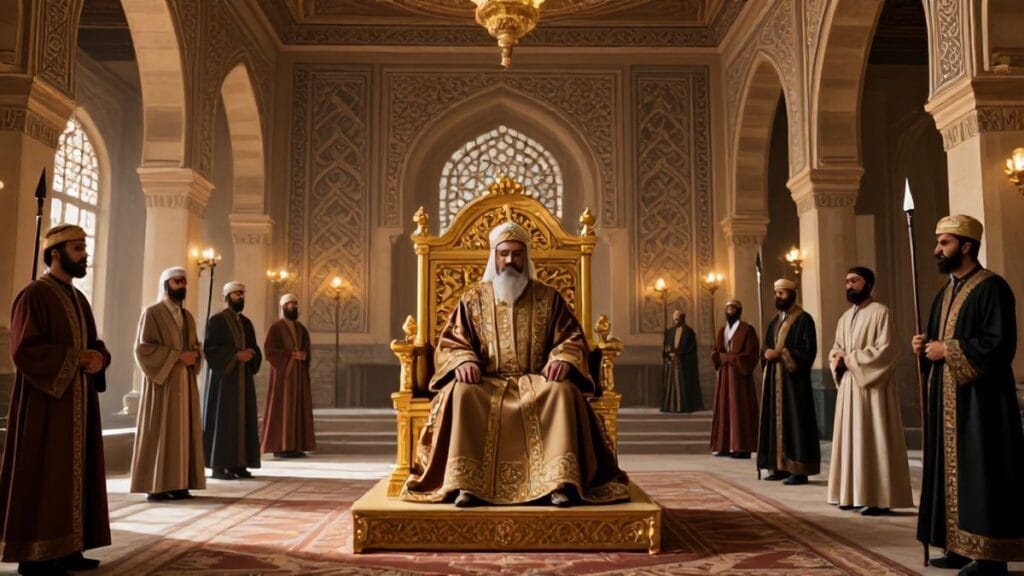
On 10 August 847, the day recorded by chronicles as the moment al-Mutawakkil assumed the caliphate, Samarra became a theater of deliberate spectacle. Inside a great hall adorned with banners bearing Qurʾanic verses and Abbasid black, leading officials assembled: Turkish commanders in fine armor, bureaucrats in embroidered robes, scholars with ink-stained fingers, and emissaries from distant provinces. Each carried their own hopes and fears, but together they were about to set a seal on the new reign.
Al-Mutawakkil entered dressed in ceremonial garments—perhaps a turban wound in the recognized Abbasid style, a cloak rich but not ostentatious. The air was thick with incense and murmured recitations. A proclamation was read, invoking God’s will and the lineage of the Prophet’s family, then naming Jaʿfar as al-Mutawakkil ʿala-llah, the one who places his trust in God. Hands were raised in oath, first among the high-born and the powerful, then, in more public ceremonies, among the soldiery and populace.
Outside, in the streets and markets, the news spread quickly. Cries of “The caliph has been chosen!” rang out, and coins might have been scattered to the crowds—small, glittering symbols of a promise that life would go on, and perhaps improve, under the new ruler. For most subjects, whoever bore the caliphal title mattered less than whether taxes would be tolerable, order maintained, and justice at least occasionally done. Yet the whisper went around that this caliph might be different: more devout, more sympathetic to the scholars, less enamored of controversial theology.
But this was only the beginning. As oaths were sworn, tensions remained carefully veiled. The Turkish generals, whose nod had put al-Mutawakkil on the throne, watched to see how pliant he would be. The scholars, bruised by years of persecution under the mihna, waited to see whether his piety would translate into real change. The new caliph, for his part, must have felt both triumphant and wary: the empire was now his responsibility, but so too were its multiplying crises.
The New Court of al-Mutawakkil: Rituals, Ceremonies, and Masks
Once enthroned, al-mutawakkil abbasid caliph set about reshaping the atmosphere of the court. Ceremonies became key instruments of power, choreographed displays in which hierarchy and favor were proclaimed without a word spoken. Audiences with the caliph grew more formal. Petitioners—governors, ambassadors, scholars, or simply the desperate—would be led through corridors lined with guards and attendants, past walls adorned with Qurʾanic inscriptions and courtly frescoes, before kneeling or bowing in the caliph’s presence.
In these rituals, the caliph rarely lost his composure. Chroniclers describe al-Mutawakkil as dignified, alert, often keen to project a balance between piety and grandeur. He would listen to recitations from the Qurʾan, then discuss issues of governance, dispense robes of honor to those he favored, and sometimes order punishments or rewards on the spot. The entire palace was a stage on which loyalty and obedience were performed, under the ever-watchful eyes of the Turkish guard.
Behind the public performances, however, lay a more complex portrait of the man. Sources present al-Mutawakkil as at times generous and at others hot-tempered. He could show leniency to those who begged forgiveness, yet also unleash fury on perceived rivals or offenders. His sense of humor, occasionally coarse, did not always align with the image of a solemn, devout ruler. In private evenings, he enjoyed music and poetry, even as his religious policies moved the empire away from the cultural milieu of his predecessors.
The court itself reflected these contradictions: theologians debating the nature of God’s attributes might dine alongside military commanders planning campaigns or scholars drafting new administrative regulations. Eunuchs, often invisible in official narratives, wielded quiet influence as gatekeepers and confidants. Poets composed panegyrics praising the caliph’s justice and bravery, hoping for patronage, while scribes worked late into the night copying decrees that would ripple out into the provinces. In Samarra, the rituals of empire never truly slept.
Guardians or Jailers? The Turkish Military Elite and Their Caliph
If al-Mutawakkil’s accession was secured by any one group, it was by the Turkish military elite. Their commanders, such as Wasif and Bugha, had become kingmakers. They possessed their own networks of loyalty, wealth, and fear. To them, the caliph was at once a necessary symbol—legitimizing their authority—and a potential threat to be contained.
At first, relations between al-mutawakkil abbasid caliph and his Turkish officers were outwardly cordial. He confirmed many of their offices, paid their arrears, and allowed them to retain substantial control over the army. He needed them to defend the empire’s borders and to maintain order in restive regions. Their soldiers’ presence in Samarra was a daily reminder that his throne sat atop a foundation of steel.
Yet the structural tension was obvious. The caliph, in theory God’s deputy on earth, could not easily accept that his writ depended on the goodwill of men who had been legally slaves—or their descendants—only a generation before. The officers, in turn, had grown used to dictating terms. They had watched caliphs come and go, some at their own instigation. Their barracks were close; their loyalties could shift suddenly.
Over time, al-Mutawakkil tried to chip away at their dominance. He experimented with appointing non-Turkish officials to key military or provincial roles, and he sometimes sought to play different factions of the Turkish elite against one another. These were dangerous games. The more he tried to free himself from their grip, the more they came to see him as ungrateful, unpredictable, and perhaps disposable. Yet behind the celebrations of his early reign, this contest between caliph and commanders was the quiet drumbeat of impending crisis.
A Return to Orthodoxy: Theology, the Mihna, and the Scholars
One of the earliest and most consequential acts of al-Mutawakkil was his reversal of the mihna. Around 848–851, he began to dismantle the apparatus of the inquisition that had policed theological views under his predecessors. No longer would judges and scholars be compelled to affirm that the Qurʾan was created; pressure to endorse the doctrines of the Muʿtazila was relaxed, then abandoned. In time, supporters of the rationalist school lost their privileged place at court.
This move was not merely a doctrinal adjustment; it was a profound reshaping of the relationship between state and religion. By ceasing to impose Muʿtazili creed, al-mutawakkil abbasid caliph won the gratitude of many traditionalist scholars, especially those of what later became known as the Sunni mainstream. The name of Ahmad ibn Hanbal, once flogged for resisting the mihna, now became emblematic of steadfastness. Though Ahmad himself had died not long after the end of the inquisition, his symbolic rehabilitation under al-Mutawakkil sent a powerful message: the caliph would now appear as guardian of Sunni tradition, not its disciplinarian.
This pivot had political logic. The caliph, wary of the overbearing power of the Turkish military and the aloofness of the Muʿtazili intelligentsia, found in the jurists and hadith scholars a potential counterweight—figures whose influence among the populace could undergird his own legitimacy. Aligning with them allowed him to tap into a broad reservoir of popular piety, especially in Baghdad, where resentment of the inquisition had run high.
Yet even here, complexities abounded. Ending the mihna did not usher in an age of tolerance and free thought. Rather, it marked the ascendance of a more rigid orthodoxy. The caliph, having repudiated rationalist theology, now promoted a stricter Sunni line, favoring scholars who opposed speculative theology and philosophies seen as foreign or dangerous. While many welcomed the end of persecution, others would later wonder if one form of dogmatism had merely replaced another. Still, in the long arc of Islamic history, al-Mutawakkil’s decision would be remembered as a turning point, cementing the trajectory of Sunni orthodoxy for centuries to come.
Baghdad and the Provinces: Echoes of a New Reign
Though the caliph now resided in Samarra, Baghdad remained the emotional heart of the empire. How, then, did the city react to news of al-Mutawakkil’s accession and his early measures? Reports suggest a mixture of relief and cautious hope. The end of the mihna, especially, resonated powerfully in a city where scholars had suffered and where public opinion often tilted against state control of doctrine.
Baghdad’s markets, mosques, and study circles buzzed with talk of the new caliph. Preachers began to insert references to his policies in their Friday sermons, praising his support for tradition and urging obedience. Merchants, ever pragmatic, focused on stability: would tax policies be predictable, would caravans be safe on the roads, would currency debasement be avoided? For the moment, there were signs of cautious optimism. In some areas, al-Mutawakkil reduced or regularized certain levies, seeking to win hearts by lessening fiscal burdens.
In the provinces, reactions varied. In Khurasan, distant and often semi-autonomous, local elites watched for signs of central weakness or opportunity. In Egypt, where control of the grain supply made the region critically important, governors pledged loyalty but always kept an eye on the balance of power between Samarra and the local garrison. In the Levant, restive tribes and communities waited to see whether the new ruler would bring fresh forces or leave them largely to their own devices.
The caliph understood that symbolic acts mattered. He sent letters announcing his accession, often accompanied by gifts or remissions of certain taxes, to key cities. New coins were minted bearing his name, spreading the news of his authority into every hand that received wages or made purchases. Yet the further one traveled from Samarra, the more abstract the person of al-mutawakkil abbasid caliph became. To a peasant in a village near the Syrian desert, “the caliph” meant, above all, whichever governor’s men arrived to collect dues or enforce conscription. For the empire to endure, the distant figure in Samarra had to be felt as more than a shadow; he needed to be perceived as a source of justice, or at least predictable rule.
Jews, Christians, and Others: Changing Tides for Dhimmis
Al-Mutawakkil’s religious policies did not only affect Muslim scholars. His reign also marked a change in the status of non-Muslim communities living under Abbasid rule: Christians, Jews, and others classified as dhimmis—protected peoples who paid a special tax and accepted certain legal restrictions in exchange for security. Earlier Abbasid caliphs had, at times, employed Christians and Jews in high administrative roles, valuing their expertise, especially in finance and medicine. Social attitudes varied, but official policy often oscillated between pragmatic tolerance and occasional pressure.
Under al-Mutawakkil, however, the climate became notably harsher. Concerned with underscoring Muslim identity and Sunni orthodoxy, he issued decrees that tightened restrictions on dhimmis. They were required to wear distinctive clothing or badges, to avoid imitating Muslims in dress or public behavior, and sometimes barred from occupying high government posts. Certain churches and synagogues were reportedly ordered destroyed or restricted in their public expression.
These measures were not entirely without precedent, but their codification and enforcement under this caliph marked a significant shift. While many local officials may have applied the rules unevenly, depending on local circumstances, the tone was unmistakable: the caliphate was asserting a more exclusivist religious identity. For Christians and Jews who had grown used to a measure of integration and influence, this change felt like a door quietly closing.
Yet behind the legal texts lay human stories. Jewish merchants who had done business with Muslim colleagues for decades now found themselves more visibly marked. Christian physicians who served in the court had to navigate new social hierarchies that placed them at a greater official distance from the caliph. Some likely adapted, cultivating discreet patronage networks and keeping their heads down. Others, resentful and wounded, recorded their grievances in community chronicles. The long-term effect was a subtle but significant narrowing of the shared civic space that had once characterized much of Abbasid urban life.
The Shia and the City of ʿAli: Al-Mutawakkil’s Policy toward Karbala
If al-Mutawakkil’s stance toward dhimmis was increasingly restrictive, his policies toward the Shia—those who revered the family of ʿAli as rightful leaders of the Muslim community—were at times openly hostile. Shia devotion focused especially on the martyrs of Karbala: al-Husayn, grandson of the Prophet, and his supporters who were killed in 680. Their shrine in Karbala became a center of pilgrimage, mourning, and quiet dissent, a place where alternative visions of Islamic leadership were remembered.
For a caliph keen to assert Sunni orthodoxy and the Abbasid claim to legitimate rule, this was uncomfortable. According to several sources, al-Mutawakkil ordered the destruction or leveling of the shrine at Karbala, attempting to suppress the ritual gatherings that coalesced around it. He also curtailed public displays of mourning that might implicitly criticize the caliphal regime as heirs to the Umayyads, who had been responsible for Husayn’s death.
These actions were more than symbolic vandalism; they were an assault on a living memory that sustained a community. Shia devotees did not abandon their reverence for Husayn; instead, their rituals became more clandestine, their narratives of oppression more deeply entrenched. What the caliph viewed as a necessary defense of Sunni dominance, many Shia interpreted as further proof that worldly rulers—with their palaces and armies—stood in stark contrast to the moral authority of the Prophet’s family.
Ironically, by trying to erase public signs of Shia devotion, al-mutawakkil abbasid caliph may have contributed to its internal hardening. The attempt to dismantle a shrine could not reach into hearts, where the story of Karbala continued to burn. Over the centuries, Shia remembrance would only grow more elaborate and emotionally powerful, while the name of al-Mutawakkil lingered in their memory as that of a persecutor.
Palaces, Canals, and Gardens: The Imperial Dream at Samarra
Even as he tightened religious policy, al-Mutawakkil pursued a vision of worldly splendor in Samarra that rivaled the most extravagant of his predecessors. He oversaw the construction of new palaces, audience halls, hunting estates, and gardens. Vast sums were poured into architecture and landscaping. Canals were dug to bring water to newly created pleasure grounds, where trees imported from distant regions shaded ornamental lakes populated with rare birds.
Among his most notable projects was the Jawsaq al-Khaqani palace complex and extensions to the city’s grand mosque, whose spiral minaret still stands today as a haunting relic of Abbasid ambition. Chroniclers speak of halls whose ceilings were painted with scenes of hunting and warfare, of carpets from Khurasan and textiles from Egypt, of gold and silver tableware reflecting the flicker of lamps late into the night. In these spaces, the caliph received ambassadors from Byzantium, emissaries from distant emirates, and delegations from across the Islamic world.
Such monumental building was not merely self-indulgence; it was a political statement. By transforming Samarra into a city of marvels, al-mutawakkil abbasid caliph signaled that the Abbasid caliphate remained, in principle, the cultural and political center of the Islamic world. At a time when rival powers were rising on the periphery, the gleam of his palaces served as a reminder of the dynasty’s unmatched resources.
Yet there was a cost. The building works demanded heavy expenditure from the treasury and increased pressure on tax revenues. Labor had to be conscripted, materials transported, and provincial governors pushed to provide the means. For common people far from Samarra, tales of the caliph’s gardens may have sounded as distant as legends from another world—while they themselves struggled under the weight of exactions needed to finance that dream. The magnificence of Samarra was both real and fragile, a glittering surface spread thin over deep fiscal and social strains.
Intrigue in the Corridors: Princes, Ministers, and Family Rivalries
No caliph ruled alone, and al-Mutawakkil’s court seethed with rivalries. His own family, the Abbasid clan, contained multiple potential heirs and factions. Brothers, sons, and cousins vied—often quietly—for influence and position. Court officials, from viziers to chamberlains, attached themselves to different royal figures, hoping to back the right contender in future successions.
Early in his reign, al-Mutawakkil designated his son al-Muntasir as heir apparent, investing him with visible honors and entrusting him with certain military responsibilities. At first, this seemed a routine act of dynastic prudence. But over time, as other sons grew and as the caliph’s suspicions sharpened, the decision became a point of tension. Some sources suggest that he later attempted to shift favor toward another son, al-Muʿtazz, creating a royal triangle of father and sons that would fracture devastatingly after his death.
The viziers—chief ministers responsible for coordinating administration—were likewise fragile figures. They could rise to immense power, managing finances, overseeing the post, and serving as the caliph’s day-to-day executive, yet they always risked abrupt dismissal, imprisonment, or worse. A whisper of corruption, a hint of intrigue with a rival prince, or simply the caliph’s boredom could spell doom. One minister might be showered with gifts and titles one year, then stripped and chained the next.
In these corridors of intrigue, alliances between Turkish commanders and members of the Abbasid family were especially dangerous. If a prince could win the loyalty—or at least the temporary support—of key officers, he might hope to nudge the line of succession in his favor. Conversely, a caliph aware of such maneuvers might preemptively sideline or punish potential rivals. The result was a court atmosphere that mixed opulent banquets with hidden daggers, poetry recitals with whispered plots. The question was no longer only whether al-mutawakkil abbasid caliph could rule the empire, but whether he could keep his own household from tearing itself apart.
From Confidence to Paranoia: The Caliph and His Turkish Guard
As the years passed, the relationship between al-Mutawakkil and his Turkish military protectors deteriorated steadily. What had begun as a wary coexistence slid into mutual mistrust. The caliph resented their overbearing influence and sought ways to curb their power: reassigning commands, attempting to promote non-Turkish officers, and occasionally humiliating commanders in public to reassert his authority. Each move left bruised egos and simmering resentment.
Meanwhile, the Turkish elite watched the caliph’s growing suspicion with alarm. They saw him favoring other groups, redistributing estates, and considering the relocation of parts of the court—perhaps even contemplating a partial return to Baghdad, where their grip would be weaker. They also noted his shifting favoritism among his sons, seeing in it the possibility that a future caliph might not be as “grateful” as the one they had helped enthrone.
Chroniclers describe episodes that reveal a ruler increasingly on edge: sudden outbursts of anger, harsh punishments for minor offenses, and impulsive decisions that alienated potential allies. One anecdote—recorded with the vividness typical of medieval Arabic historians—tells of the caliph ordering the physical humiliation of a high-ranking officer over a slight, an act that burned like acid in the honor culture of the military caste. Whether every detail is accurate or not, such stories capture the sense of a relationship sliding toward breaking point.
By the late stages of his reign, al-mutawakkil abbasid caliph was surrounded by men he no longer trusted, commanding an army whose loyalty he could not be sure of, and managing a family whose internal divisions threatened to erupt. The same Turkish guard that lined his processions and guarded his chambers had begun to look less like protection and more like a ring of iron closing in on him. The stage was set for tragedy.
Night of Knives: The Assassination of al-Mutawakkil
The end came on a winter night in December 861, within the very palace that was supposed to be the safest place in the empire. Accounts differ in detail, but the broad outline is chillingly consistent. Al-Mutawakkil had been dining and drinking with intimates, including his son al-Muntasir. Tension with the Turkish officers, particularly Wasif and Bugha, had reached a dangerous high. Rumors swirled that the caliph planned to strip them of their positions or even have them killed.
According to al-Tabari and other historians, a conspiracy formed among those officers, possibly with the knowledge—or at least the tacit acceptance—of al-Muntasir, who stood to gain the throne. In the dead of night, armed men entered the caliph’s quarters. The exact choreography of betrayal is lost to time: some say that the conspirators burst in while al-Mutawakkil and al-Muntasir were together, others that the son had already withdrawn. What remains constant is the image of a caliph caught off-guard, his guards either complicit or overpowered.
He was cut down where he sat, his body later found by servants or loyalists who could do nothing but weep. Thus ended the life of the man who had ruled for nearly fourteen years, who had reshaped theological policy, cultivated courtly splendor, tightened religious boundaries, and struggled bitterly with the military colossus he had inherited. His blood soaked into palace floors that had once echoed with proclamations and praise.
In that moment, something deeper than a life was extinguished. The illusion that the caliph remained truly sovereign over his own army suffered a mortal blow. If God’s deputy on earth could be slain in his own palace by soldiers who owed him allegiance, what did that say about the balance of power within the empire? The assassination of al-mutawakkil abbasid caliph was not only a personal tragedy; it was a public declaration that the sword outranked the pen, and perhaps even the prayer.
Aftermath of a Murder: The Anarchy at Samarra
The immediate aftermath of the assassination was as telling as the act itself. Al-Muntasir was swiftly proclaimed caliph, his name inserted into Friday sermons and minted on coins. Yet his rule, shadowed by the circumstances of his father’s death and by the looming presence of the Turkish officers who had made it possible, was brittle from the start. He reigned for barely six months before dying—whether from illness or poison remains contested—and the succession that followed descended into a chaotic period known by historians as the “Anarchy at Samarra.”
In the years that followed, from 861 to roughly 870, caliphs rose and fell with dizzying rapidity, many of them manipulated or even murdered by the military factions that dominated Samarra. The throne became a prize in an increasingly brutal game, its occupants chosen less for statesmanship than for perceived malleability. Provincial governors watched this spectacle with incredulity and calculation. Some tightened their local autonomy, remitting fewer taxes and acting ever more like independent rulers in all but name.
For ordinary people in Iraq and beyond, the political breakdown manifested as uncertainty and suffering. Troops went unpaid and turned to looting; bandits flourished; local disputes escalated in the absence of stable authority. The glittering ceremonies that had once marked al-Mutawakkil’s early reign seemed like distant memories, irrelevant to those facing hunger or violence.
This era of anarchy did more than tarnish the prestige of the Abbasid caliphate; it permanently altered its structure. Over time, real power flowed away from Samarra and Baghdad into the hands of regional dynasties and commanders: the Tulunids in Egypt, the Saffarids and Samanids in the east, and others. The caliphate survived as a symbol, but its capacity to compel obedience across its vast domains was gravely diminished. Historians often look back on the assassination of al-mutawakkil abbasid caliph as the hinge on which this transformation turned.
Legacy of a Contested Reign: Faith, Power, and Fragmentation
How, then, should we understand the reign that began in hopeful ceremony on 10 August 847 and ended in bloody betrayal fourteen years later? Al-Mutawakkil’s legacy is complex, marked by achievements and failures that continue to echo in historical memory. On the one hand, he decisively ended the mihna and repositioned the Abbasid state as the champion of Sunni orthodoxy. This move shaped the subsequent trajectory of Islamic theology, lending state support to schools of law and belief that would dominate much of the Muslim world for centuries.
On the other hand, his embrace of a narrower religious vision, coupled with restrictive policies toward dhimmis and Shia communities, contributed to the narrowing of the empire’s pluralistic ethos. What had once been a relatively flexible imperial framework—combining a universalist faith with pragmatic governance of diverse peoples—tilted toward a more exclusionary ideal. While that shift brought coherence for some, it deepened resentment and alienation for others.
Politically, al-Mutawakkil neither fully mastered nor fully succumbed to the Turkish military elite. Instead, his reign revealed the structural problem at the heart of the late Abbasid project: a caliphate dependent on a professional slave army that it could neither effectively control nor safely dispense with. His attempts to curb their power only heightened tensions, culminating in his assassination and inaugurating the Anarchy at Samarra. In this sense, his reign was less the cause than the symptom of deeper forces, yet it was during his years that those forces became impossible to ignore.
And yet, it would be too simple to portray him only as a victim of circumstance or a villain of bigotry. He was also a builder, a patron of art and architecture, a ruler who could be generous and devout. The palaces and mosques of Samarra, the reorientation of the caliphate toward the scholars of hadith and law, the symbolic rehabilitation of figures like Ahmad ibn Hanbal—all these bear his stamp. His story reminds us that historical actors are rarely one-dimensional; they are shaped by their times even as they try, and sometimes fail, to shape those times in return.
How Historians Remember al-Mutawakkil Today
Modern historians approach al-Mutawakkil with a mix of fascination and caution. Primary sources such as al-Tabari’s History of the Prophets and Kings or al-Yaʿqubi’s chronicles provide rich detail but are themselves products of particular political and theological milieus. Some later Sunni writers praise al-mutawakkil abbasid caliph as a defender of orthodoxy who courageously ended the mihna and humbled heretical doctrines. Shia and some non-Muslim sources, by contrast, emphasize his persecution and intolerance, especially his actions toward Karbala and dhimmi communities.
Contemporary scholarship tends to situate him within larger structural trends. Patricia Crone, Hugh Kennedy, and other historians of the Abbasid period have highlighted the centrality of the Samarra experiment: the relocation of the capital, the reliance on Turkish guards, and the resulting erosion of caliphal autonomy. Within this frame, al-Mutawakkil appears as a ruler trying to assert old models of authority in a new and unforgiving environment. His theological policies are seen not only as expressions of conviction but also as instruments in the broader contest between court, scholars, and army.
There is also growing interest in the social and cultural dimensions of his reign. Archaeological excavations at Samarra have revealed the scale and sophistication of Abbasid architecture and urban planning, offering a material counterpoint to textual narratives of chaos and decline. These findings suggest that even in an age of political strain, the caliphate remained capable of remarkable aesthetic and logistical achievements.
Ultimately, historians remember al-Mutawakkil neither as a simple hero nor as a simple villain, but as a pivotal figure in a transitional era. His accession in 847, in the garrison city of Samarra, marked the beginning of a reign that would both consolidate Sunni orthodoxy and hasten the fragmentation of imperial power. The contradictions of his rule—pious yet often harsh, magnificent yet precarious, commanding yet vulnerable—mirror the contradictions of the Abbasid project itself as it moved from unified empire toward a more diffuse, post-imperial Islamic world.
Conclusion
On that August day in 847, when Jaʿfar ibn al-Muʿtasim was proclaimed al-mutawakkil abbasid caliph in Samarra, few could have guessed how decisively his reign would shape the future of the Islamic world. His accession crystallized a moment in which theology, military power, and imperial governance collided. By ending the mihna and raising Sunni traditionalism to the status of state orthodoxy, he set a pattern that outlived the political fortunes of his dynasty. By tightening restrictions on religious minorities and suppressing Shia devotional spaces, he narrowed the public sphere even as he claimed to defend the faith.
At the same time, his struggle with the Turkish military elite exposed the fragility of caliphal authority in an age of professionalized armies. His assassination by his own guards, within the palaces he had so lavishly embellished, symbolized a turning point: from that night onward, the illusion of an unassailable, all-powerful caliph was impossible to sustain. The Anarchy at Samarra that followed signaled the beginning of a long process by which real power drifted from the center to the peripheries, even as the caliphate endured as a symbol of unity.
Yet the story of al-Mutawakkil is more than a sequence of policies and battles; it is also a human drama. It is the story of a man raised in the shadow of stronger brothers, unexpectedly elevated to the pinnacle of power, who tried to reconcile his convictions with the brutal logic of empire. He built palaces and broke shrines, courted scholars and antagonized soldiers, trusted in God and yet could not save himself from men’s knives. To stand again on that dawn in Samarra is to feel the weight of choices whose consequences reached far beyond his lifetime.
In the end, his reign invites reflection on enduring questions: How should rulers wield religious authority? What happens when the guardians of a state become its masters? And how do the personal traits of a single leader—his faith, his fears, his ambitions—intertwine with long, impersonal forces of history? The rise of al-mutawakkil abbasid caliph on 10 August 847 did not determine everything that followed, but it marked a decisive bend in the river of Abbasid history, one whose currents can still be traced in the religious and political landscapes of the modern Middle East.
FAQs
- Who was al-Mutawakkil?
Al-Mutawakkil, born Jaʿfar ibn al-Muʿtasim, was the tenth Abbasid caliph, ruling from 847 to 861 CE. He is best known for ending the mihna (inquisition), promoting Sunni orthodoxy, and overseeing major building projects in the capital city of Samarra. - Why was his accession in Samarra significant?
His accession in Samarra highlighted the shift of Abbasid political power away from Baghdad and into a purpose-built garrison city dominated by Turkish slave-soldiers. This setting made clear the growing influence of the military in caliphal succession and governance. - What was the mihna, and what did al-Mutawakkil do about it?
The mihna was a state-imposed inquisition, begun under earlier caliphs, that forced scholars and judges to affirm a specific theological doctrine—that the Qurʾan was created. Al-Mutawakkil dismantled this inquisition, ending official enforcement of Muʿtazili theology and aligning the caliphate with Sunni traditionalism. - How did he treat non-Muslim communities?
Under al-Mutawakkil, policies toward Jews, Christians, and other dhimmis became more restrictive. He issued decrees that required distinctive clothing, limited their access to high office, and sometimes ordered the destruction or curtailment of non-Muslim religious buildings. - What was his policy toward the Shia and Karbala?
Al-Mutawakkil pursued a harsh line toward Shia devotion, targeting the shrine of Husayn at Karbala and attempting to suppress public mourning rituals. These actions deepened Shia perceptions of persecution and reinforced their narrative of suffering at the hands of unjust rulers. - Why was he assassinated?
He was assassinated in 861 CE by Turkish guards, likely at the instigation of or with the acquiescence of leading military commanders and his son al-Muntasir. The killing was driven by escalating tensions between the caliph and the Turkish military elite, whom he had tried to curb and humiliate. - What was the “Anarchy at Samarra”?
The Anarchy at Samarra refers to the chaotic period following al-Mutawakkil’s death (c. 861–870), when successive caliphs were made and unmade by military factions in Samarra. It was marked by frequent coups, assassinations, and a sharp decline in central authority. - How did al-Mutawakkil’s reign affect Islamic theology?
By ending the mihna and supporting Sunni traditionalist scholars, al-Mutawakkil helped entrench Sunni orthodoxy as the dominant theological framework in much of the Islamic world. His policies contributed to the long-term marginalization of Muʿtazili rationalism in official circles. - What role did architecture play in his rule?
Al-Mutawakkil invested heavily in building projects in Samarra, including palaces, mosques, canals, and gardens. These works projected imperial power and cultural sophistication, even as they strained the treasury and highlighted the gap between court splendor and social unrest. - How do historians view al-Mutawakkil today?
Historians see him as a pivotal but ambivalent figure: a caliph who reoriented the Abbasid state toward Sunni orthodoxy and monumental architecture, yet whose inability to resolve the tension with the Turkish military helped precipitate political fragmentation. His reign is considered a key turning point in the transition from a centralized Abbasid empire to a more decentralized Islamic world.
External Resource
Internal Link
Other Resources
- Encyclopaedia Britannica – general search for the exact subject
- Google Scholar – academic search for the exact subject
- Internet Archive – digital library search for the exact subject