Table of Contents
- A King at the Edge of Empire
- From the Banks of the Danube to the Gates of Rome
- Alaric and the Fractured Roman World
- Sieges, Ransoms, and a City on Its Knees
- The Sack of Rome in 410: A World Unmoored
- Southward into Bruttium: The Last March
- Cosenza: A King Struck Down
- The Mysterious Funeral of Alaric I
- Gold, Slaves, and a Hidden River Tomb
- Rome After Alaric: Panic, Prophecy, and Blame
- The Visigoths Without Their King
- Faith, Fate, and the Meaning of Disaster
- Historians, Legends, and the Search for the Grave
- The Long Echo of 410 in European Memory
- Archaeology, Landscape, and the Valley of the Crati
- Reassessing Alaric: Destroyer or Founder of a New World?
- Conclusion
- FAQs
- External Resource
- Internal Link
Article Summary: In the late summer of 410, as the dust of the Sack of Rome still hung in the Mediterranean air, a Gothic king rode south into the rugged hills of Bruttium, never to emerge alive. This article follows the life and alaric i death as a single, continuous thread binding together the fall of Roman power in the West and the birth of a new, fractured Europe. We trace Alaric’s journey from a frontier soldier in imperial service to the leader of a restless people, his uneasy alliances with Roman generals, and his audacious capture of the Eternal City. At Cosenza, in the valley of the Crati, illness, exhaustion, and perhaps despair brought his campaign to an abrupt halt, and his followers staged one of the most enigmatic royal burials in late antiquity. The narrative then turns to the consequences of alaric i death for both Goths and Romans: shifting alliances, deepened religious anxieties, and a lingering sense that an age had ended. We explore how medieval chroniclers, Renaissance scholars, and modern archaeologists have reimagined his life and mysterious tomb, often blurring the line between history and legend. Above all, the story of alaric i death reveals how a single moment, in a provincial corner of Bruttium, helped to redefine what it meant to live in the shadow of a collapsing empire. Yet behind the chronicles and campaigns lies a more intimate human drama: a dying king, a loyal warband, and a river briefly forced to forget its course so it could carry a dead man into the underworld of memory.
A King at the Edge of Empire
The story that culminates in alaric i death beside the river near Cosenza begins far from the sun-blasted hills of Bruttium. It begins on the contested borders of the Roman Empire, in the cold light of the Danubian frontier, where Roman laws were etched on stone but survival was written in hunger, fear, and steel. Alaric first enters history not as a scourge of Rome but as a soldier in its armies, one more ambitious officer in the swirling chaos of the late fourth century. He was born around 370, probably among the Tervingi or a related Gothic group north of the lower Danube, at a time when pressure from the Huns, mismanagement by Roman officials, and environmental strain were making the frontier a fault line of human desperation.
By the time Alaric was a young man, the Goths had already crossed into the Empire, invited in as foederati, “allied peoples” who would fight Rome’s battles in exchange for land and food. In theory, this arrangement bound barbarian warriors to the imperial throne; in practice, it left them at the mercy of corrupt local officials and shifting political winds. There, in the space between promise and betrayal, Alaric’s identity was forged. He saw his people used and discarded, praised as heroic auxiliaries in one season and treated as disposable intruders in the next. No one in those years could have guessed that this young Gothic officer would one day lead his warriors into the heart of Rome itself—and that his own fate, the very moment of alaric i death, would mark a turning point in the long story of imperial decline.
The Empire he served was already cracking. Civil wars, economic collapse, and the overmighty generals of the late fourth century had drained Rome of the resilience that had carried it through earlier crises. Emperors were made and unmade by troops on distant frontiers; court intrigues in Ravenna and Constantinople could decide the survival or ruin of entire provinces. For men like Alaric, caught between military service and ethnic loyalty, there was no safe path. Each victory brought suspicion. Each demand for better terms sounded like a threat. The edge of empire was no longer a line on a map—it was a condition of being, and Alaric, raised in that borderland, learned to move between identities as deftly as he moved his cavalry between battle lines.
From the Banks of the Danube to the Gates of Rome
Alaric first emerges clearly in our sources in the 390s, a decade that witnessed the Empire’s desperate attempts to harness Gothic military power while containing its political consequences. Serving under the Eastern emperor Theodosius I, Alaric fought at the Battle of the Frigidus in 394, a brutal clash in the Julian Alps between Theodosius and the usurper Eugenius. Contemporary accounts speak of a cold, stormy battlefield where entire Gothic contingents, perhaps including Alaric’s own men, were hurled into suicidal frontal assaults to break the enemy line. One late writer suggests that the Goths were used almost as expendable shock troops, their bodies thrown against fortified positions in a display of imperial ruthlessness that would not be forgotten.
It is easy to imagine the younger Alaric watching Roman officers calculate Gothic losses with chilling detachment. He had delivered victory to Theodosius, but at a terrible cost in lives. The rewards that followed were meager. No high command, no governorship, no stable settlement for his followers. The message was clear: the Empire needed Gothic muscle but dreaded Gothic ambition. So, within a few years of Frigidus, Alaric stepped away from his role as a subordinate commander and allowed a new identity to crystallize around him—that of rex, king of the Visigoths. The title was as much a political necessity as an ethnic one: his people demanded someone who could negotiate, threaten, and, if needed, defy Rome.
Thus began the long dance between Alaric and the imperial court. He moved his followers through the Balkans, raiding and bargaining, pushing for a permanent homeland within imperial territory. To Roman eyes, he was both a rebel and a potential ally, a problem to be solved and a weapon to be aimed at rival generals. To the Goths who followed him, he was the only shield they had against famine and betrayal. When he first turned his gaze toward Italy, he was not yet the destroyer of Rome, but a hungry king searching for leverage. Italy, rich but poorly defended, offered that leverage in abundance.
Alaric and the Fractured Roman World
To understand how the story reaches its tragic culmination in alaric i death at Cosenza, one must first grasp the political disarray of the Western Empire he confronted. After Theodosius died in 395, the Empire was formally divided between his sons: Arcadius in the East, Honorius in the West. Both were young, inexperienced, and easily dominated by powerful advisers. The West, with its capital eventually lodged in the watery fastness of Ravenna, was particularly vulnerable. There, the half-Vandal general Stilicho emerged as the real center of power, the man charged with defending an empire that stretched from Britain to North Africa.
Into this fractured landscape strode Alaric, now openly styling himself king. At times, Stilicho saw in him a useful ally, a tool to be wielded against the Eastern court or against rival generals. At other moments, he represented an existential threat to Italian security. Contemporary chroniclers reveal a strange oscillation: official negotiations one month, military confrontation the next. This uncertainty played in Alaric’s favor. Every time Roman factions turned against each other, the Goths gained room to maneuver—and yet, paradoxically, this same instability kept him from securing the lasting settlement he craved.
For the senators of Rome, watching from their marble palaces, the situation was bewildering. They wrote letters, delivered speeches, and hunched in whispered conversations under colonnades, trying to determine whether Alaric was a barbarian scourge or a negotiable nuisance. For peasants in the Apennine valleys, his name was spoken in fear as rumors of marching columns and scorched fields filtered through the countryside. For the Christian clergy, his advance into Italy became a canvas for moral warnings: Rome’s sins were finally being answered. The fractured Roman world projected its anxieties onto Alaric, and as he advanced, he became less a man and more a symbol of the time’s unraveling certainties.
Sieges, Ransoms, and a City on Its Knees
By the early 400s, the conflict between Alaric and the Western court sharpened into a series of dramatic confrontations around Rome itself. Italy had not seen a foreign army on its soil for centuries, and the psychological shock was almost as powerful as the material danger. Alaric’s Goths were not merely raiders; they were a mobile, organized community, with families and baggage trains, seeking sustenance. Their presence turned the breadbasket of Italy into a battleground of negotiation and intimidation.
Three times, Alaric drew a tightening ring around the city of Rome. The first siege, in 408, was an exercise in controlled pressure. He surrounded the walls, cut off supplies, and waited. Inside, panic rose like the summer heat. The Senate, facing famine, disease, and a terrified populace, chose to negotiate. The price of lifting the siege was staggering: gold, silver, silk, spices, and, according to some sources, thousands of slaves. This ransom, remembered in terse lines by the historian Zosimus, left Rome humiliated but not yet destroyed. The gates opened, the treasure flowed out, and the Goths withdrew—for a time.
But this was only the beginning. Political upheaval in Ravenna, including the execution of Stilicho and the massacre of many Gothic families serving in Roman armies, shattered the fragile trust built in earlier years. Alaric, furious and now with more displaced warriors flocking to his banner, returned to the walls of Rome. The city became a bargaining chip, a hostage in his negotiations with the court of Honorius. Each time the Emperor’s ministers vacillated, each time an agreement collapsed, Alaric tightened the noose. The urban aristocracy, once secure in its belief that Rome was untouchable, now tasted the iron bitterness of siege: empty granaries, shuttered markets, and the creeping realization that the Eternal City might not be eternal after all.
The Sack of Rome in 410: A World Unmoored
In late August 410, after years of tension, miscommunication, and broken promises, the catastrophe finally came. On the night of August 23–24, according to later accounts, a group inside Rome opened the Salarian Gate to Alaric’s troops. Whether this was the work of slaves, sympathizers, or desperate negotiators remains uncertain, but the result is clear: Gothic warriors poured into the city that had not fallen to a foreign enemy in nearly eight centuries. The sack of Rome, a watershed in the late antique imagination, was at once brutal and strangely constrained.
Ancient writers like Orosius and later Augustine insisted that the violence, while real, did not resemble the total annihilation some had feared. Churches were respected more often than not, Christian sanctuaries offered refuge, and certain districts escaped large-scale destruction. Yet for those living through it, the difference between “moderated” sack and total ruin was academic. Houses were looted, temples desecrated, and aristocratic families stripped of treasures accumulated over generations. Fires broke out, statues were toppled, and prisoners were dragged into the night on chains. Women were assaulted, children torn from their parents. In the smoke and turmoil, Rome’s sense of its own invincibility disintegrated.
The psychological impact of the sack rippled far beyond Italy. In North Africa, the bishop Augustine of Hippo grappled with the news, eventually crafting his monumental City of God partly as a response to those who claimed Christianity had weakened Rome’s ancient gods. The pagan historian Zosimus interpreted the disaster as punishment for abandoning the old cults. To many contemporaries, events in 410 were not just a military setback but proof that history itself had turned a corner. And at the center of that turning stood Alaric, the Gothic king whose name would be forever linked with the city’s humiliation—and whose story would soon be defined by the mystery of alaric i death in a remote southern valley.
Southward into Bruttium: The Last March
After the sack, Alaric did not linger over the ruins of Rome. Whatever satisfaction or strategic advantage he drew from the city’s fall, he understood that he now stood exposed. The Western Empire might have been weak, but it was not yet dead, and the Goths could not remain indefinitely in central Italy, surrounded by hostile forces and a resentful populace. So he turned his army southward, driving down the spine of the peninsula toward the rugged toe of Italy—Bruttium, modern Calabria.
The motives for this march have long been debated. Some sources suggest Alaric hoped to cross the narrow straits to Sicily and from there perhaps to North Africa, eyeing the fertile lands and strategic granaries that had long sustained Rome. Control of Africa meant control of the Empire’s food supply; for a mobile people like the Visigoths, it might also offer a more stable homeland. But the sea posed a new set of dangers. Attempts to secure a fleet are said to have failed, either through storms, sabotage, or Roman countermeasures. As the campaign dragged on, the Goths found themselves far from the heartlands of Italy, hemmed in by mountains, coastline, and the relentless pressure of survival.
In Bruttium, nature itself took center stage. This was a land of steep ridges, deep valleys, and sudden torrents—beautiful but unforgiving to a marching army with families in tow. The heat could be stifling, the hills draining the strength from humans and animals alike. Rivers, including the Crati, cut through the landscape like scars. In this harsh environment, illness took root. Disease had always stalked armies, and the Visigoths were no exception. Underfed soldiers, poor sanitation, and close quarters made their camp a breeding ground for fevers. It was here, amidst the dust of the roads and the mists of the river valleys, that the drama of alaric i death began to unfold.
Cosenza: A King Struck Down
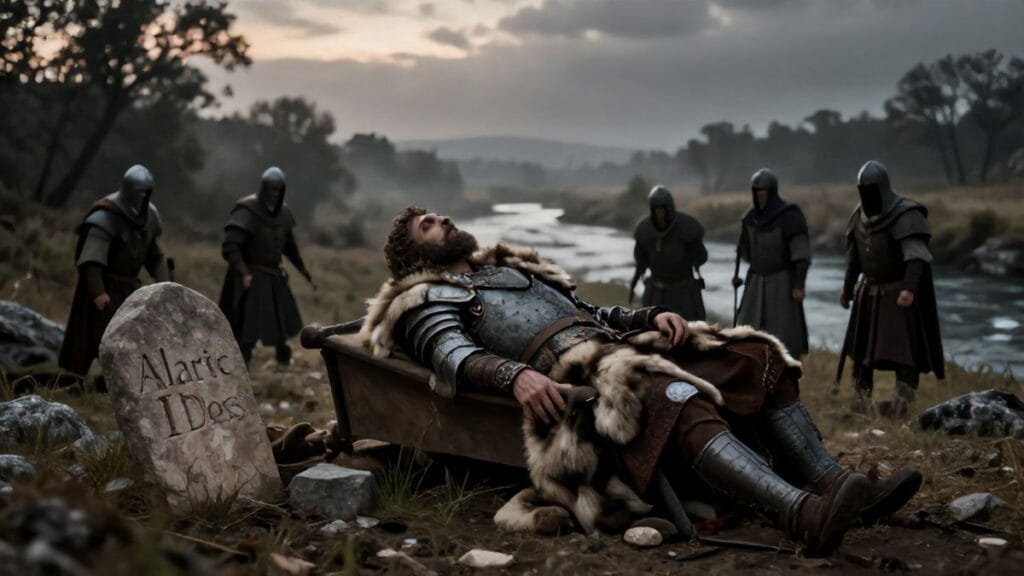
The chronicles do not linger on the moment itself. They do not describe the sound of labored breathing in a royal tent, the anxious consultations of Gothic warriors, or the bitter taste of herbs administered by desperate healers. Instead, they speak with the stark economy typical of ancient writers: somewhere near Cosenza, in Bruttium, in the late summer or early autumn of 410, Alaric fell ill and died. It is astonishing, isn’t it, that a man who had stood at the gates of Rome and shaped the course of imperial history should exit the stage in a few brief lines.
Yet behind those lines lies a scene we can attempt to reconstruct. Cosenza, then known as Consentia, lay at the confluence of rivers, ringed by hills that would have funneled the Gothic approach. The army, already strained by months of marching and inadequate supplies, must have been on edge. Rumors of pursuit or counterattack would have circulated; every delay seemed dangerous. When their king collapsed, perhaps with fever, perhaps with complications from an earlier wound or exhaustion, the Visigothic leaders faced an existential crisis. Alaric was more than a commander: he was the political and symbolic center of their world.
The nature of his illness remains unknown. Some have speculated about malaria, common in low-lying, marshy regions of Italy, or typhus, spread in crowded camps. Others have wondered whether the stress of years of campaigning and negotiation broke a body already weakened by long exposure to hardship. Ancient sources are silent on such medical details, but unanimous on one point: he died swiftly enough that his grand designs came to nothing. The planned crossing to Sicily was abandoned. The campaign in Bruttium, which might have been another chapter in Alaric’s long confrontation with Rome, instead became the setting for his final act. And so alaric i death, more sudden than his enemies could have hoped and more devastating than his followers could have imagined, caught the Visigoths between triumph and uncertainty.
The Mysterious Funeral of Alaric I
It is in the burial of Alaric that history blurs into legend. The sixth-century historian Jordanes, writing long after the events but drawing on earlier Gothic traditions, tells a story that has fascinated readers for centuries. According to him, the Visigoths diverted a river—often identified with the Busento, a tributary of the Crati—so they could dig a pit in its dry bed. There, in the temporary hollow, they laid their dead king, along with rich grave goods, weapons, and the spoils of war, perhaps even treasures taken from Rome itself. When the burial was complete, the river was allowed to flow back over the grave, hiding it from the eyes of enemies and looters.
As if that were not enough, Jordanes adds a darker coda: the slaves and laborers who carried out the work were put to death so that the location of the tomb would remain forever secret. This chilling touch—whether literal truth or a stylized flourish—has imprinted itself on the modern imagination. It conjures an image of torchlit labor in the dead of night, water churning around hastily placed embankments, and a guarded circle of Gothic warriors standing watch as their king is lowered into a grave that no one will ever see again.
Some modern historians view this account with skepticism, suggesting that it may owe more to Gothic epic tradition than to precise reportage. Diverting a river, even a small one, requires immense labor and engineering knowledge. Yet, as specialists in late antique military logistics have pointed out, large armies were capable of impressive earthworks when motivated—digging ditches, building bridges, and constructing siege lines in surprisingly short order. In the charged atmosphere following alaric i death, with fear of Roman reprisal and the need to protect his body from desecration, such an extraordinary effort does not seem impossible. Whether the details are exact or embellished, the funeral story reveals a central truth: the Visigoths saw in Alaric not just a leader but a figure worthy of a burial that defied both time and human trespass.
Gold, Slaves, and a Hidden River Tomb
The legend of the river tomb naturally invites a tantalizing question: what was buried with Alaric beneath those currents near Cosenza? Later retellings, especially in the Romantic era, imagined unimaginable riches—gold statues, imperial regalia, heaps of plunder from the sack of Rome, even sacred relics spirited out of devastated basilicas. The historical truth is almost certainly more modest but still meaningful. The Goths had, by all accounts, extracted a great ransom from Rome during the sieges and then looted additional wealth during the sack. Even a fraction of that treasure invested in Alaric’s grave would have made it an extraordinary deposit by late antique standards.
We must picture items of both symbolic and practical value: finely worked weapons, jeweled belts, ceremonial armor, perhaps Roman silverware and coins stamped with the faces of emperors he had defied. These grave goods, if they exist beneath the sediments of a Calabrian river, would offer a unique snapshot of the cultural fusion occurring in 410: Roman artistry repurposed into Gothic royal power. Yet the very secrecy that protected the tomb also condemns us to speculation. No document maps the burial site. No medieval chronicler claims to have stumbled upon it. The silence is almost absolute, as if the water itself conspired to erase all trace.
That silence, however, has not dampened curiosity. Over the centuries, local lore in Cosenza grew up around the Busento, whispering of treasure beneath its waters. In the nineteenth century, poets like August von Platen romanticized the story, depicting Gothic warriors weeping by the starlit river as they consigned their king to the depths. Modern treasure hunters, both official and clandestine, have dreamed of locating the spot, though serious archaeological efforts have been cautious, constrained by urban development, environmental concerns, and the steep odds against success. To dig for Alaric’s tomb is to dig into a palimpsest of legend and landscape, not knowing whether the spade will turn up myth or metal—or nothing at all.
Rome After Alaric: Panic, Prophecy, and Blame
While the waters of the Crati or Busento flowed back over the secret grave, far to the north the shockwaves of alaric i death spread through Roman society. News traveled slowly, carried by traders, deserters, and official messengers, but when it came, it sparked a mixture of relief and dread. On one hand, a primary architect of Rome’s humiliation was gone. The immediate threat of another attack on central Italy receded. On the other, rational observers understood that the structural problems that had given rise to Alaric’s career—military dependency on barbarian forces, political instability, fiscal exhaustion—remained unsolved.
For many Romans, the temptation to seek supernatural explanations proved irresistible. Pagan traditionalists argued that the gods had first shown their anger through the sack of 410 and then, having used Alaric as an instrument of chastisement, had cast him aside. Christian preachers, meanwhile, saw in his sudden demise a sign of divine justice: the destroyer of Rome struck down in a remote corner of Italy, without succession securely arranged, his grand designs thwarted. In sermons and letters, bishops wove the news into a broader tapestry of eschatological speculation. Was this the beginning of the end, or merely another chapter in God’s inscrutable plan?
At the same time, there was a more practical reckoning. Senators who had fled Rome during the sack tried to rebuild their lives in other cities, especially in North Africa and the Eastern Empire. The financial cost of the ransoms and looting weighed heavily on aristocratic fortunes. The imperial administration struggled to reassure provincial elites that order would be restored. Behind these efforts lurked the unspoken fear that Alaric had not been a one-time aberration but a harbinger. If one barbarian king could bend Rome to his will, others might follow. In this sense, alaric i death did not close a chapter; it made clear that the book itself had changed.
The Visigoths Without Their King
For the Visigoths, the loss was more immediate and visceral. They had followed Alaric through hardship and uncertainty, across borders and into the heart of an empire that alternately courted and reviled them. Now, in the hills around Cosenza, they faced a future abruptly unmoored from his leadership. Yet the Gothic political structure, while centered on charismatic kingship, was not entirely dependent on one man. Almost at once, the mantle passed to Alaric’s brother-in-law, Athaulf, a capable warrior who inherited both the throne and a precarious strategic situation.
Athaulf chose pragmatism over further Italian adventure. Abandoning the dead king’s southern ambitions, he led the Goths northward, eventually crossing the Alps into Gaul and then into Hispania. There, in the following decades, the Visigoths would carve out a more stable kingdom, one that fused Roman administrative practices with Gothic military might. It was this realm, rather than Alaric’s Italian expeditions, that would leave a lasting institutional legacy in Western Europe. Yet Alaric’s shadow lingered. His name, remembered at councils and in chronicles, became a point of reference for what the Visigoths had once dared to attempt.
Within the community itself, stories of his life and death likely circulated in oral tradition, sung or recited in Gothic around campfires and in royal halls. Jordanes, writing in the sixth century, hints at such material, drawing on what he claims was a now-lost work about the Goths by Cassiodorus. In those tales, alaric i death at the river’s edge near Cosenza may have taken on the hues of tragic heroism: the great king who had humbled Rome but was denied the time to found a lasting dominion on Italian soil. These memories would shape Visigothic identity long after the bloody fields of Italy were left behind.
Faith, Fate, and the Meaning of Disaster
The sack of Rome and the subsequent death of its Gothic conqueror forced contemporaries to confront age-old questions about fate, divine will, and historical change. No text better captures this struggle than Augustine’s City of God, begun in the aftermath of 410. While Augustine never focuses exclusively on Alaric, the king’s actions are the silent backdrop to much of his argument. In Augustine’s view, earthly cities rise and fall, subject to the flux of human sin and divine judgment. Only the heavenly city, built on faith, endures. The fallibility of Rome thus becomes a theological lesson rather than a cosmic catastrophe.
Pagan thinkers, by contrast, mourned the loss of Rome’s aura of inviolability. Zosimus, writing from a non-Christian perspective, cast the disasters of the early fifth century as a direct consequence of abandoning the old gods and traditional sacrifices. In his narrative, Alaric and his Goths are instruments of decay, the inevitable fruit of misguided policy and sacrilegious reform. Even among Christians, opinions varied. Some saw Alaric almost as a scourge sent to cleanse Rome of moral corruption; others emphasized the mercy shown in the sparing of churches and the limited scope of physical destruction, arguing that God’s protective hand was still visible.
Yet beyond these intellectual debates, there was a more intimate spiritual crisis. Ordinary believers—whether in Italy, Africa, or Gaul—heard rumors of Rome’s fall and of alaric i death and struggled to mesh them with the sermons they heard on Sundays. If God ruled history, why had the heart of Christianized empire been so humbled? Was Alaric’s own end in a distant province an example of divine retribution, or just another instance of the random cruelty of sickness and war? Such questions, rarely preserved in formal texts, nonetheless shaped the lived religious experience of the age, lingering in whispered prayers and private doubts long after theologians had moved on to other concerns.
Historians, Legends, and the Search for the Grave
Centuries after the waters were said to have closed over Alaric’s secret tomb, the fascination with his burial place had not dimmed. Medieval chroniclers in Italy occasionally alluded to the story, sometimes muddling details but preserving the core image of a king entombed beneath a diverted river. In the early modern period, antiquarians began to ask whether the tale might have a basis in fact. Maps of the Cosenza region were scrutinized; local topography was compared to the hints left in late antique texts. Still, firm evidence remained elusive.
By the nineteenth century, with Romanticism in full flower, Alaric’s burial had become a touchstone for poets and nationalists. August von Platen’s poem “Das Grab im Busento” (“The Grave in the Busento”) painted a haunting scene: Gothic warriors gathered in nocturnal sorrow, their king lowered into the riverbed as laments rose beneath the stars. In literature like this, historical precision mattered less than emotional resonance. Alaric was transformed into a symbol of lost grandeur, of foreign kings who had briefly bested Rome only to vanish into the landscape they had once threatened.
Modern scholarship has approached the question with greater methodological rigor. Archaeologists and historians have debated the feasibility of Jordanes’ account, examining comparable waterworks from antiquity and the logistical capabilities of large armies. Some have proposed that even a partial diversion or temporary damming at a narrow river bend could have allowed for a symbolic river burial without the dramatic engineering implied by a full redirection. Others have suggested alternative burial scenarios entirely, arguing that the story of the river tomb may be a later embellishment built on a simpler grave somewhere near Cosenza. Yet the absence of contradictory evidence keeps the legend alive. In the end, the continuing search for Alaric’s grave tells us as much about our desire to touch the past as it does about the realities of early fifth-century funerary practice.
The Long Echo of 410 in European Memory
Alaric’s life and his enigmatic end in Bruttium reverberated through European memory in subtle but enduring ways. The sack of Rome in 410 became, in later historiography, one of the symbolic markers of “the fall of the Roman Empire,” even though the Western imperial structure limped on for another six decades. Schoolbooks and popular histories have often placed Alaric alongside later figures like Attila and Odoacer as emblematic agents of Rome’s demise, sometimes oversimplifying his motives and context in the process.
In medieval chronicles, Alaric appears as both villain and portent. Some writers cast him as a forerunner to later invaders, the first crack in a dam that would ultimately burst under the assaults of Vandals, Huns, and Lombards. Others, especially in Spanish and French contexts where Visigothic heritage would later be claimed, treated him as a kind of founding figure—a flawed but necessary predecessor to the more stable kings of Gaul and Hispania. In these narratives, alaric i death at Cosenza acquires a bittersweet tone: the man who might have created a Gothic Italy instead becomes a stepping stone toward a different geographic destiny for his people.
In the modern era, as scholars have moved away from simple “decline and fall” models toward more nuanced views of late antiquity, Alaric’s role has been reinterpreted again. Rather than a simple destroyer, he appears as a participant in a complex process of transformation—a leader navigating the collapse of old structures and the emergence of new forms of power. Yet the dramatic contours of his story, culminating in a mysterious burial beneath a Calabrian river, ensure that he remains one of the most vividly remembered figures of his age. History, after all, clings to images: the gates of Rome swinging open in the night, the torchlit banks of the Busento, the sudden silence of a dead king’s tent in the hills above Cosenza.
Archaeology, Landscape, and the Valley of the Crati
To walk today along the riverbanks near Cosenza is to enter a landscape where myth and geology intertwine. The Crati River and its tributary, the Busento, wind through a modern city layered over its Roman and late antique antecedents. Bridges, embankments, and urban construction have altered the waterways’ courses over time, complicating efforts to match current topography to ancient descriptions. Yet the basic elements remain: a valley hemmed by hills, rivers that can swell quickly with winter rains, and stretches of bank that might once have lent themselves to earthworks by a determined army.
Archaeological work in the region has focused more on urban stratigraphy and broader settlement patterns than on the pinpoint search for Alaric’s tomb. Nonetheless, every excavation that reveals late Roman building phases or burials adds a small piece to the puzzle of what Cosenza and its surroundings were like in 410. Pottery shards, coins, and structural remains sketch a picture of a provincial town integrated into the imperial economy but vulnerable to the shocks of war. If the Visigoths did indeed camp nearby, their material traces may be scattered in plowsoil or buried beneath later construction, unrecognized or indistinguishable from other transient presences.
Some scholars have suggested that even if Jordanes’ river diversion story is broadly accurate, the actual burial might be unreachable without massive, and ethically questionable, intervention in the modern urban fabric. Riverbeds shift. Sediments accumulate. The probable grave site might now lie beneath buildings, roads, or heavily channelized sections of the waterway. Others hold out hope that future non-invasive technologies—ground-penetrating radar, refined geomorphological mapping—could one day identify anomalies consistent with large-scale ancient earthworks. For now, though, the valley of the Crati keeps its secret. The landscape that witnessed alaric i death and burial remains eloquent but inscrutable, a reminder that not all historical mysteries are meant to be solved.
Reassessing Alaric: Destroyer or Founder of a New World?
In recent decades, historians of late antiquity have tried to look past the simple image of Alaric as the man who “sacked Rome” and toward a fuller understanding of his aims and legacy. When one considers the entire arc from his early service under Theodosius to alaric i death in Bruttium, a more complex figure emerges. He was, first and foremost, a leader trying to secure a future for his people within the collapsing Roman framework. Repeatedly, he sought official recognition, stable land grants, and a place for the Visigoths as foederati under conditions they could accept. Military pressure on Rome and on Italian territories was, in this light, a means to an end rather than an end in itself.
At the same time, he cannot be absolved of the suffering he caused. The sieges of Rome led to famine and disease, the sack brought plunder and trauma, and the ravaging of Italian countryside left deep scars in local communities. The ethical landscape of late antiquity, however, was one in which such actions were brutally commonplace. Roman generals themselves had used similar tactics against rebellious provinces and rival claimants to the throne. What made Alaric’s campaigns feel uniquely shocking was less their intrinsic cruelty than their target: the Eternal City, the symbolic heart of the Mediterranean world.
Some scholars, following the work of historians like Peter Heather and Bryan Ward-Perkins, argue that figures like Alaric should still be seen as contributing significantly to the “fall” of Roman power in the West. Others, inspired by the “transformation of the Roman world” paradigm, emphasize continuity and adaptation, seeing in Alaric not a destroyer but a midwife of new political formations. In this view, his death at Cosenza did not simply remove a threat to Rome; it marked a shift in the location and nature of post-Roman power. The Visigothic kingdom that eventually flourished in Gaul and Hispania owed much to the experiences, alliances, and internal solidarities forged under his leadership, even if they crystallized only after his passing.
Ultimately, assessing Alaric means confronting our own expectations of historical causality and moral judgment. Was he a tragic hero, undone by the very empire he tried to negotiate with? A ruthless opportunist exploiting Roman weakness? Or something more ambiguous: a man navigating an age when old categories of Roman and barbarian, conqueror and subject, were breaking down? The secretive nature of his burial captures this ambiguity perfectly. Alaric lies, if anywhere, beneath a river that refuses to give up its dead, a liminal figure in both life and death, straddling worlds that were already dissolving into one another.
Conclusion
From the storm-lashed battlefields of the Danube frontier to the hushed, torchlit banks of a Calabrian river, the life and death of Alaric I trace the fault lines of a world in transition. He began as a soldier in Rome’s service, a young Gothic leader whose ambitions were molded by the empire’s need for barbarian troops and its simultaneous fear of their power. Over two turbulent decades, he became both negotiator and nemesis, tightening sieges around Rome, extracting ransoms that testified to the city’s vulnerability, and finally presiding over the sack that shattered an eight-hundred-year aura of invincibility. Yet the story does not end at Rome’s breached gates. It continues southward, into Bruttium, where illness and exhaustion overtook him at Cosenza and where alaric i death transformed a formidable living opponent into a haunting, absent presence.
The Visigoths who buried him under a diverted river, if Jordanes is to be believed, did more than hide a body and its treasures; they consigned a chapter of their own history to the depths. In the centuries that followed, theologians, chroniclers, poets, and historians struggled to make sense of what his life had meant. Was he divine scourge or victim of fortune, destroyer of empire or unwitting architect of new kingdoms in Gaul and Hispania? The answers have shifted with each age’s concerns, mirroring changing views of Rome’s end and Europe’s beginnings. Meanwhile, the physical landscape of Cosenza has gone on quietly reshaping itself, its rivers altering course, its urban fabric thickening, its sediments bearing silent witness to a moment that can no longer be recovered in full.
And yet, even in absence, Alaric remains. His name endures in textbooks and scholarly debates, in local legends and the dreams of treasure hunters, in the verses of Romantic poets and the footnotes of late antique monographs. He stands as a reminder that history often crystallizes around individuals who embody the tensions of their time, and that the end of an age is rarely marked by a single, clean event. Instead, it is made up of many intersecting stories—of sieges and negotiations, of faith and fear, of rivers forced briefly to forget their paths so they can carry a king into the realm of legend. In the dim space where fact and story meet, Alaric I still rides through the hills of Bruttium, and the waters of the Crati still murmur over a secret that may never be fully revealed.
FAQs
- Who was Alaric I?
Alaric I was a Visigothic king, born around 370, who rose from service in the Roman army to become one of the most significant barbarian leaders of late antiquity. He is best known for leading the Visigoths in the sack of Rome in 410, an event that profoundly shook contemporaries and later generations. His career illuminates the complex relationship between Rome and the so-called barbarian peoples on its frontiers. - How and where did Alaric I die?
Alaric I died in 410 near Cosenza in Bruttium, in the south of the Italian peninsula. Ancient sources report that he fell ill during a campaign that likely aimed at reaching Sicily and possibly North Africa. His illness, possibly a fever such as malaria or another disease common in crowded military camps, ended his life unexpectedly and forced the Visigoths to abandon further operations in southern Italy. - What is the legend of Alaric I’s burial in the river?
The most famous account of Alaric’s burial comes from the historian Jordanes, who wrote in the sixth century. He claims that the Visigoths temporarily diverted a river—traditionally identified as the Busento near Cosenza—dug a grave in its dry bed, and buried Alaric along with rich treasures and spoils. Afterward, they allowed the river to flow back over the tomb and killed the workers who had helped, ensuring that the grave’s location remained secret. - Did Alaric I’s death end the Gothic threat to Rome?
Alaric I’s death removed a major figure of charisma and strategic talent, and it brought an immediate halt to Visigothic campaigns in southern Italy. However, it did not end the broader “Gothic threat” to Roman authority. Under his successor Athaulf, the Visigoths moved into Gaul and Hispania, eventually forming a powerful post-Roman kingdom that continued to shape Western politics for more than a century. - Was the sack of Rome in 410 as destructive as often claimed?
The sack of 410 was deeply traumatic, but ancient Christian authors like Orosius and Augustine emphasized that it was not total annihilation. Many churches were respected as sanctuaries, and while there was looting, violence, and forced displacement, large parts of the city’s physical infrastructure survived. Nevertheless, the psychological impact was immense, as it ruptured the belief that Rome was untouchable and marked a turning point in perceptions of imperial stability. - Has Alaric I’s tomb ever been found?
No, Alaric I’s tomb has never been securely identified. Despite centuries of speculation and occasional local legends pointing to stretches of the Crati or Busento rivers near Cosenza, archaeological evidence is lacking. Modern scholars are divided over whether Jordanes’ account of a river burial is literally true, partially true, or largely legendary, and the practical difficulties of investigating under modern urban conditions further hinder any definitive search. - What were Alaric I’s main goals in his campaigns against Rome?
Most historians believe that Alaric sought a stable, officially recognized homeland for his people inside the Roman Empire, along with secure status and payment as foederati. His sieges and eventual sack of Rome were a way to exert pressure on the imperial government, not an attempt to destroy the city outright. The repeated failures of negotiations and internal Roman politics pushed him toward increasingly drastic actions. - How do historians today view Alaric I’s role in the fall of the Western Roman Empire?
Contemporary scholarship tends to see Alaric as a significant but not solitary factor in the Western Empire’s decline. His actions exposed deep structural weaknesses—political fragmentation, reliance on barbarian troops, and economic strain—but he did not singlehandedly cause Rome’s fall. Many historians frame him as part of a broader transformation of the Roman world into post-Roman successor kingdoms rather than as a simple destroyer. - What sources describe Alaric I and his death?
Key sources include the historian Zosimus, the Christian writer Orosius, and later authors such as Jordanes, who preserves Gothic traditions, and Procopius, who comments retrospectively on earlier events. Augustine’s City of God does not focus on Alaric by name but responds to the shock of the 410 sack and its theological implications. Modern historians also rely on coinage, archaeological evidence, and comparative studies of late Roman military practices to contextualize these texts. - Why is Alaric I still important today?
Alaric I remains significant because his life encapsulates the complexities of a world in transition from Roman rule to a patchwork of barbarian kingdoms. His campaigns, especially the sack of Rome and his enigmatic burial near Cosenza, continue to fascinate scholars and the public alike. Studying him helps illuminate how empires manage—or fail to manage—their frontiers, how cultural identities shift in times of crisis, and how dramatic events can echo in collective memory for more than a millennium.
External Resource
Internal Link
Other Resources
- Encyclopaedia Britannica – general search for the exact subject
- Google Scholar – academic search for the exact subject
- Internet Archive – digital library search for the exact subject